
University–Industry Collaboration in Korea
Korea’s university–industry channels are strong, but foreign researchers need to know which doors are actually open.

The Door Foreign Researchers Need to Find
Korean universities do more than educate.
In STEM and advanced industries, they often sit close to companies, public funding, regional policy, and applied research. A university can be a place to study, but it can also become a route toward a company, a lab project, an internship, or a future job.
That does not mean every route is open in the same way.
Korea has some of the most distinctive and tightly binding university–company channels in the world. The clearest example is the company-sponsored contract department: a degree path designed with a major firm, often linked to scholarships, training, internships, and future employment.
For domestic students, this can be a powerful bridge.
For foreign researchers, it is usually not the first door to build a plan around.
The more useful task is to read Korea’s university–industry channels carefully: which routes are built around domestic undergraduate admissions, which routes pass through graduate labs, and which routes are beginning to open through company-linked global or regional tracks.
University–Industry Collaboration Is a Connection Layer.
Industry–university collaboration in Korea is not a side activity.
It is part of how many universities connect education to companies, research, local industries, and public programs.
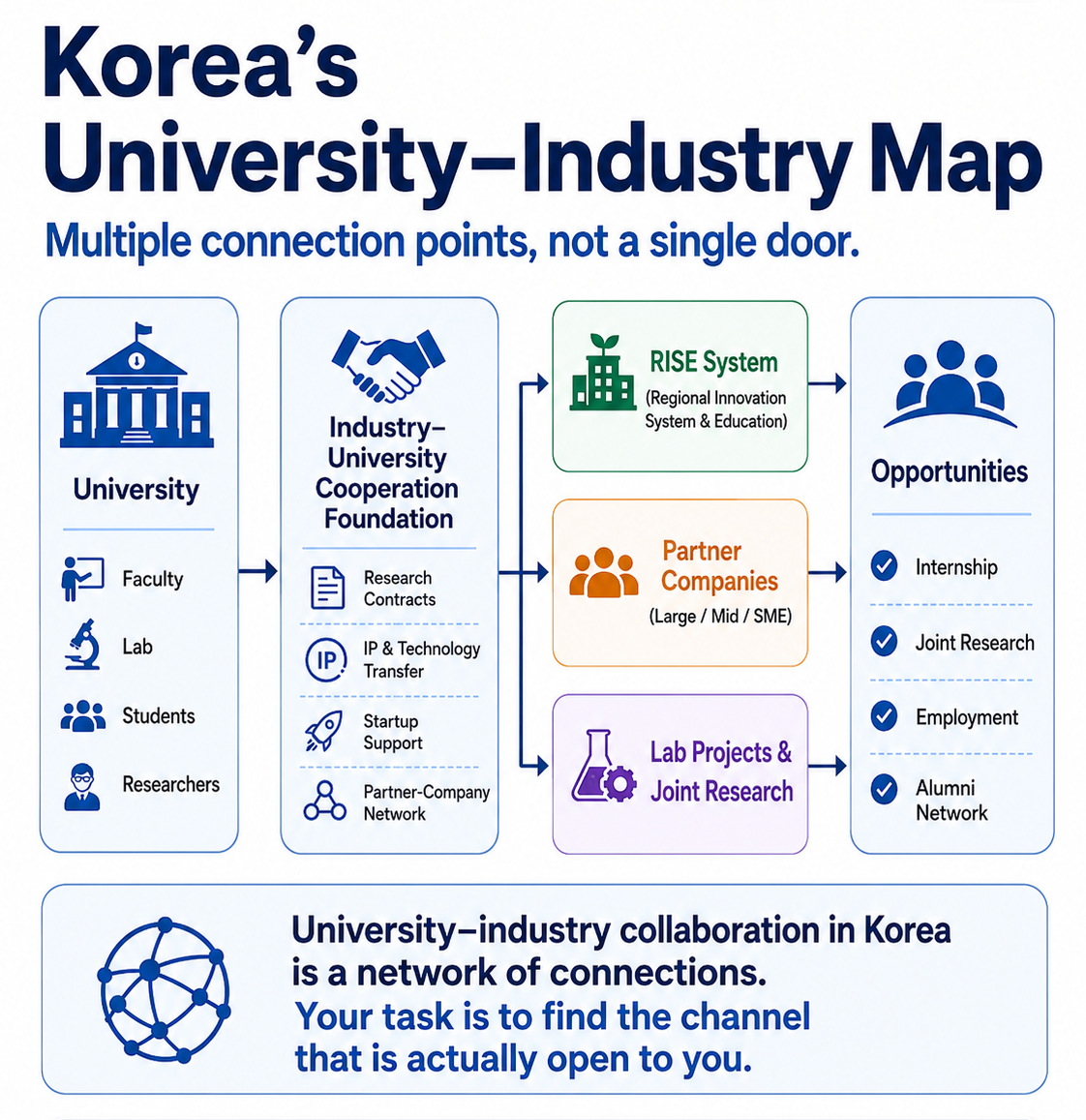
The visible layer is the university itself: departments, degrees, professors, labs, and graduation.
The less visible layer is the connection structure: company projects, internships, technology transfer, startup support, partner-company networks, and research contracts.
At the center of this structure is the university’s Industry-University Cooperation Foundation. This office often handles company contracts, intellectual property, technology transfer, startup support, and cooperation with partner firms.
The policy environment has also shifted.
LINC 3.0 helped build university infrastructure for field training, startup education, partner-company networks, technology transfer, and collaboration with industry. But from 2025, Korea’s university-support model has moved more strongly toward RISE, a regional university-support framework that gives local governments a larger role in connecting universities to regional industries.
So the question is no longer only:
Does this university have an industry program?
The better reading is:
Which companies, regions, labs, and student groups can actually use that program?
For foreign researchers, this distinction matters.
A university may have strong industry connections. But the usable route may depend on level of study, visa status, language, lab access, company need, and whether previous foreign students have used that route before.
The Main Gate: Company-Sponsored Contract Departments
The most direct route is the company-sponsored contract department.
In Korean, this is often called 채용조건형 계약학과 — a contract-based department linked to future employment.
This model is unusually strong.
A company signs an agreement with a university. The department trains students for a specific industrial field. The company may provide scholarships, living support, internships, field training, and job placement after graduation.
The result is a degree path with a binding character that is hard to find in many other higher-education systems.
In semiconductors and advanced technology, this model has become highly visible.
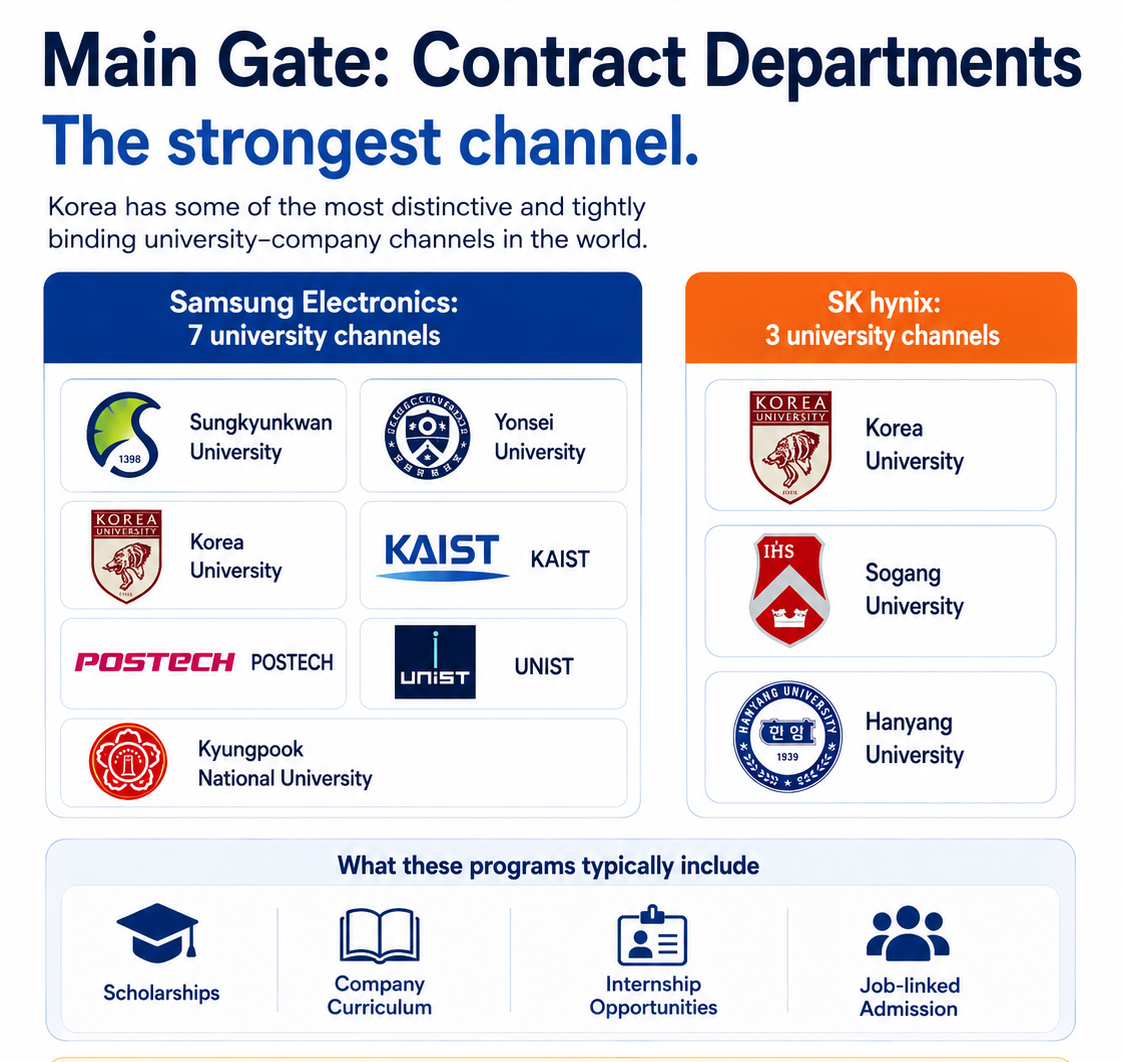
Samsung Electronics is associated with seven university channels.
SK Hynix is associated with three university channels.
The attraction is obvious.
Study the field.
Receive support.
Train for the company.
Graduate into employment.
For domestic Korean students, this can be one of the strongest routes from university to a major technology company.
But foreign readers need to understand the entry logic.
These departments are generally built around the domestic undergraduate admissions system and domestic hiring assumptions. Selection often depends on Korean admissions categories, company-specific conditions, and long-term employment expectations.
But the strongest large-company contract departments are not the main route most international students can realistically use.
They are important because they show how tightly Korea can connect university education to industrial manpower needs.
They are less useful as a direct entry plan for most foreign applicants.
The Side Door: Where Foreign Researchers Actually Enter
If the main gate is difficult, the whole university–industry structure is not closed.
Foreign researchers usually need a different door.
The more realistic routes appear at the graduate and lab level.
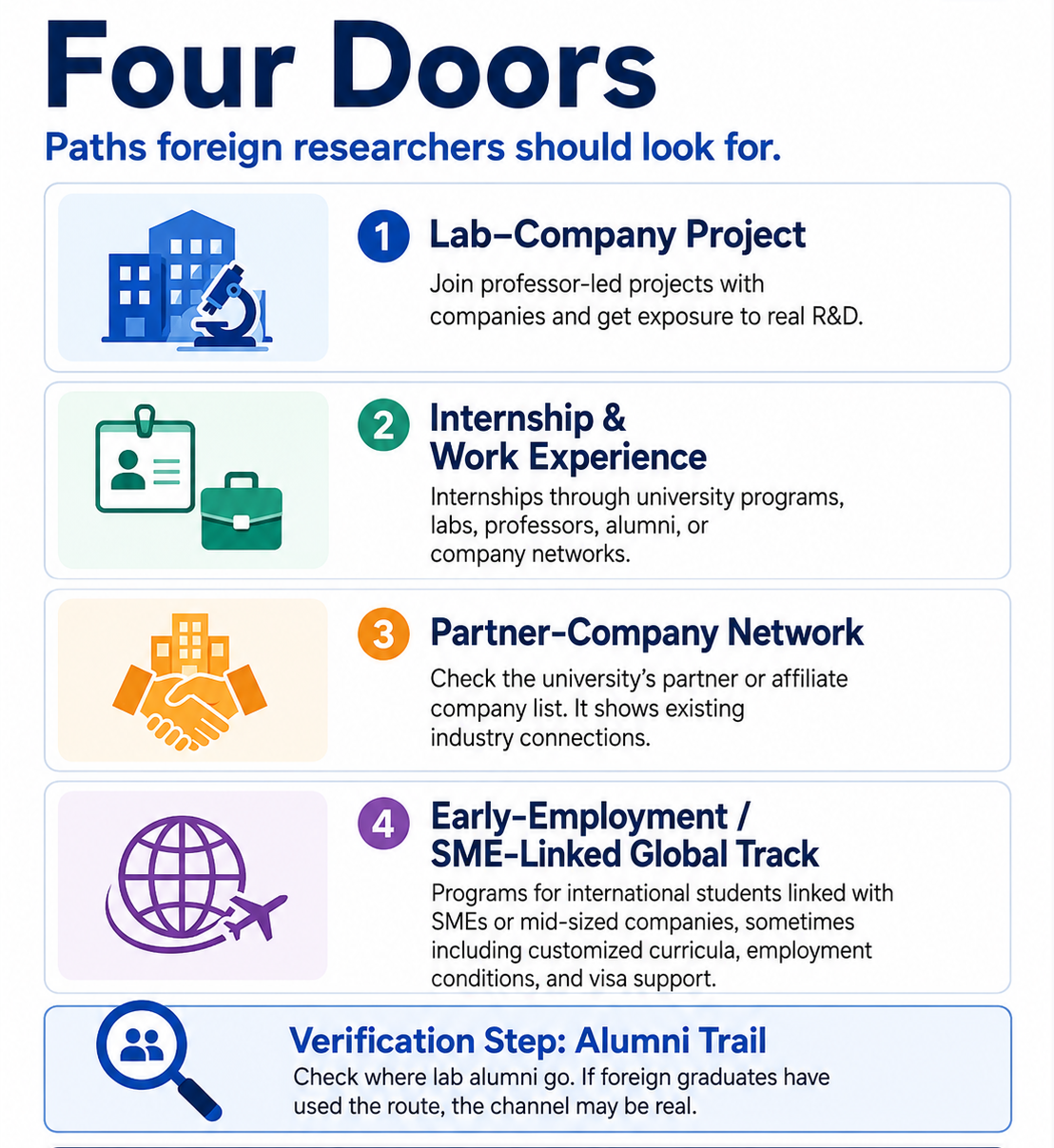
A foreign master’s student, PhD student, postdoc, or research assistant may enter industry-linked work through a professor’s project, a company-sponsored lab, a joint research center, an internship, or a partner company connected to the university.
This route is less automatic than a contract department.
But it can be more flexible.
It is usually less prestigious.
But for some foreign students, it may be more usable.
The practical point is simple: foreign researchers should not only look at the strongest corporate pipeline. They should look for the channel that is actually designed to let them enter.
A Company Project Can Help You. It Can Also Narrow You.
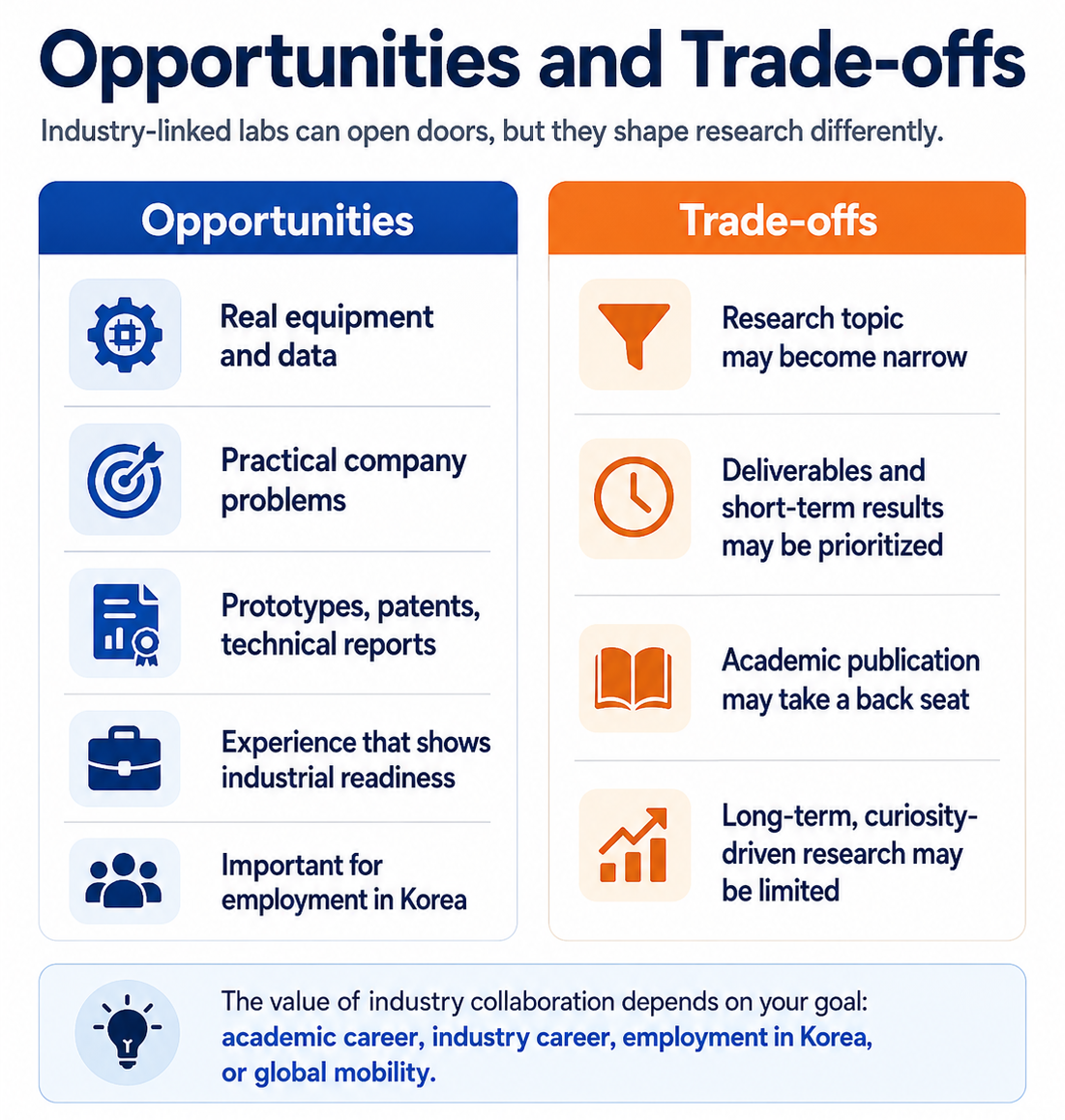
Industry-linked labs can be powerful places to work.
They may offer real equipment, practical data, company problems, prototype experience, patents, and applied research topics.
For some foreign researchers, this is exactly what they need.
It can make the degree travel better.
A paper may show academic ability.
A prototype may show industrial readiness.
A patent may show applied value.
A company project may show that the researcher has worked near real demand.
But there is a trade-off.
A lab with heavy company funding may not always prioritize slow, curiosity-driven research. The project may need deliverables. The company may want usable results. The professor may balance academic publication with contract obligations.
That can be useful.
It can also narrow the research path.
If your goal is an academic career, you need to know whether the lab still produces strong papers.
If your goal is industry, you need to know whether the project connects to hiring, not only deliverables.
If your goal is mobility outside Korea, you need to know whether the work creates a portfolio that can be understood globally.
Industry collaboration is not automatically good or bad.
Its value depends on where it takes you.
Germany Is a Useful Comparison — But Not the Same Model.
German readers may find Korea’s university–industry collaboration familiar.
Germany also has strong bridges between education and industry. Fraunhofer institutes connect applied research to industrial needs. The dual study model, or duales Studium, links academic study with company-based training.
So the idea of education connected to employment is not foreign to Germany.
The difference is access.
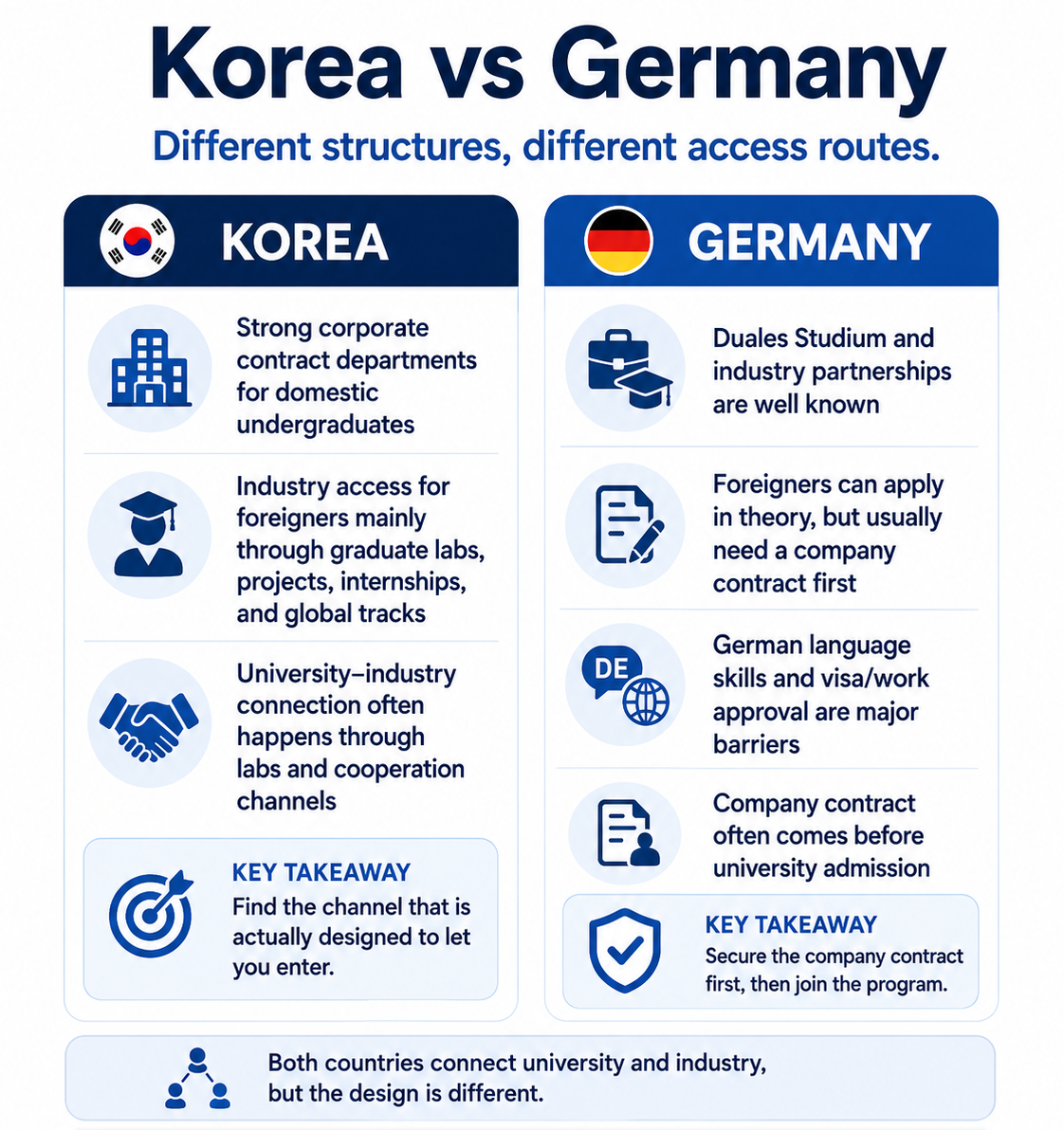
Korea’s universities can connect strongly to industry.
But that connection is not one road.
Large-company contract departments show how tightly Korea can connect higher education to corporate manpower needs. Yet those routes are generally not the most realistic entry path for foreign researchers.
Foreign researchers should look at the university’s industry connections as a map of usable routes.
The university name matters.
But the accessible door matters more.