
Is Korea a Research Powerhouse — or a KPI Machine?

How Government Research Funding Shapes Labs, Papers, and Foreign Researchers
Research funding is not neutral.
In Korea, research funding often determines which labs grow, which topics move fast, which papers get produced, and where international students can actually find funded positions.
1. The Money Does Not Flow to “Universities.” It Flows to Projects.
International students often imagine that a university funds the lab.
In many Korean research environments, the reality is more specific.
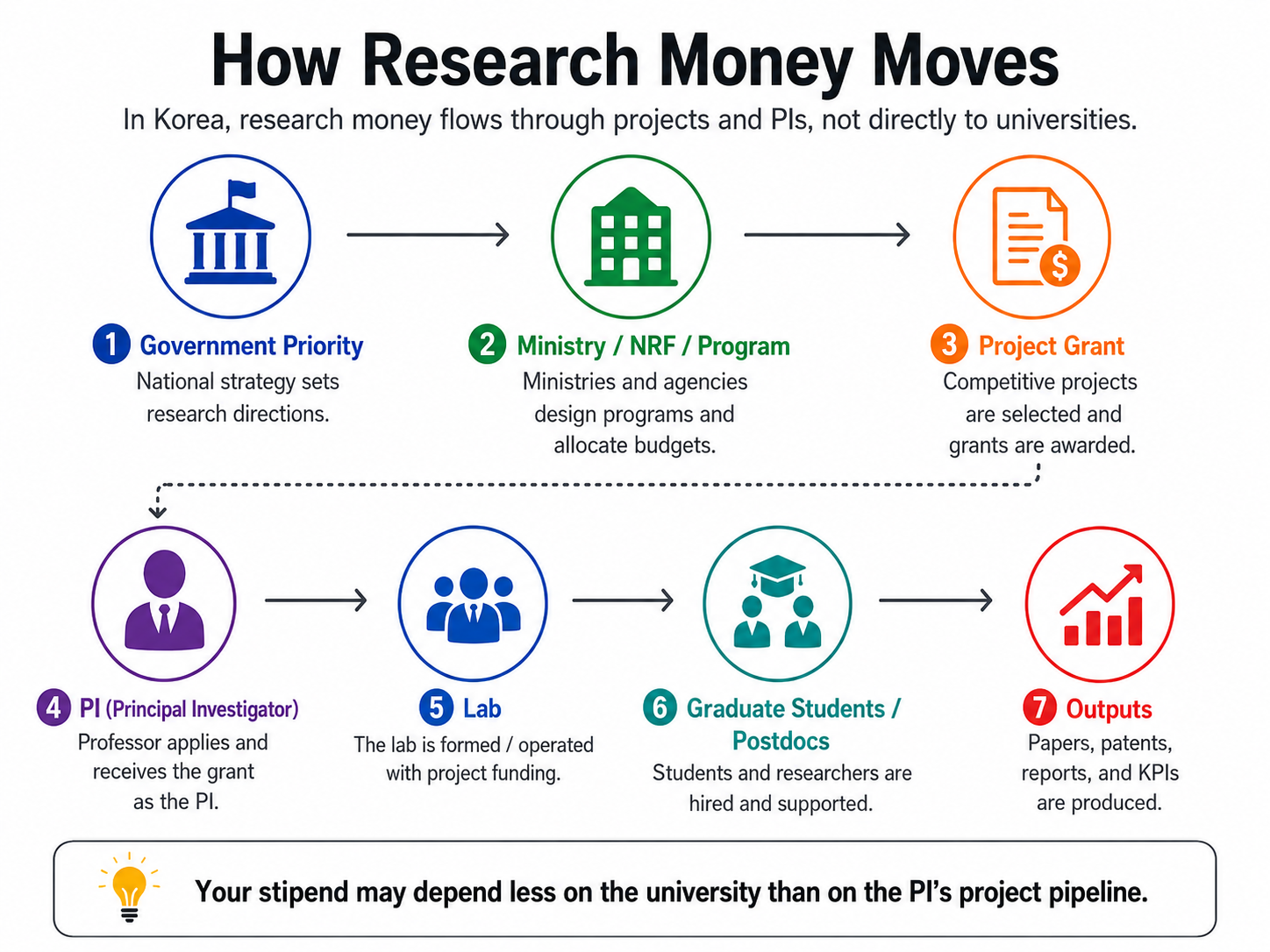
Money usually flows through projects.
A government ministry announces priorities. Agencies such as the National Research Foundation of Korea allocate competitive grants. Professors apply for projects. Labs receive funding through the PI. Graduate students and postdocs are then hired, paid, or supported through those projects.
This matters because your stipend may not simply come from “the university.”
It may come from the professor’s grant.
That is the financial root of the student-worker ambiguity discussed in the previous article. You are officially a student. But your daily labor, stipend, and research output may be tied to the PI’s project pipeline.
So if you want to understand a Korean lab, do not only ask whether the professor is famous.
Ask:
What projects does this lab currently run?
A lab with multiple multi-year grants is not the same as a lab dependent on one short-term project.
The first may offer stability.
The second may offer urgency.
Both can produce good research. But they create different lives for graduate students.
2. Funding Is a Signal of Growth Fields.
In Korea, government funding is not only money.
It is a signal.
When the government builds AI graduate schools, semiconductor training programs, battery initiatives, biotech clusters, or energy-transition projects, it is telling the research system where people, labs, and outputs should move.
For international researchers, this is useful.
A field that receives concentrated government funding often has three things:
- more funded graduate positions
- more postdoc and project openings
- stronger links to industry or national strategy
This does not mean every funded field is good for every foreign student.
But it does mean that funding can reveal where Korea is trying to create capacity.
The difference between a mature field and a growth field matters.
Korea is already strong in areas such as memory semiconductors, displays, shipbuilding, automotive manufacturing, and petrochemicals. These sectors are important, but they may have narrower entry points for foreign researchers, especially when Korean-language integration is high.
Growth fields can be different.
AI, system semiconductors, secondary cells, biotech, energy, and advanced materials often create more openings because Korea is still building talent pipelines.
The practical question is not:
“Is Korea famous for this field?”
It is:
“Is Korea funding this field now?”
Funding shows where openings may appear.
3. Project Funding Changes Research Behavior.
Korea funds research strategically.
But it often evaluates research quantitatively.
This is where the tension begins.
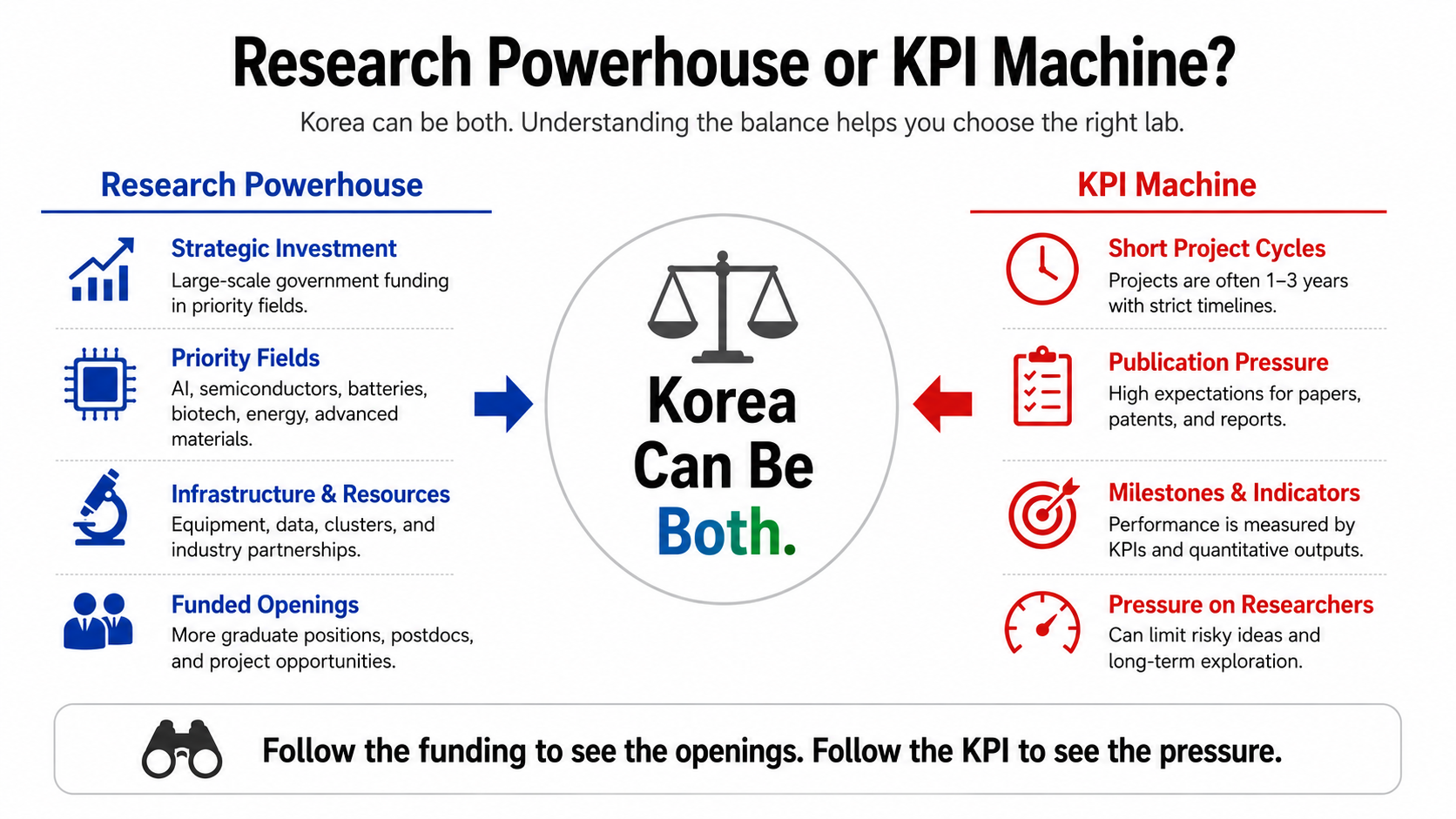
Project-based funding usually comes with milestones, reports, output indicators, publication targets, and performance reviews. The system rewards speed. It also rewards visibility.
This can be an advantage.
A Korean lab tied to active government projects may move quickly. Students may get fast feedback, clear deadlines, and access to equipment, collaborators, conferences, and industry-linked topics.
For some international researchers, this is a powerful environment.
You learn fast.
You publish fast.
You see how research connects to national strategy and industrial demand.
But there is a cost.
If the lab is too KPI-driven, research questions may become narrower. Safer projects may be preferred over risky ones. Short-term publishable output may matter more than slow, deep inquiry.
This is the core tension of Korean research:
Is Korea a research powerhouse — or a KPI machine?
The answer is not one or the other.
It can be both.
That is why international researchers should not ask whether a lab has funding in general. They should ask what kind of funding it has.
A curiosity-driven grant, an industry-linked project, a national strategic program, and a short-term KPI-heavy project create very different research lives.
The question is:
Does this funding support the research you want to do — or redirect it?
4. Foreign Researchers Can Participate — But Affiliation Matters.
For international researchers, funding access depends heavily on status and affiliation.
A foreign researcher based at a Korean institution may be able to participate in, or in some cases apply for, research funding depending on the program. A researcher based outside Korea is often limited to collaborator or co-researcher status.
The exact rule varies by program.
This is why affiliation matters.
A foreign PhD student, postdoc, or faculty member inside a Korean university is not in the same position as an overseas collaborator. The domestic affiliation can make them part of the funding system.
At the graduate-student level, programs such as BK21 can also matter. BK21 supports graduate education and research groups, and eligible international students may benefit through fellowships or research support depending on the project team and current guidelines.
But the important point is not one fixed stipend number.
The important point is structure.
If your lab is inside a well-funded BK21 group, strategic graduate school, or NRF-backed research team, your stipend and research opportunities may be more stable.
If your lab is outside those channels, support may depend more heavily on the PI’s individual project pipeline.
So before applying, ask:
- Is the department part of BK21?
- Is the lab attached to a national strategic program?
- Does the PI currently hold multi-year grants?
- Are foreign students included in funded projects?
- Is the stipend structure written clearly?
These are not administrative details.
They are career-risk signals.
5. Funding Volatility Is Real.
Korean R&D funding is large.
But it is not politically immune.
The 2024 R&D budget cut showed how quickly research environments can be affected by national budget decisions. The following recovery and expansion in 2025 and 2026 showed the other side: Korea remains committed to large-scale research investment, especially in strategic technologies.
For international researchers, the implication is simple.
Korea is still a major research investor. But the funding environment can move.
That means lab-level stability matters.
A lab supported by several multi-year projects may absorb policy shocks better. A lab dependent on one short-term grant may become fragile when budgets shift.
This does not mean you should avoid project-funded labs.
Most research labs are project-funded.
It means you should read the funding structure before entering.
A funded lab can be a launchpad.
A narrowly funded lab can become a pressure cooker.
The difference is duration, diversity, and transparency.
Decision Note
Government research funding has two faces.
It creates openings.
It also creates pressure.
For international researchers, the question is not simply whether Korea spends a lot on R&D.
The better question is:
Is the lab I am entering driven by curiosity, by KPI pressure, or by a productive balance of both — and can its funding last long enough to support my degree?
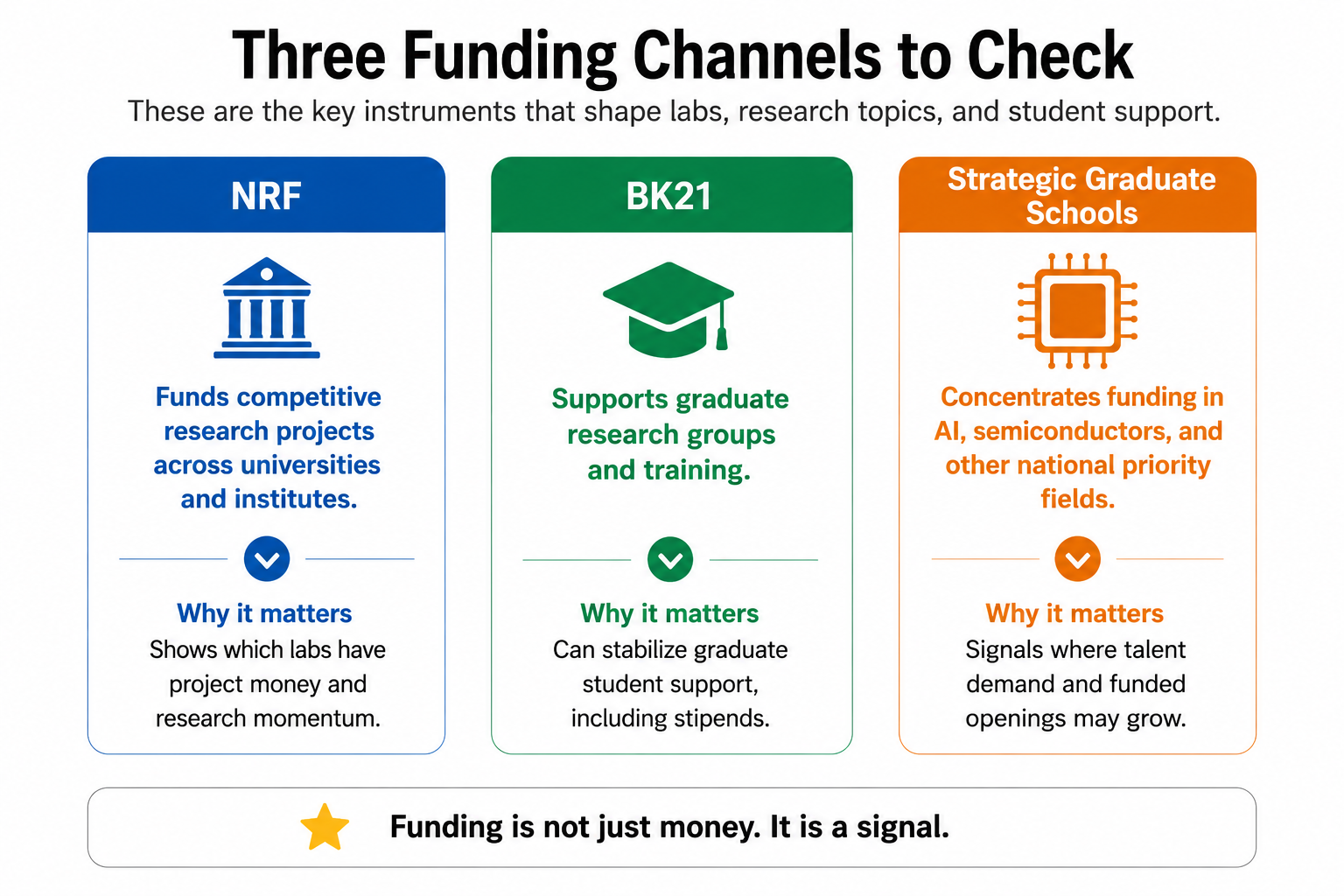
Policy instruments are not just bureaucracy.
They shape the research map.
If a field is repeatedly named in national programs, graduate-school initiatives, and NRF calls, it is probably not just academically relevant. It is strategically relevant.
That can create openings for foreign researchers.
It can also create KPI pressure.
Both matter.
One Action This Week
Choose one lab you are considering.
Search the PI’s recent project record through public sources such as NRF, IRIS, university research pages, or the lab website.
Look for three things:
- Duration — Are the projects multi-year or short-term?
- Diversity — Does the lab rely on one project or several?
- Alignment — Does the funding match Korea’s priority fields?
Then ask one practical question to a current student or alumnus:
“Is the lab’s funding stable enough to support students through graduation?”
That answer may matter more than the lab’s ranking.
Korea’s research system is powerful because it can move money quickly toward strategic fields.
That is its strength.
It can build AI programs, semiconductor training pipelines, battery research groups, and national technology initiatives with speed.
But that same system can also create pressure.
When research is organized around projects, indicators, and short funding cycles, labs may move toward what can be measured quickly.
For foreign researchers, the lesson is not to avoid Korea.
It is to read the funding.
Follow the funding, and you will see where the openings are.
Follow the KPI, and you will see where the pressure begins.
A good lab is not only a famous lab.
It is a lab with the right field, the right PI, the right funding structure, and enough stability to let you finish well.
Funding shows where Korea wants research to go.
KPI pressure shows how fast labs must get there.