Inside Korean Graduate Labs
How International Researchers Should Read PIs, Projects, Alumni, and Lab Culture
In STEM, this may look like a fast-moving R&D unit. In social science, policy, business, or design, it may look like a professor-led project team or research center.
You register as a student.
But your daily life may look like that of a junior researcher inside a small technology company.
That is not necessarily a bad thing. Korea offers world-class infrastructure, strong corporate funding, and powerful industrial networks.
But those advantages are not delivered by a logo.
They are delivered by a specific lab, a specific PI, and a specific micro-environment.
Stop choosing only the university.
Start choosing the lab.
1. The Korean Lab Is a Hierarchy
Before applying, international students should understand one thing.
A Korean STEM lab is not flat.
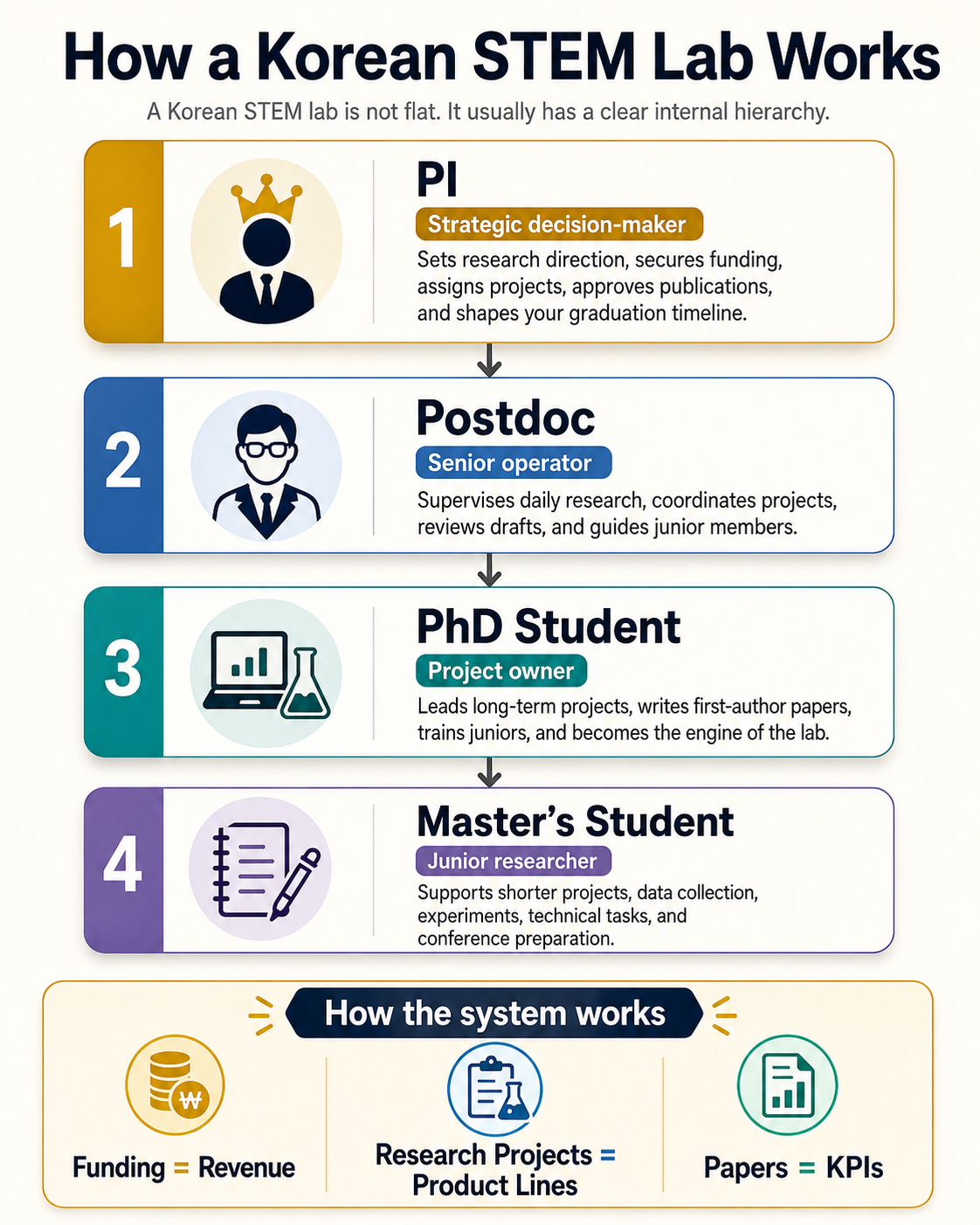
That is why lab culture matters more than university branding.
A healthy lab can accelerate your career.
A poor-fit lab can consume your time, health, and mobility.
2. Why International Students Are More Exposed to Lab Politics
When international students struggle in Korean labs, the problem is not always academic ability.
Often, the problem is information access.
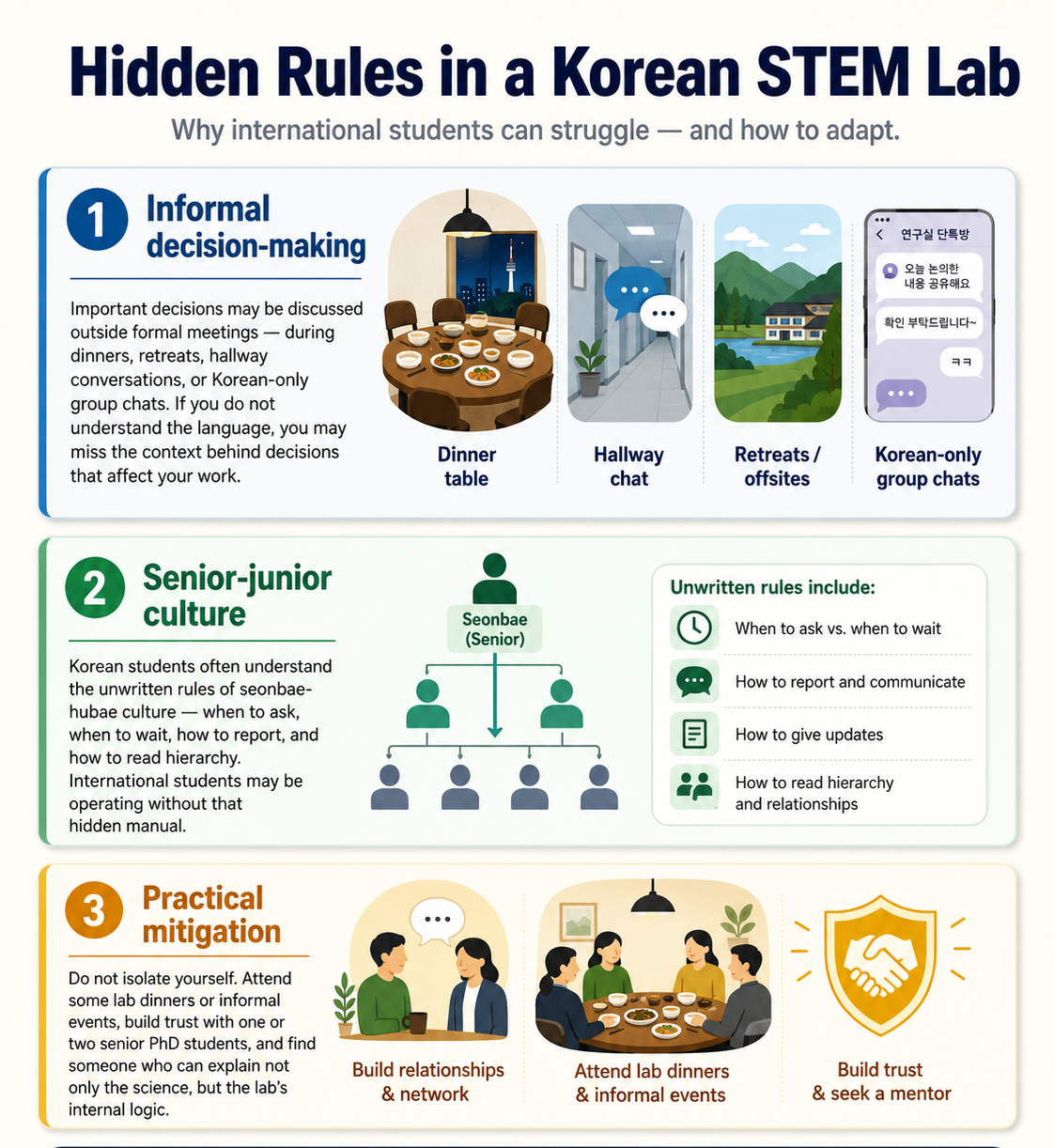
Many important decisions happen outside formal meetings.
Project allocation, authorship expectations, equipment use, conference priorities, and informal feedback may be shaped through Korean-language conversations, dinners, group chats, or senior-junior relationships.
For Korean students, these systems are familiar.
For international students, they can be invisible.
In a Korean lab, technical competence is necessary.
Information access is survival.
3. There Is No “Average” Korean Lab Culture
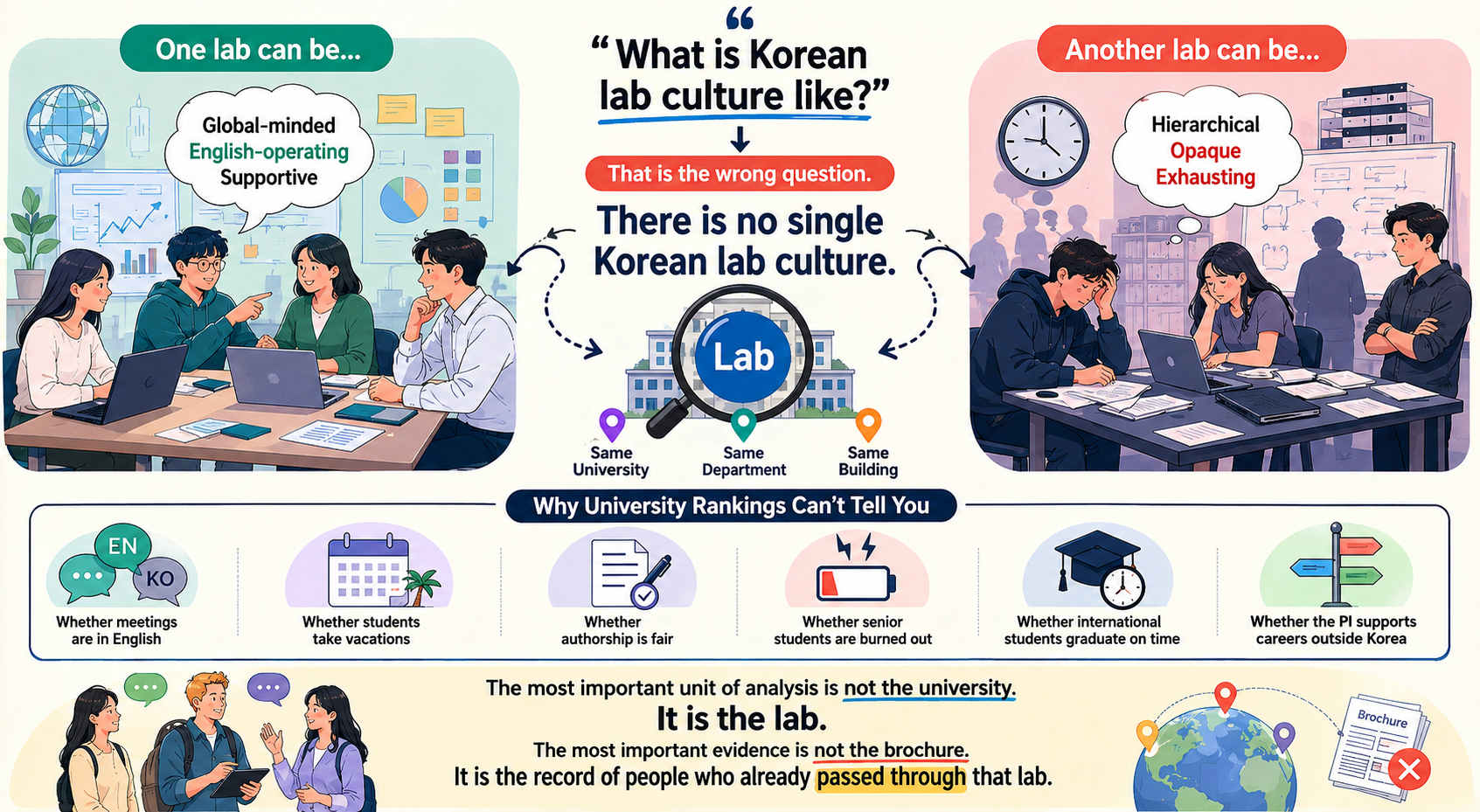
The most important unit of analysis is not the university.
It is the lab.
And the most important evidence is not the brochure.
It is the record of people who already passed through that lab.
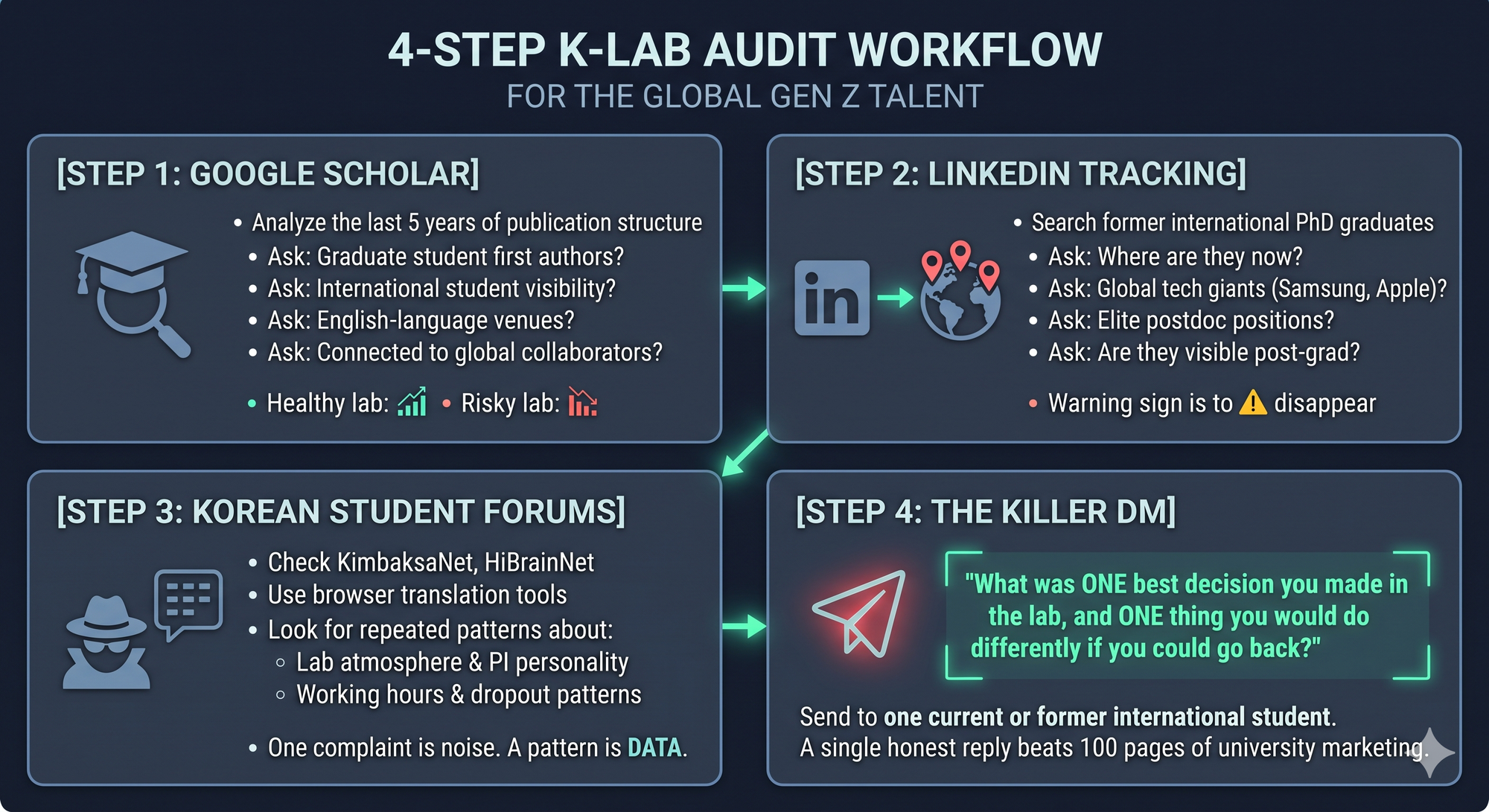
4. The Four-Hour K-Lab Reverse-Engineering Protocol
Do not apply blindly based on rankings.
Spend four hours auditing the lab.
This is the minimum due diligence before committing two, five, or more years of your life.
5. Red Flags and Green Flags
Before accepting admission or signing a scholarship agreement, evaluate the lab across five dimensions.
If a lab triggers two or more serious red flags, be careful.
If it shows several green flags, it may be a rational choice.
K-Lab Audit
Red Flags vs. Green Flags
Use this table before accepting an admission offer or scholarship agreement.
| Category | Red Flag | Green Flag |
|---|---|---|
| Publication structure | Few English papers; unclear student authorship; PI dominates credit. | Strong English output; students frequently first author. |
| Alumni network | No visible international PhD alumni. | International alumni placed in companies, postdocs, or research institutes. |
| Working hours | Implicit 70+ hour weeks; no clear vacation norms. | Predictable working rhythm; boundaries are respected. |
| Operating language | “English-friendly” on paper, but meetings and reviews are mostly Korean. | Lab meetings, paper drafts, and technical feedback happen in English. |
| Lab morale | Burned-out seniors, high turnover, avoidance of direct answers. | Students can explain expectations clearly and discuss careers openly. |
This table is not a moral judgment.
It is a risk-management tool.
The goal is not to find a perfect lab.
The goal is to avoid a structurally bad fit.
The Real Question Is Not “Is the University Good?”
Domestic Korean students often say:
“The university is the city.
The department is the neighborhood.
The lab is the house.
The PI is the landlord.”
It is a useful metaphor.
You do not live your daily life inside a ranking.
You live inside a lab.
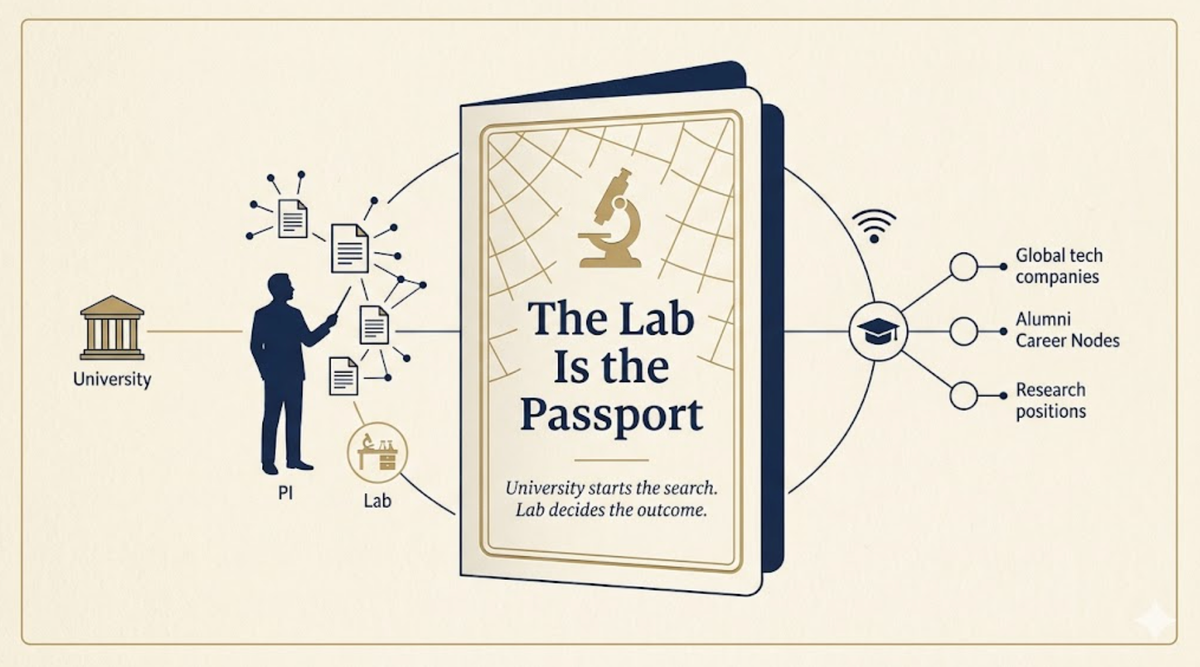
The university brand may help open the door.
The department may shape your academic neighborhood.
But the lab determines your daily life, your publication record, your recommendation letters, your network, and sometimes your mental health.
For international STEM researchers, this is the central rule:
The university name starts the search.
The lab decides the outcome.
South Korea can be a powerful place to build a STEM career.
But the system is not automatic.
A famous university does not guarantee a good lab.
A strong department does not guarantee a healthy PI.
An English admissions page does not guarantee an English-working environment.
The real passport is the lab.
Stop choosing logos.
Start choosing micro-environments.