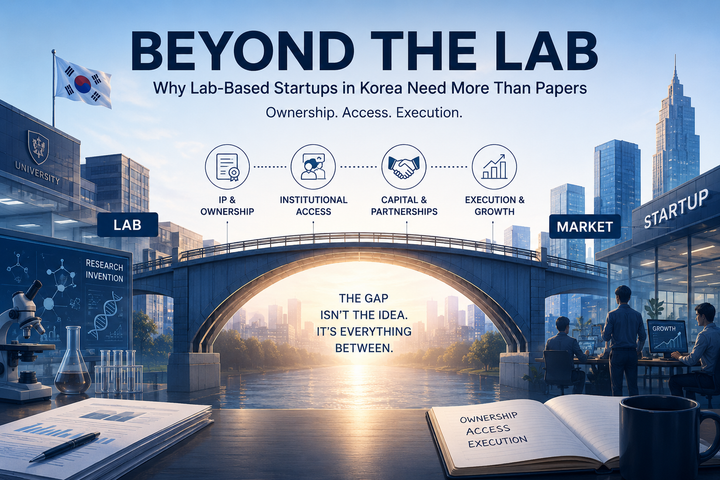
Korea’s Campus Startup Boom Is Designed, Not Spontaneous
Korea’s campus startup route can be open to foreign founders. But it is not informal. It is built through university support, policy funding, IP, incorporation, and startup visa conditions.

How universities, startup visas, and policy funding create one of the rare Korean routes foreign founders can actually use
Korean campus startups can look like a wave of entrepreneurial energy.
But inside the university, the route is rarely just spontaneous.
There are startup support offices.
Government startup packages.
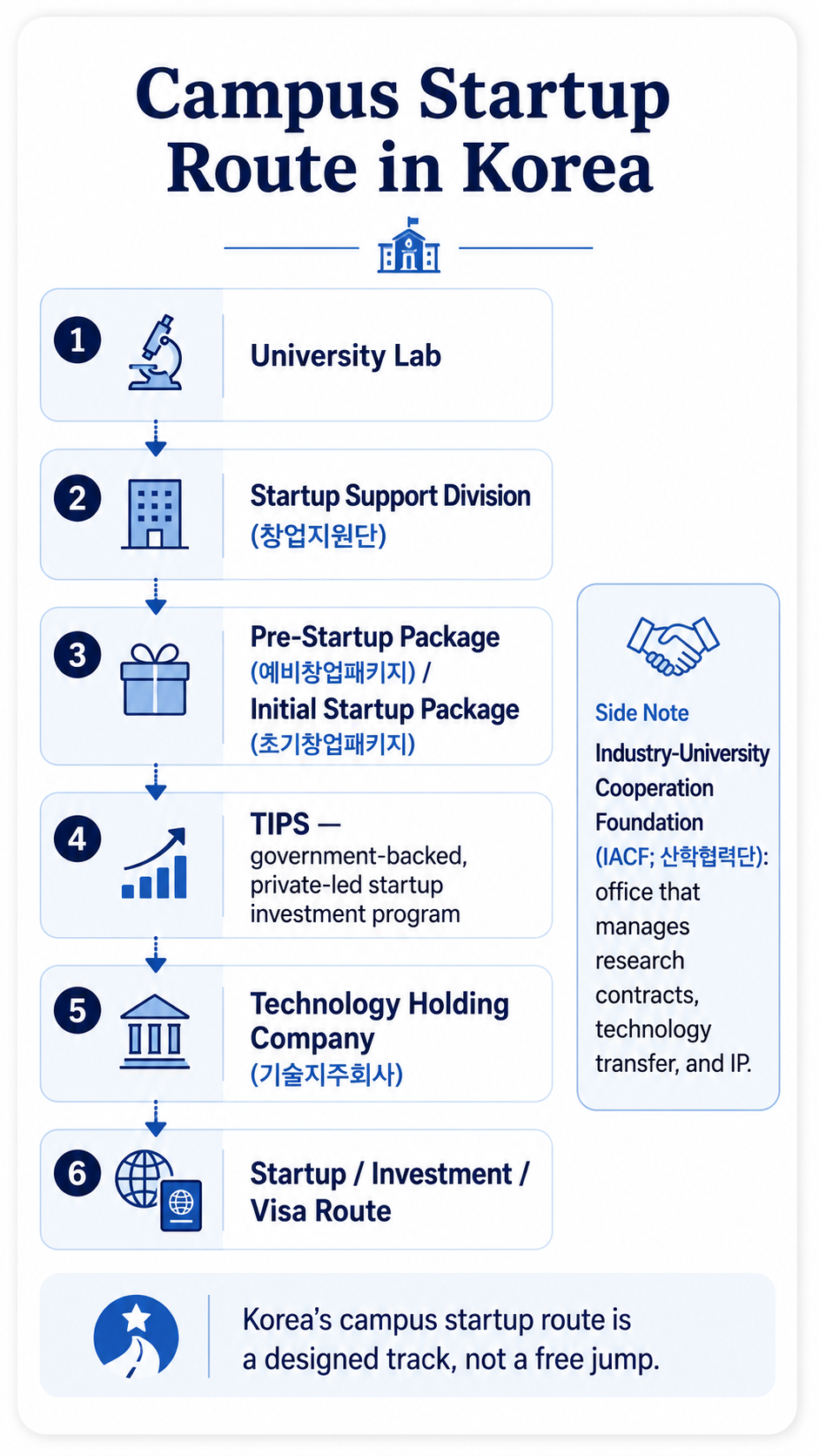
TIPS(government-backed, private-led startup investment program) operators.
University technology holding companies.
Startup immigration programs.
And visa categories that translate degrees, IP, technology, and incorporation into eligibility.
This is why Korea’s campus startup route matters for foreign researchers.
Unlike some university-to-company channels, startup pathways can be genuinely open to foreign founders.
But they are not loosely open.
They are designed.
The door exists.
But it is built with points, certificates, technology, intellectual property, incorporation, and university ownership structures.
Campus Startups Are a Policy-Built Route
Korea’s campus startup infrastructure does not rely only on individual ambition.
The institutions are already there.
Many universities have startup support divisions that provide incubation space, mentoring, startup education, and connections to investors or government programs. The Ministry of SMEs and Startups and the Korea Institute of Startup & Entrepreneurship Development support early-stage founders through programs such as the Pre-Startup Package and Initial Startup Package.
TIPS connects promising technology startups to private-led investment and follow-on support.
University technology holding companies support the commercialization of research outcomes, especially when lab technology moves toward a company.
In other words, campus startup activity in Korea is not simply a founder jumping into the unknown.
It is often a founder entering a pre-built route.
For foreign founders, the important point is not whether Korea has a startup mood.
The important point is which part of that route is actually open to them.
The Startup Boom Is About Risk Absorption, Not Culture
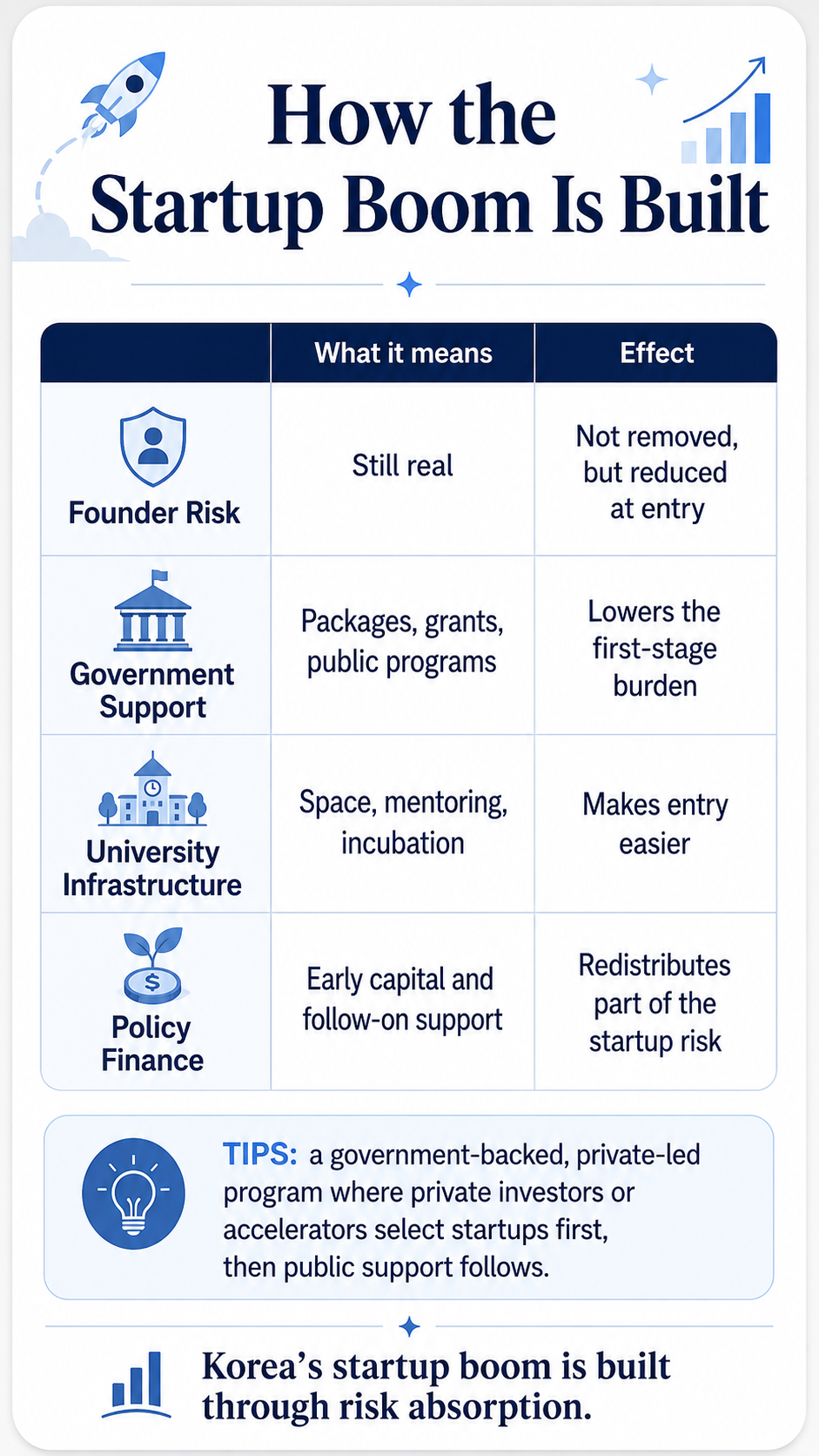
Korea’s campus startup activity is better understood through risk absorption than through culture alone.
Government grants, university startup spaces, mentoring, local-government programs, and policy finance reduce part of the early burden. The founder still carries risk, but the first stage is not carried alone.
That changes who can enter.
When the first layer of risk is lowered, more students, researchers, and lab teams can try entrepreneurship without treating it as a total break from the university system.
This does not mean startup failure becomes easy.
It means the entry cost is partially redistributed.
That is the key structure.
Which government program supports the first stage?
Which university provides space or mentoring?
Which technology connects to a TIPS operator?
Which IP can be transferred into a company?
Which founder can turn preparation into visa eligibility?
These are the working conditions of Korea’s campus startup route.
For foreign researchers, the same logic applies.
An open startup route does not mean an informal route.
It means there are support structures, and those structures come with conditions.
The Foreign Founder Door Is Open — But Conditional
This is where campus startups differ from some other university-to-company routes.
For foreign founders, the startup door can be real.
The main structure has three parts.
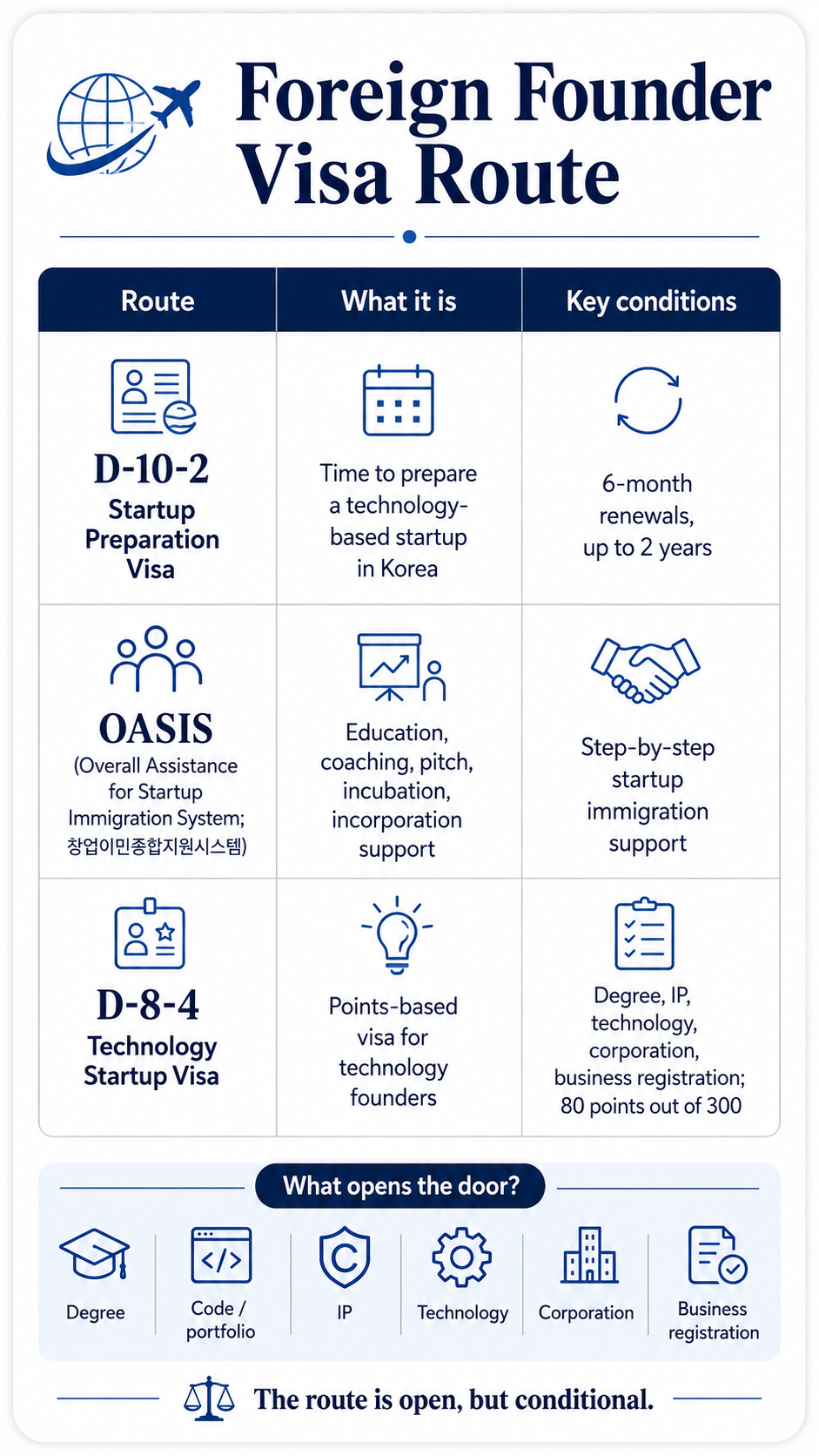
First, D-10-2.
D-10-2 is the startup preparation visa. It gives foreign founders time to prepare a technology-based business in Korea. OASIS participation, a business plan, academic background, and preparation records can support this route.
The stay is usually managed in six-month units, with a maximum stay of up to two years.
Second, D-8-4.
D-8-4 is the technology startup visa.
It is not simply a visa for having a startup idea.
It is a points-based route. The draft standard used here is a 300-point scale with an 80-point threshold. Degree level, intellectual property, technology, incorporation, and business registration matter. The route generally assumes at least a Korean associate degree or a foreign bachelor’s degree, unless another qualifying recommendation or condition applies.
Third, OASIS
OASIS is the Overall Assistance for Startup Immigration System. It provides staged support for foreign technology founders, from startup education and IP training to coaching, pitch competitions, incubation, and incorporation support.
Together, these routes make Korea unusual.
The country does not only say that foreign founders are welcome.
It provides a track by which preparation, technology, and IP can become immigration arguments.
But that also means the route is not casual.
Language alone does not open the door.
A vague idea does not open the door.
Your degree, code, portfolio, IP, incorporation plan, and business registration can.
From Graduate Lab to Startup: IP Comes First
For graduate students, the startup route often begins inside the lab.
An algorithm, sensor, material, medical device, AI model, biotech process, or platform technology may become the basis of a company.
But the first startup question is not only whether the technology can be built.
It is who owns it.
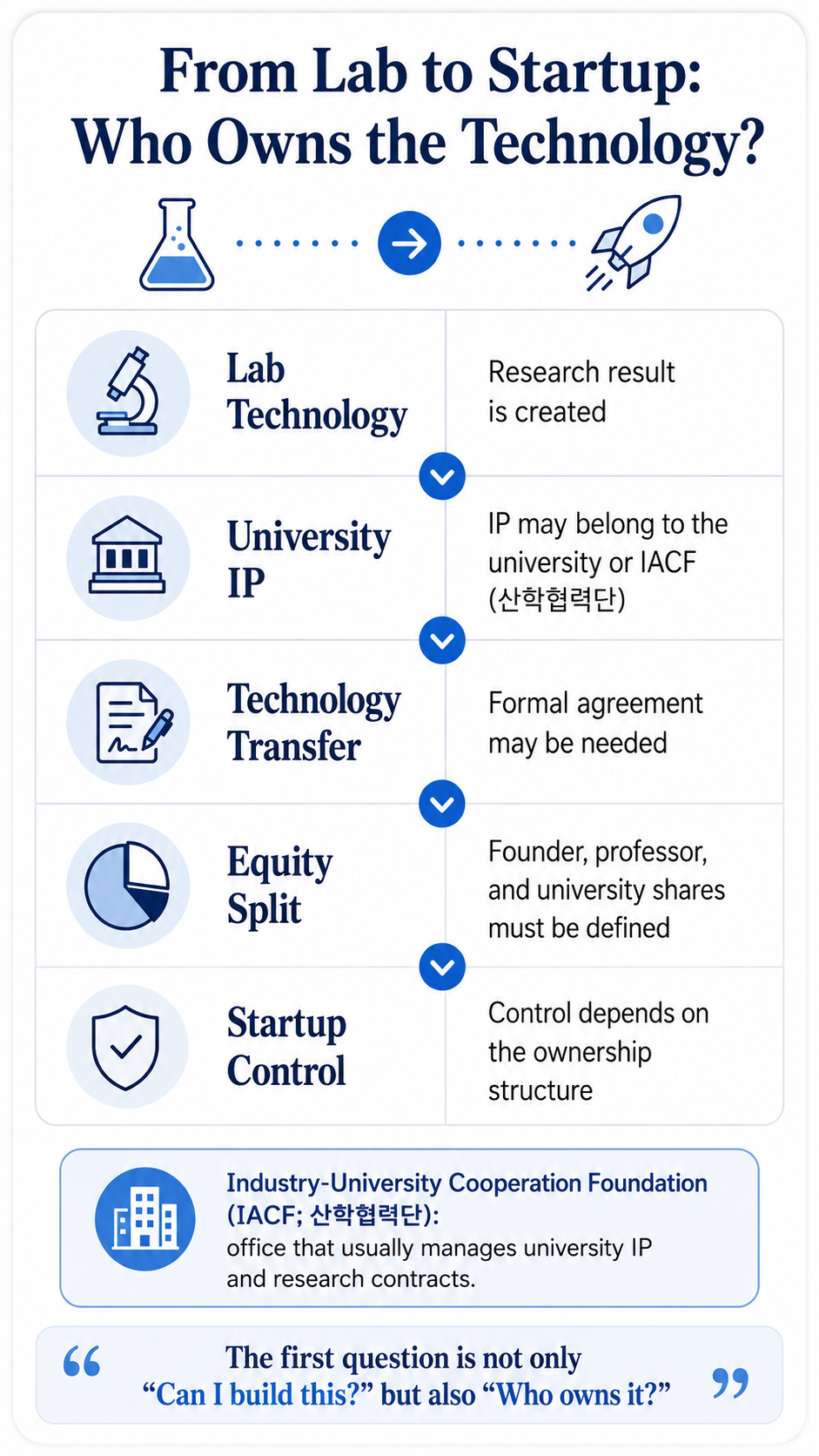
Technology developed inside a university lab may not belong personally to the student or researcher who worked on it. In many Korean university settings, research outcomes can be treated as employee or institutional inventions, with intellectual property managed through the university’s Industry-University Cooperation Foundation or technology holding company.
That does not block startup formation.
But it changes the order of work.
Before a founder builds the company, the founder must understand the IP position, technology transfer terms, equity structure, professor involvement, university rights, and founder control.
For foreign graduate students, this is critical.
D-8-4 may require technology and IP.
But the IP may sit inside the university.
A researcher may have built the technology, but the right to commercialize it may require a formal agreement.
This is where many lab-based startups become complicated.
The issue is not talent.
It is ownership.
This connects directly to the next article: From Labs to Startups — The Missing Bridge. Korea has strong research output, but the bridge from lab results to market companies can still be difficult. IP ownership, professor startups, equity splits, and technology-transfer terms can become the lock inside the route.
Failure Is Still Costly — Germany as a Comparison
Korea’s campus startup route is well designed.
But a designed route does not make failure light.
A failed startup can still leave marks on credit, reputation, family expectations, career options, and visa status. Government re-startup programs may reduce part of the burden, but failure tolerance often changes more slowly than policy infrastructure.
This matters for foreign founders.
A visa route can open the door.
A startup package can support the first stage.
An incubator can provide space.
But none of these automatically solves what happens after failure.
Germany offers a useful comparison.
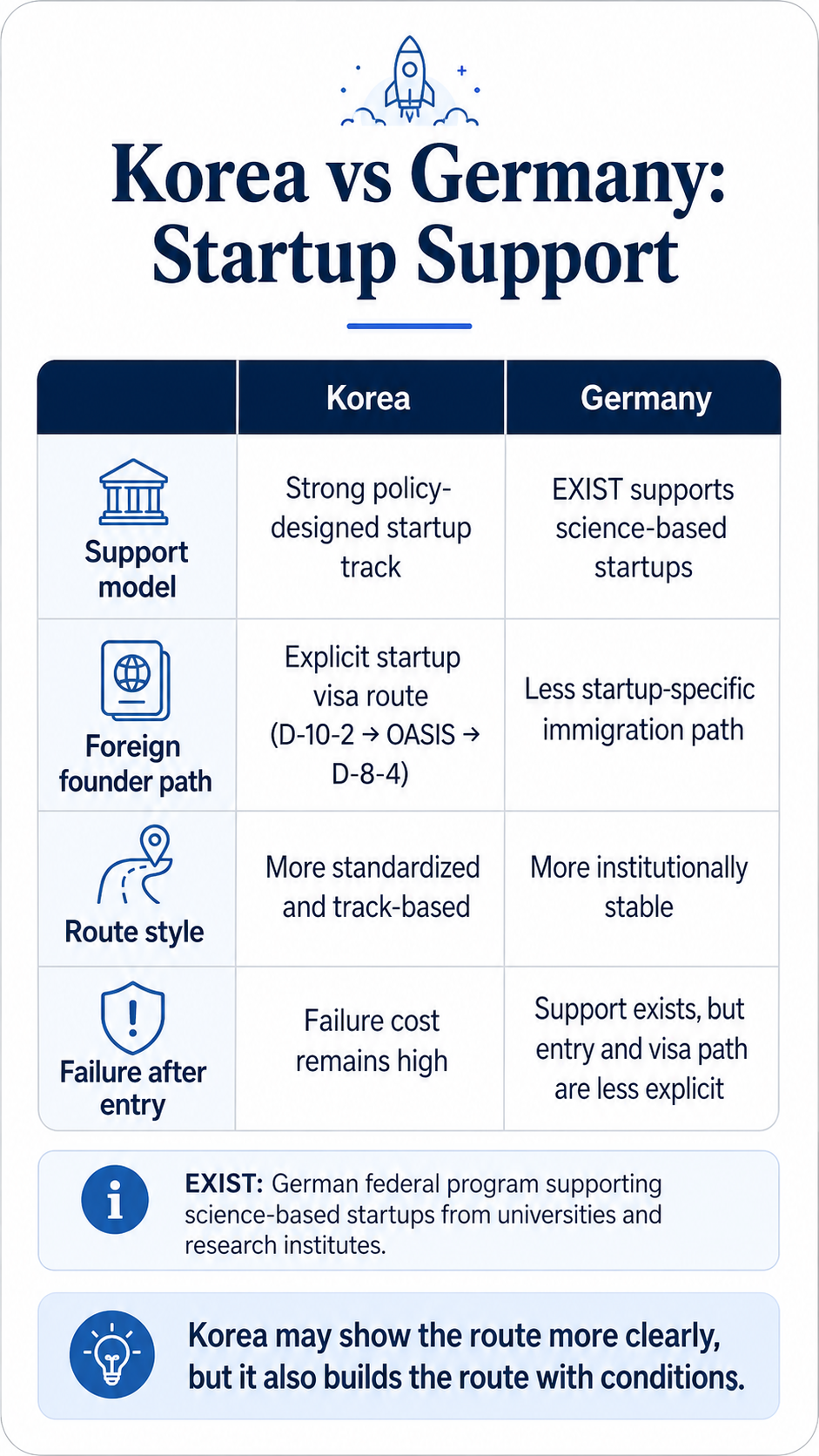
Germany’s EXIST program supports science-based startups from universities and research institutes. It can provide early-stage support for founders, including living costs, materials, and coaching. In that sense, it resembles parts of Korea’s lab startup support and pre-startup infrastructure.
The difference is design.
Korea’s route is more explicitly connected to startup immigration categories such as D-10-2, OASIS, and D-8-4. For foreign founders, that can make the map clearer.
But it also makes the route more standardized.
Korea may show the door more clearly.
It also asks the founder to follow the track more closely.
Decision Note
Campus startups may be one of the more open Korean university routes for foreign founders.
But the openness should not be misunderstood.
This is not an open field.
It is a designed door.
Korea provides programs, visa routes, startup education, public funding, and university commercialization structures. These can make entry possible for foreign founders in ways that other university-to-company routes do not.
But the same structure also asks for proof.
What is your technology?
Who owns the IP?
Can it be transferred?
Do you have incorporation plans?
Can your portfolio become points?
Can the route survive failure?
The value of Korea’s campus startup ecosystem is that it gives the founder a map.
The risk is that the map is also a track.