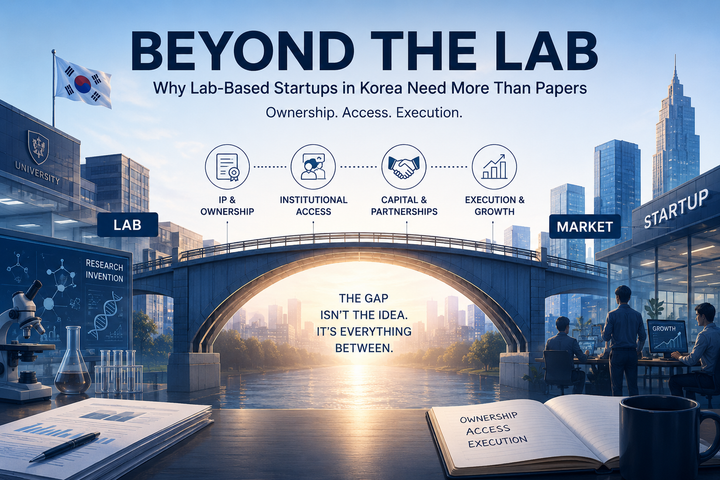

Korea’s Research Arbitrage: Why Foreign Gen Z Scientists May Still Come
Korea is not the easiest research destination. But in a world shaped by U.S.–China rivalry, supply-chain blocs, and stricter Western research controls, Korea may still offer strategic upside for foreign Gen Z scientists who know how to navigate labs, visas, industries, and language.

That is exactly where the arbitrage begins.
Korea is not fully open, but it is not closed. In a world where research mobility is increasingly shaped by security blocs, supply chains, and immigration filters, Korea sits close to strategic industries such as semiconductors, batteries, AI, biotechnology, displays, robotics, and parts of defense and space technology.
For a foreign researcher who knows how to read the system, Korea is not just a study destination.
It can become a career-positioning zone.
Korea’s Value Is Not Ease. It Is Strategic Positioning.
It is easy to misread Korea if you compare it directly with Singapore or the United States.
Singapore is closer to an English-based settlement model. The United States remains the center of global research networks, even as access becomes more politically filtered. Korea is different from both. Some Korean graduate schools and research labs can operate in English, but administration, informal channels, long-term settlement, and local networks still run heavily through Korean.
So Korea’s value is not that it is easy.
Its value is that it can be strategically useful.
In semiconductors, batteries, applied AI, biotechnology, displays, robotics, and related fields, Korea sits close to industries that matter in the new supply-chain order. University labs, government projects, corporate R&D, industry-university collaboration, and startup pathways are often tightly linked. A foreign researcher inside this ecosystem is not only earning a degree. They may be building a portfolio inside a strategic industry.
That matters.
As U.S. and European research systems become more sensitive to security, nationality, research partnerships, and export-control logic, foreign researchers cannot only ask which university is most famous. They also have to ask which country can give them a field, a lab, an industry connection, a visa route, and a portable career signal.
On that calculation, Korea can be conditionally attractive.
In a closing world, the useful country is not always the easiest one.
It is the one you can still design around.
The Four Arbitrage Points: Industry, Geopolitics, Lab Access, Visa
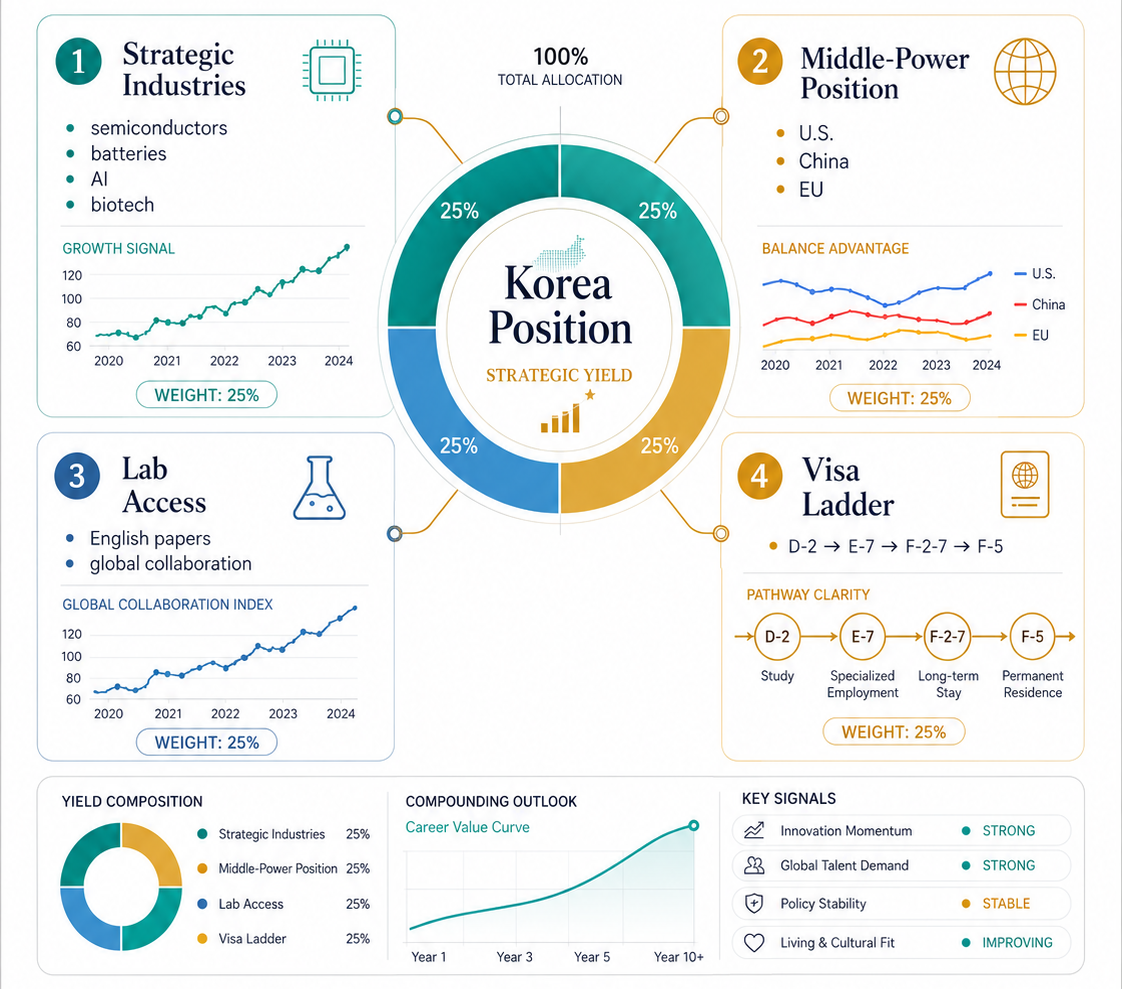
Foreign Gen Z researchers can find four kinds of arbitrage in Korea.
The first is industry arbitrage.
Korea is directly connected to global demand in semiconductors, batteries, applied AI, biotechnology, displays, robotics, and some defense and space-related fields. Choosing a research topic in these areas is not only an academic decision. It is a way of placing yourself inside a future supply chain. Korean labs are often close to these industries, and that proximity can become a career asset.
The second is geopolitical arbitrage.
Korea is a security and technology partner of the United States, but its industrial structure cannot fully disconnect from China. That middle position creates uncertainty, but it also gives researchers exposure to a country that operates between major blocs. In a world where technology systems are splitting, experience in a middle-power innovation economy can itself become a career signal.
The third is lab-access arbitrage.
Not every Korean lab is good for foreign researchers. Some are closed, hierarchical, or Korean-only in practice. But some labs need English publications, international collaboration, overseas conference networks, and global project visibility. In those labs, a foreign researcher can become more than a student. They can become a source of global output.
The fourth is visa-ladder arbitrage.
Korea’s long-term settlement route is complicated, but not completely opaque. A researcher can enter on D-2 student status, move to E-7 professional employment, then potentially move toward F-2-7 points-based residence and later F-5 permanent residence. The problem is that students who discover this ladder near graduation are already late. Those who plan it from the D-2 stage have more control.
Arbitrage is not automatic.
It belongs to the person who plans early.
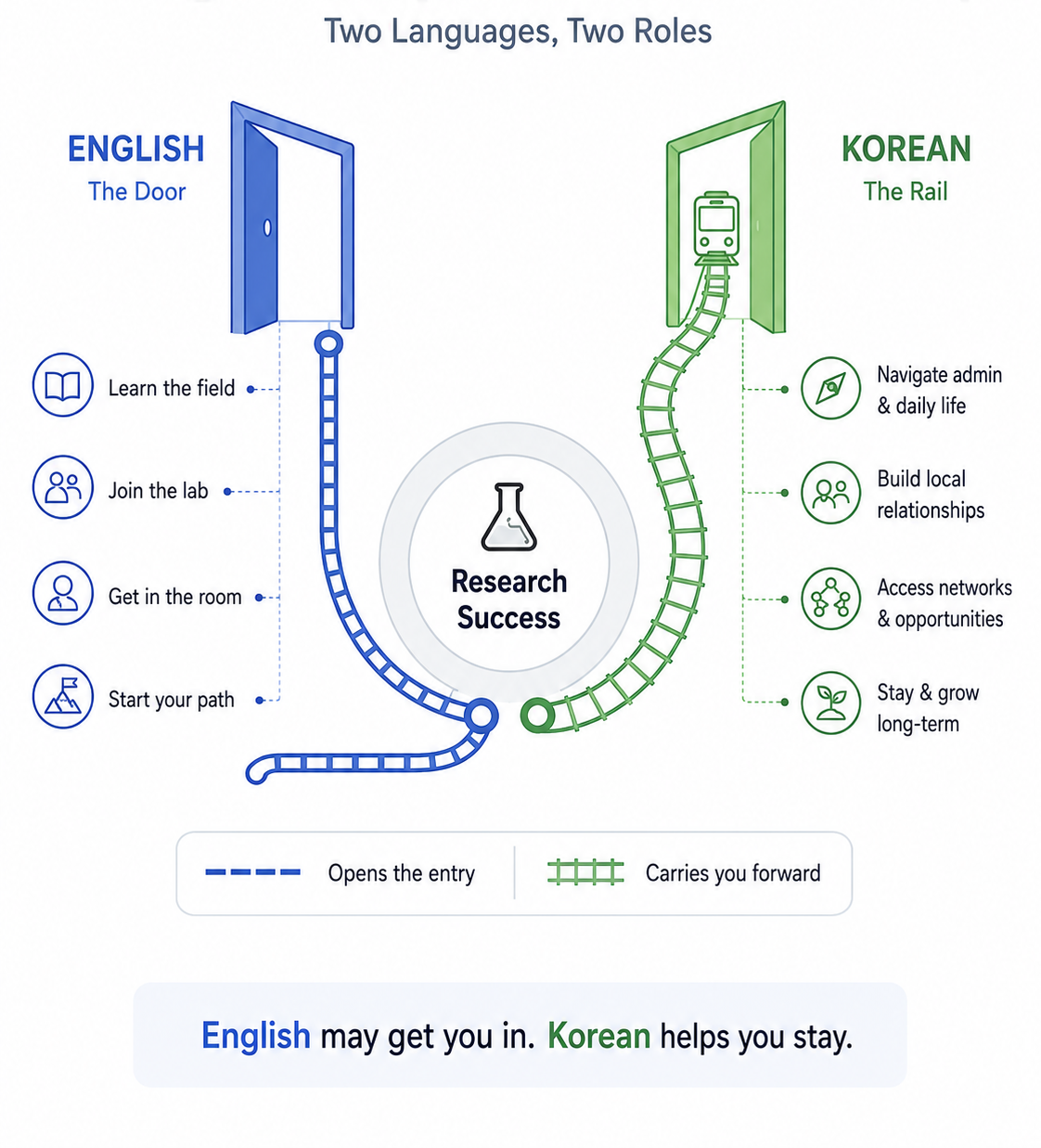
English Opens the Lab. Korean Keeps You in Korea.
English can be enough to enter the Korean research system.
At KAIST, POSTECH, and some research-oriented universities and internationalized labs, a foreign student can take courses, write papers, and complete a degree in English. In fields where international journals and global collaboration matter, English is a powerful research asset.
But settlement works at another layer.
Administration, housing contracts, hospitals, KakaoTalk, dinners, informal lab information, visa counseling, KIIP, and local networks often operate in Korean. Korean is not only a cultural courtesy. It is infrastructure for lowering the cost of staying.
If you miss this distinction, Korea becomes frustrating.
You may enter the lab through English, but the important information may move in Korean. Visa paperwork may require Korean interpretation. Lab trust may form through informal conversations. Administrative problems may be solved faster by those who can read the local system. In that situation, foreign researchers are not marginalized because they lack ability. They are marginalized because they are outside the channel.
If you understand this early, the strategy changes.
Korean should not be treated as something “nice to have.” It should be treated as settlement infrastructure. You do not need perfect fluency at the beginning. But you do need enough Korean to read administration, networks, visa signals, and informal lab movement.
English opens the lab.
Korean lowers the cost of staying.
Who Stays: The 46.8% Pattern
The data is direct.
After graduation, 46.8% of international students plan to continue living locally. Another 36.8% plan to leave for their home country or a third country, while 16.5% plan to move elsewhere. Nearly half may stay, but a large share leaves.
The real question is who stays.
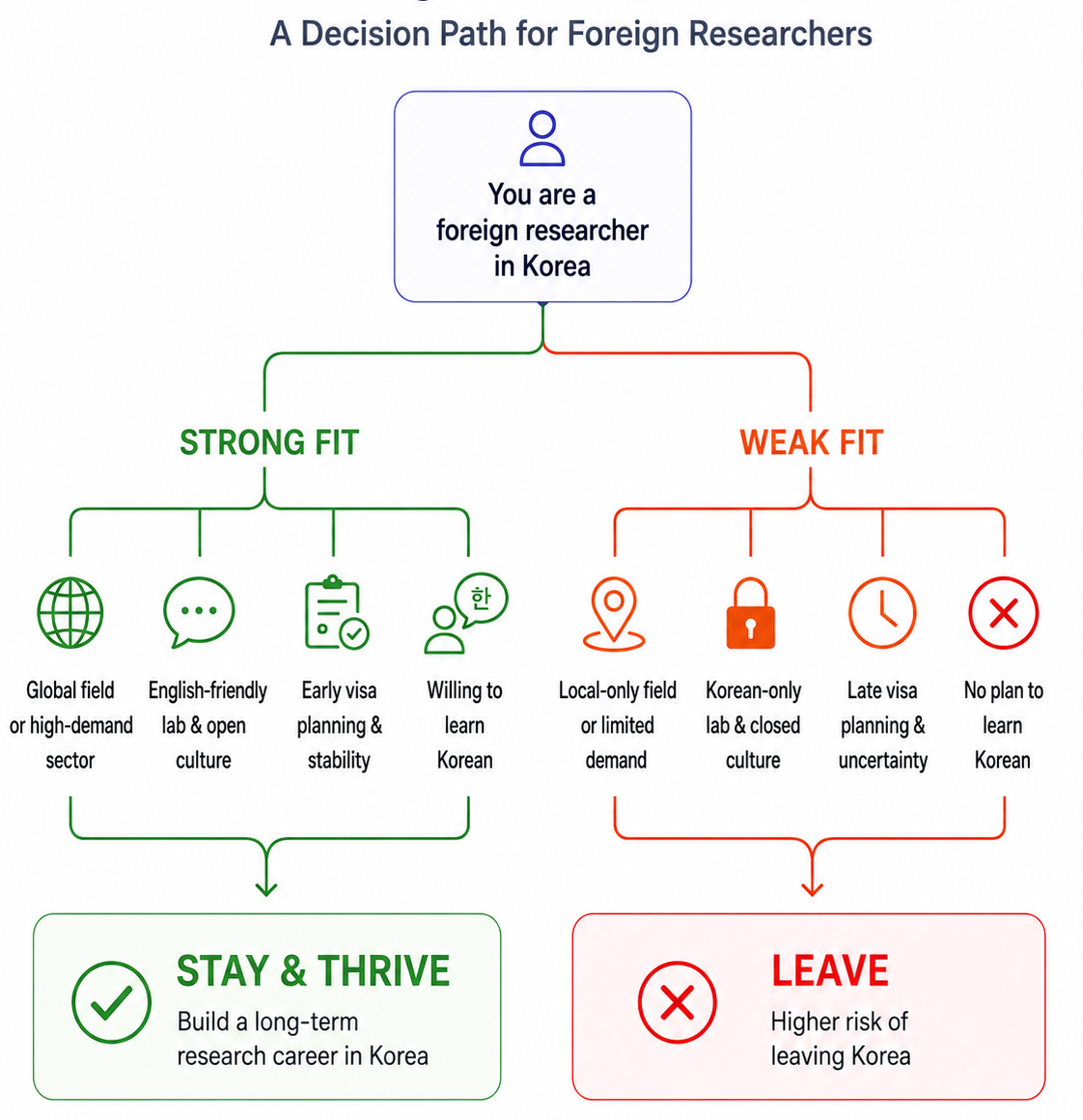
Across the K-Uni series, the pattern is consistent. Those who stay tend to build four assets: a globally demanded field, an English-operating lab, an early visa ladder, and load-bearing Korean.
If your field is too locally bound, your career mobility weakens. If your lab runs through Korean-only informal channels, you sit outside the information flow. If you leave visa planning until the end, the E-7 transition can make you heavily dependent on one employer or PI. If you do not build Korean, the cost of administration, housing, networks, and settlement stays high.
People do not leave only because Korea is bad.
Many leave because they did not build the assets Korea rewards. Without a global field, an international lab, a long-term visa plan, and Korean-language settlement capacity, Korea becomes narrow over time.
With those assets, Korea looks different.
It becomes a place to build a portfolio inside strategic industries. Visa becomes planning rather than stress. Korean becomes leverage rather than burden.
Those who stay are not simply the people who chose Korea.
They are the people who designed what to build inside Korea.
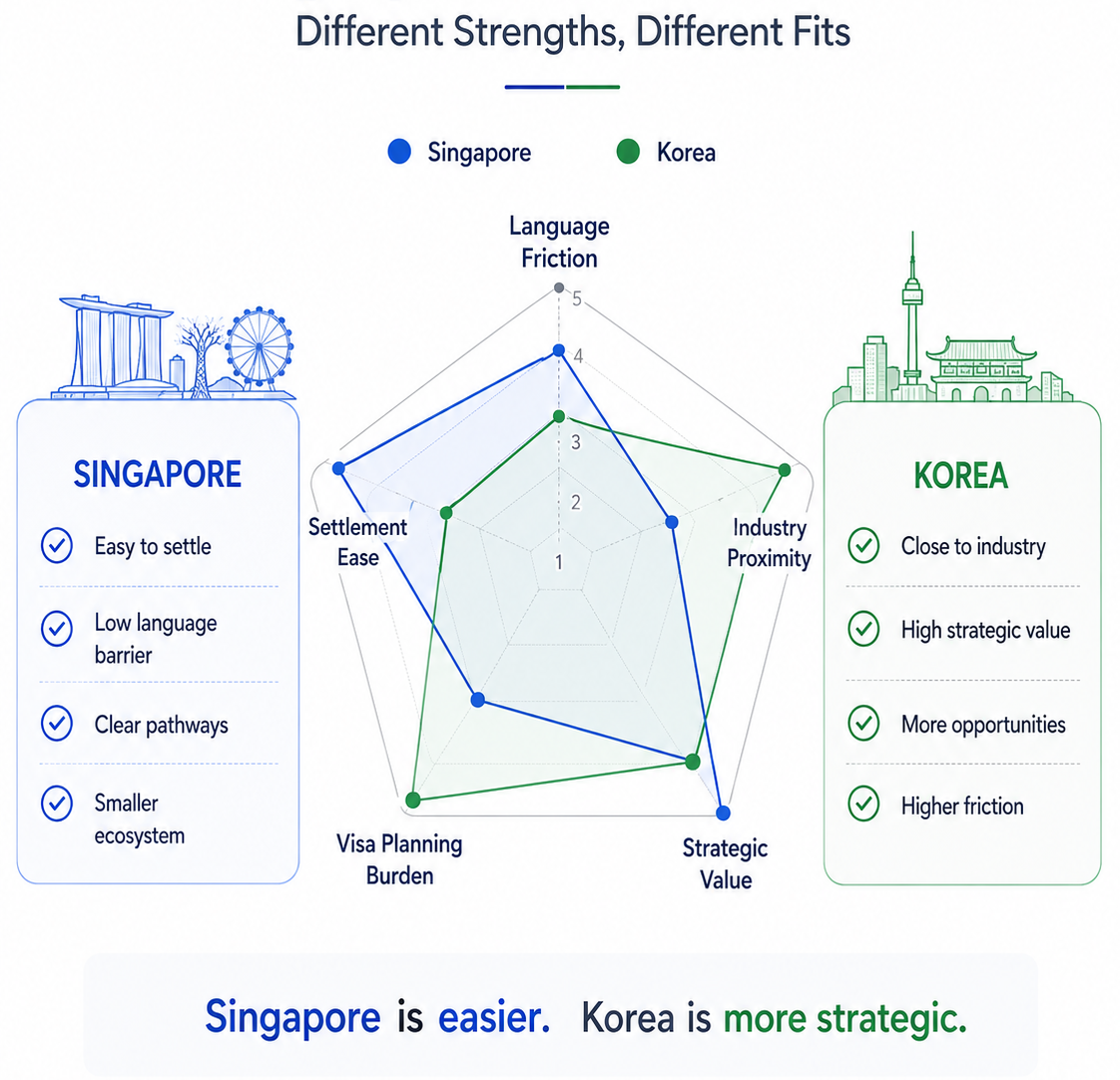
Singapore Is the Easier Model. Korea Is the Strategic Model.
Singapore and Korea offer very different models for foreign researchers.
Singapore is closer to an English-based settlement hub. Much of research, administration, corporate life, and daily life can operate in English. For high-skilled foreign talent, the friction between entry and settlement is comparatively lower. It is close to a model where the country can work through English.
Korea is not that model yet.
Korea can open the lab in English, but researchers still need Korean to lower settlement costs and enter local channels. It is less smooth than Singapore. But Korea can offer deeper proximity to specific strategic industries such as semiconductors, batteries, applied AI, biotechnology, and advanced manufacturing.
Neither model is automatically better.
Singapore is easier.
Korea is more specific.
If you want English-based settlement, lower language friction, and a global hub environment, Singapore may be the better model. But if you want to build a technical portfolio inside a specific supply chain, work near Korean strategic industries, and design language and visa pathways early, Korea can offer a different kind of upside.
Korea is not a destination for everyone.
But for the right researcher, it can be a strategic one.
Decision Note: Korea Is Not for Everyone. It Is for Navigators.
The final K-Uni question is not simply whether Korea is a good place for foreign researchers.
The better question is this:
For which foreign researchers is Korea strategically useful?
In 2026, researchers can no longer choose only by university brand. Visa policy, research security, supply chains, technology blocs, language, networks, and long-term residence all shape the value of a destination. In that calculation, Korea is not the easiest answer. But it is too important to ignore.
Korea lets some foreign researchers begin research in English.
But staying requires Korean.
Korea is not fully open to foreigners.
But it is close to industries that matter.
Korea is not for everyone.
But for those who combine a global field, an English-operating lab, an early visa ladder, and load-bearing Korean, the arbitrage exists.
Korea is not for everyone.
It is for navigators.