Women in Korean STEM: Where the Pipeline Leaks
Korea’s STEM system can widen entry for women, but authority moves more slowly. For foreign women researchers, Korea is not automatically risky or attractive. It depends on the lab’s senior ratio, power structure, and transparency.

Korea’s STEM gender problem is not the absence of policy.
The policy exists. Korea has the Act on Fostering and Supporting Women Scientists and Technicians. It has WISET, the Korea Foundation for Women in Science, Engineering and Technology. It has R&D career-return support, hiring targets, mentoring programs, and public statistics tracking women in science and technology.
Yet the top remains narrow.
Women are strongly present at the entrance of higher education, but their share declines across STEM degrees, doctoral training, research employment, PI roles, and leadership positions. This is not simply a story of women missing from the beginning. It is a story of where the system stops converting women into authority.
Policy can bring people into the system.
Authority moves through a more complicated path.
This table is not only about gender ratio.
It shows the difference between the stages that the state can widen and the stages that organizations change more slowly. Education, hiring, return programs, and subsidies can be designed through policy. But becoming a PI, holding a leadership role, leading a major project, or gaining authority inside a lab depends on internal institutional codes.
The entrance is built by policy.
The top is shaped by power.
Why Entry Does Not Become Authority
Korea’s women-in-STEM policies have made the entrance wider.
The Act on Fostering and Supporting Women Scientists and Technicians institutionalized policy support for women scientists and engineers. WISET operates training, mentoring, statistics, and career-return programs. R&D career-return support helps women whose research careers were interrupted re-enter the research system. Hiring targets have also helped raise women’s presence in public R&D organizations.
These policies matter. The share of women among new hires has risen, and the share of women in the science and technology workforce has been improving. Korea’s problem is not policy absence. The problem is that policy works at one layer, while authority moves at another.
Hiring can be expanded. Return can be supported. Training can be funded.
But becoming a PI, holding a leadership post, or leading a large research project is not decided by headcount alone. Those positions are shaped by reputation, recommendation, internal trust, project networks, senior sponsorship, and peer recognition.
Career-return support has the same limitation. It can reopen the door to the lab, but it does not automatically restore the researcher’s previous publication momentum, project network, internal reputation, or path to authority. Returning to research and returning to power are not the same thing.
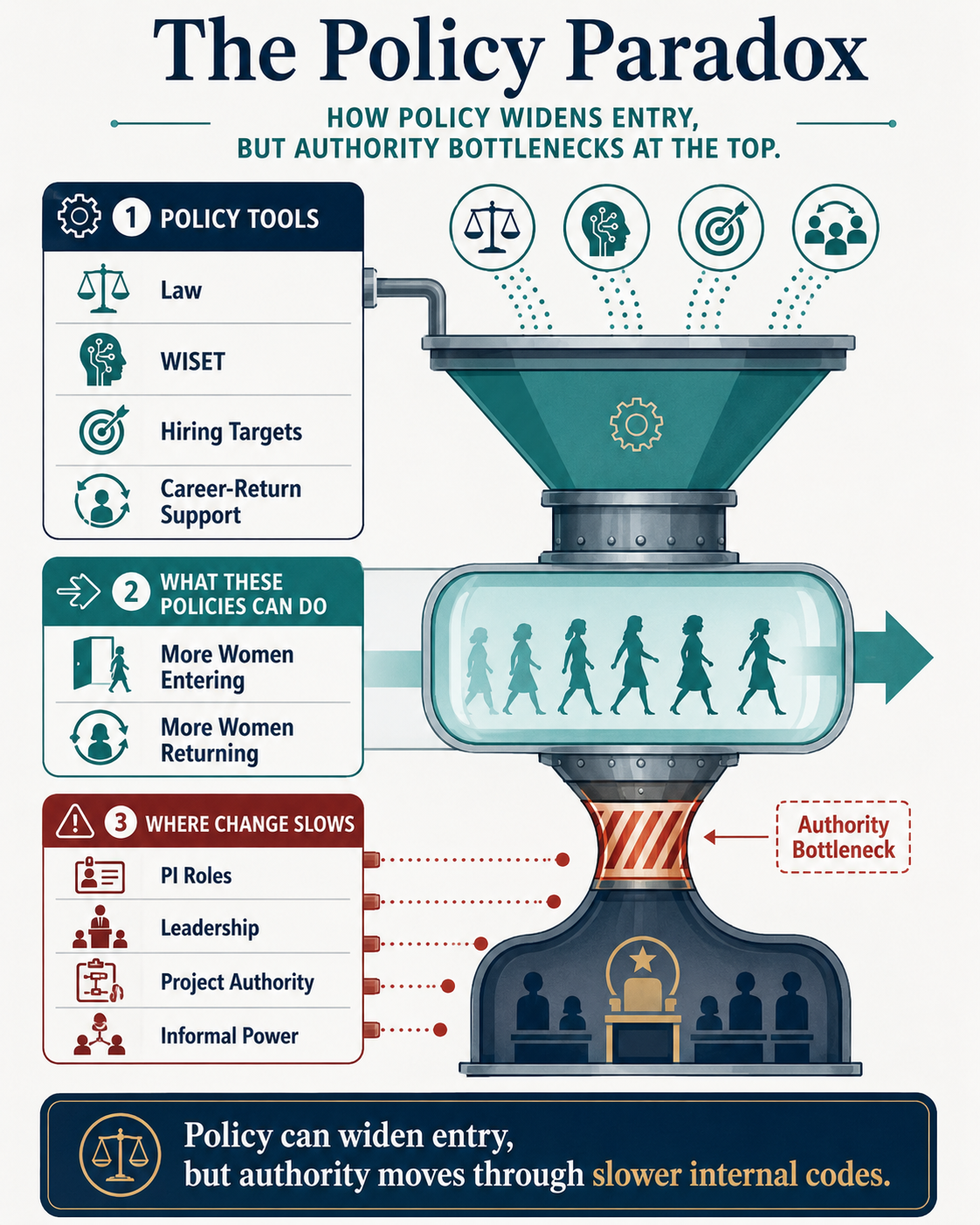
This is the policy paradox in Korean STEM. Money circulates, programs exist, and more women enter. But the top opens more slowly.
Entry has widened.
Authority still moves slowly.
Where Authority Actually Moves
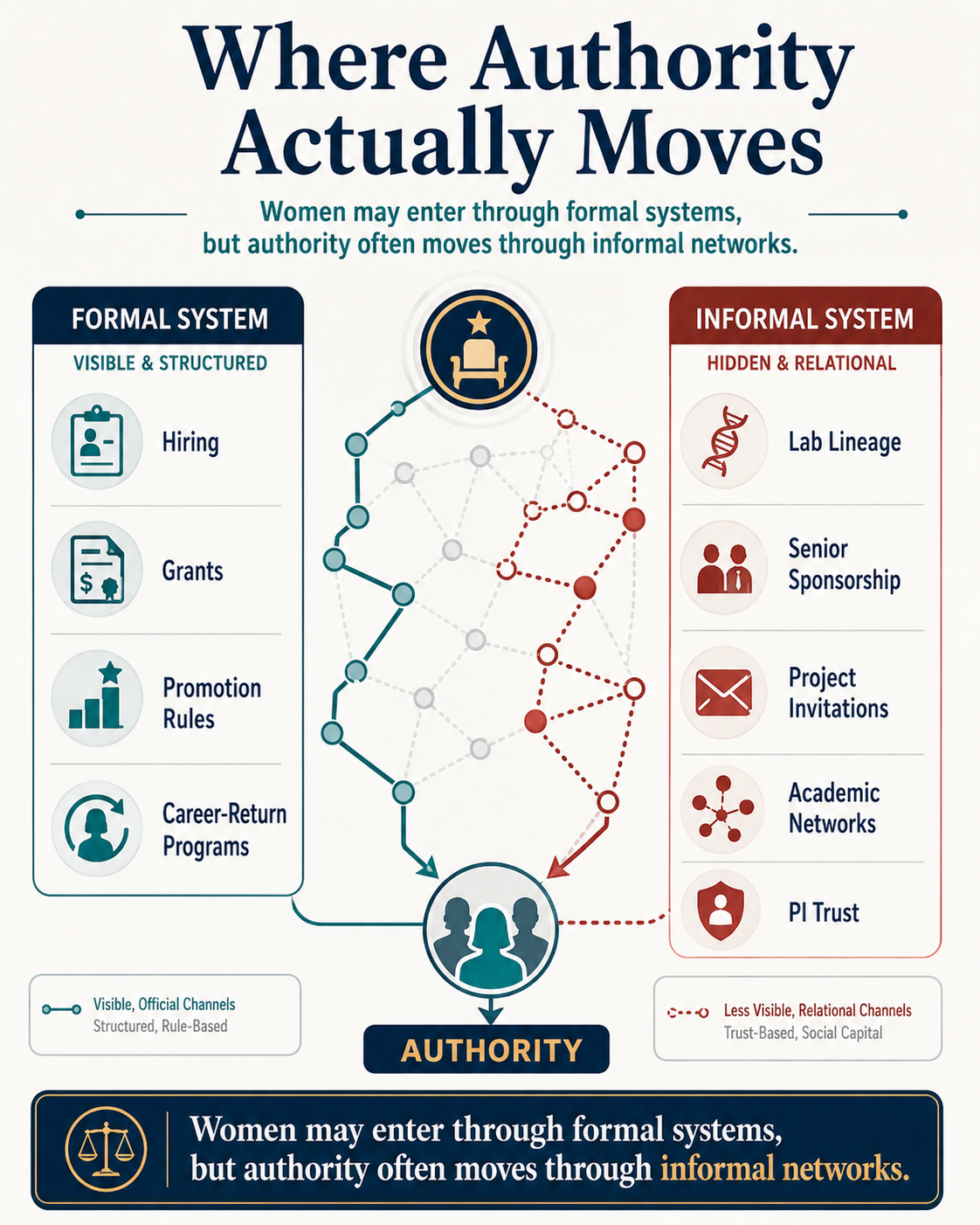
Authority in Korean STEM does not move only through formal titles.
Labs operate through rules, but also through relationships. Who joins a project? Who becomes a co-author? Who gets introduced at a conference? Who receives the PI’s trust? Who is invited into the next grant team? These movements are not always visible in formal regulations.
This is where informal networks matter.
In Korean organizations, school ties, senior-junior relationships, lab lineage, academic networks, and private social channels can become routes for information and opportunity. They are not merely social habits. In some settings, they become internal circuits through which trust, reputation, and project access move.
If those circuits are male-centered, women may enter the formal system but remain delayed in the internal route to authority. Hiring may be formal, but authority can still move through recommendation, reputation, lab genealogy, and informal networks.
Apprenticeship-style hierarchy strengthens this problem. In a PI-centered lab, being recognized as an independent researcher is not only about output. It is also about being read as trusted, long-term, institutionally aligned, and already inside the network.
This is why the leaky pipeline is not only about women leaving.
It is also about women entering the inner circuit of authority too late.
Foreign Female Arbitrage: Freedom and Isolation
Foreign women researchers occupy a distinct position inside Korean STEM.
They are not in the same position as Korean women researchers. They are also not in the same position as foreign men. Gender, language, nationality, visa status, and lab hierarchy overlap in their case. That overlap creates risk, but it can also create strategic leverage.
First, there is freedom.
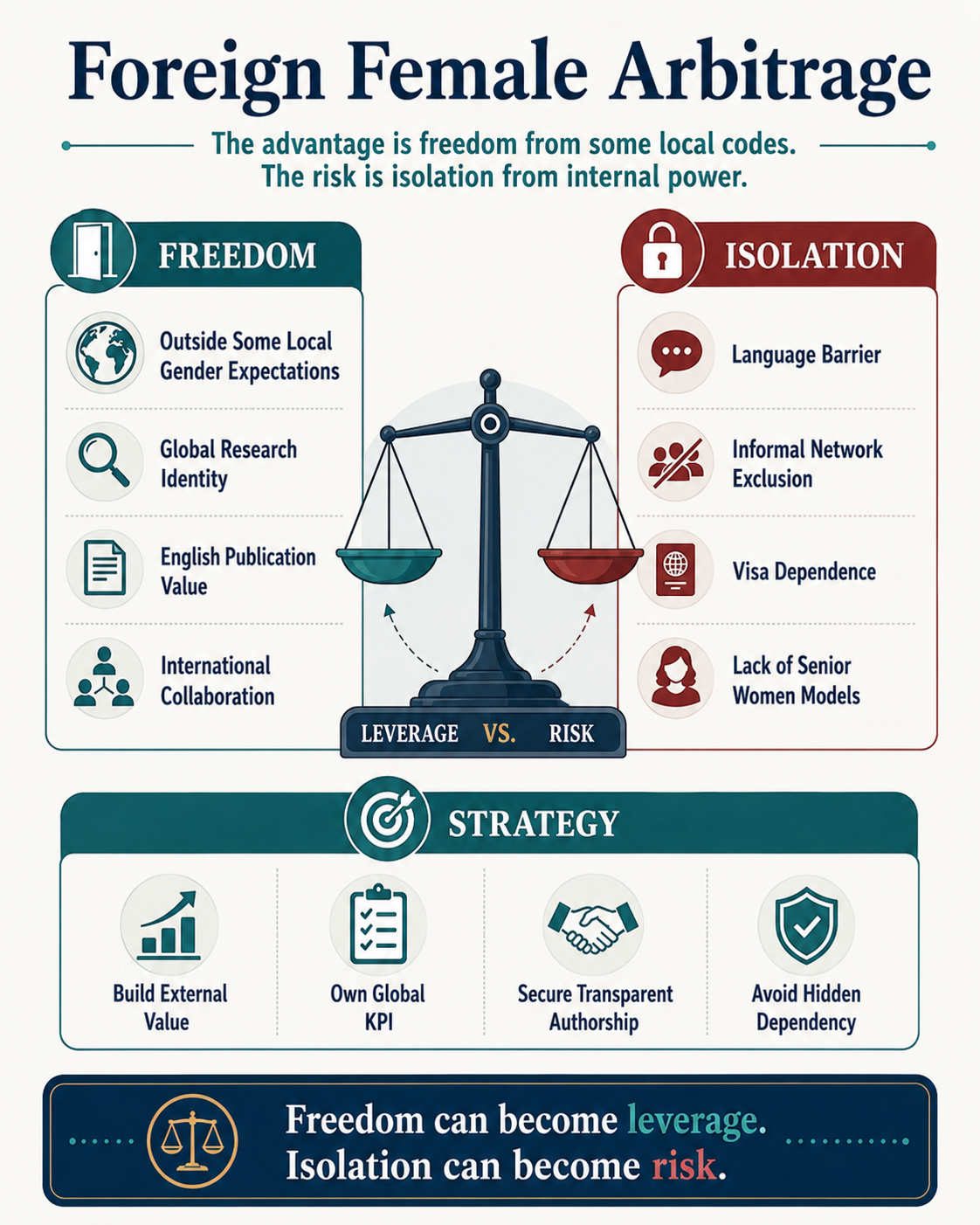
Foreign women may stand at some distance from local gender expectations that apply more directly to Korean women. Expectations around marriage, childbirth, family care, daughter-in-law roles, or a compliant feminine image may not attach to them in the same way. In some labs, a foreign woman may be read less through local family-gender codes and more as an independent researcher who brings English papers, international collaboration, and global project value.
That distance can become protection.
But there is also isolation.
When information and authority move through Korean-language informal networks, foreign women can face both language barriers and gender barriers. They may be outside dinners, senior-junior circles, academic lineages, and the PI’s older trusted network. Visa and contract dependence can make that position more vulnerable.
A Korean woman researcher may face gender barriers inside the local network.
A foreign woman researcher may face gender barriers from outside the local network.
The strategy is therefore not to force entry into a closed internal circle. It is to build bargaining power through external value: English-language publication output, international collaboration, global grant links, conference networks, data access, or specialized technical skills that the lab cannot easily replace.
When a Korean lab reads a foreign woman researcher as a source of global output rather than only as lab labor, her position changes.
Freedom can become leverage.
Isolation can become risk.
Decision Note: Korea Is Conditionally Attractive
Korea is not automatically hostile to foreign women researchers.
It is not automatically favorable either.
It is conditionally attractive.
The advantages are real. Korea has research funding, strategic fields, fast industry links, and strong policy concentration in areas such as AI, semiconductors, biotechnology, and batteries. Some universities and labs need international output, English publications, and foreign collaboration. In those settings, a foreign woman researcher can become an external asset the organization needs.
But the risks are also real. A lab can have many women students but no women PIs. It can host foreign researchers but have no long-term foreign women cases. It can have funding but unclear authorship rules. It can welcome international talent while letting information move through informal Korean-language channels.
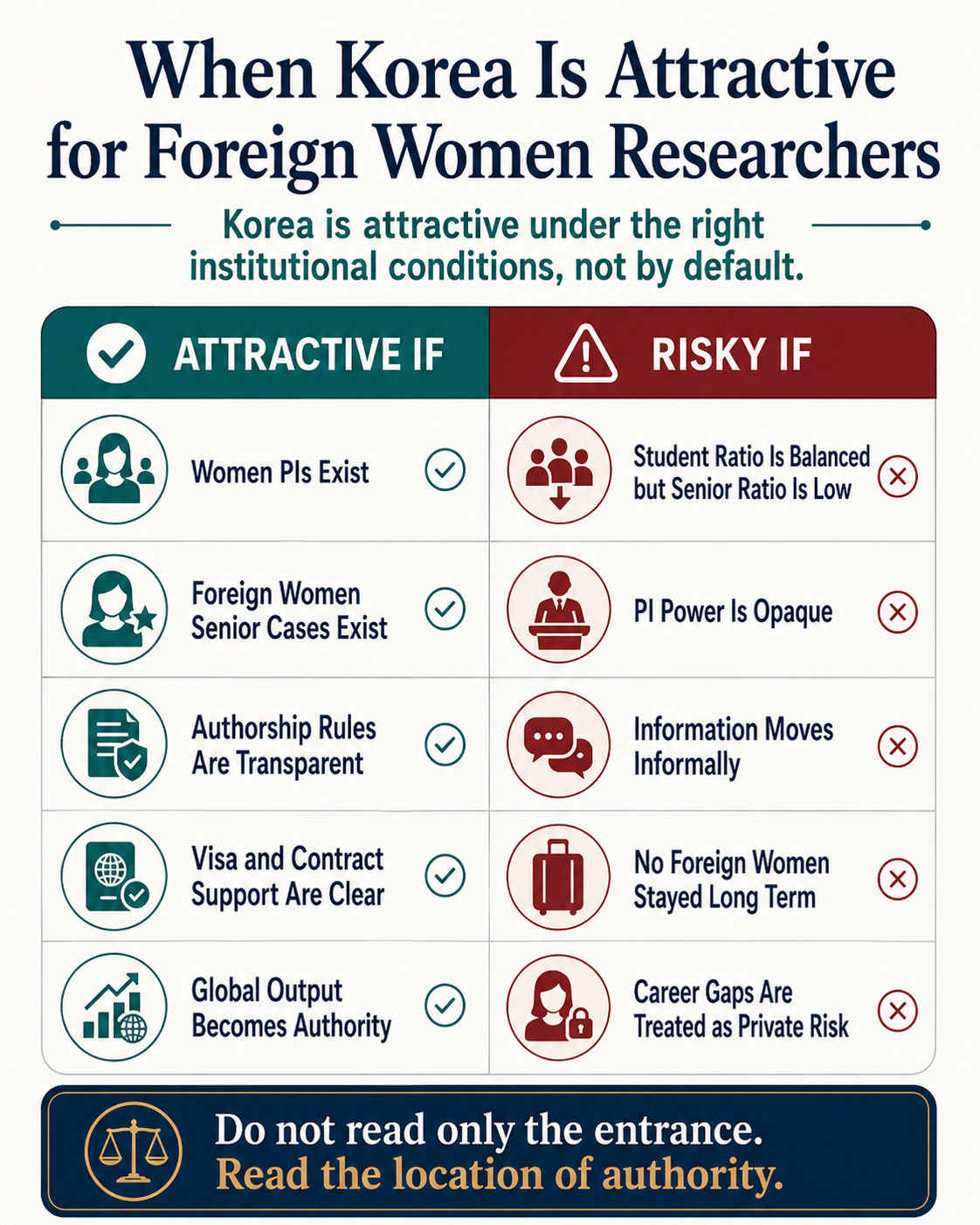
The attractive conditions are concrete.
Look for women PIs. Look for women in leadership. Look for foreign women postdocs or professors who stayed long enough to become senior precedents. Look for transparent authorship rules, clear project roles, visa support, contract clarity, and a lab culture where global output becomes actual authority.
The key test is simple. Do not ask only how many women enter. Ask how far women rise. Do not ask only whether foreigners are accepted. Ask what authority foreigners gain. Do not ask only whether a policy exists. Ask whether it has produced a real career path.
If those conditions exist, Korea can be attractive.
Without them, it may be a system with an open entrance and a narrow top.
Cross-read
Ep.12 — Korea Can Bring Researchers Back. Can It Make Them Stay?
Ep.13 — Women in Korean STEM: Where the Pipeline Leaks
Ep.14 — Foreign Researchers in Korean Labs