
The Money Behind Public Labs
Public labs are not free infrastructure. The route a company uses determines which costs it pays, when it pays them, and what it does not need to own.
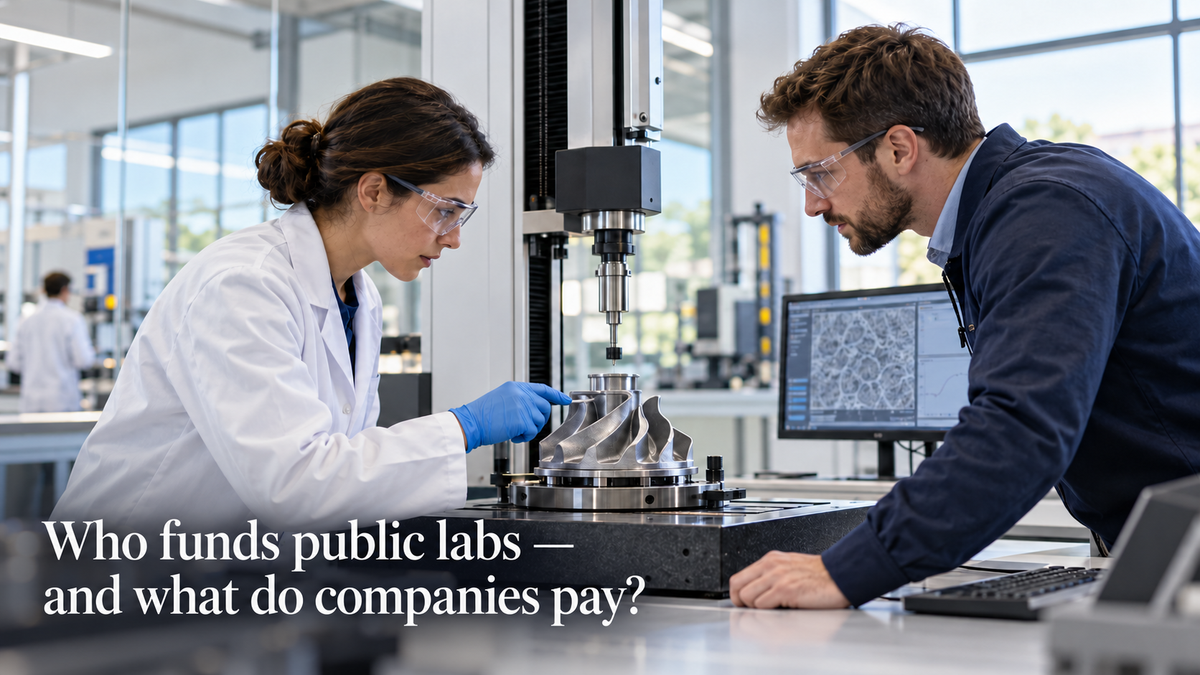
Who funds public labs — and what do companies pay?
“Public labs do not remove a company's costs. They change what kind of cost it is, when it falls, and who bears it.”
— EPISODE KEYSTONE
Why This Matters
In both Korea and Germany, companies perform most of the R&D. Yet both countries maintain public research institutes. A public lab does not make researchers' time or equipment free: someone pays the salaries, buys and maintains the equipment, and runs the pilot facilities.
So this episode asks two questions. Who keeps a public lab running? And when a company uses it, who pays?
01. Companies Perform Most of the Research
- Korea, 2024: companies performed 81.4% of R&D; public research institutes 10.1%; universities 8.4%.
- Germany, 2024: companies 67.5%; universities 17.6%; non-university research institutions 14.9% (K-Welle's calculation from Destatis figures).
Public labs are a minority of R&D spending. But they hold what no single company can easily keep: specialist equipment and staff, testing and pilot infrastructure, and research that starts before a market exists.
02. The Funding Formula
- Fraunhofer, 2025: externally earned income accounted for 71.1% of the operating budget. Separately, industry revenue accounted for 31.0% and federal and state public projects for 30.1% of project funding.
- Korea's NST institutes, 2025: 37.3% government contributions and 62.7% self-generated income — which includes government-commissioned projects and is not broken down further.
These percentages do not share the same accounting base, and NST's self-generated income is not equivalent to Fraunhofer's external project funding. They cannot be used to rank which system is “closer to the market.” What they do show is how each system is designed to secure funding beyond its base contribution.
03. The Formula Shapes Behaviour
In editorial shorthand, Fraunhofer's funding formula pushes institutes to find demand outside — from companies, governments or the EU. Korea's Project-Based System (PBS), introduced in 1996, was closer to: “win projects.” That does not mean Germany follows companies and Korea follows government. The difference is which way of raising money pushed behaviour more strongly.
Korea's formula is now changing. Under the Post-PBS plan approved in September 2026, institutes are to set core missions and reward results rather than contract volume. How this will change behaviour in the labs is still unfolding.
THE QUESTION IS NOT ONLY
How much does the government give a research institute?
IT IS ALSO
Which research capabilities stay in public hands — and under what cost structure can companies access them?
Five Doors, Five Cost Routes
Even at the same institute, what a company pays depends on which door it walks through. K-Welle groups those routes into five editorial categories:
- Contract research — buying research time instead of owning the capability
- Publicly funded joint R&D — sharing still-uncertain development costs with government
- Infrastructure use — turning the cost of owning equipment into the cost of using it
- Joint development — each side contributing something different
- Technology transfer — a separate price for the right to use intellectual property
Continue the Full Analysis
The full article follows these five routes using Fraunhofer and KITECH as reference points. It then uses a hypothetical €5 million pilot facility to show how the size and timing of a company's cash needs change depending on the route it chooses — and which costs remain.
Sources and reporting notes are in the full analysis.
FLOW POSITION: Source · Entry · NEXT: Ep.3 The Place of Subsidy — Who Takes the First Investment Risk?