Subsidy: Where It Fits
Before a subsidy reaches a company, someone has to decide what the support is meant to change. This episode follows that decision from Infineon Dresden to Korea’s different routes for industrial investment support.

Who takes the first investment risk?
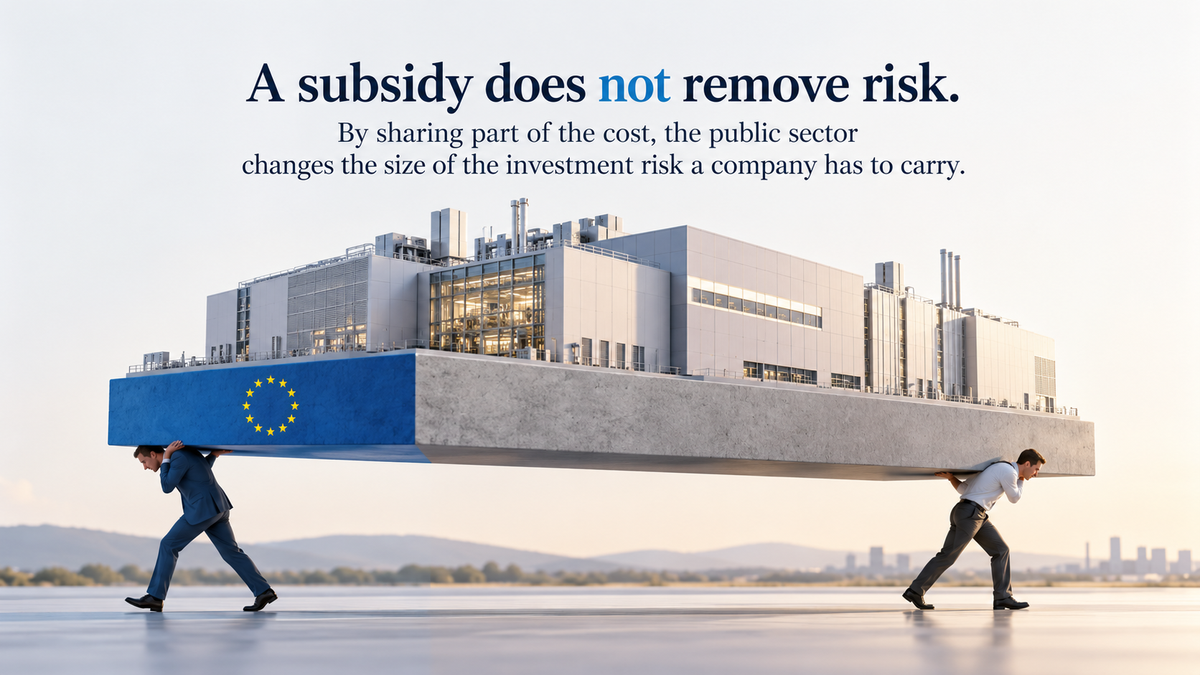
“A subsidy does not remove risk. By sharing part of the cost, the public sector changes the size of the investment risk a company has to carry.”
— EPISODE KEYSTONE
Why This Matters
A factory investment can involve both private and public money, but they do not bear the same risks. A government grant does not transfer the risks of demand, revenue, production and operation to the government.
So before any money arrives, two questions come first. How would the company's decision change without support? And after support, which costs and risks still remain with the company? The place of a subsidy lies between them.
The Company Moved First
- February 2023: Infineon announced a €5 billion investment in Dresden, conditional on EU State aid approval and Germany's final grant procedure. It had applied for about €1 billion in public support.
- Early start: Germany's Federal Ministry for Economic Affairs and Climate Action (BMWK) allowed the project to begin before the State aid review was completed. Construction started in 2023; final approval came later.
- July 2026: the fab opened. The risks of building, running it and finding demand stayed with the company throughout.
What Does a Subsidy Have to Change?
When a government considers support for a specific investment, the questions are broader than one company:
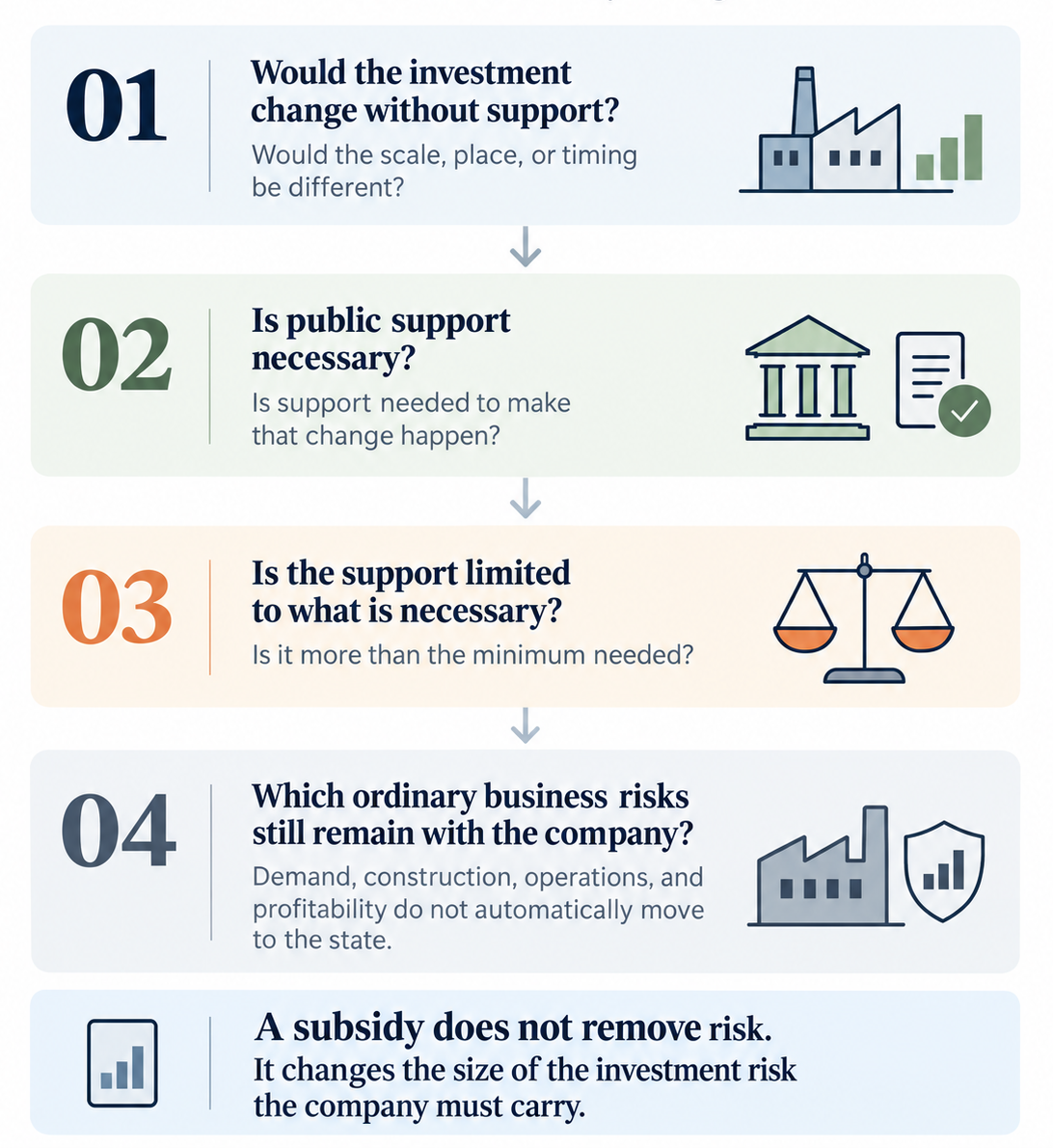
A grant for an investment that would have happened anyway does not change the investment decision. A grant that is needed for the investment to change does. These questions reflect the logic of EU State aid assessment, although the exact legal tests vary by scheme.
Infineon: The Funding Gap
In February 2025, the European Commission approved a German State aid measure providing Infineon with a direct grant of up to €920 million. The key counterfactual finding was that “the beneficiary would not carry out this investment in Europe without public support”.
The aid was “limited to the minimum necessary based on a proven funding gap”. It was not set as a fixed share of the investment; it was limited by the funding gap recognised as necessary to make the investment take place in Europe. The Commission linked the grant to an investment “amounting to €3.5 billion”, while the company put its total investment at €5 billion. The published summary does not explain the difference.
THE QUESTION IS NOT ONLY
How much does the government give?
IT IS ALSO
What would be different without support — and which risks remain with the company even after it?
Continue the Full Analysis
The full article follows what came with the money — the conditions Infineon accepted, including an agreement to share with Germany potential additional profits going beyond current expectations. It then turns to Korea, which addresses the same investment problem through different instruments: tax credits, cluster infrastructure and, for particular categories of investment, grant schemes without a plant-by-plant funding-gap calculation. And it asks which risks remained with the company after the grant.
Sources and reporting notes are in the full analysis.
FLOW POSITION: Source · Vehicle
NEXT: Ep.4 The Fund's Choice — Who Picks the Companies?