
The Technology Clock
A long technology journey does not always need more capital. Sometimes the first step is to reduce how much cash is needed.

A decade of technology is not one long wait. It is a structure for sharing time and risk.
Why this matters
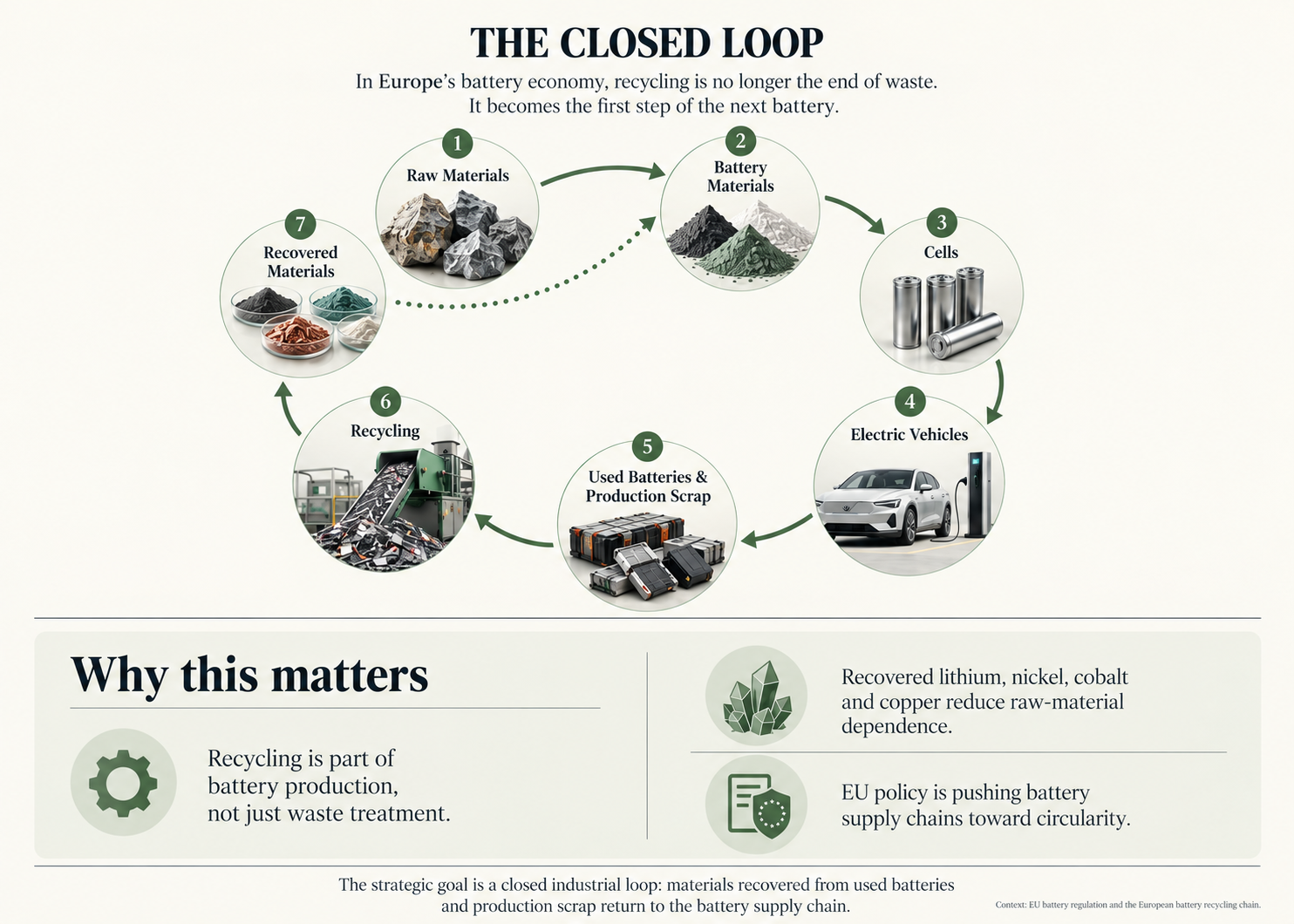
Battery recycling is no longer only about disposing of waste. In Europe, regulation is turning spent batteries into part of a closed industrial loop: materials are recovered, processed and expected to return to battery production.
That changes the question around recycling technology. The issue is no longer simply whether a process works. It is whether that process can survive the long journey from research to pilot, permit and industrial use — and who carries the cost and risk along the way.
1 · Europe is building a closed loop
The EU Battery Regulation is pushing recycling beyond waste treatment. Recovery targets rise over time, and from 2031 certain industrial and EV batteries must contain minimum shares of recycled materials.
The policy logic is clear: recover more lithium, nickel, cobalt and copper inside Europe, and bring those materials back into production.
The battery therefore does not end at disposal. It enters another industrial cycle.
2 · Korean companies are already inside that loop
Korean battery companies already operate major production sites in Europe. LG Energy Solution produces batteries in Poland, while Samsung SDI operates in Hungary.
Recycling infrastructure is following.
POSCO's Polish recycling plant processes battery scrap and spent batteries into black mass, which is then sent to Korea for further metal recovery.
The question for Korean–German cooperation is therefore not simply who has the better technology.
It is:
Where can capabilities on both sides connect along the chain?
Korean capabilities in materials and recycling may connect with German capabilities in pre-treatment and public research infrastructure.
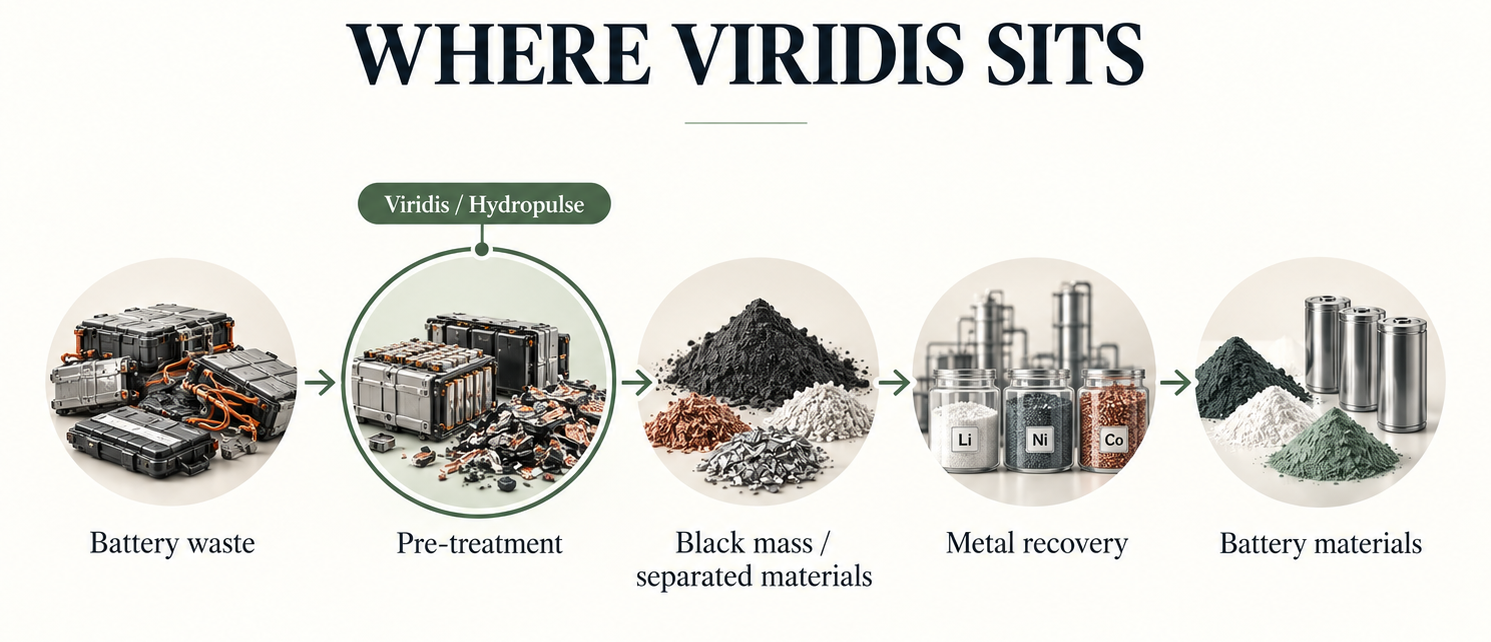
3 · Viridis sits upstream in the recycling chain
Viridis Recycling grew out of research at Fraunhofer IWKS.
Its Hydropulse process uses shock waves in water to break battery cells apart, aiming to reduce damage compared with conventional mechanical shredding.
But industrialisation asks questions that laboratory results cannot answer alone:
- Can the result be repeated at much larger scale?
- How much energy, chemicals and water are required?
- What does processing one tonne actually cost?
- Will customers accept the recovered material?
Those answers determine whether investment, licensing or industrial cooperation can move forward.
4 · Technology has its own clock
Viridis did not move directly from research to market.
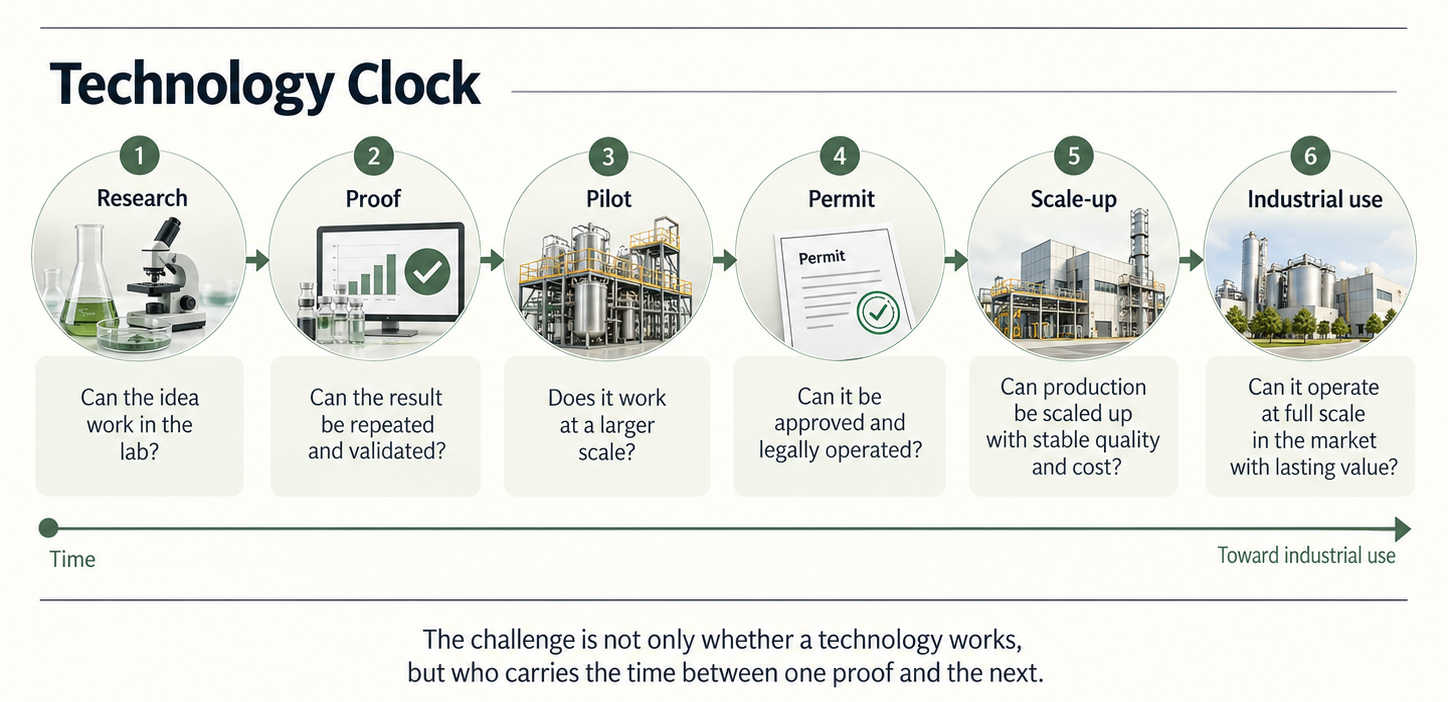
The path described by IWKS includes research, technology transfer, company formation, process validation, pilot infrastructure, environmental permitting and scale-up.
At each point, the question changes.
Does it work?
Can the result be repeated?
Can the facility legally operate?
Can this material enter a real production process?
Can volume and revenue sustain the operation?
The uncertainty does not simply shrink. It changes form.
And when the uncertainty changes, the institutions and capital able to carry it may change too.
The question behind the clock
A technology may need years to move from laboratory proof to industrial operation.
Why keep backing a technology that takes this long to mature?
Who carries the time until the next proof?
Continue the full analysis
The full article goes one step further.
It compares the Technology Clock with the Money Clock and asks which resources can carry each stretch of a technology's time — including one overlooked option: reducing how much cash is needed in the first place.