
Who Can Wait Ten Years?
A decade of technology is not one long wait. It is a structure for sharing time and risk.
THREE FLOWS IN THIS EPISODE
The flow of materials: how a battery becomes a battery again. The flow of technology: from research to a permit. The flow of money: who carries each stretch of that time. The question arises where the three meet.
On 14 July 2026, Fraunhofer IWKS in Hanau, near Frankfurt, issued a short press release. A company that started at the institute had received a permit to process lithium-ion batteries and battery waste on an industrial scale. The company is called Viridis Recycling.
Readers of K-Institute will remember IWKS. It is the institute where Dr. Songhak Yoon explained black mass and battery recycling, and how hard — and how important — the pilot stage is for a lab technology on its way to industry. Viridis is on that same road.
According to IWKS, the company grew out of recycling technology the institute had developed over several years. The technology was transferred to a separate company, the Hydropulse process was validated, and a pilot-scale recycling plant was built. Then the Hanau site received a permit under Germany's Federal Immission Control Act (Bundes-Immissionsschutzgesetz, BImSchG). The permit does not certify how well the technology performs. It is the legal basis for treating battery waste in an industrial facility. The next steps are set out too: a first pilot line in the Stuttgart region, due to start in the first quarter of 2027, with capacity raised in stages. The road is not finished.
But first: why keep backing a technology that takes this long to mature? And — the question the research team in our opening met when its grant ran out — who carries the time until the next proof?
Spent Batteries Are No Longer the End of the Line
In Europe, battery recycling is changing its meaning. The old question was how to dispose of used batteries safely. The new one is different: how much of the lithium, nickel, cobalt and copper inside them can be recovered — and put back into the next battery?
The EU Battery Regulation (Regulation (EU) 2023/1542) turned that shift into numbers. Targets for recycling efficiency and for the recovery of individual materials from lithium-based waste batteries rise in stages until 2031. From 2031, industrial and electric-vehicle batteries above a certain size must contain a minimum share of recycled material in their active materials. Among its aims, the regulation lists reducing dependence on raw materials from third countries.
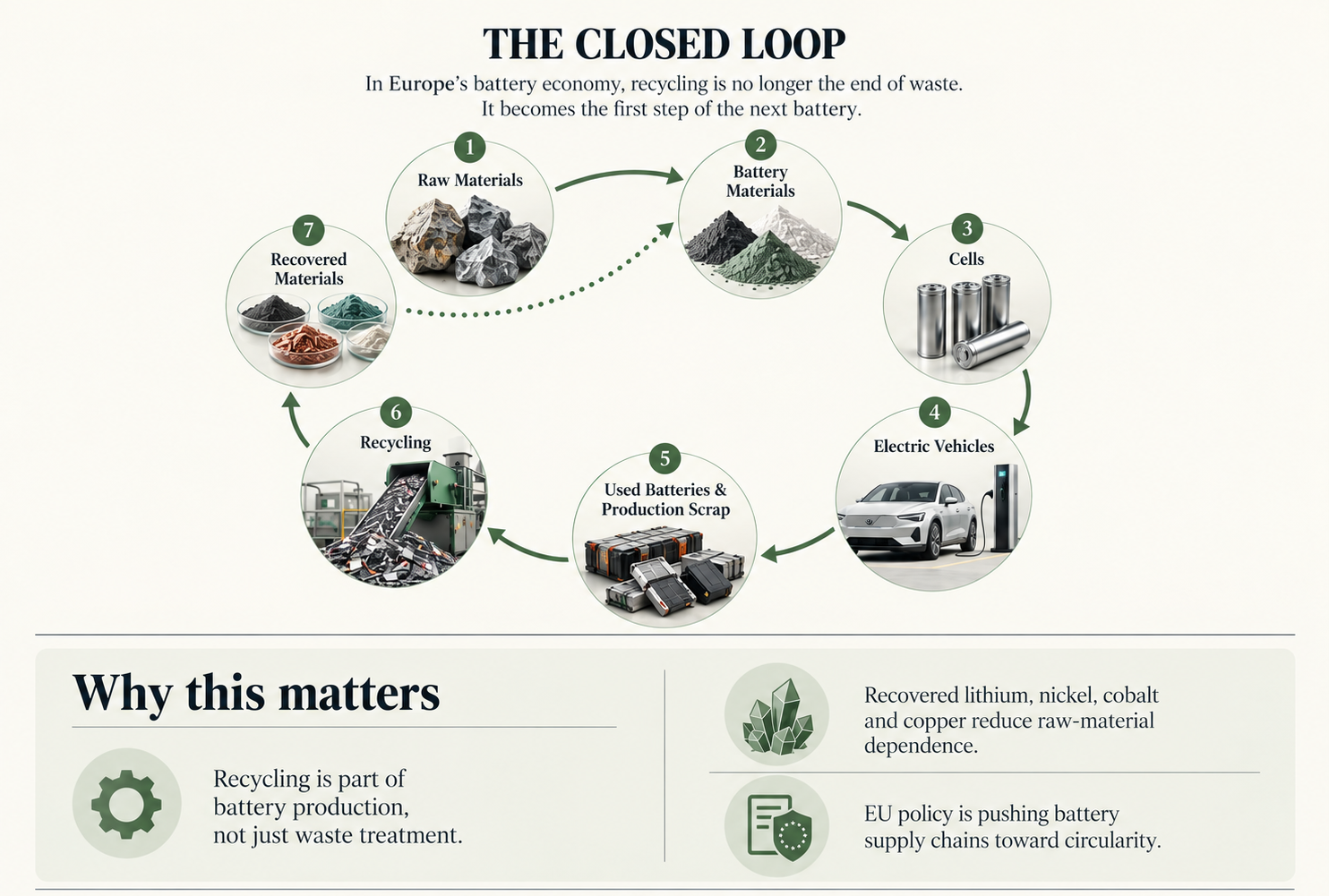
Recycling has become one step in a closed loop that runs from waste back to battery production: raw materials → battery materials → cells → electric vehicles → spent batteries and production scrap → recycling → recovered materials → battery materials again. That loop is what Europe is building.
How Korean Batteries End Up in Europe
Korea is not far from this loop. LG Energy Solution runs a battery plant in Wrocław, Poland, and Samsung SDI one in Göd, Hungary; both supply European carmakers. Whether a battery is made in Korea, Poland or Hungary, it enters Europe's regulations and collection system the moment it reaches the EU market. Once used, it joins Europe's waste stream — and a growing share of its materials must be recovered inside Europe and returned to industry.
Korean companies are therefore already building recycling chains inside Europe. In August 2022, POSCO completed PLSC, a recycling plant in Brzeg Dolny, Poland. According to POSCO, the plant collects and dismantles battery production scrap and spent batteries generated in Europe to produce 7,000 tonnes of black mass a year. The black mass is shipped to POSCO HY Clean Metal in Korea, which extracts lithium, nickel, cobalt and manganese. The technology came from SungEel HiTech.
Something has changed here. Korean recycling technology has moved to Europe, because recycling plants need to sit close to the markets where batteries are made, used and discarded. The question for Korean–German battery cooperation, then, is less whose technology is ahead. It is where Korean capabilities in materials and recycling might connect with German capabilities in pre-treatment and public research infrastructure.
Where Does Viridis Sit in That Chain?
One common battery-recycling route runs: discharge and dismantling → shredding → black mass → hydrometallurgy → recovery of lithium, nickel and cobalt. POSCO's Polish plant produces black mass; the metal recovery that follows is done by its joint venture in Korea.
Viridis's Hydropulse process targets a step further upstream. According to IWKS, it breaks battery cells apart with shock waves generated in water, which damages the materials less than mechanical shredding. The long-term aim is better recovery of key raw materials such as lithium, nickel, cobalt and graphite.
At the industrial stage, recovery rates are only part of the picture. How much lighter do the downstream steps become? How much energy, chemicals and waste water are saved? How many euros does it cost to process one tonne? Public sources do not answer these questions. The answers sit with the company running the plant, the institute validating it, and the customers who would take the recovered materials. Those answers can shape whether investment, licensing or joint ventures move forward.
In July 2026, at a forum held by the National Research Council of Science & Technology (NST) and Fraunhofer, the Korea Institute of Industrial Technology (KITECH) and IWKS signed a memorandum of understanding (MOU). It opened a door to cooperation. Which process will be validated by whom, and who will pay for it, is still to be settled.
The Technology Clock
In the lab, a technology can work. Industry asks different questions. Does a process that works at 10 kilograms give the same result at 10 tonnes? Do purity and recovery rates hold over months of continuous operation? Are results stable when the type of battery coming in changes? Then come the customer's questions: can the recovered material go into a real production process, and is its quality the same every time?
Laid out as IWKS has described it, the road runs: research → spin-off and technology transfer → registration as a certified waste-management company → process validation → pilot plant → permit → scale-up. The press release says only that the research took “several years”, and it does not give the year the company was founded. So this article gives no years either. IWKS's account makes the sequence of these milestones visible, even though it does not provide dates for each one. The permit was not the end: IWKS itself called it “a precondition for scale-up”. It explained that Stuttgart was chosen to make cooperation along the battery value chain easier and to speed up industrialisation.
Follow Viridis's path, and what has to be confirmed changes at each step. In research, the question was whether the process works. At pilot scale, it becomes whether the same result can be repeated. The permit stage requires meeting the conditions to run an industrial facility. After that, the questions are whether the recovered material can go into a customer's process, and — at commercial scale — whether volumes and revenue can sustain operations. Our reading is this: as time stretches, it is not the same risk that continues. The kind of uncertainty left over changes from one stage to the next — and so do the parties and the money that can carry that time.
K-Institute called this road Research → Proof → Pilot → Adoption. Battery recycling adds another layer in between: industrial facilities, permits and operating conditions. Spent batteries must be managed for fire and hazardous substances, waste water and emissions, storage and transport. That is why the technology's time stretches. This is the second flow: the flow of technology.
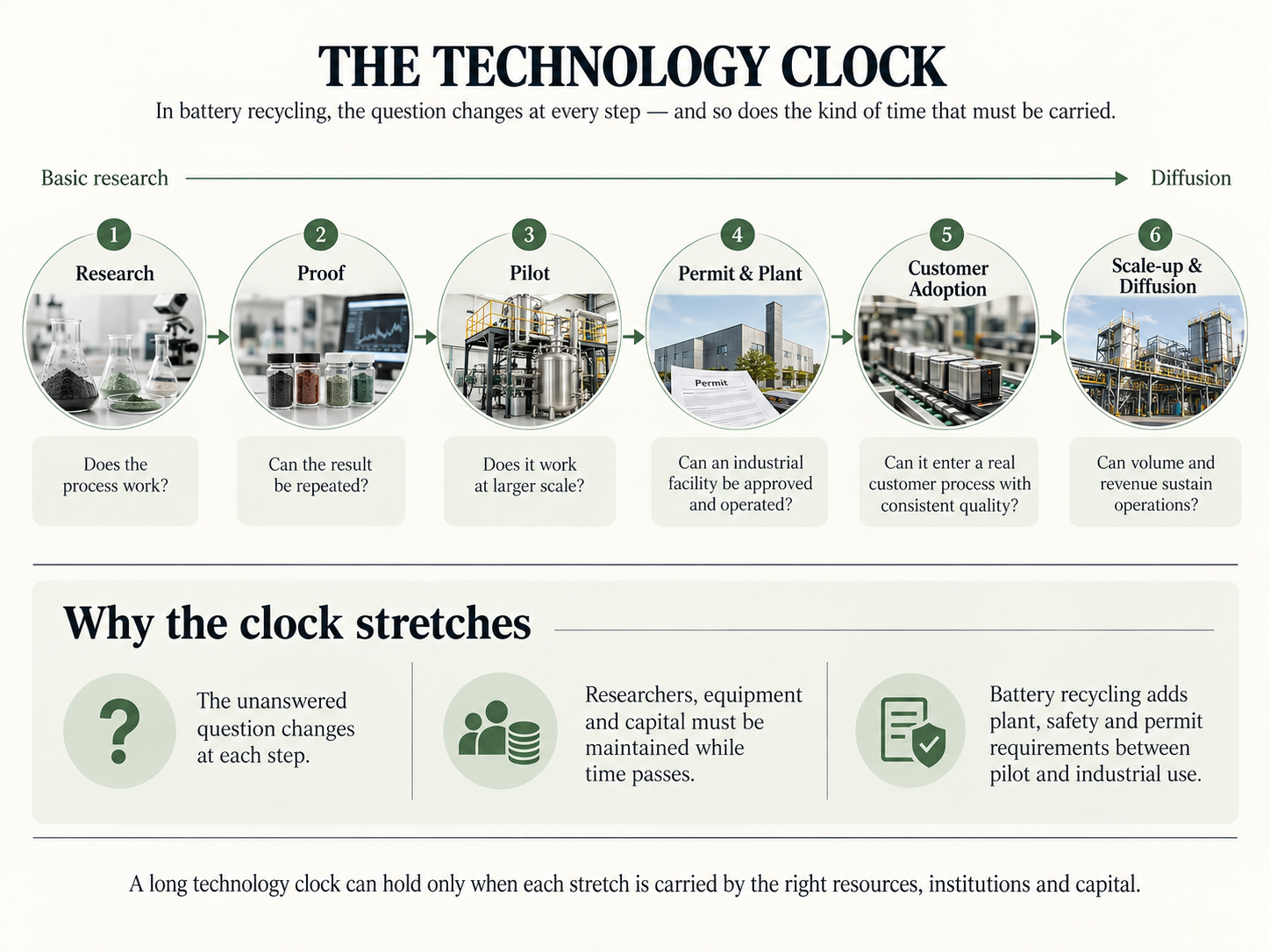
Technology's time does not only pile up on the calendar. Keeping researchers, running equipment and tying up capital all cost money while it passes. Aligning the technology clock with the money clock therefore comes down to one question: who bears that cost, and over which stretch?
A reader might ask here: how many years is this road? And what kind of money can walk it alongside the technology?
The Money Clock
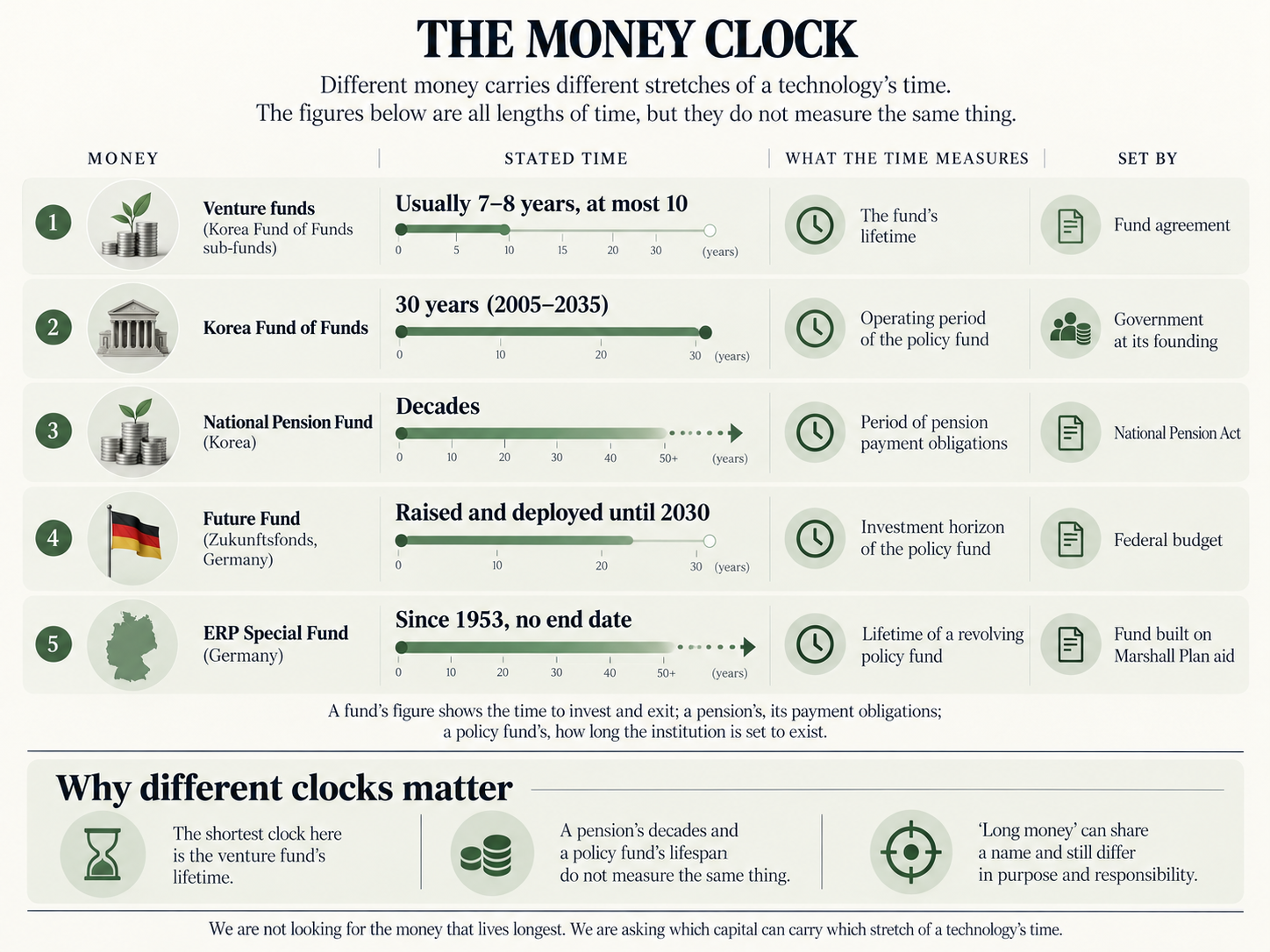
Money runs on several clocks at once. How long a fund lives, how long investors wait to be repaid, how long a policy fund exists, how long a pension scheme owes payments — these are different clocks. We are not looking for the money that lives longest. We set the clocks side by side to see which capital and resources can carry which stretch of a technology's time. Every figure below is a length of time, but they do not measure the same thing. A fund's figure shows the time to invest and exit; a pension's, its payment obligations; a policy fund's, how long the institution is set to exist.
Money | Stated time | What the time measures | Set by |
|---|---|---|---|
Venture funds (Korea Fund of Funds sub-funds) | Usually 7–8 years, at most 10 | The fund's lifetime | Fund agreement |
Korea Fund of Funds | 30 years (2005–2035) | Operating period of the policy fund | Government at its founding |
National Pension Fund (Korea) | Decades | Period of pension payment obligations | National Pension Act |
Future Fund (Zukunftsfonds, Germany) | Raised and deployed until 2030 | Investment horizon of the policy fund | Federal budget |
ERP Special Fund (Germany) | Since 1953, no end date | Lifetime of a revolving policy fund | Fund built on Marshall Plan aid |
None of these periods means anyone will wait that long for a single company. A pension looking decades ahead is not the same as waiting decades for one deep-tech firm.
In this table, the shortest clock is the venture fund's lifetime. According to press reports, sub-funds of Korea's Fund of Funds usually live seven to eight years, ten at most, and must invest and exit within that time. That is where the ten years in our title come from. Korea Venture Investment Corporation (KVIC), which manages the Fund of Funds, describes it not as money that holds a start-up for a long time, but as a structure that invests in sub-funds and “recycles recovered capital” back into the venture market.
The pension has the longest obligation in the table. Korea's National Pension Fund looks decades ahead, to when today's contributors will draw their pensions. Fourteen per cent of the fund is in alternative investments, which NPS Investment Management describes as an asset class that contributes stable long-term returns. But under the National Pension Act, the purpose of this money is not to wait for technology. It is to manage reserves for paying pensions.
Germany has a different kind of long money. Built on Marshall Plan aid, the ERP Special Fund has, since 1953, recovered its money and lent and invested it again in companies and investment markets. Germany's Federal Court of Audit says the fund's capital must be preserved. It is not an old budget but capital that keeps coming back. Money can be “long-term” for very different reasons, with very different responsibilities attached to it.
The Money in Viridis Is Not Visible
Who invested how much in Viridis, and how long they waited, cannot be confirmed from public sources. Nor can we separate how much Fraunhofer research funding and how much outside industry money went into developing Hydropulse at the earlier stage. The IWKS press release does not name investors.
So this article does not link any particular capital to Viridis's technology clock. It leaves the gap as it is. The route the technology took from research to pilot and permit is visible. Which money carried that time is not. The technology clock is public; the capital clock is not. That asymmetry is what this episode found.
Infrastructure Also Buys Time
Some things are visible. IWKS says Viridis continues to use the institute's research infrastructure and the pilot facilities in Hanau after the spin-off. Had the company needed to build a pilot plant on its own from scratch, it would have needed more capital. Access to a research institute's equipment reduces the money a company must raise itself. By reducing how much capital a company must raise itself, research infrastructure can extend the period the company can sustain development. What K-Institute Episode 4 called “infrastructure a company cannot build alone” reappears here as a question of the money clock. One way to find money is to need less cash.
Public sources show other responses too. One is to lengthen the fund clock: in December 2025, Korea's cabinet approved a bill allowing the lifetime of venture funds to be extended in ten-year steps. Another is to recycle the money that comes back — the structure of both the Fund of Funds and the ERP fund.
In general, several kinds of capital can overlap in a technology like this: research funding and facilities from public research institutes, location support from regional governments, founders' capital, bank loans or grants, and later scale-up capital from industrial companies or investors. They do not arrive in the same order. Each technology has different remaining risks and needs different resources, so the mix changes. Nor do they need to take part for the same reason. A research institute looks at technology transfer, a regional government at local industry, an industrial company at recycling capacity and secure raw materials, an investor at future cash flows. Which of these went into Viridis cannot be confirmed. But one thing is visible: different money, for different reasons, can share the same technology's time. This is the third flow: the flow of money.
Closing
Viridis's next steps are still open. Securing feedstock, customer approval and money for a commercial plant all remain. The direction of the market it is heading for is clear. The EU requires more raw materials to be recovered from spent batteries, and from 2031 it requires those materials to go back into new batteries. What the case helps illustrate is something broader: research funding, institute facilities, company capital, customers and follow-on capital can each carry different stretches of a technology's time.
The “ten years” look less like one investor's patience than a technology's time shared among several parties.
The same questions return to the research team in our opening episode. What must be proved next? Does that proof need cash, equipment or research time? And who has a reason to carry that stretch? If a Korean technology has to pass through similar stages in Europe, who carries the next stretch becomes the question. In our analysis, that role could fall to additional research funding — or to European institutes, customers and financiers.
A long technology clock can hold when money and infrastructure with a reason to carry each stretch follow one another.
A decade of technology is a structure for sharing time and risk.
The next episode turns to one part of that structure: the stretch public labs carry. In a country where business pays for most R&D, what does a public lab such as Fraunhofer IWKS take on?
FLOW POSITION: Source · Allocator · NEXT: Ep.2 In a Country Where Business Pays Most, What Do Public Labs Take On? → Source
About This Reporting
Statements about Viridis Recycling stay within the scope of Fraunhofer IWKS's press release of 14 July 2026. The company's founding year and sources of funding are not in that release, and K-Welle has not confirmed them separately. POSCO's Polish plant follows POSCO's 2022 announcement; the locations of Korean battery makers' European plants follow each company's public materials; EU targets follow Article 8 and Annex XII of Regulation (EU) 2023/1542. The memorandum of understanding between KITECH and IWKS is described only as far as the forum's official announcement states; whether it has been carried out has not been checked.
Setting the technology clock beside the money clock is an editorial arrangement; it does not mean that any particular fund invested in Viridis. The list of capital types in Section 07 is general and does not describe Viridis's actual funding. The purposes and time periods of each institution follow their disclosures and the relevant laws; the lifetime of sub-funds and the bill on fund extensions follow press reports. The “three flows” are an editorial framework by K-Welle, not an official classification.
The research team in the opening and closing is the hypothetical example from Ep.0; it does not describe any particular institution or company. The paragraph on stage-by-stage uncertainty in Section 04 and the sentences on Korean technology in the closing are the editors' interpretation drawn from Viridis's path, not statements made by public sources. This article does not constitute legal, tax, investment or contractual guidance.
Corrections: editor@k-welle.com
Sources
In addition to the material linked in the text, we consulted:
- K-Welle, K-Institute, Episode 4 (infrastructure a company cannot build alone), Episode 5 (the pilot as the price of belief), Episode 6 (Dr. Songhak Yoon, IWKS)
- Fraunhofer IWKS — Ausgründung Viridis Recycling erhält BImSchG-Genehmigung , 14 July 2026
- NPS Investment Management — operating principles (in Korean)
- Federal Agency for Civic Education (bpb) — ERP-Sondervermögen
- Federal Ministry for Economic Affairs — Investitionsoffensive für den Mittelstand , 30 July 2025
- Regulation (EU) 2023/1542 concerning batteries and waste batteries, Article 8 and Annex XII