
Who Pays, and Who Decides?
Who pays for the next stage of technology — and who decides where the money goes? This opening piece maps the institutions, funds and decisions between public budgets and industrial use.

A KRW 821 trillion budget — and the question of how money reaches technology
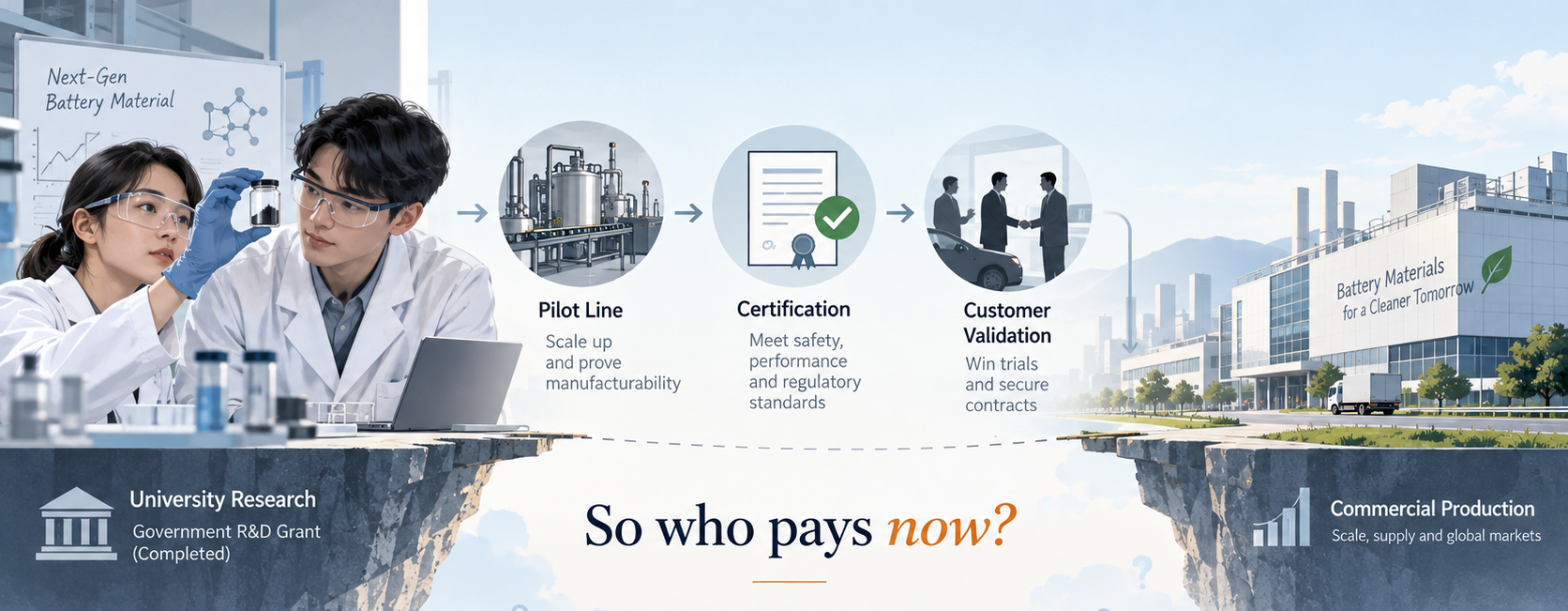
Imagine that a university lab in Korea has just produced a new battery material. Two doctoral students spent two years on it, and the experiment worked. That is where the research grant ended. The next test needs a pilot line, certification and validation by a customer. None of that is what a research grant is for.
So who pays now?
On 1 September 2026, the Korean cabinet approved the government's budget proposal for 2027. Total expenditure comes to KRW 820.9 trillion (about $590 billion), 12.8% more than this year. The government calls it the highest growth rate on record. It is still a proposal: the National Assembly must review it before it becomes final.
But a budget document does not say how that money reaches labs, start-ups and factories. Between the budget and industry sit institutions and funds, banks and investors — and the people who decide what moves next. K-Flow follows the route through that middle ground.
News that "the government is investing" arrives every day. What lies between the number in that headline and the bench in the lab?
Where Did K-Institute Stop?
K-Institute, K-Welle's previous series, followed Korea's public research institutes. It traced how technology moves from public research toward industrial use. Along that route, the story kept stopping in front of the same kind of question.
In Episode 11 of K-Institute, three Korean researchers at Fraunhofer answered the same questions in writing. Asked where cooperation most often stops, they pointed to three different places: the joint project, the step into the pilot, and the pilot itself.
Who Actually Pays for Korean Technology?
Official statistics are the starting point. Roughly one-fifth of Korea's spending on research and development (R&D) is funded by the government, while business accounts for most of the remainder — a pattern shared by several large economies.
In 2024 Korea spent KRW 131 trillion (about $95 billion) on R&D, more than 5% of its GDP. Japan, China, Taiwan and the United States show a similar business share; in Germany and the wider EU, the state's share is closer to one-third. Sources: US National Science Foundation (NSF), Bundesbericht Forschung und Innovation (BuFI), Eurostat. Reference years and classifications differ, so the comparison shows approximate positions only.
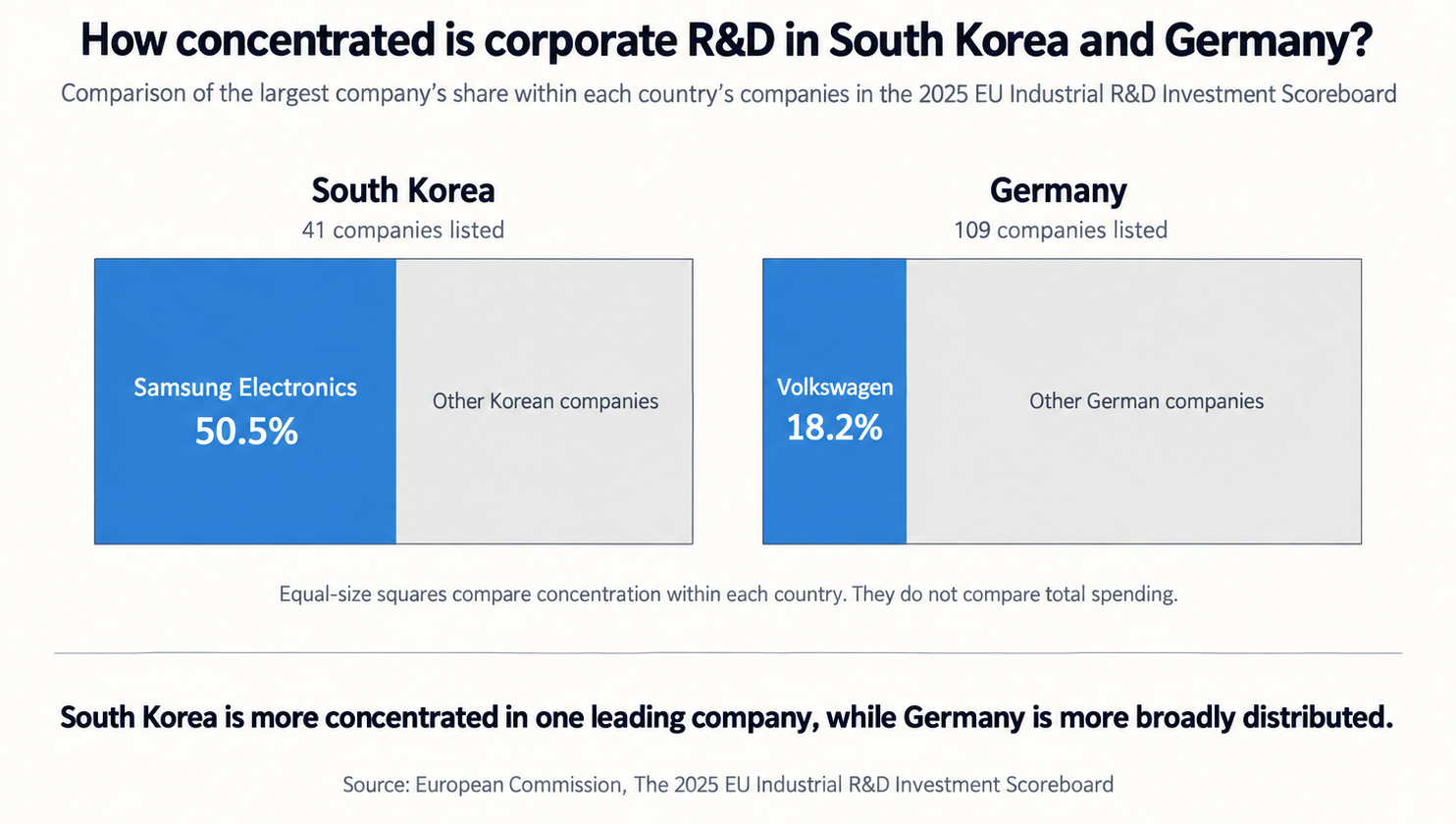
The difference lies in how that business money is concentrated. Of the 41 Korean companies on the European Commission's 2025 EU Industrial R&D Investment Scoreboard, one — Samsung Electronics — accounts for half of their combined R&D spending. Among the 109 German companies listed, the largest, Volkswagen, accounts for less than one-fifth.
None of this means the government's role is small. R&D that companies pay for with the help of tax credits is not counted as government funding in these statistics (OECD indicator notes). Beyond direct spending, the government also acts through tax relief, guarantees, policy loans and stakes in funds.
Each of these tools works differently from a grant. A tax credit changes the price of a company's own R&D. A guarantee changes whose credit a lender looks at. A stake in a fund sets the terms under which private managers choose. The useful question is where public money enters the flow, and what it changes there.
Treat government and business as two separate purses, and it becomes hard to explain how money actually reaches technology. K-Flow follows how public and private money interact on their way to technology. At each stage, whose money is it — and who decides where it goes?
Following the Flow
K-Flow divides the route money travels into six positions. Each position comes with one question a reader can ask.
| Stage | Position | The question to ask | Typical actors and mechanisms |
|---|---|---|---|
| Before money reaches technology | 1 SOURCE | Is it the state's coffers, a company's coffers, or retirees' pensions? | National budget, policy funds, pension funds, corporate funds, bank funds, private capital |
| 2 ALLOCATOR | Who sets the rules on what this money may be spent on? | Ministries, public financial institutions, public funds, institutional investors, corporate headquarters | |
| 3 VEHICLE | Is it money you never repay, money you must repay, or money you receive in exchange for a share of your company? | Grants, loans, guarantees, equity investment, fund investment | |
| Where money meets technology | 4 ENTRY | Through which door does my technology enter — and who notices it there? | Open calls, accelerators, demo days, university technology-transfer offices, corporate technology-scouting teams, chambers of commerce and trade-promotion agencies, introductions |
| 5 SELECTION | Who says yes, and on what basis? | Technology validation, due diligence, investment committees, customer validation | |
| After they meet | 6 SCALE-UP | Once the answer is yes, what else has to be cleared? | Pilot production, mass production, first customer, regulation, follow-on capital, market entry |
The third position — the vehicle — is where headlines most often collapse very different kinds of money into a single word: "investment." In practice, that word covers five distinct kinds of money.
| Kind of money | In plain words |
|---|---|
| Grant | Money you do not repay. It is typically restricted to specified purposes and reporting requirements. |
| Loan | Money you must repay. If the project fails, the debt remains. |
| Guarantee | No money is handed over upfront. The guarantor promises to repay part or all of your loan if you cannot. |
| Equity investment | Money you do not repay like a loan; in return, the investor takes an ownership stake in your company. |
| Fund investment | The capital is delegated to a fund manager, who decides which companies to invest in. |
The word may be the same. The risk is not.
The 2027 budget proposal allocates KRW 1.3 trillion (about $900 million) to the Korea Fund of Funds — a public vehicle that puts money into venture capital funds. Place that single budget line on the six positions:
The path of the money and the path of the company meet at the fourth position.
These six positions are an editorial framework for practical understanding — not an official classification of any government or institution. Nor does real money always move in this order. It is a map for asking, whenever a new case comes up, which position we are looking at. The six positions are a way to keep those two questions visible as money changes form.
Same Headline, Three Different Flows
'The state is investing.' Three countries produced stories under that same sentence. Let us place each of them on the six positions.
In August 2025 the US government took a 9.9% stake in the chipmaker Intel. The Wall Street Journal described it as a march toward “state capitalism with American characteristics” .
Writing about the wider shift that December, the economist Dani Rodrik argued that “the post-neoliberal consensus is here” .
A Korean daily called it “a scar left on the free market” .
Set the names aside for a moment. What actually moved?
United States. According to Intel's announcement, most of the roughly $8.9 billion was CHIPS Act grants promised but not yet paid; they became a 9.9% equity stake in Intel. The government holds it as a passive shareholder, with no board seat.
Korea. According to the Financial Services Commission (FSC), the KRW 150 trillion (about $110 billion) National Growth Fund is half private money and half a public fund raised through government-guaranteed bonds — a guarantee, not a budget outlay. A nine-member committee of private-sector experts decides only on the public half.
Germany. According to the Federal Ministry of Finance, the federal government puts up about €30 billion in public money and guarantees for the Deutschlandfonds, aiming to draw in more than four times as much. The fund is an umbrella for several programmes. KfW, Germany's public promotional bank, coordinates it and invests on the government's behalf.
| Country | What the state put up | Who sets the direction |
|---|---|---|
| United States | Equity, converted from promised grants | Intel's management; the state is a passive shareholder |
| Korea | A guarantee on the public half; the other half is private money | A nine-member expert committee for the public half; private investors for their own money |
| Germany | Public money and guarantees | The federal government sets the programmes; KfW implements them on its behalf, often alongside private co-investors |
In all three cases the state stepped forward. The same headline hid a different payer, a different vehicle and a different decision-maker. So what exactly did each state put up — and who sits in the seat that decides where the money goes?
Two Questions to Carry
K-Welle does not rule on whether "the age of the state-led economy" is the right frame. Instead, we hand readers two questions for reading that frame: Who puts up the money? Who sets the direction?
K-Flow does not follow a single number. It follows how money changes form, and who controls it at each stage.
K-Institute kept returning to the question of who pays for the pilot stage. In Episode 6, it wrote that the valley appears when the next proof of a technology has no clear owner. For the research team in our opening, that decides whether the research stops, whether the team goes into debt, or whether it moves on. K-Flow asks the same question at the scale of a country: who carries the next risk?
About This Reporting
This opening piece sets out the questions and the map that the K-Flow series will use. It does not assess any specific fund, programme, company or investment decision, and it does not constitute legal, tax, investment or contractual guidance.
Budget figures follow the government's announcement and press coverage of the 2027 budget proposal approved by the cabinet on 1 September 2026. The proposal is still under review by the National Assembly, so final figures may differ; we will correct them once the budget is adopted. Dollar amounts in brackets are approximations converted at the Seoul foreign-exchange market closing rate of 18 September 2026 (about KRW 1,383 per US dollar) and will vary with the exchange rate.
In 2024 Korea spent KRW 131 trillion (about $95 billion) on R&D, more than 5% of its GDP. The government shares cited (Korea about one-fifth; Germany and the EU closer to one-third) come from NSF/NCSES, the Bundesbericht Forschung und Innovation and Eurostat; these statistics have different reference years and classifications, so they show approximate positions only. Expressions such as "nearly half" and "one-fifth" are the editors' approximations derived from official statistics, not official indicators.
The US, Korean and German cases are described only as far as the cited official announcements state. Details of the National Growth Fund's approvals and changes to its limits follow press reports. The German Federal Ministry of Finance's releases do not specify who takes individual investment decisions within the Deutschlandfonds; the text therefore describes KfW's role only as coordinating and implementing on the government's behalf.
The battery-material scene in the opening is a hypothetical example to aid understanding; it does not describe any particular institution or company. The six-position map is an editorial framework for practical understanding — not an official classification of any government or institution. References to the Fraunhofer researchers draw on their written interviews published in K-Institute, Episode 11 (2026), which the interviewees confirmed before publication.
Corrections: editor@k-welle.com
Sources
In addition to the material linked in the text, we consulted:
- K-Welle, K-Institute (Edition 03, September 2026): Ep.1, Ep.2, Ep.5, Ep.6, Ep.11, Ep.12
- Korea.net — 2027 budget proposal
- K-Gonggam (Korean government policy magazine) — 2027 budget proposal
- Dani Rodrik, “The Post-Neoliberal Consensus Is Here” , Project Syndicate, 16 December 2025
- Greg Ip, “The U.S. Marches Toward State Capitalism With American Characteristics” , Wall Street Journal, 11 August 2025 (headline and excerpt only)
- Kim Sang-yun, “Trump's Hand on Intel: A Scar Left on the Free Market” (in Korean), Edaily, 27 August 2025
- Federal Ministry of Finance — Deutschlandfonds progress report , 15 July 2026
- NSF/NCSES — GERD by source of funds, Table DISC-11
- Bundesbericht Forschung und Innovation — R&D expenditure
- Eurostat — R&D expenditure