
Who Moves Public Technology Into Use?
A promising patent is only the starting point. The real question is whether the rights, know-how and implementation conditions make the technology usable.
Why finding a patent is not the same as obtaining a usable technology
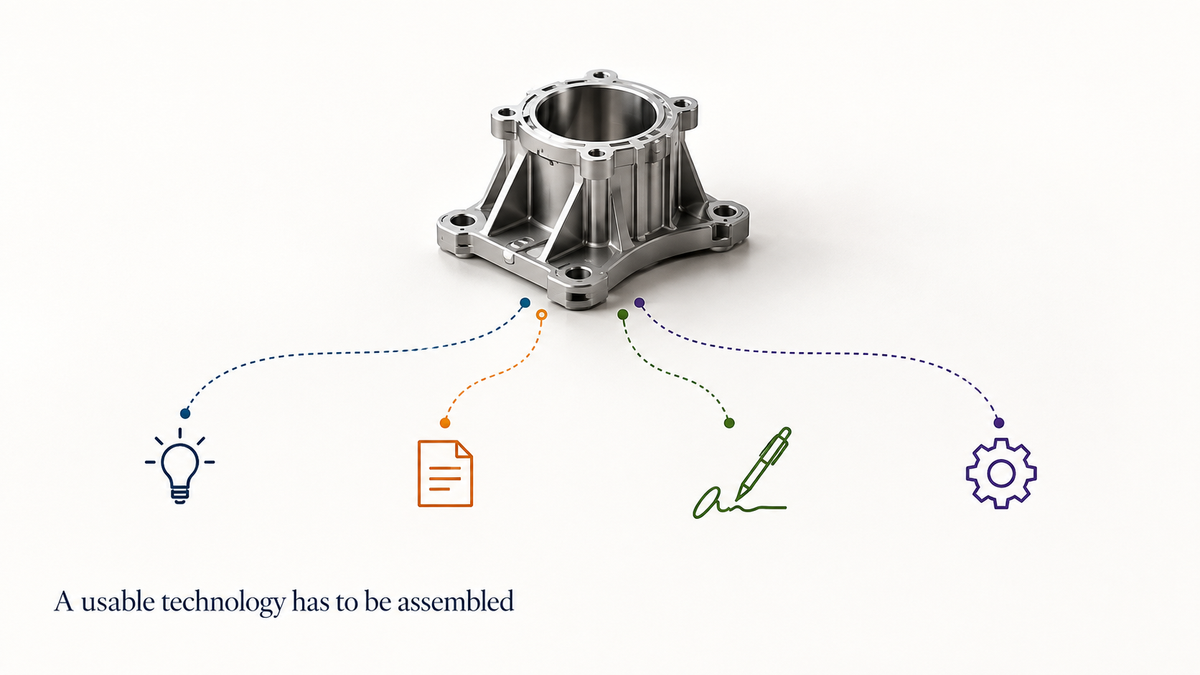
A patent can be found. A usable technology has to be assembled.
In 2024, the global engineering company KBR launched KCOTKlean after integrating KIMM's CPOx technology into its K-COT® process. The significance is not simply that a Korean public research institute held a promising technology. The technology had to fit an existing industrial process, an engineering platform and a commercial product architecture before it could move into use.
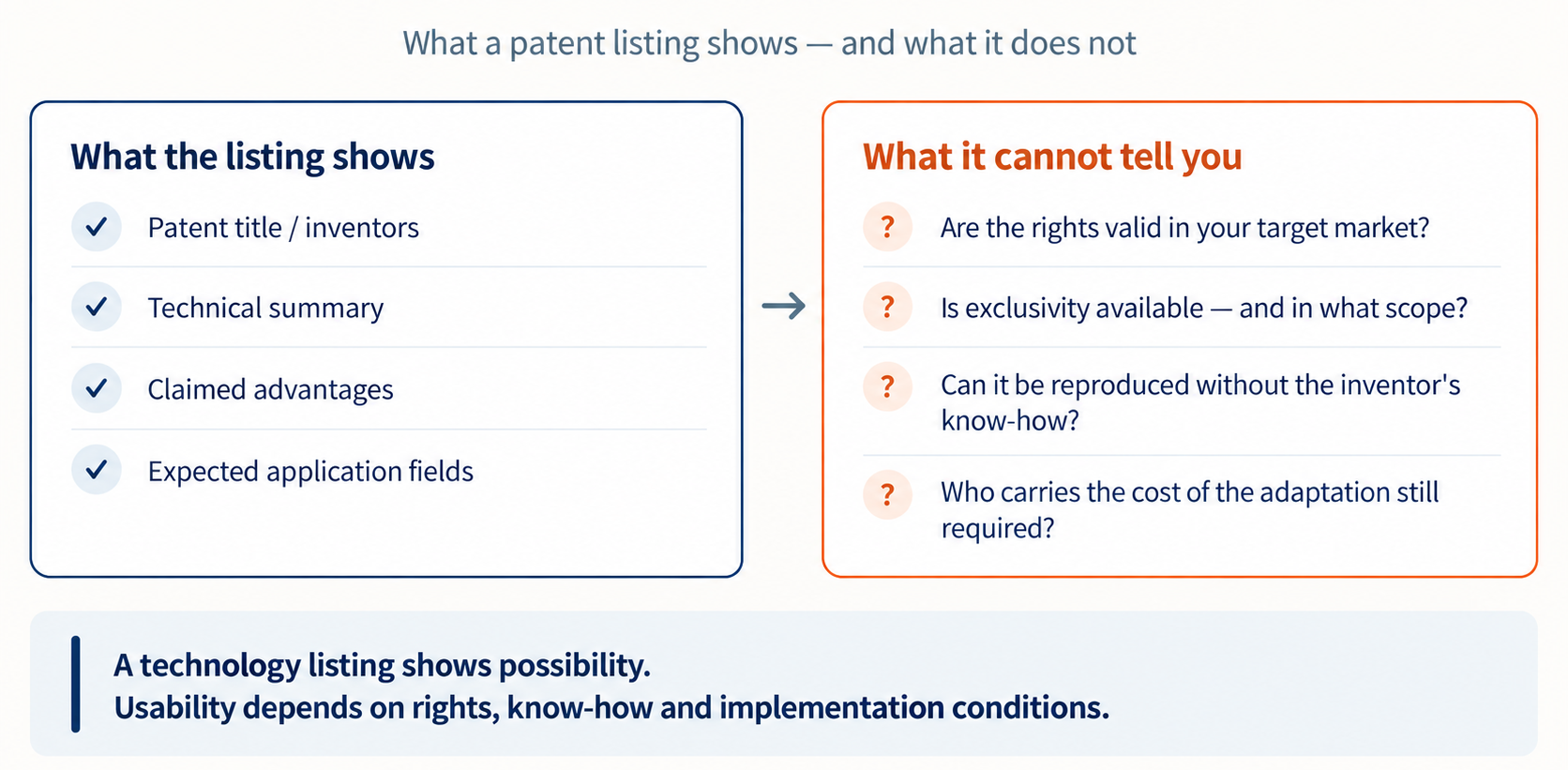
That is the gap this article examines. A patent search may identify a candidate technology, but it does not tell a European company whether the relevant rights are valid in its target market, whether exclusivity is available, whether the technology can be reproduced without the inventor's know-how, or who will pay for the development still required.
The central question is therefore: what has to move with the patent before a company can actually use the technology?
The Patent Is Not the Product
Technology listings from Korea's public research institutes typically include patent titles, researchers, technical summaries, advantages and expected fields of application. Such materials are useful for narrowing candidates, but they differ from a product specification or a performance guarantee.
A patent describes the scope of an invention to be legally protected. Actual implementation may require process sequences, material choices, equipment settings, failure conditions and quality-control experience that are not fully written into the patent document. Even where a laboratory prototype exists, there is no guarantee of the same result at the company's production scale and under its customers' conditions.
The company's first question therefore comes before "can we buy this patent?" What rights, evidence, know-how and development support would we need to make this technology usable in our product, process and market?
A technology listing shows possibility. Usability depends on the rights and implementation conditions attached to it.
What "Transfer" Actually Means
Technology transfer does not always mean a transfer of patent ownership. The official guidance of Korea's public research institutes generally distinguishes the following forms.
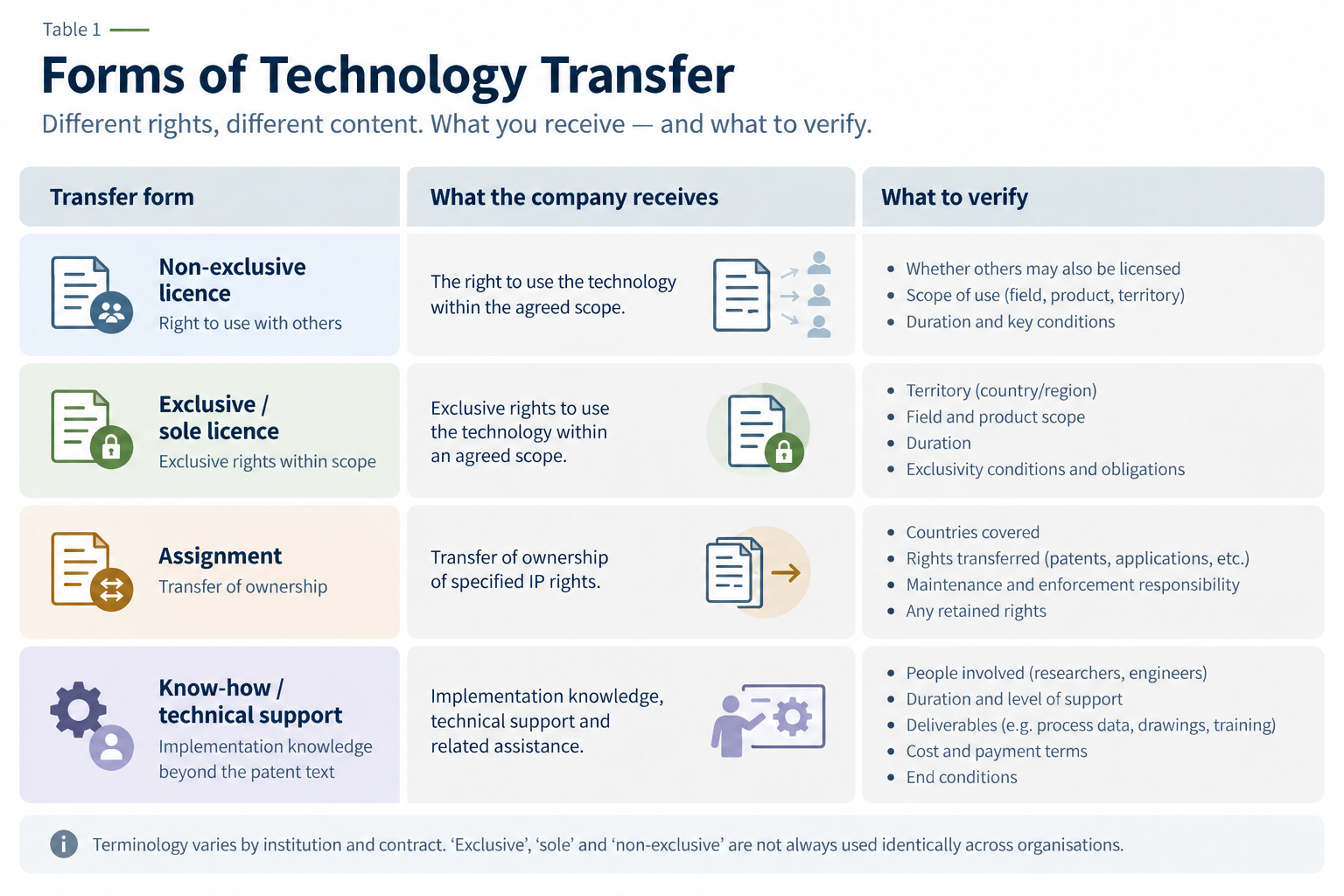
An exclusive licence does not automatically mean exclusivity in every country and for every use. It may be exclusive only within the territory, product, field and term the contract defines. Conversely, receiving an assignment of the patent does not make the technology production-ready.
What is being transferred determines both the price and the responsibilities. A patent licence, drawings, software and data, samples and equipment, the researcher's know-how, and follow-on joint development are distinct elements of a technology-transfer package and should be negotiated separately.
Who Does What? — Researcher, TLO, Platform, Company
Public technology rarely moves through a single hand-off. The researcher, the TLO, the platform and the company each perform different functions.
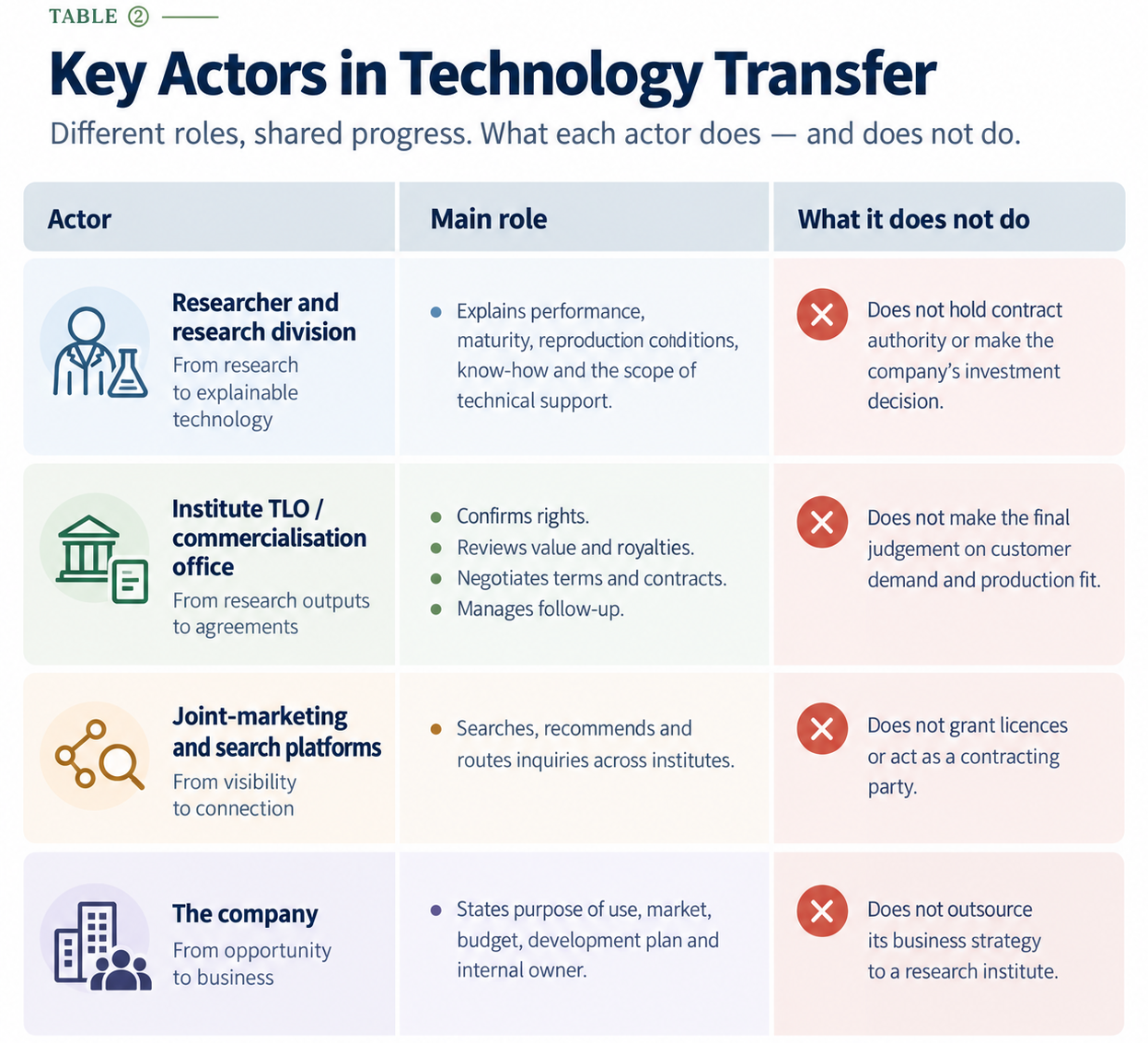
The layer where you search and the layer where you contract are also different. The National Tech-Bank (NTB) is a broad starting point for national R&D outcomes and technology-transfer information; NST's ONE ST joint-marketing pages gather the technologies, recommendations and inquiry routes of the institutes under NST in one place; and individual institutes run their own technology search and online transfer-application channels. These layers are not competitors — they do different jobs.
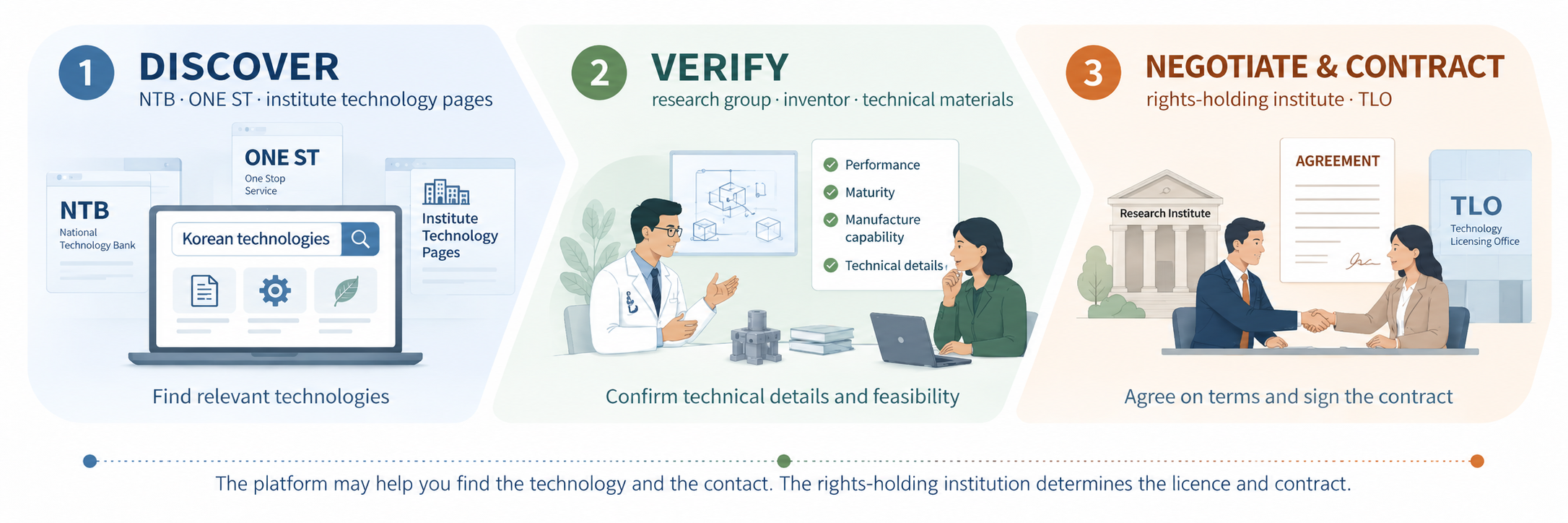
The platform may help you find the technology and the contact. The rights-holding institution determines the licence and contract.
For European companies, the first contact may also come through an intermediary layer rather than a cold inquiry — KIST Europe, K-FAST, KOTRA's European offices, or an existing Korean customer or partner. These intermediaries help with discovery and translation; they do not replace the review of rights and usability.
A researcher's positive assessment of fit does not constitute a contract. Conversely, agreeing licence terms with the TLO while leaving out the researcher's know-how and the scope of follow-up support can open a gap at the implementation stage. Technical validation and rights negotiation are connected, but they are not the same decision process.
Knowing who does what is only the first step. The next question is whether the technology is actually usable under your own business conditions.
The Usability Test — Six Questions Before You Negotiate
Once a promising patent is found, review it against six questions about usability in your own business, not only against the quality of the science. These six questions are the central tool of this article.
Six Questions Before You Negotiate
Who owns the relevant IP, where is it valid, and are there joint owners, existing licences or third-party rights?
What territory, product, field, duration and degree of exclusivity can actually be licensed?
Under what scale and conditions has the technology been demonstrated, and what failure conditions and comparative data exist?
What cannot be reproduced from the patent alone? Is researcher training, or access to samples, design materials, software or process guidance, required?
What still has to change for your equipment, raw materials, quality system, customers or EU regulation?
Who inside the company owns the budget, testing and market entry?
Patent validity, licence scope and freedom to operate are separate questions. A technology-transfer agreement does not replace the company's own IP, regulatory or legal review.
From Search to Implementation — Five Steps
Procedures differ by institute, but the published guidance, reorganised from a European company's perspective, comes down to five steps.
Five Steps
Identify the candidate technology and the rights holder through listings and patent materials.
Check performance, TRL, reproduction conditions, available materials and know-how requirements with the research group.
Define the boundaries: confidentiality, the scope of data, samples and software, and the intended field of use.
Agree the licence type, territory, field and duration, upfront and running royalties, and technical-support terms.
Connect know-how transfer, adaptation work, pilot validation and technical support to a clear implementation plan, including responsibilities, milestones and exit conditions.
Post-contract management — performance reporting, royalty payment, extension and termination — is a separate operational matter, and should be set out in the agreement in advance.
These five steps are K-Welle's editorial frame. In practice, open competition, technology valuation, internal review, government approval, the consent of joint owners, or export-control and security screening may be added.
Three Ways the Deal Can Be Structured
The European entity becomes the contracting party and applies the technology in its own products or processes.
This looks simplest, but whether the institute can contract with a foreign entity, the patent's status in the target countries, and the arrangements for royalty payment, tax, foreign exchange, export control and technical support all have to be confirmed institute by institute. In practice, direct licensing may still be preceded by technical consultation, partner matching or other exploratory contact.
A Korean production entity or local business partner adopts the technology and connects its application with the European parent or customers.
Here, sub-licensing, the transfer of technology and data, and the scope of production and sales territories have to be made explicit between the Korean contracting party and the actual European user. A Korean licensee does not automatically give the European parent or customer the right to use the technology.
Where the technology has not yet been validated under the company's conditions, it may be better to run joint research or a pilot first, and then set the terms for the results and any new IP.
If licensing is deferred until after joint development, background IP, new IP, data rights, priority rights and cost responsibility should still be defined before the work begins. Leaving them "to be discussed later" invites conflict once results exist.
The One-Page Technology Access Brief
If Route 2's problem brief was the first deliverable of a research collaboration, the first deliverable of technology adoption is a one-page technology access brief. Naming a technology and writing “we would like to purchase it” is not enough to judge the fit.
A Licence Is Not Yet Implementation
Public technology may be discovered in a database, but it does not move through a database. The researcher explains what the technology can do. The TLO defines the rights and economics. The company takes responsibility for implementation.
A good agreement therefore connects more than IP. It connects know-how, validation, follow-on development, cost, timing and the conditions for success or exit.
Search finds the technology. The agreement defines the right to use it. Implementation makes it valuable.
Research Routes — Three Ways In
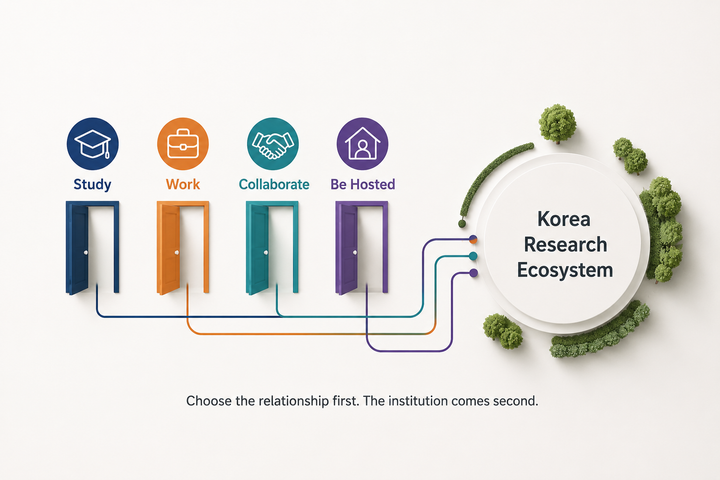
A researcher chooses the relationship to build with Korea's R&D system.
A company turns a manufacturing problem into a measurable research question.
Public technology is connected to the right to use it and a plan to implement it.
About This Reporting & Sources
This article draws on publicly available official materials from the Korea Institute of Industrial Technology (KITECH), the Korea Institute of Machinery and Materials (KIMM), the Korea Atomic Energy Research Institute (KAERI), NST's ONE ST platform and the National Tech-Bank (NTB).
The purpose of this series is to help readers ask better questions before expensive decisions, rather than to make the decisions for them.
The detailed types and terminology of licences differ by institution and contract; the distinctions in this article and its tables are simplifications for practical understanding. The forms of transfer, royalties, review procedures, the possibility of contracting with foreign entities and the scope of technical support differ by institute and technology.
This article does not warrant the validity of any specific rights, freedom to operate, regulatory conformity or the outcome of any contract. In an actual transaction, confirm with the institute's TLO and the company's own legal, tax and IP advisers.
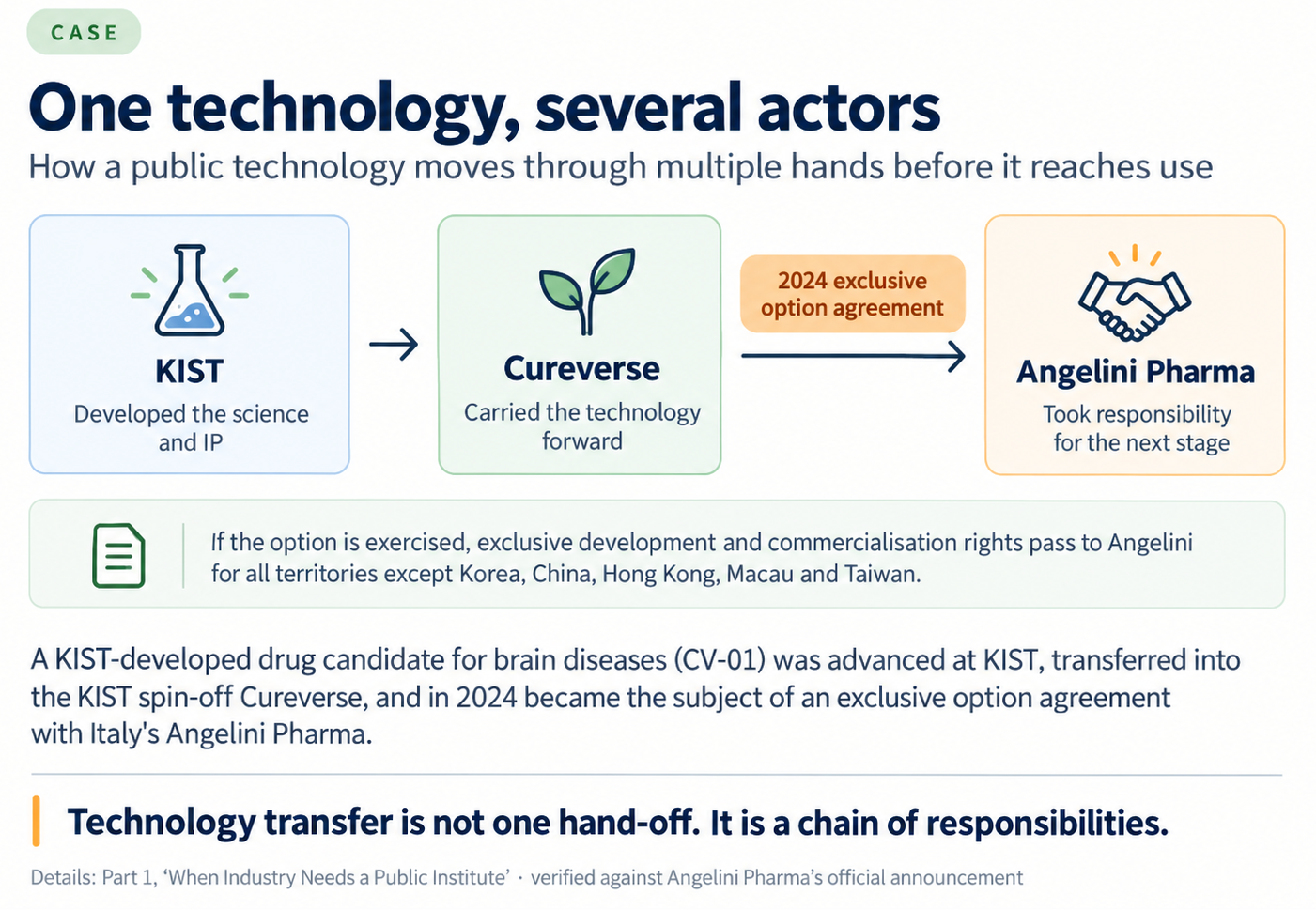
The Cureverse–Angelini case is described within the scope confirmed by Angelini Pharma's official announcement; contract amounts are not stated, in line with series policy. The KBR–KIMM case follows KBR's official announcement of 8 July 2024.
Organisations, contact points, search services and terms of use change; re-check official guidance before inquiring.
Sources · links on publication
- KITECH — technology transfer: purpose, contracts, types and the TLO
- KITECH — procedures: identification, negotiation, contracting, transfer and follow-up
- KIMM — non-exclusive and exclusive licences, technology sale and transfer procedures
- KAERI — licences, patent assignment, technical consultation and know-how transfer
- NST ONE ST — joint-marketing search of institute technologies (onest.re.kr)
- NST Joint TLO Marketing Office — technology transfer and commercialisation support within the ONE ST portal
- NTB — national R&D technology and transfer information search
- KBR — KCOTKlean official announcement, 8 July 2024 · K-COT® + KIMM CPOx integration
- Angelini Pharma — official announcement of the exclusive option agreement with Cureverse for CV-01, October 2024