
Four Ways to Enter Korea's Research Ecosystem
A practical guide to four ways into Korea’s research ecosystem — study, work, collaborate or be hosted — with where to look, what to verify and when Korea may be worth the move.
Study, Work, Collaborate, or Be Hosted
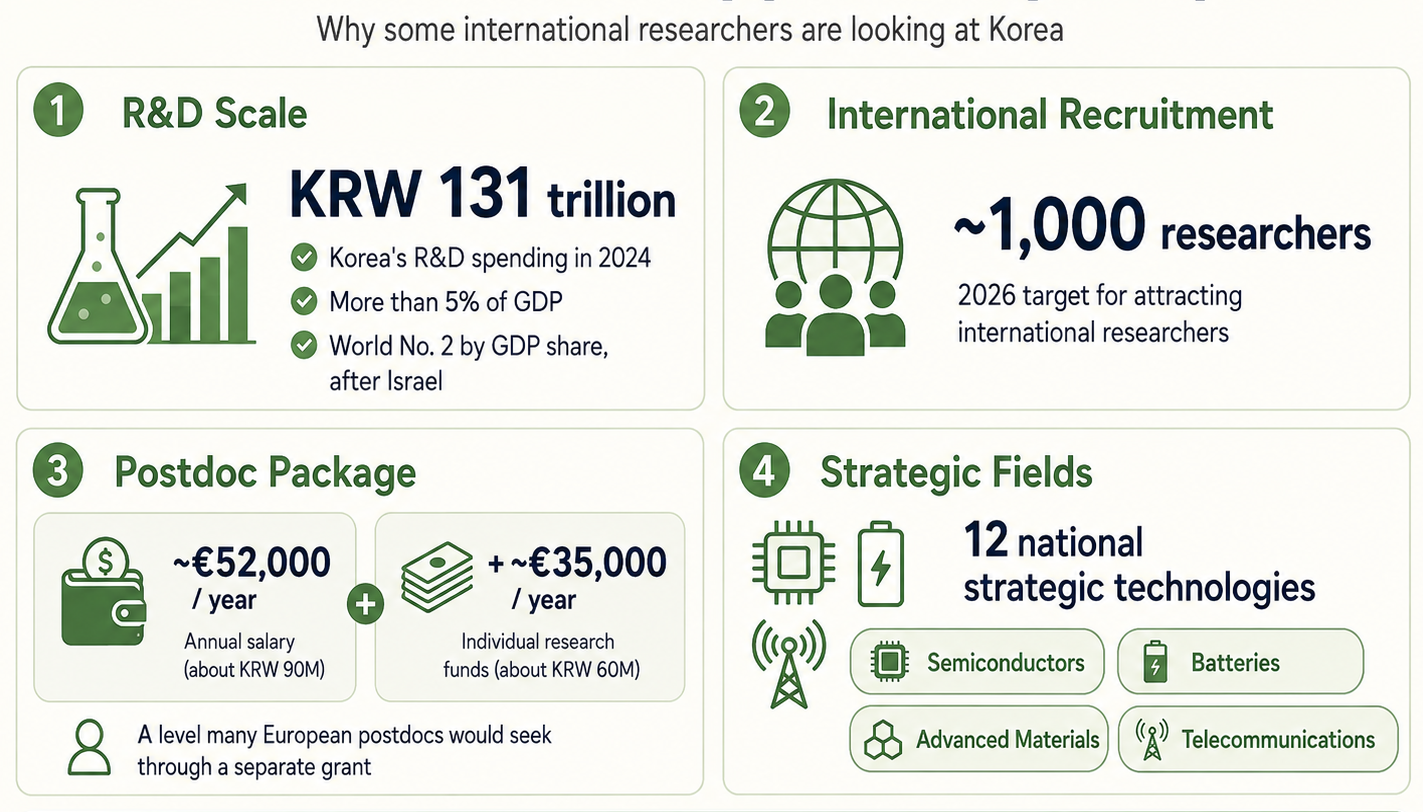
In 2024, Korea spent 131 trillion won on research and development. For the first time, that was more than 5% of GDP — the second-highest share in the world, after Israel.
And the system is now recruiting from outside. For 2026, the government has set a target of bringing in around 1,000 international researchers. The programme behind it guarantees postdoctoral researchers an annual salary of roughly €52,000 — in the range of a German public-sector postdoc salary (TV-L E13), and about twice the Korean postdoc average — plus around €35,000 a year in individual research funds, a budget many European postdocs would have to win through a separate grant. It now spans all twelve national strategic technologies. Semiconductors, batteries, advanced materials, telecommunications — technologies that European labs and factories already know by name come out of this ecosystem.
When one of the world's most research-intensive systems is widening its doors, one question remains. What do you want from Korea — a degree, a job, a research capability, or a temporary base inside the system? The door you should open depends on the answer. The door and the corridor behind it, however, are different stories — and we will come to the corridor after the doors.
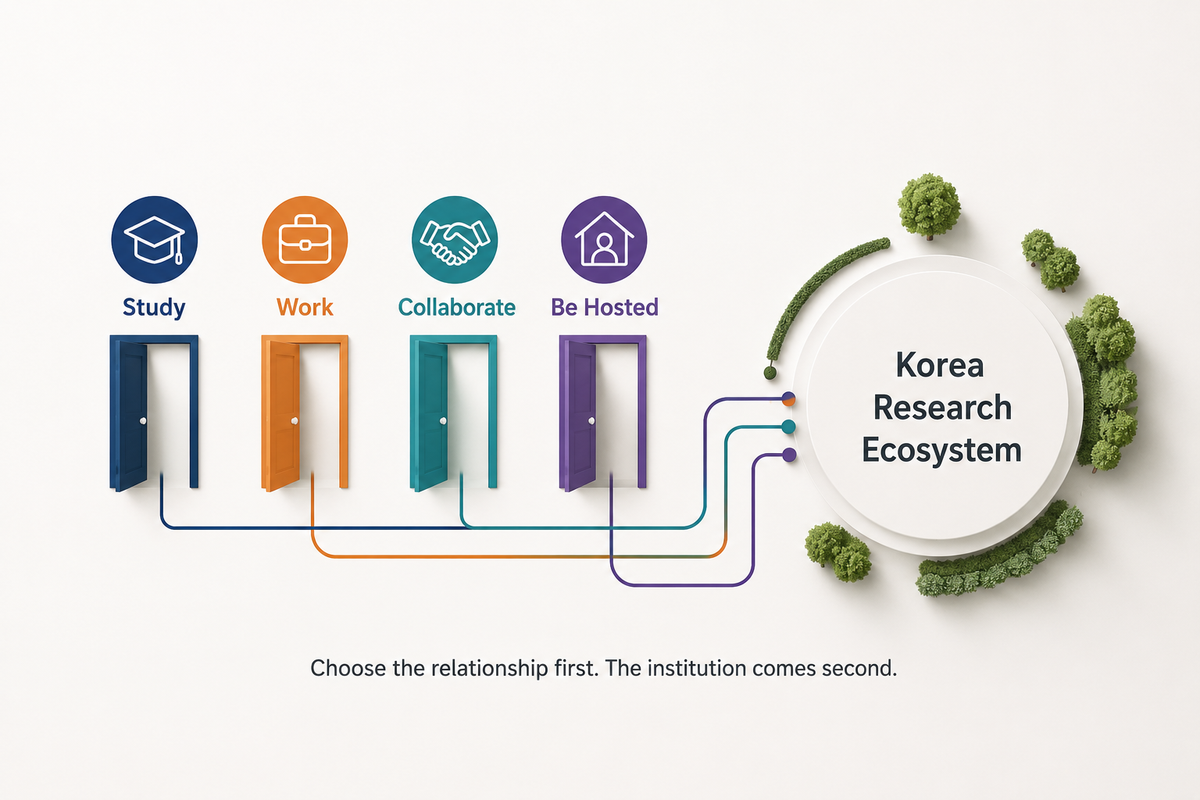
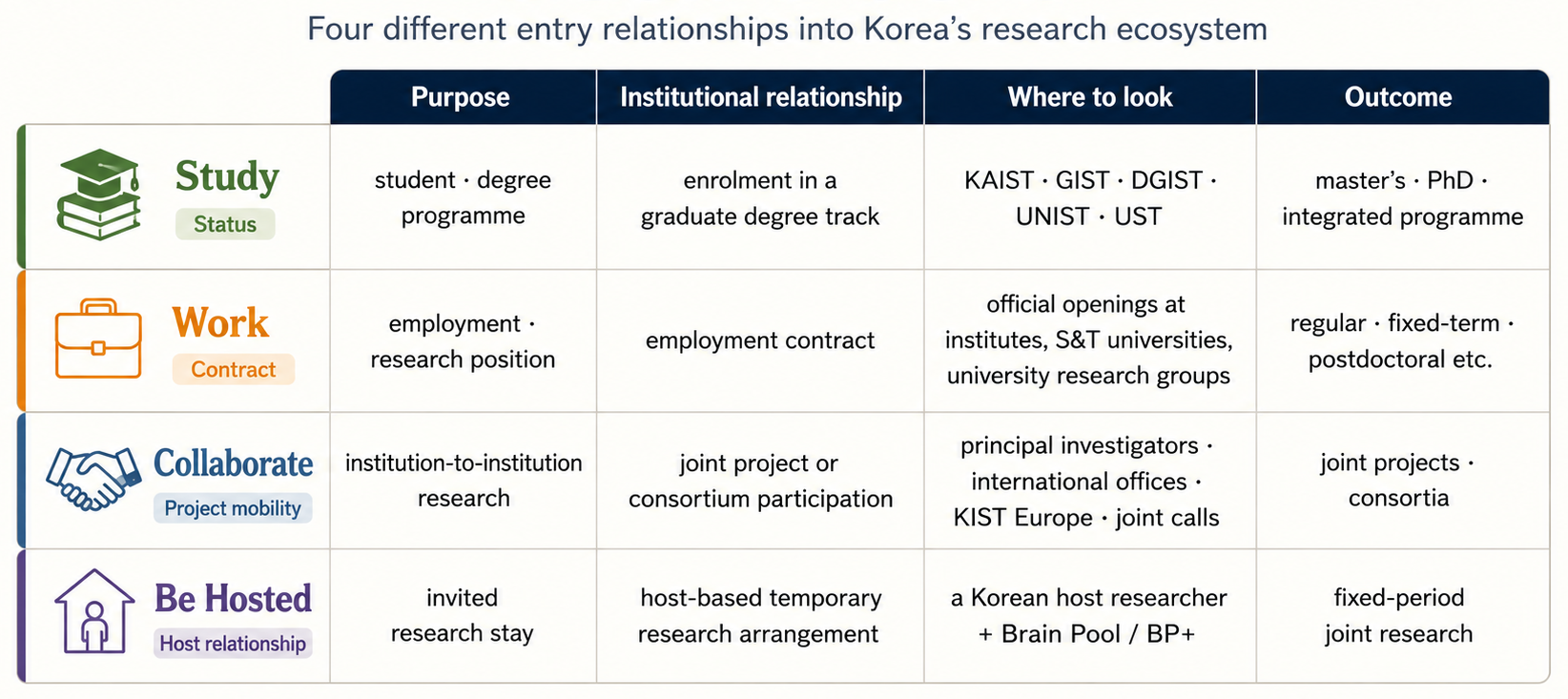
Before you choose an institution, choose a relationship — Study, Work, Collaborate, or Be Hosted.
Start with a Verb
When a European researcher says "I want to join KIST," the sentence is not yet specific enough. The starting point differs depending on whether you want to earn a degree in Korea, apply for a research position, build a joint project while keeping your current affiliation, or spend a fixed period in a Korean laboratory as a hosted researcher.
And the doors do not all open at government-funded institutes. Science and technology universities (KAIST, GIST, DGIST, UNIST), government-funded research institutes (KIST, ETRI, KRICT, KIMM and others), international joint-research platforms (KIST Europe, Horizon Europe, bilateral calls) and hosting schemes (Brain Pool, BP+) form a single entry ecosystem. The four routes can connect — a UST student may later apply for a research position, and a European collaborator may later join a Korean hosting programme. But no route automatically guarantees the next.
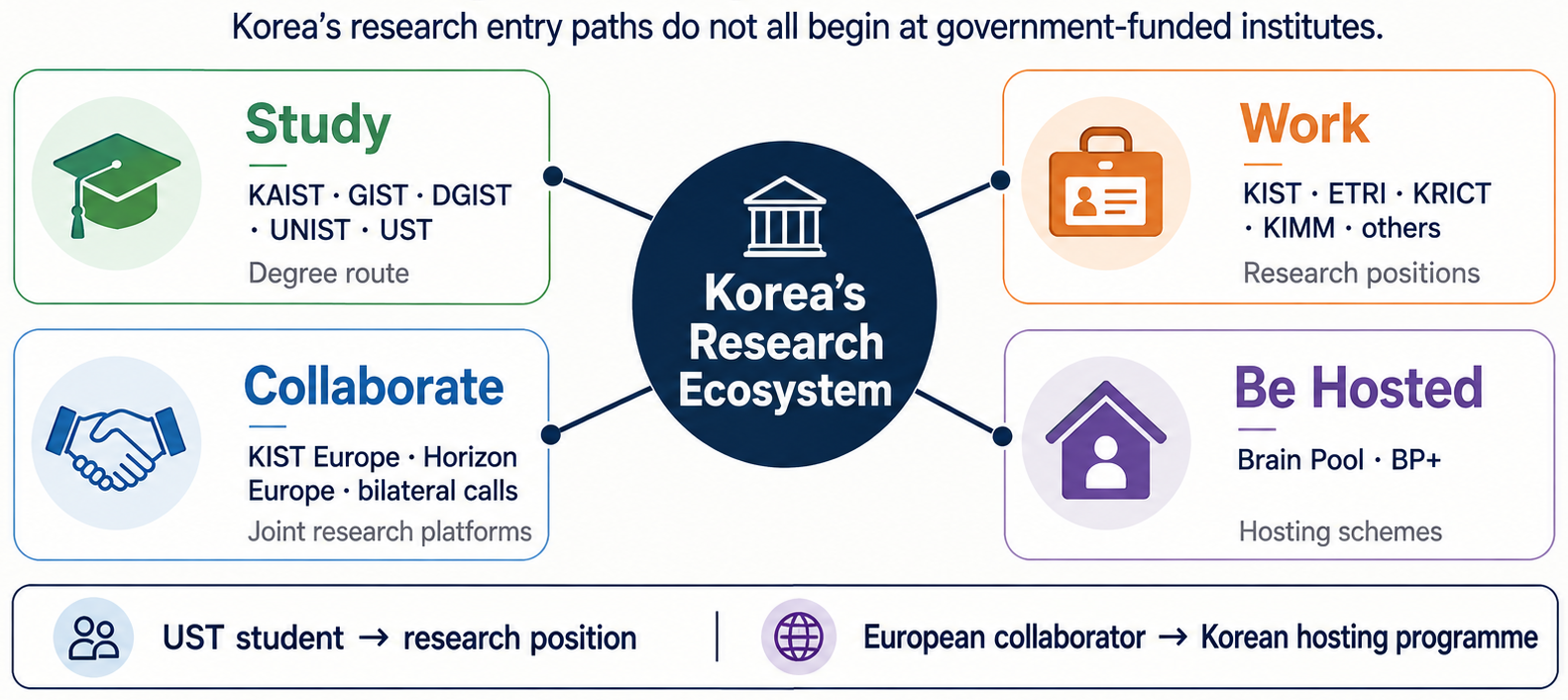
An institution's name tells you where. The verb tells you what relationship you are trying to create.
Study — Why Korea Can Be Worth the Detour
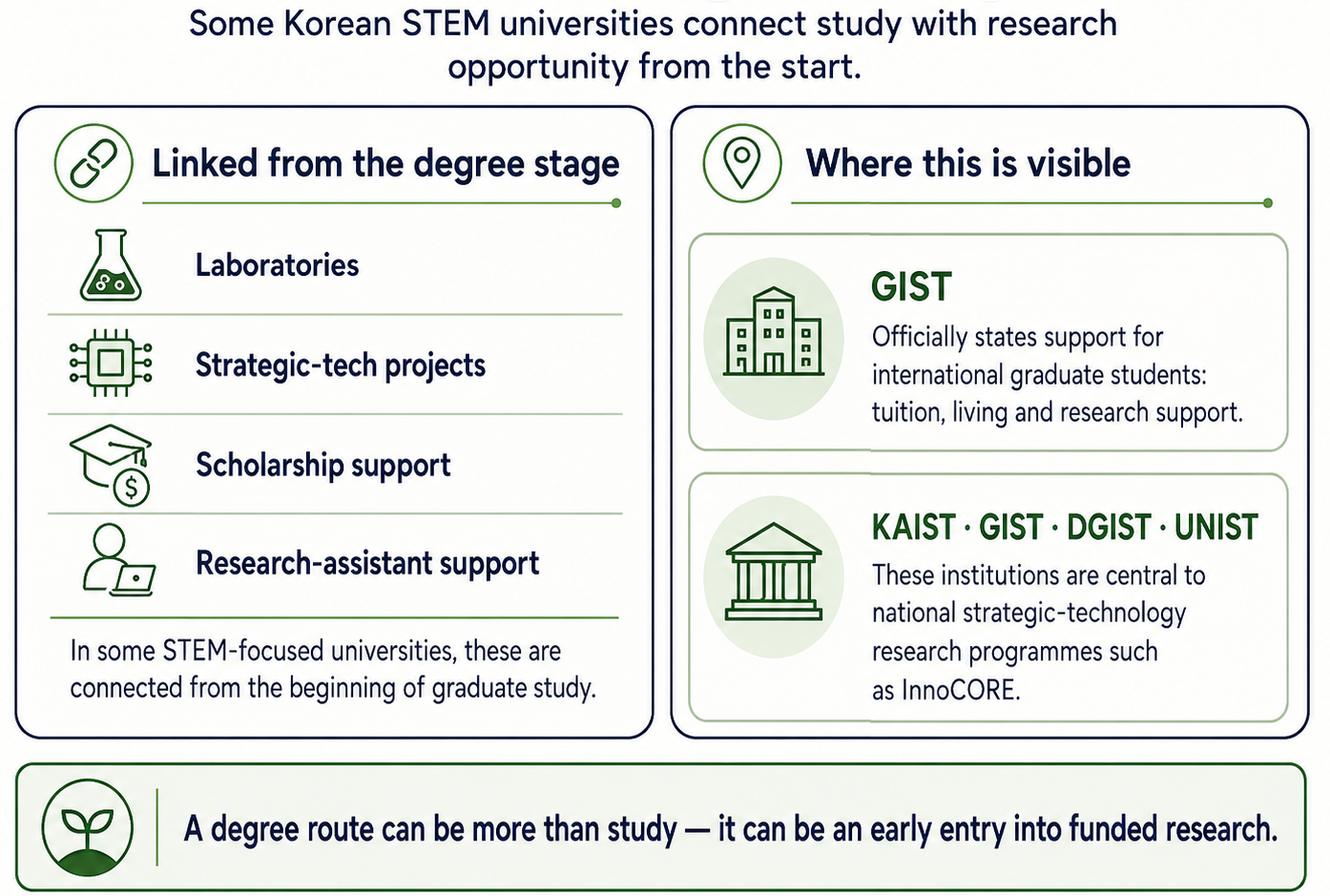
Why this route can make sense in Korea. What deserves attention in Korean graduate admission is the connection beyond the degree. At some STEM-focused universities, laboratories, national strategic-technology projects and scholarship or research-assistant support are linked from the degree stage onward. GIST officially states tuition, living and research support for international graduate students, and KAIST, GIST, DGIST and UNIST sit at the centre of national strategic-technology research programmes such as InnoCORE. Scholarship structures and conditions differ by institution and should be checked individually.
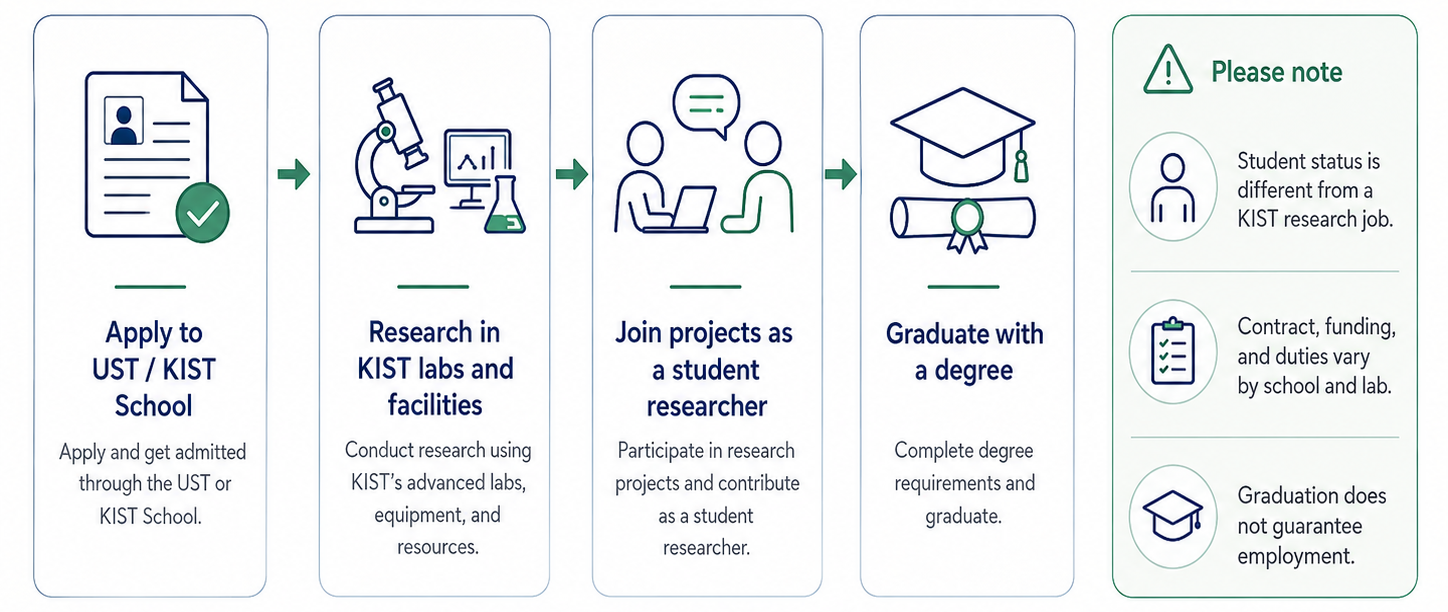
To pursue a degree inside a government-funded institute, UST is the clear route. UST is a research-oriented graduate university operated jointly by Korea's government-funded research institutes, with each participating institute serving as a School. A KIST School student conducts degree research in KIST's laboratories with KIST's equipment, and signs a student-researcher employment agreement with the School. That agreement covers research activity during the degree; it does not constitute regular research employment or guarantee employment after graduation.
The decision question. If you are choosing between another European graduate programme and Korea, the question to ask is about access rather than ease. Does Korea open a research field, an infrastructure, or a funded project that is harder to reach elsewhere?
Where to look
What to verify before applying
The degree route and the employment route are not the same door. If Korea gives you access to a research field or funded project that is harder to reach elsewhere, the degree is worth the detour. If not, the distance needs a stronger justification.
Work — Look at the Ecosystem Behind the Job
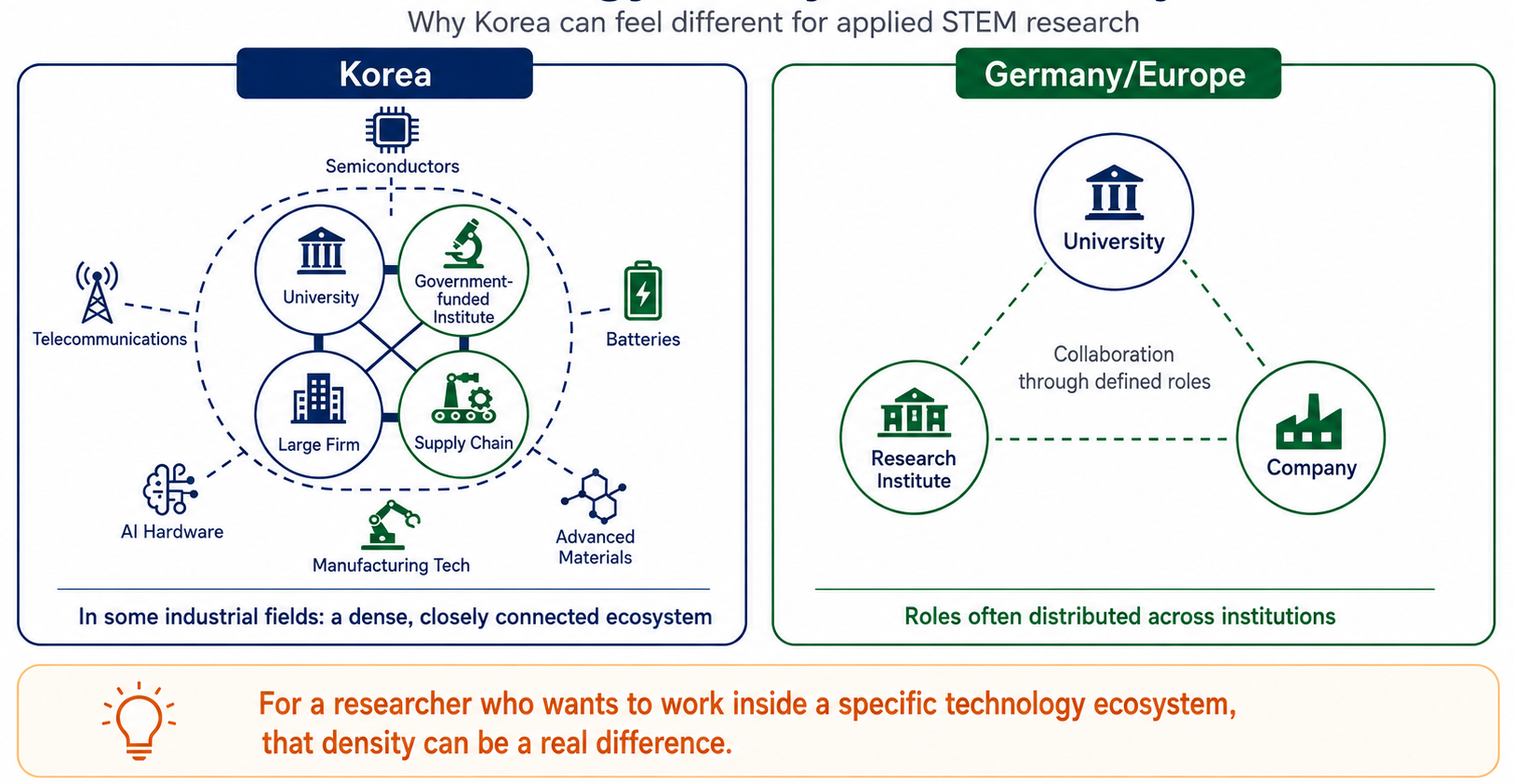
Why this route can make sense in Korea. The practical reason to look for a research position in Korea comes from the density of certain fields. In semiconductors, batteries, advanced materials, telecommunications, AI hardware and manufacturing technology, corporate R&D and public research sit unusually close together. Where German research often divides roles between universities, Fraunhofer institutes and companies, in some Korean industrial fields universities, government-funded institutes, large firms and supply-chain companies are concentrated geographically and industrially. For a researcher who wants to work inside a specific technology ecosystem, that density can be a real difference.
Policy is moving to widen this door as well. InnoCORE is one sign of that policy direction: it combines postdoctoral recruitment with industry–academia joint supervision, corporate-demand joint research and entrepreneurship support — a signal carried by the design more than the scale.
The decision question. Can this position place me closer to a technology ecosystem I want to work inside?
Where to look
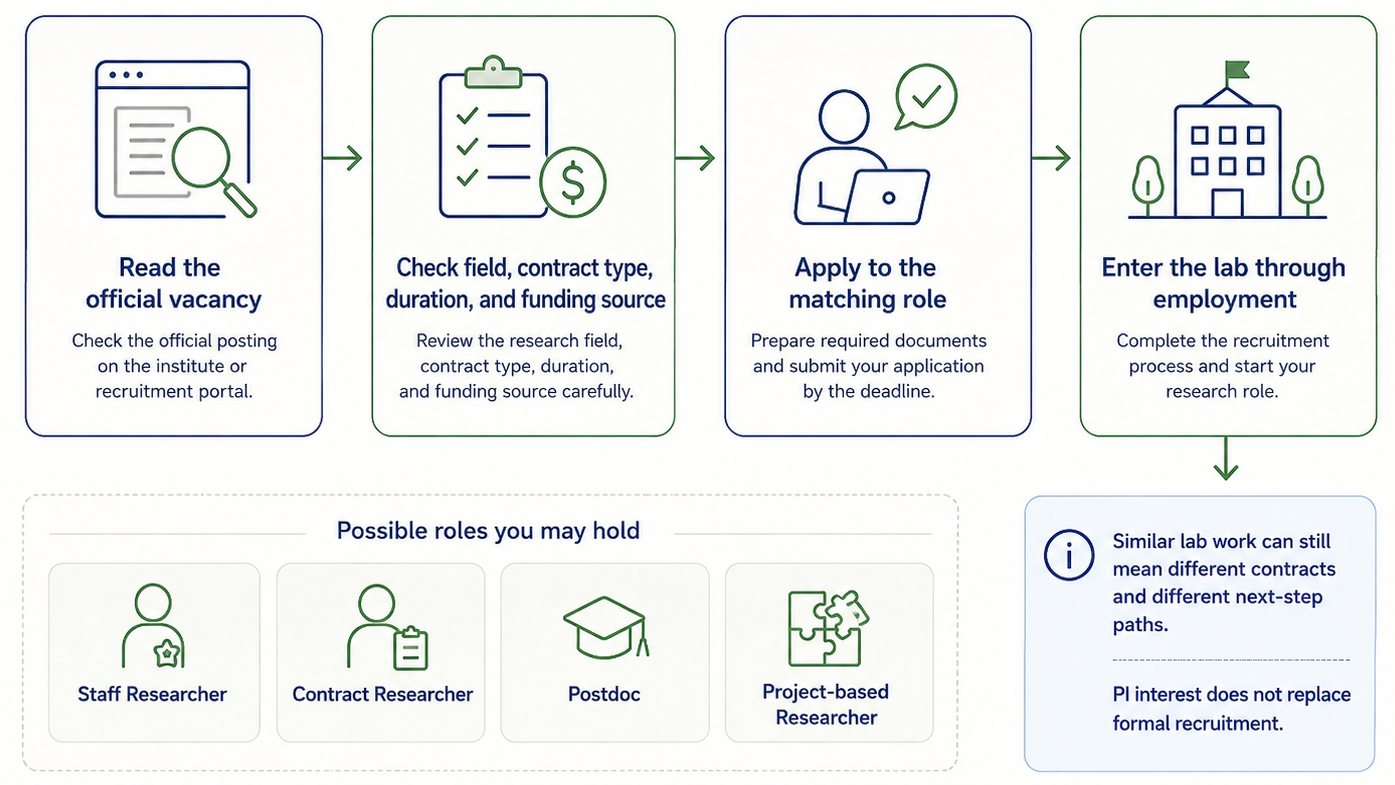
What to verify before applying
The first thing to read on this route is the contract behind the posting, before the institution's name. Choose Korea for a research position when the ecosystem behind the job matters as much as the job itself.
Collaborate — Testing the System Without Moving
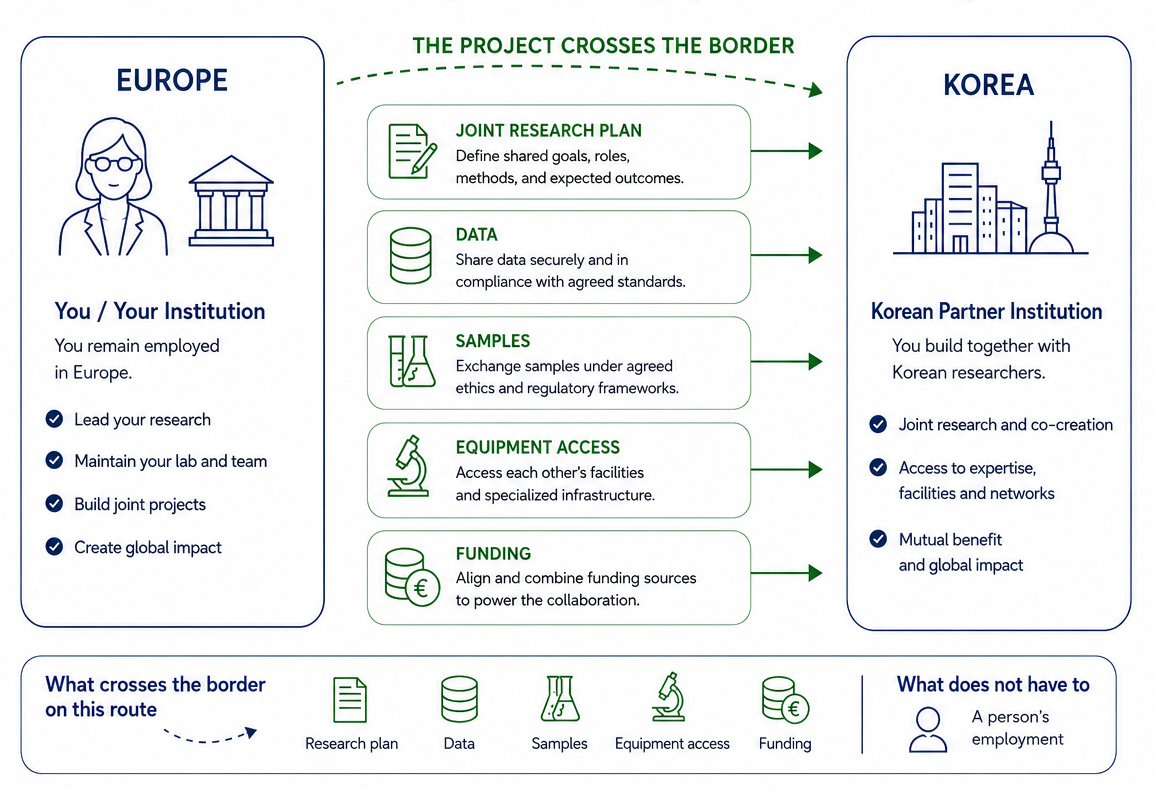
Why this route can make sense in Korea. You do not have to relocate to Korea to work with a Korean research institution. A researcher employed by a European university or institute can keep that affiliation and build joint projects, joint experiments or international consortia with Korean partners. What crosses the border on this route is the research plan, the data, the samples, the equipment access and the funding — a person's employment does not have to.
What makes the route attractive is the nature of what becomes reachable. In fields such as semiconductor processing and packaging, battery materials, advanced materials, manufacturing automation, telecommunications and photonics, hydrogen and fuel cells, and industrial AI, a Korean partner may be connected to real industrial problems, samples, processes and validation environments — a connection that goes beyond co-authorship.
KIST Europe illustrates the structure. Established in Saarbrücken, Germany in 1996, KIST Europe has connected Korean and European research capabilities from inside the European research environment. In the Horizon Europe UPeM project, launched in 2026, KIST Europe joined a consortium with Fraunhofer, UFZ and industrial partners to measure and analyse PFAS emissions from electrolysers and fuel cells and to validate them under industrial conditions. KIST Europe's role in this case is the interface — less a channel that moves European researchers to Korea than a connection that lets Korean research capability enter Europe's joint-research structures.
The decision question. Can a Korean partner give my project access to capabilities, industrial problems or validation environments that I do not already have?
Where to look
What to verify before building the collaboration
KIST Europe: What It Can Do / What It Does Not Guarantee
- Institutional connection for Korea–EU joint research
- An interface between European consortia and Korean research capability
- Exploration of cooperation in public research fields
- A Korean research base inside the European research environment
- Employment at KIST Seoul
- Korean residence status
- Matching with a specific laboratory
- Personal employment through participation in a joint project
Collaborate is the lowest-risk way to test whether Korea adds something your current research system cannot provide.
Be Hosted — Testing from Inside Before a Larger Decision
Why this route can make sense in Korea. The value of hosting programmes such as Brain Pool goes beyond the funding. They offer a time-limited way to step inside a specific Korean laboratory — without giving up an existing career — and to experience the equipment, the research culture, the industrial network and the administrative environment at first hand. Instead of guessing from outside whether the Korean research environment fits your next career step, you can find out from inside.
The starting point of this route is a Korean host researcher or institution, more than the call itself. The international researcher and the Korean counterpart first define a joint research topic and roles; depending on the programme type, the Korean principal investigator or institution then applies; if selected, the international researcher spends a fixed period conducting joint research at the host institution. At first contact, therefore, what needs to be visible alongside a CV is the overlapping research topic, the problem to be solved together, the methodology, data or equipment experience you bring, and the research period you need.
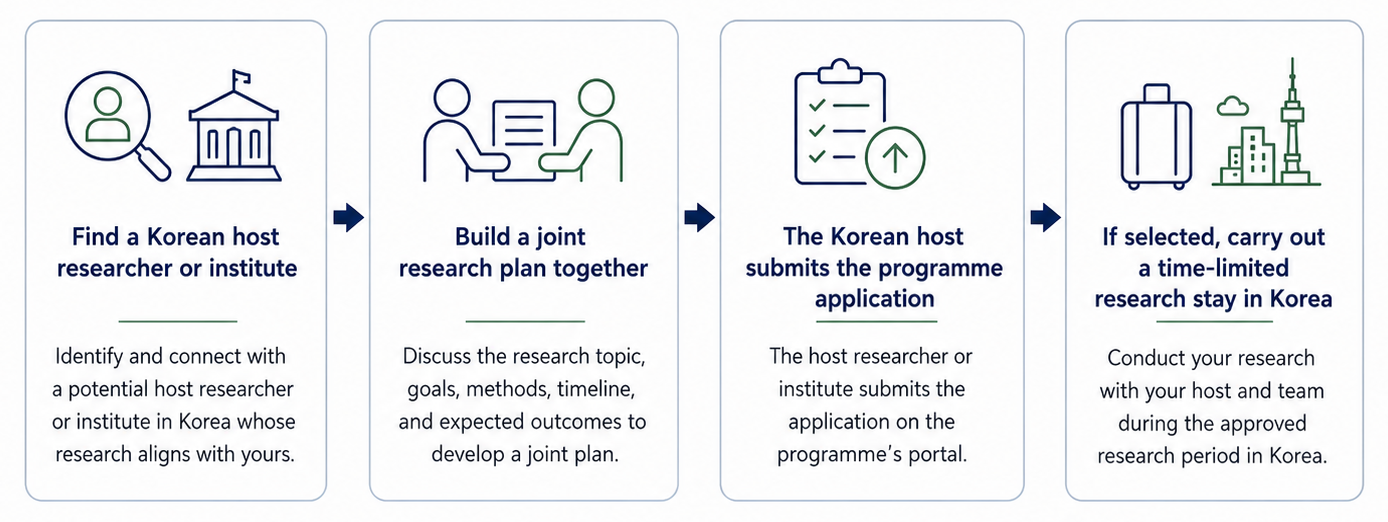
Brain Pool and BP+ are being operated in the direction of expanding international recruitment, and the government has set targets for attracting international scientists and researchers through 2030. A connection with a specific laboratory, however, does not by itself lead to selection — matching and selection are separate steps.
The decision question. Is there a host in Korea whose research environment is worth experiencing from the inside?
Where to look
What to verify before committing to a research stay
The core of this route is the order. Host → Joint Plan → Application → Research Stay. And its use reaches beyond the money. Be Hosted is not only a funding route. It is a way to test the Korean research environment before making a larger career decision.
What Happens After the First Door?
The door is open. The corridor behind it is short.
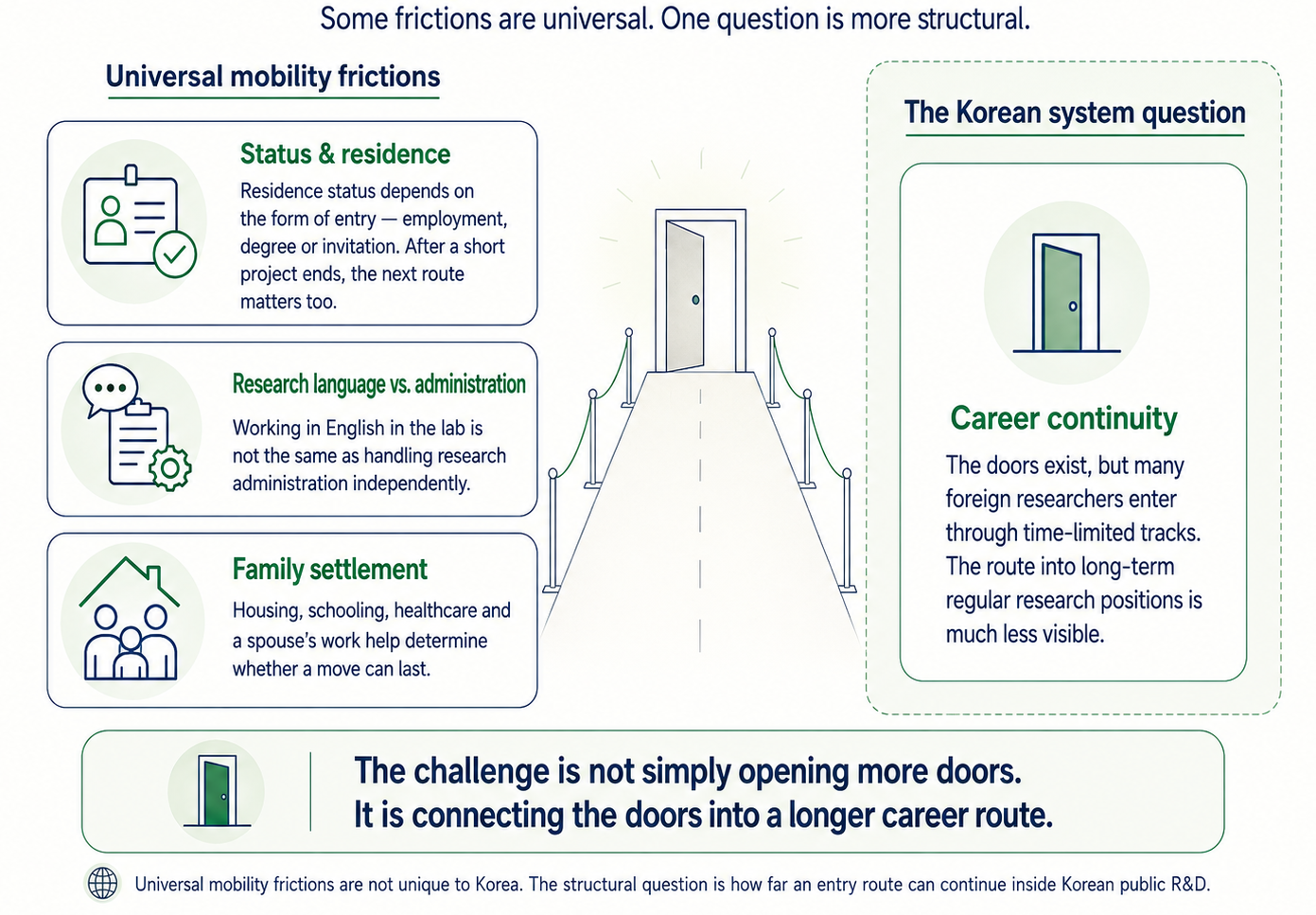
The degree ends — then what? The fellowship ends — then what? The joint project ends — then what? The fixed-term contract ends — then what? The corridor is the name of this question.
Some of the friction of moving is not specific to Korea. Residence status is tied to the form of employment, degree or hosting; a laboratory's working language and its administrative language can differ; a long-term move brings housing, schooling, healthcare and a partner's career with it. Korea, too, is expanding English-language research administration and settlement support for international researchers.
Entry and early research opportunities are expanding. But narrow the view to the government-funded institutes under NST, and another picture appears. As of June 2024, of the 232 international R&D personnel identified there, 37 held regular positions — about 0.2% of all regular research staff at those institutes.
That number does not describe an international researcher's probability of being hired. But it does show, at the least, that cases of international researchers entering long-term institutional careers are still very rare.
So the remaining question is conversion rather than entry. How often does a fixed-term research opportunity lead to the next career step?
The opportunity is becoming more visible. The career route still has to catch up.
Choose the Opportunity, Not the Easier Door
You do not need to memorise the organisation charts of Korean research institutions first. Decide first which relationship you are trying to create — degree, employment, joint project or hosted stay. Once the relationship is clear, finding the right posting, programme and office becomes much easier.
What you settle at the first door is less the institution's name than the relationship you are asking it to create. And whether to open the door should be judged by the opportunity behind it, not by its width.
Do not choose Korea because the door is easier. Choose it when the research opportunity behind the door is unusually strong.
Which Door Should You Open First?
Reader Route
About This Reporting
This article draws on official materials from KIST, KIST Europe, UST, the Ministry of Science and ICT, the National Research Foundation of Korea and the European Commission.
The purpose of this series is to help readers ask better questions before expensive decisions, rather than to make the decisions for them. The “four doors” are K-Welle's editorial frame, reorganising publicly available systems by the reader's purpose; they are not an official classification.
The UPeM case is described within the participant structure published on CORDIS. KIST Europe's participation in the project does not imply the recruitment of individual researchers or their relocation to Korea.
Under UST's current international admissions guidance, admitted students enter into an employment agreement with their School. Contract terms, funding sources, support conditions and the scope of research duties may vary by School, major and laboratory. The agreement does not constitute regular research employment or guarantee employment after graduation.
University scholarship and support conditions differ by institution and year. Brain Pool eligibility, duration and funding conditions may also change with each annual call. Host matching and project selection are separate procedures.
The R&D investment figures in the introduction follow the Ministry of Science and ICT's Survey of Research and Development: 2024 total R&D expenditure of approximately KRW 131 trillion, exceeding 5% of GDP for the first time and ranking second globally by GDP share.
The programme figures cited in the introduction are KRW 90 million in annual salary and KRW 60 million in individual research funds, based on the ministry's programme announcement. Euro figures are approximate conversions at the exchange rate used at the time of verification and will vary with currency movements.
The TV-L E13 reference is a range comparison rather than an equivalence. Gross pay scales, taxation, social insurance and living costs differ between Germany and Korea.
International research-personnel figures follow KISTEP's tally for NST-affiliated institutes as of June 2024: 232 international R&D personnel, including 37 in regular positions, equivalent to about 0.2% of all regular research staff at those institutes.
The NST figures and Korea's national R&D investment figures cover different populations and are not directly compared in this article. A detailed breakdown of European nationalities is not available in the public data used here.
Sources · link on publication
- KIST — KIST School
- UST — International admissions and student support
- KAIST · GIST · DGIST · UNIST — international graduate admissions and scholarship guidance
- European Commission CORDIS — UPeM, Project ID 101250924
- IRIS · National Research Foundation of Korea — Brain Pool / BP+ calls (2026)
- Ministry of Science and ICT — Survey of Research and Development · InnoCORE appointments · InnoCORE expansion plan
- EURAXESS Korea — research careers and researcher mobility in Korea
- KISTEP — international R&D personnel at government-funded institutes · Demand Brief No. 102
- NST — Guidebook for international researchers · international researcher statistics
- IRIS — registration and English-language services for international researchers