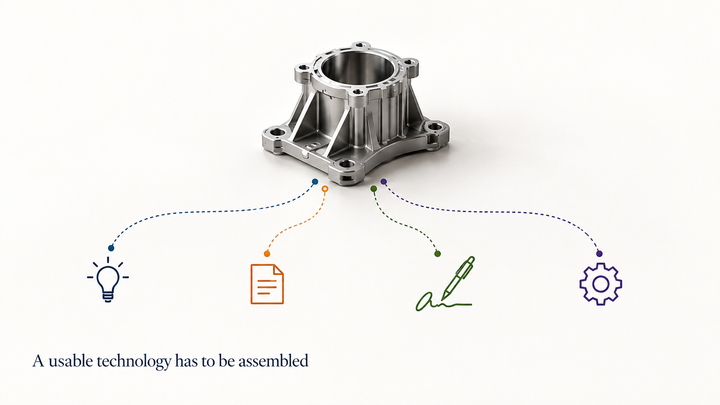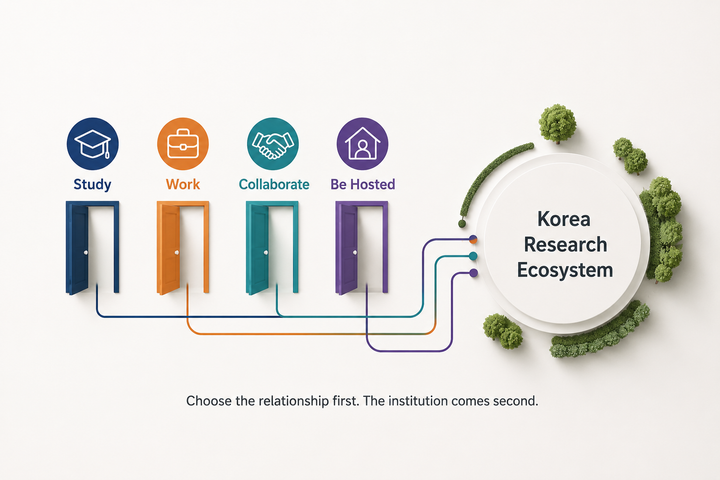

Why Does a European Factory Look to Korea?
When does a factory problem become a research project — and when is Korea the right place to solve it?
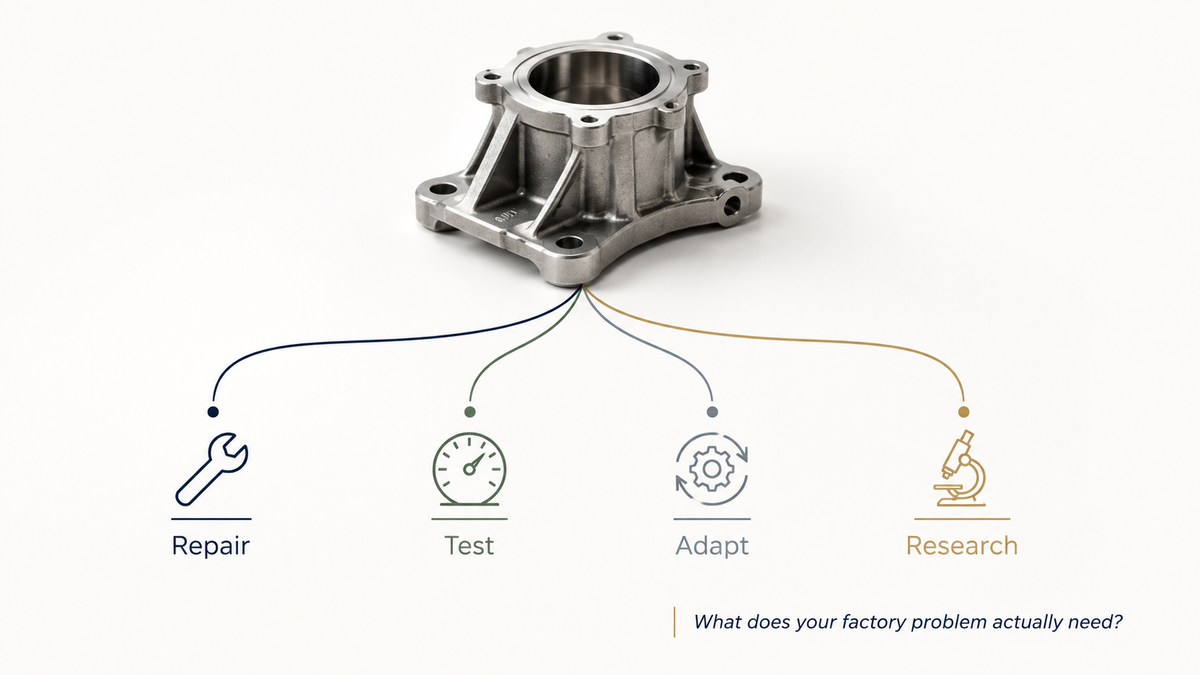
How a European company can turn a manufacturing bottleneck into a Korean public-research collaboration
Raise the line speed, and the coating cracks. Change the raw-material supplier, recalibrate the equipment — the defect rate stays where it is. The factory knows it has a problem. What it cannot do is separate the cause: the material, the temperature, the tension, or the process sequence.
A symptom like this is not yet a research project. It becomes a researchable problem when the gap between current and target conditions can be measured, when the unexplained cause can be investigated through testable hypotheses, and when the result would change an actual decision.
And making a problem researchable does not by itself mean bringing it to Korea. European companies already have access to Fraunhofer institutes, universities, specialised RTOs and testing organisations. Korea becomes relevant when a Korean partner can provide equipment, pilot environments, materials and process expertise, or supply-chain access that is harder to secure at home.
So the central question of this article is not an institution's name but the problem's need. What does your factory problem need — a repair, a test, an adaptation, or a research partnership?
Is This Problem Researchable? — Five Questions That Turn a Symptom into a Problem
"Our quality is unstable" is an important signal, but it is still early for a research question. For a research organisation to engage, the problem has to show when, where and under what conditions it recurs.
"The coating cracks too often" is far less useful than "when line speed rises from 18 to 24 metres per minute, the crack rate increases from 2% to 11% within a specific humidity range." The second version provides conditions to observe, a baseline to compare and variables to change.
The factory already holds most of the data — equipment logs, defect samples, operator records, raw-material batches, temperatures and pressures, inspection results. The path to a research project opens when you decide which relationship between variables and outcomes to test, rather than repackaging the same material under a new name.
The Researchability Test
Condition · Question · Evidence to prepare
The five conditions do not have to be complete from the start. The "Unknown" in particular does not need to be resolved — not knowing the cause may be exactly where the research begins. What has to be explainable, at minimum, is what can be observed and which result would change the company's next decision.
A researchable problem is one in which the failure conditions and the success criteria can both be observed.
Do You Actually Need Research?
Separate repair, test, adaptation and research partnership first.
Not every factory problem should become a research project.
For routine equipment maintenance, standard-part purchases, a single test under an established method, or certification alone, a service provider or a testing and certification body may be the better fit. The first branching point is where the problem's need sits among four options.
What Does the Problem Need?
Classify the problem before choosing the research route.
The opposite trap is the request that is too broad. "Apply AI to our factory" or "help us find a Korean technology partner" describes an ambition, not yet a research problem. The object, condition, measurable gap and decision still have to be defined. A research institute cannot set the company's strategy on its behalf, infer causes without sufficient site data, or supply the internal owner who will use the results.
Separating what ends with a diagnosis or a test, what needs an existing technology adapted, and what needs a new method developed together reduces the cost of knocking on the wrong door.
Why Bring This Problem to Korea?
If you have a researchable problem and it needs a research partnership, the next question is location. Korea may be worth considering when the relevant material, component or process is concentrated in a dense industrial ecosystem; when research institutes sit close to manufacturing sites and supply chains; or when the equipment and pilot-validation environment you need is available there.
It may also matter when a Korean customer or supplier is part of the problem, or when the Korean side holds manufacturing or process know-how that the problem requires. The answer will vary by field.
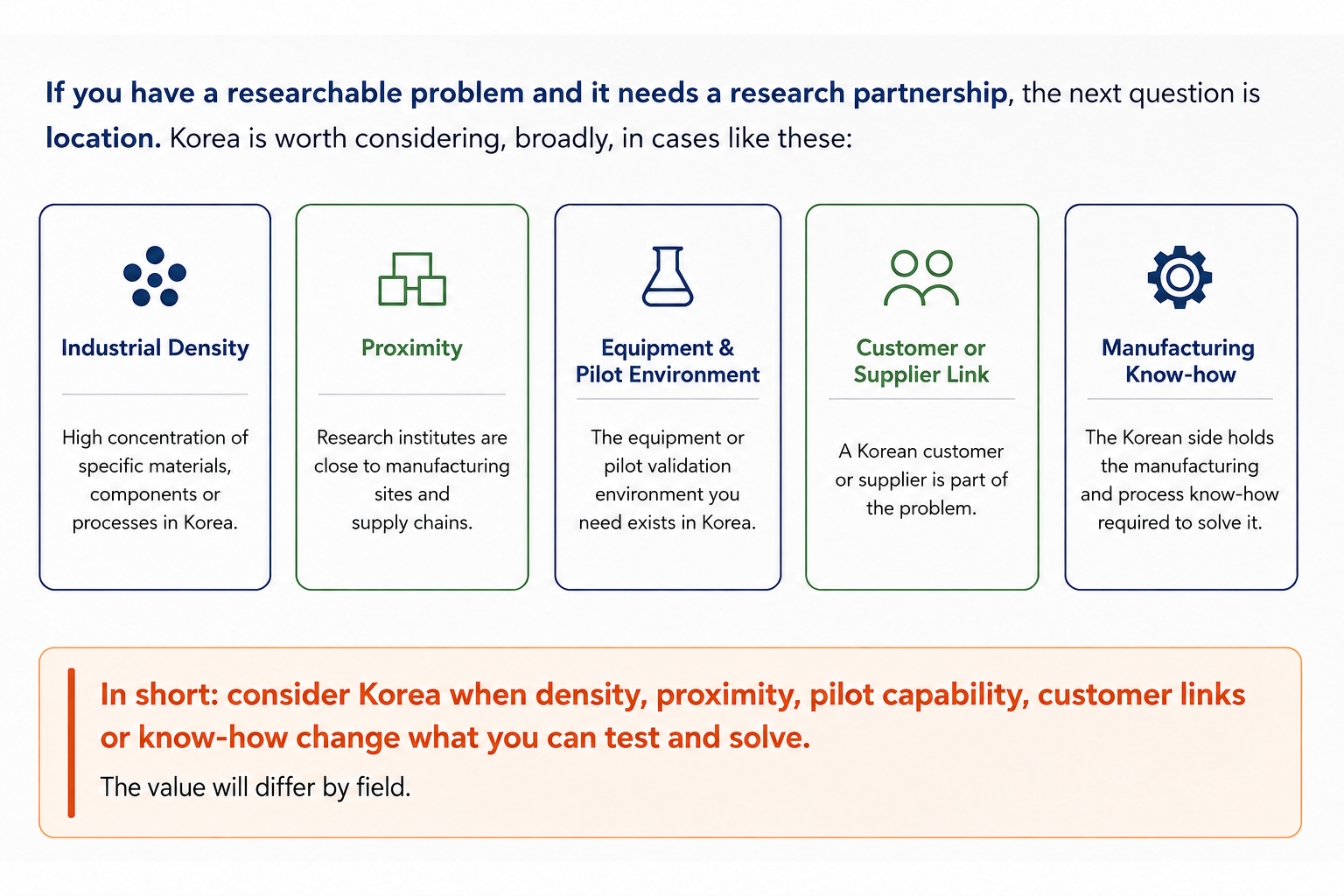
"Cheaper," "easier" or "government-funded" are weak reasons on their own to choose Korea. What matters is different access — access your home system does not provide. The decision question follows.
Can a Korean partner test this problem under conditions — equipment, pilot lines, supply-chain proximity — that are harder to access at home?
Bring the problem to Korea only when Korea changes what you can test, access or validate.
Where KITECH Fits
One case where manufacturing problems meet public research.
KITECH is one of the clearest places to see how Korea's public research system can engage with manufacturing problems. It is not the only possible entry point. Depending on the problem, KIMM, KRICT, ETRI or another public research institute may be closer to the required capability.
Which Korean public research institute may fit the problem?
KITECH is a strong entry point for manufacturing problems, but it is not the only one. The better fit depends on the technical nature of the problem, the infrastructure required and the kind of validation or development the company needs.
The Korea Institute of Industrial Technology (KITECH) is a government-funded research institute whose core mission is the development, application and diffusion of manufacturing technology. What makes KITECH relevant here is less its size than the way it brings several functions relevant to manufacturing problems into one public-research system. KITECH operates technical consultation, testing and analysis, on-site technical support, joint research, equipment access and technology transfer for manufacturing companies. Its Rental Lab can provide space, equipment access and technical exchange for manufacturing companies undertaking joint research or equipment-based work.
Where KITECH Fits — Need / Function / What to Verify
KITECH can engage with manufacturing problems in different ways. The relevant route depends on whether the company needs diagnosis, testing, process validation, technology adoption or international co-development.
One limit matters. KITECH's general company-support programmes are designed primarily for small and medium-sized Korean enterprises, and the applicability to foreign entities or European companies needs to be confirmed separately. A company with only a European entity should not assume it can apply under the same conditions; eligibility, costs and the contracting party belong in the first inquiry.
Three Ways a European Company Can Structure the Relationship
The routes between a European company and a Korean manufacturing research institute cannot be reduced to a single application channel. What shapes the real structure is who owns the problem and the contract inside Korea.
Three Ways a European Company Can Structure the Relationship
The route depends on who owns the problem, how the collaboration is structured, and what stage the company is in.
A. When a Korean entity or a Korean customer owns the problem. If the European company has a Korean subsidiary, plant, customer or supplier, that Korean party can be the operational owner of the site problem, the samples and the follow-up implementation. This is also the easiest configuration in which to check whether domestic company-support channels apply. Foreign ownership alone does not determine eligibility, so the size, location and sector conditions of each individual programme still need to be checked.
B. When Korean and European organisations form an international joint project. If the problem needs research capability on both sides and fits a call's purpose and timeline, Korean and European companies and research organisations can form a consortium. KITECH can be a research partner in such a project, but call selection and institutional matching do not follow automatically. Eligibility, fields and funding conditions have to be re-checked against the current year's announcement.
C. When a European company proposes cooperation directly. Even without a fitting standing programme, a company with a clearly defined manufacturing problem, once it has identified the capability it needs, can inquire with KITECH's global strategy office or the relevant research division about possible cooperation. This inquiry is a starting point for finding the right research group and cooperation format — it carries no guarantee of a research contract.
Friend-shoring
KITECH's Friend-shoring strategy signals a broader policy direction toward overseas manufacturing cooperation.
KITECH presents it as a strategic international cooperation framework linking manufacturing innovation for companies operating abroad with the strengthening of Korea's manufacturing base.
Actual participation possibilities should be confirmed separately with KITECH's Global Strategy Office and the relevant research division.
The One-Page Problem Brief — What to Send First
A first contact does not need a forty-page company presentation. Eight items on one page make it far easier for researchers and international cooperation officers to judge the fit.
From Inquiry to Project — Five Steps
Actual procedures differ by institute and programme, but the general flow from a manufacturing problem to joint research can be summarised in five steps.
Choose the First Contact
Once the problem is clear enough to discuss, choose the first contact based on what you need now — not on the institute name alone.
Define the Gap Before You Ask for the Bridge
A factory problem becomes ready for research when the company can define the operating context, measure the gap, show what remains unknown, provide evidence and name the decision the result will change.
Korea becomes relevant only when a Korean partner changes what the company can test or validate — through capability, equipment, process conditions, pilot access or industrial proximity.
Your first deliverable is not a research proposal. It is a one-page problem brief.
Define the gap before you ask for the bridge.
About This Reporting & Sources
This article draws on official materials from the Korea Institute of Industrial Technology (KITECH) and the Integrated Research Information System (IRIS), together with articles published in KITECH's production-technology journal.
The purpose of this series is to help readers ask better questions before expensive decisions, rather than to make the decisions for them.
KITECH's domestic company-support programmes are designed primarily for small and medium-sized enterprises. Whether foreign entities, Korean subsidiaries or Korean partners can apply — and on what cost terms — may differ by programme. This article does not assume that a European company automatically receives the same support.
The description of Friend-shoring follows the international cooperation framework presented on KITECH's official pages. It should not be read as a single programme announcement guaranteeing eligibility or support for individual companies.
Programmes, organisational units and contact points change. Readers should re-check official guidance before making an inquiry.
- KITECH — support for companies operating abroad · Friend-shoring
- KITECH — contact points: international cooperation, technology transfer, equipment
- KITECH — technical consultation: scope and procedure
- KITECH — Rental Lab: scope and procedure
- KITECH — technology transfer guidance
- KITECH production-technology journal — Friend-shoring: linking overseas manufacturing innovation with Korea's manufacturing base
- IRIS — industrial technology and international joint R&D announcements
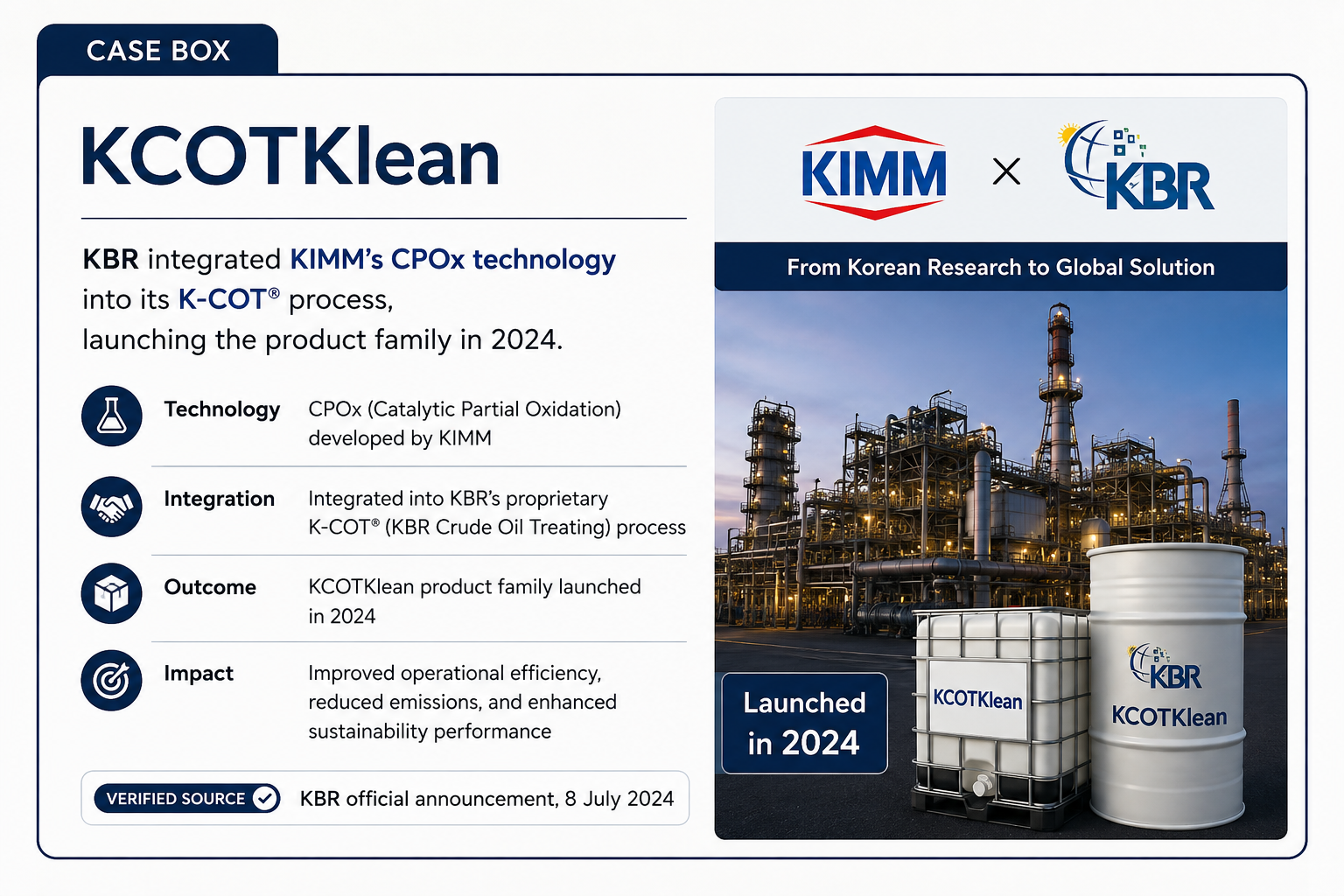
- KBR — KCOTKlean official announcement, 8 July 2024 · K-COT® + KIMM CPOx integration