The System Navigator
What makes a researcher stay in another system? Dr. Jung Han Choi reflects on research continuity, photonics, mobility and the culture that makes long-term careers possible.
What a Career Across Samsung and Fraunhofer Reveals About Research Mobility
The conditions of research mobility, read from one career that crossed from Seoul to Berlin
K-Institute| Korea Innovation Bridge, examines the conditions under which technologies and people move between Korea's public research system and the German and European research ecosystems. It is not a success manual for either side, but a map for researchers, companies and institutions on both ends of the bridge to read each other's institutions and timelines.
Researchers do not cross borders for a position alone. They move where their work can continue.
The AI you used today consumes a great deal of electricity. One of the most promising ways to reduce the power drawn by data centres is to send signals with light instead of electrons — a technology the world's semiconductor companies are now racing to develop.
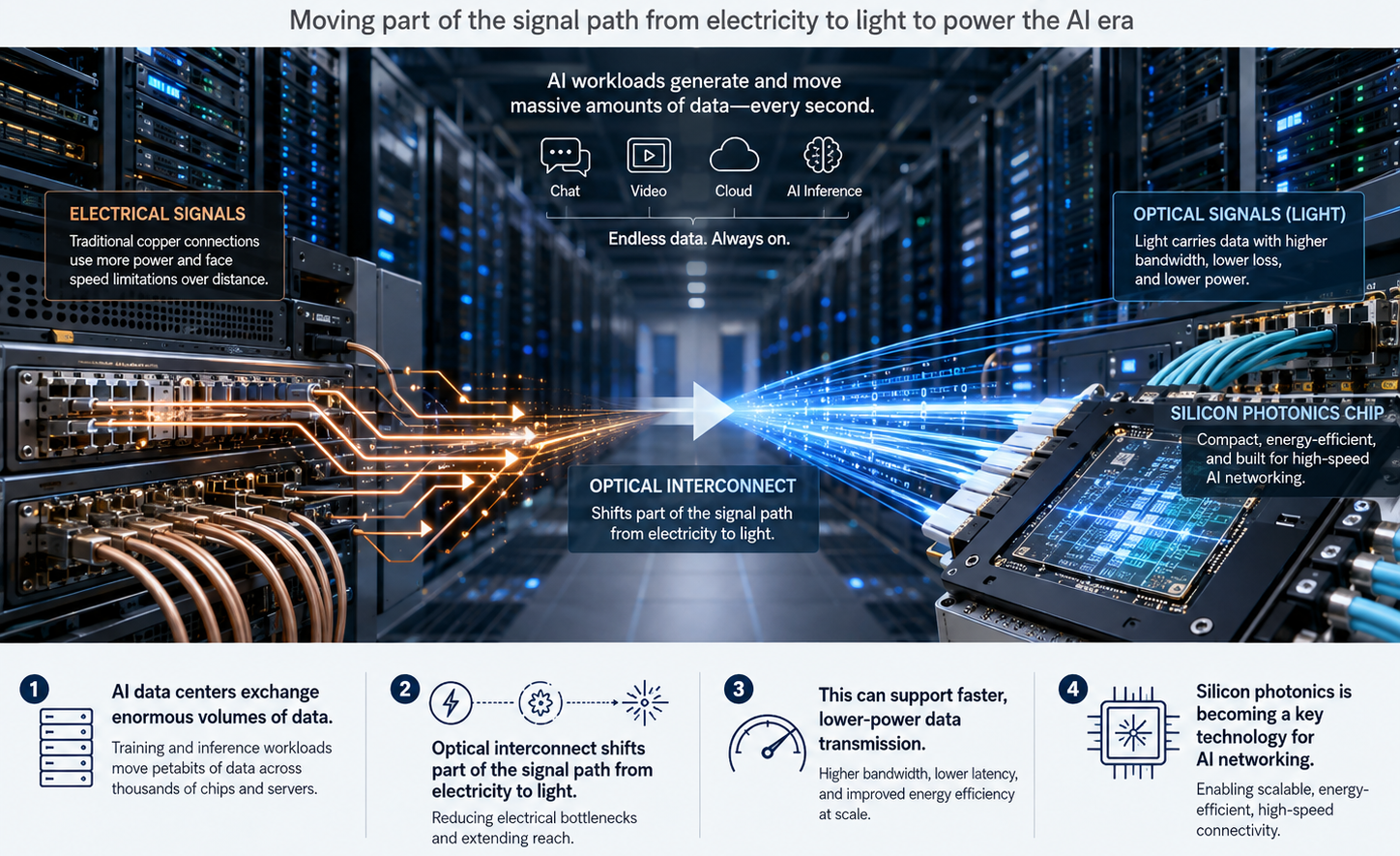
One of the research institutes leading that technology is the Fraunhofer Heinrich Hertz Institute (HHI) in Berlin. And in its IC design group, there is a researcher who came from Seoul.
The previous article — Who Chooses the System? — asked what a researcher looks at when judging a system, and stopped at this: the strongest evidence about a system is sometimes the career of a person who actually made that choice.
This article is that career. The direction is reversed: from a Korean corporate research lab to a German public applied-research institution. And that reverse journey becomes a mirror for the question this series is built around — how a European researcher's move to Korea might be designed.
The Decision
Dr. Jung Han Choi studied electronic engineering at Sogang University, earned his doctorate at the Technical University of Munich, and from 2005 worked at the Samsung Advanced Institute of Technology and Samsung Electronics' research labs. His fields were semiconductor devices and circuits, packaging, and next-generation technologies in high frequency bands.
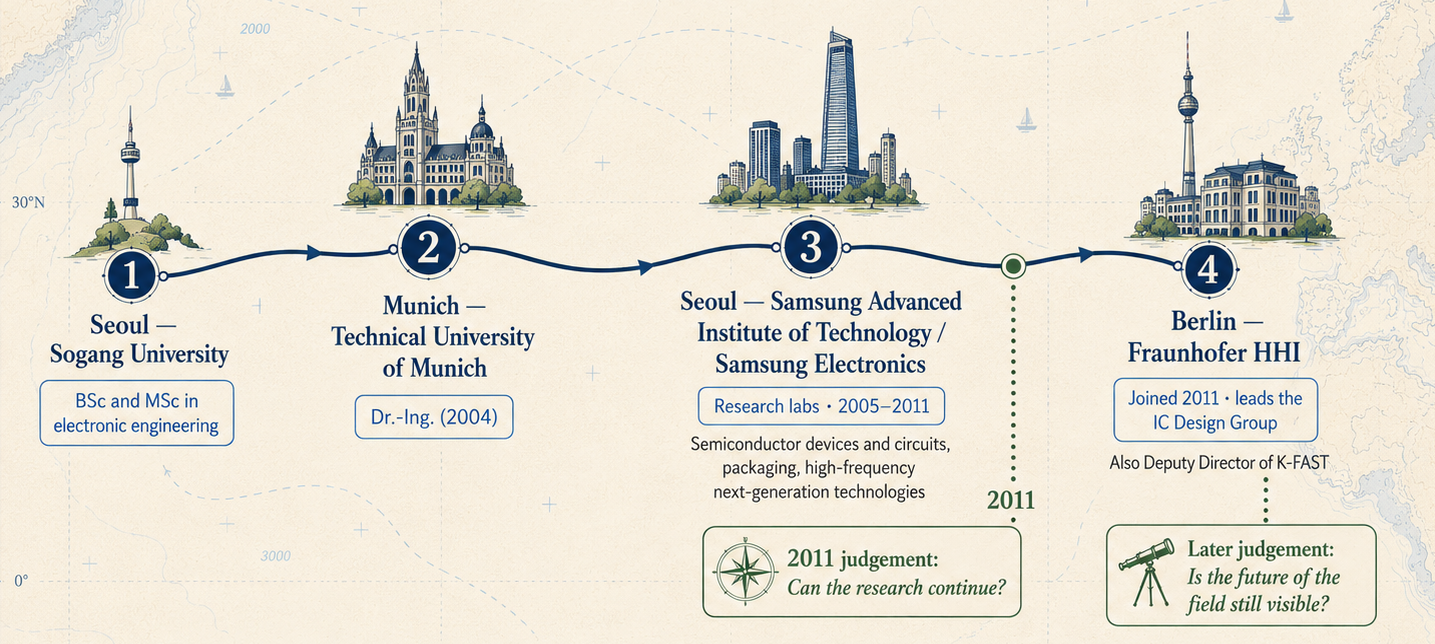
In 2011 he moved to Fraunhofer HHI. What tipped the decision?
I had spent a long time researching semiconductor devices, circuits and packaging. The biggest reason I made a different choice was the continuity of my research field.
Salary was not his first answer. Neither was the city, nor the name of the institution. Can I continue the research I have been doing? The continuity of a research topic is, for a researcher, the continuity of a career.
The organisational culture of the time also formed part of the background to the decision.
At the time, Korean companies tended to develop every solution in-house rather than embracing the open research culture of global companies, and this sometimes made it difficult to keep researchers motivated.
Profile — Dr. Jung Han Choi (최정환)
BSc and MSc in electronic engineering, Sogang University; Dr.-Ing., Technical University of Munich (2004). Worked at the Samsung Advanced Institute of Technology and Samsung Electronics' research labs from 2005 to 2011. Joined Fraunhofer HHI in 2011, where he now leads the IC Design Group. As Deputy Director of K-FAST, he also takes part in Korean–German technology cooperation.
This statement needs its coordinates in time. What Dr. Choi describes is the organisation he experienced in the late 2000s.
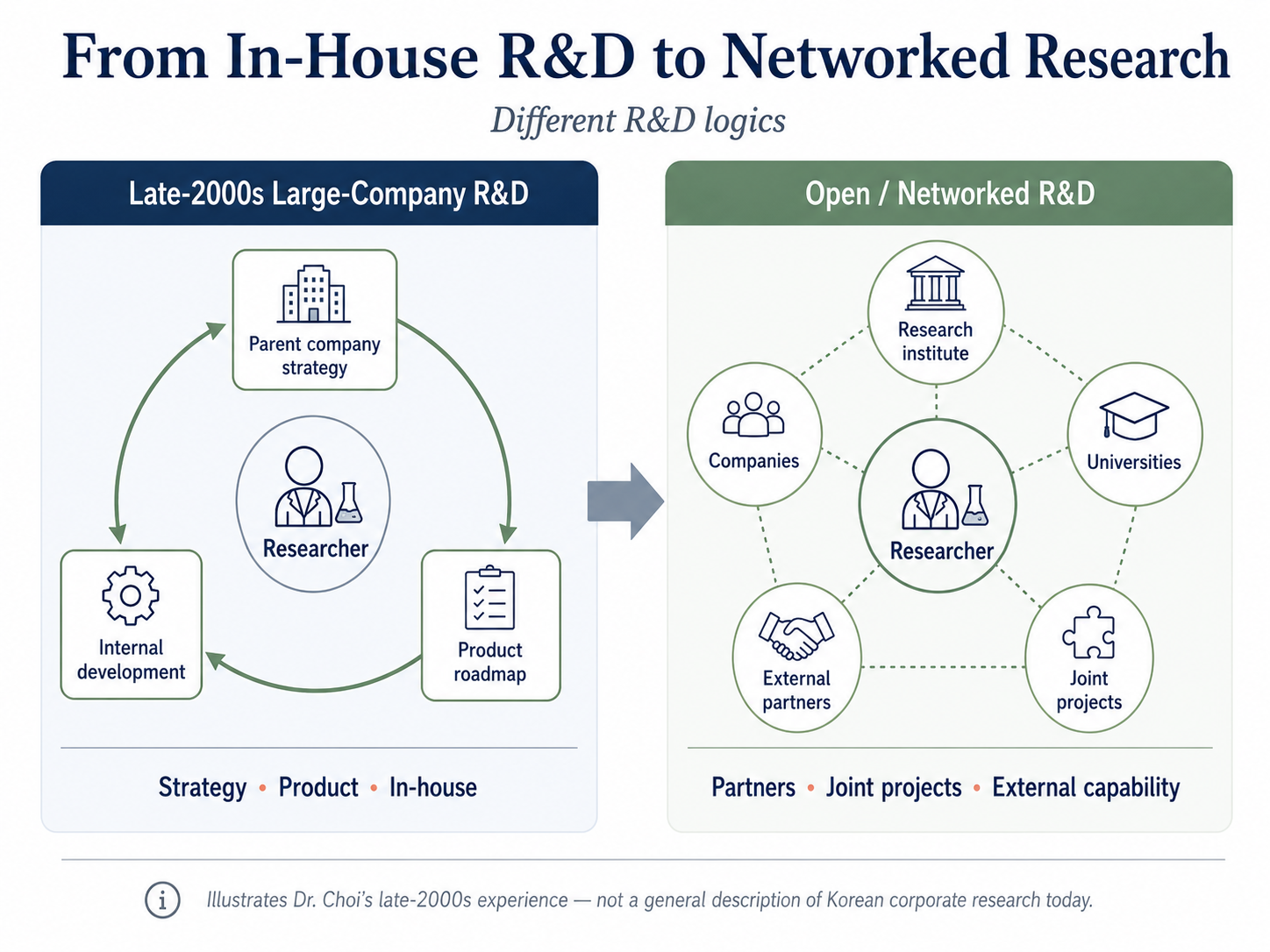
In the same interview, he assesses today's Korean research environment as greatly improved. The two statements must be read together for the passage of time to be visible.
Two Systems, Two Missions
How did the two organisations look to someone who has experienced both a Korean conglomerate's research lab and a German applied-research institution?
He reaches for the language of missions before the language of rankings.
Because the two research organisations pursue different missions, visions, strategies and core values, I think they also organise research topics and projects differently. Each organisation is internationally competitive in a way that fits its own mission and vision.
A Korean corporate research lab has the resources and the strategic research approach that befit a large company. Fraunhofer has the scale and the research methodology that fit the R&D needs of companies — especially SMEs.
| Axis | Korean corporate lab (late-2000s experience) |
Fraunhofer HHI (experience since 2011) |
|---|---|---|
| Whom the research serves | The parent company's strategy and products | The R&D needs of companies and the industrial ecosystem |
| Nature of funding | The company's strategic research investment | Contract- and project-based applied research |
| Organising logic | Corporate strategy and product roadmaps | Industrial demand and joint projects |
The table compares the two organisations Dr. Choi experienced at particular points in time. It cannot be generalised into a difference between Korea and Germany as wholes — the era and the character of the organisation act as two variables together.
The conditions of a move are never judged in a vacuum. Reading the other system's mission and funding helps a researcher estimate whether their work — and potentially their career — can continue inside it.
Why He Stayed
If the reason for moving was the continuity of research, what made fifteen years of staying? What makes Dr. Choi's answer interesting is that the two reasons are different.
Behind my decision to continue my career here in the long term was a judgement that the future marketability and applicability of photonic technology would keep growing. As everything became faster, more intelligent and smaller, and as power and environmental problems grew, I expected the electronics industry to evolve toward using optical technology. That has become reality.
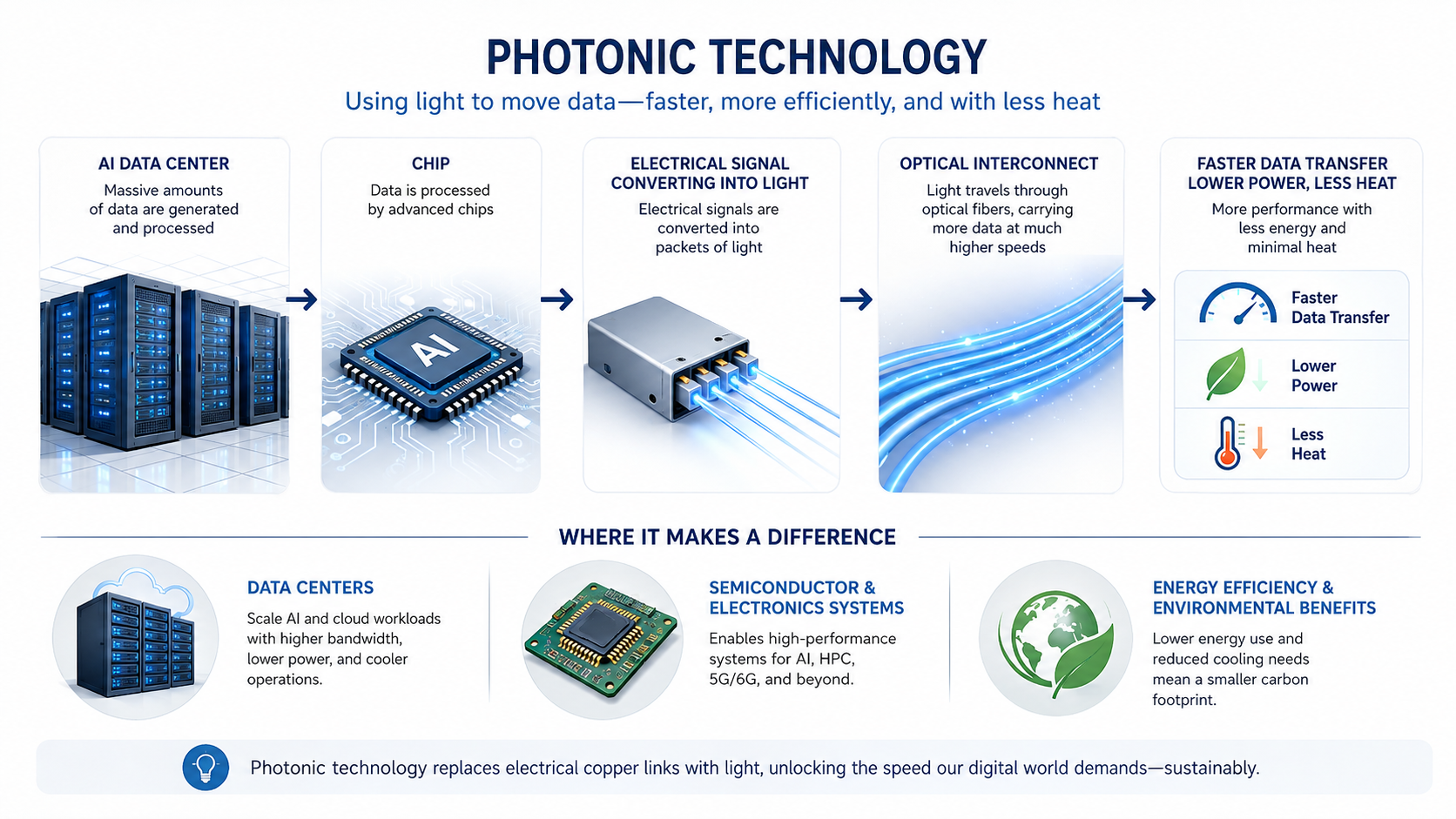
That reality is now all around us. Behind the AI you used today are data centres exchanging enormous volumes of data, and optical interconnect technology — converting part of the electrical signalling to light to lower the power burden — is expanding fast. NVIDIA has unveiled silicon-photonics-based networking switches; TSMC is developing a silicon photonics platform for high-speed, low-power data transmission. The judgement he made in 2011 has become the industry's present.
The institute where I work is leading this technology. Being here gives me a great advantage in maintaining and expanding an international network.
The question at the moment of moving was whether the research could continue. The question that emerged over time was whether the future of the field was still visible from where he stood.
What Cannot Be Seen Before Moving
Now turn the direction around. If a European researcher were considering a position at a Korean research institution, what would they want to know? Dr. Choi's assessment points less at the research conditions themselves than at the information outside the lab.
I think the research topics, contract periods, salaries, research funding, evaluation systems and working language at Korean research institutes have already improved to a world-class level.
This is not an objective verdict on Korean research institutions as a whole; it is the assessment of one researcher who has experienced both systems, and specific conditions vary by institution, rank and project. But his next answer shows where researchers from abroad actually feel the uncertainty.
One of the factors European researchers consider important is work–life balance. The administrative language needed for work beyond R&D, and the level of Korean needed for daily life, also matter. A family's living environment, education and housing would be things they want to know before applying.
Even when the official research conditions improve, the decision to move is not completed by them alone. For an international researcher, the offer extends beyond the laboratory.
Researching a Move to Korea: What to Check Beyond the Lab
A research position can be evaluated through more than its scientific topic. Before relocating, international researchers may also need to understand how the institution, workplace and everyday environment will function in practice.
Can a Joint Project Become a Door?
Where can European researchers and the Korean system first meet? In Dr. Choi's experience, the most realistic point of contact is joint research.
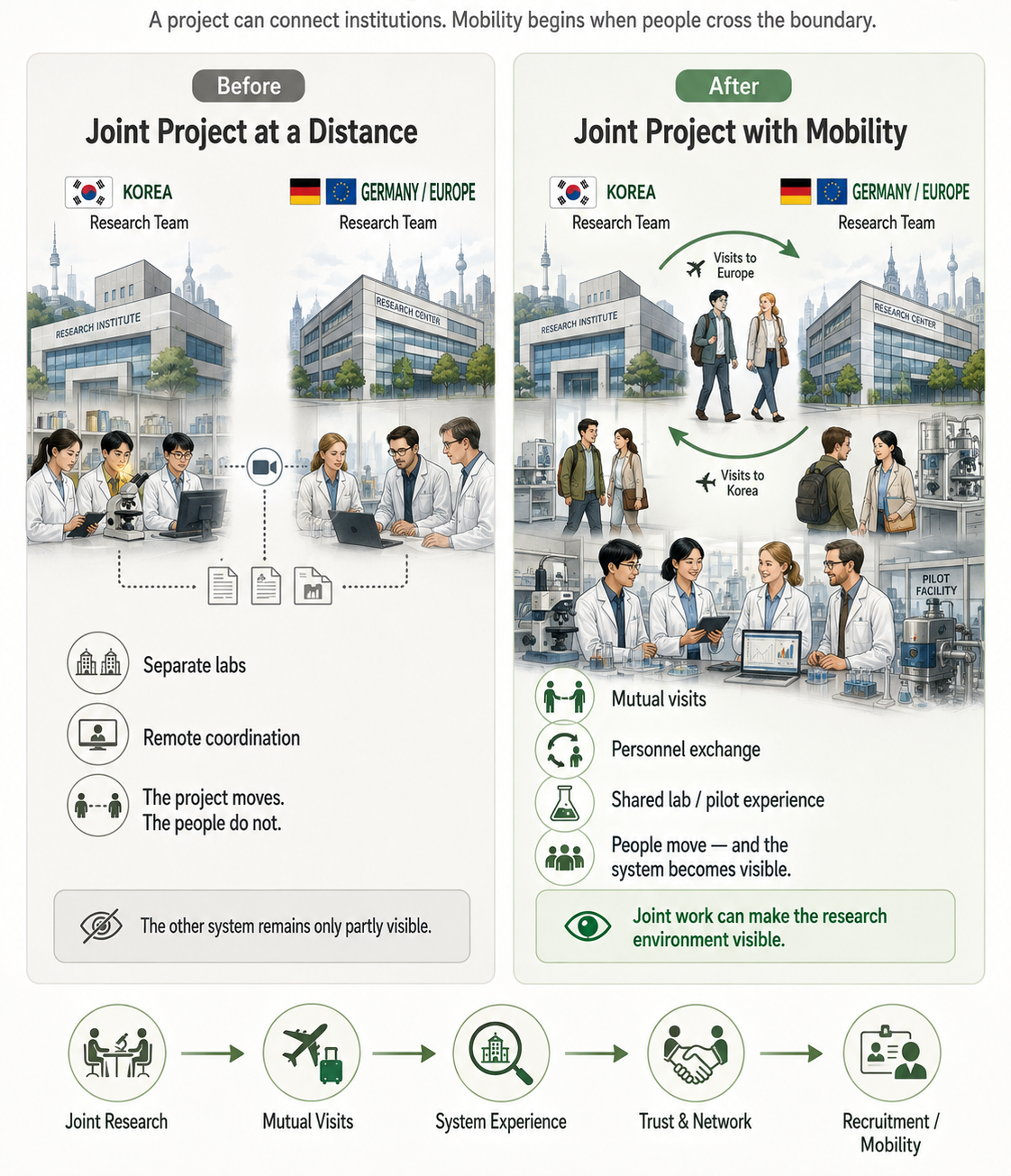
Opportunities for new cooperation seem to arise naturally in the course of doing joint research. In an actual joint project you experience, directly and indirectly, each country's companies and industrial ecosystem, its working culture and its way of doing business.
But a joint project does not turn into recruitment and mobility by itself. When the two sides simply carry out their own research at a great physical distance, the other system remains invisible.
For a joint project to become a doorway to recruitment or researcher mobility, mutual visits have to increase. For genuine joint research and future-oriented mobility, making personnel exchange a required element of joint projects would also help.
Only when people actually travel back and forth can they experience each other's research environments and ways of making decisions. Designing a joint project is not only a matter of dividing up the technical work — it can be a way of designing future talent mobility together. A vacancy may advertise a position. Joint work can make the research environment itself visible.
What Korea Should Show First
Routes of contact with Korea already exist. Dr. Choi points to conferences, trade fairs and joint projects as realistic starting points, and the Korean government supports the recruitment of overseas researchers and research teams through Brain Pool and Brain Pool+.
He argues that recruitment should not be limited to researchers with the highest publication metrics.
Researchers with strong high-impact publication records matter, but it also seems important to attract researchers who have built many points of contact with companies and research institutes through actual development work.
Asked which comes first — recruitment information, contract terms, an English working environment, or settlement support — he did not choose one. All of them matter, he answered, but beneath them lies a more fundamental condition.
What matters more is understanding the value of technology correctly and building a research culture on that understanding. The spirit of experiment and creativity — constantly challenging, debating, unafraid of failure — is built on an organisational culture that understands the value of technology development. Researchers want the research they do to be respected in its own right.
The interview changes the frame here. We began with six visible conditions of mobility: continuity, employment and funding, language and access, career portability, life outside the lab, and visibility of the route. Dr. Choi did not reject them. He placed something underneath them: whether the organisation understands and respects the value of the research itself.
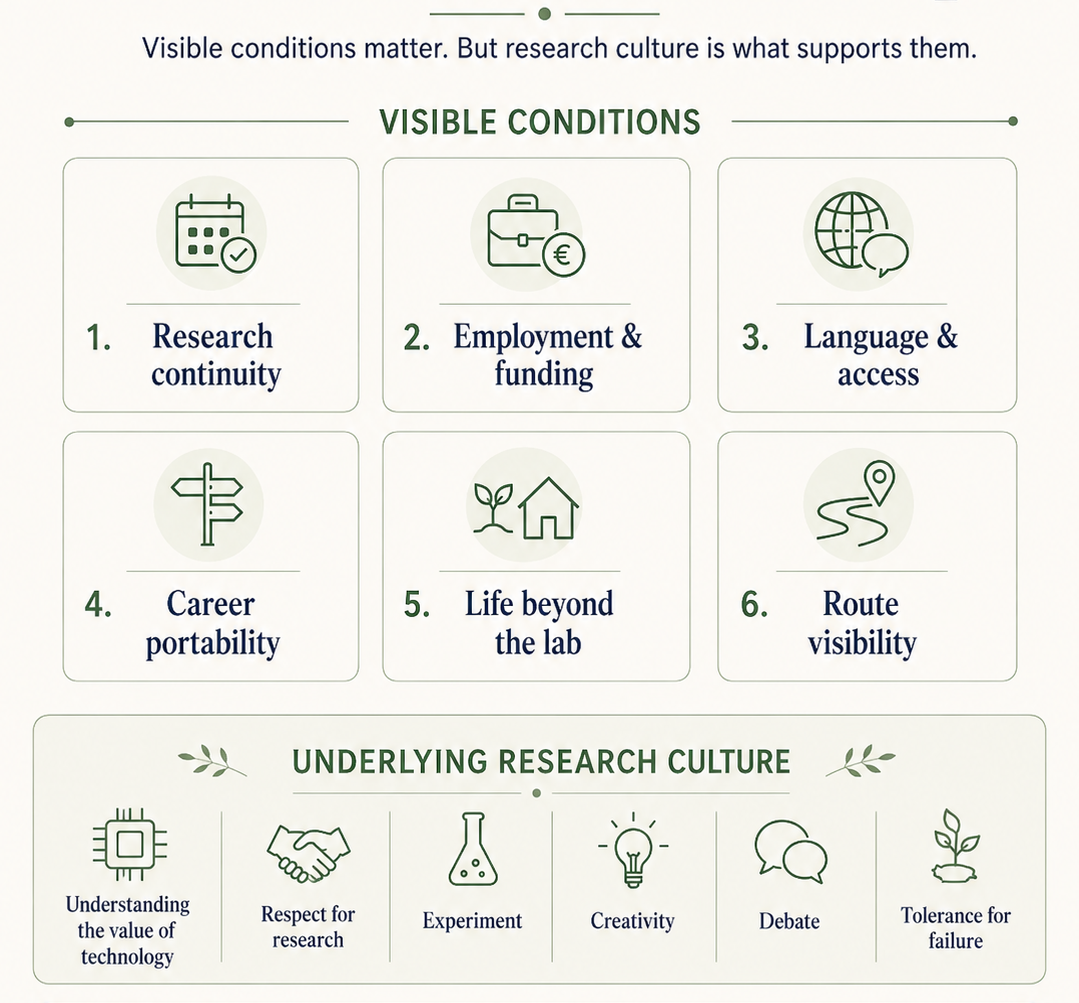
A good recruitment page can describe conditions. It cannot manufacture a research culture.
The Navigator's Map
Dr. Jung Han Choi's career does not offer a formula for research mobility. It shows how the criteria change over time. The question that matters at departure may not be the question that matters fifteen years later.
Joint research can make another system visible. But visibility requires people, not only projects, to cross the boundary.
Researchers do not cross borders for a position alone. They move where their work can continue — and where they can see a future for it.
Reader Route
If you are weighing a move, ask three things.
About This Reporting
This article is based on Dr. Jung Han Choi's written interview responses (received August 2026).
The "six conditions of choice" are an editorial hypothesis established by K-Welle when designing the interview, not an official classification. The article follows a structure in which this hypothesis is tested against the interviewee's experience and revised by the condition he added (research culture).
The comparison of the two organisations concerns the Korean conglomerate research lab Dr. Choi experienced in the late 2000s and Fraunhofer HHI since 2011. It is not generalised into a comparison of the Korean and German research systems as wholes. Statements about organisational culture are dated to the period experienced, and the interviewee's assessment that Korea's research environment has since improved greatly is carried alongside them.
Statements about the standing of his institute are attributed to the interviewee. Industry developments concerning AI data centres and optical interconnects were confirmed against official NVIDIA and TSMC materials. Quotations have been edited for rhythm and orthography without changing their meaning; before publication, the interviewee will be asked for final confirmation of the facts, the quotations and the English translations.
His answers to the common questions of After the MOU are not used in this article and are reserved for the final piece. Partner institutions supported reporting access and had no role in the content.
Corrections: editor@k-welle.com