The Fund's Choice
Who actually chooses which companies receive public capital? This episode follows the decision from government direction to KVIC, fund managers and the company — and shows why the fund’s clock matters.

Why This Matters
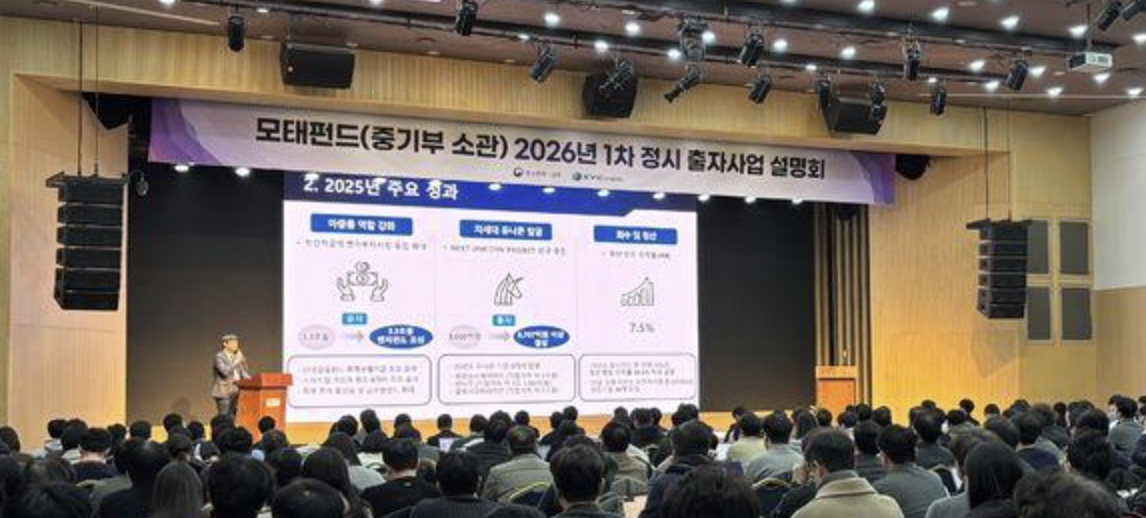
The government puts up the money. But it does not pick the companies that receive it; it picks the people it entrusts the money to. In 2026, 224 funds applied to the first regular call of Korea Venture Investment Corporation (KVIC). In deep tech, 34 applied and 15 went through to the next stage. Not one start-up presented. What was assessed was the people who will choose the companies.
So for a company seeking public capital, the first question is not only which funds the government has created. It is who actually holds the right to choose — and what that person is set up to look for.
What Does the Government Choose?
- Where the money goes: in Korea's 2027 budget proposal, the allocation to the Korea Fund of Funds rose from KRW 820 billion to KRW 1.3 trillion. KRW 240 billion goes to early-stage start-ups, KRW 285 billion to regional growth and KRW 525 billion to next-generation unicorn projects, including new security, AI and deep tech.
- The rules: the terms of investment and the criteria for selecting fund managers are written into the call in advance. If the Fund of Funds commits KRW 30 billion in the small early-stage category, the fund manager must raise a fund of KRW 50 billion, bringing in the rest from other investors.
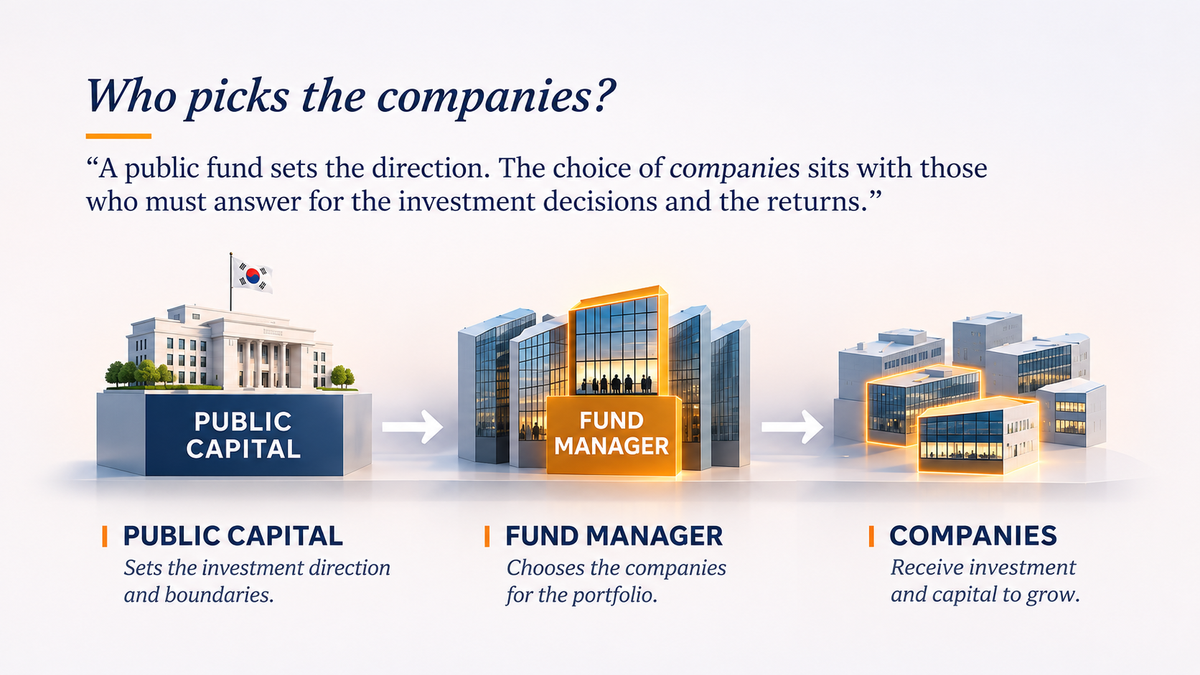
- What it does not decide: whether to invest in Company A or Company B, what valuation to put on it, on which terms to invest, and when to exit.
What the government sets is not the name of a company but the boundaries within which the money flows.
Who Actually Picks the Companies?
Within those boundaries, choosing companies is the fund manager's job. Fund managers find companies, carry out due diligence, value them and negotiate the terms; each investment decision goes through the fund manager's internal investment committee. The Fund of Funds receives the fund's partnership agreement and reports, but it does not sit where the decision on which company to invest in is made.
The work does not end with the choice. Fund managers join boards, decide on follow-on investment and, before the fund ends, must sell their stakes and return the money to investors. Choice and responsibility sit in the same hands.
Why Divide the Choice?
A government can judge that deep tech matters. Judging continuously, among hundreds of companies, which team can turn technology into a product, whether today's valuation is reasonable and how an exit might be possible some years later is a different kind of work. Venture investing weighs returns and risks across a portfolio in which some companies fail and a few large successes may decide the overall result.
K-Flow · Selection Map
The boundary of each decision
| Actor | What it chooses | What it does not choose |
|---|---|---|
| Government |
Sets the boundary
Sector, stage, region, policy direction and fund conditions. |
The individual company that ultimately receives investment. |
| KVIC |
Chooses the allocator
The fund managers entrusted to deploy capital within those boundaries. |
The individual portfolio company selected by the fund manager. |
| Fund manager |
Chooses the company
Company, valuation, investment terms, follow-on decisions and exit. |
The public-policy direction and investment mandate already set. |
The decision changes as the money moves: direction → allocator → company.
The government draws the map. Fund managers choose the companies on it.
THE QUESTION IS NOT ONLY
Who puts up the money?
IT IS ALSO
Who holds the next decision — and what are they responsible for?
Continue the Full Analysis
The full article follows the fund's own clock: what it needs to recover, how long it has to do so, and why even a strong technology may not fit if its path to exit lies too far away.
It then compares two ways public capital can share risk — Germany's KfW Capital investing pari passu with private investors, and Korea's public participatory National Growth Fund using subordinated public capital. The structures differ, but the company-level investment decision still sits with the fund manager.
Finally, it asks what a research team should read before approaching public capital.
Sources and reporting notes are in the full analysis.
FLOW POSITION — Allocator · Selection
NEXT → Ep.5 The Tax Clock — When Does a Benefit Become Real Money?