The Fund's Choice

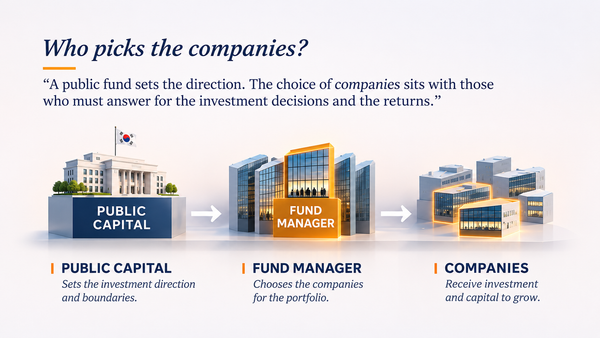
Who picks the companies?
“A public fund sets the direction. The choice of companies sits with those who must answer for the investment decisions and the returns.”
— EPISODE KEYSTONE
PART I · LENS 4 · SELECTION
Opening
The government puts up the money. But it does not pick the companies that receive it. Instead, it picks the people it entrusts the money to. If the government pays, why doesn't it choose the companies?
In 2026, 224 funds applied to the first regular call of Korea Venture Investment Corporation (KVIC). After the document review, 115 remained. Next comes an on-site due-diligence visit, and after that a presentation in front of the review panel. In deep tech, 34 applied and 15 went through to the next stage.
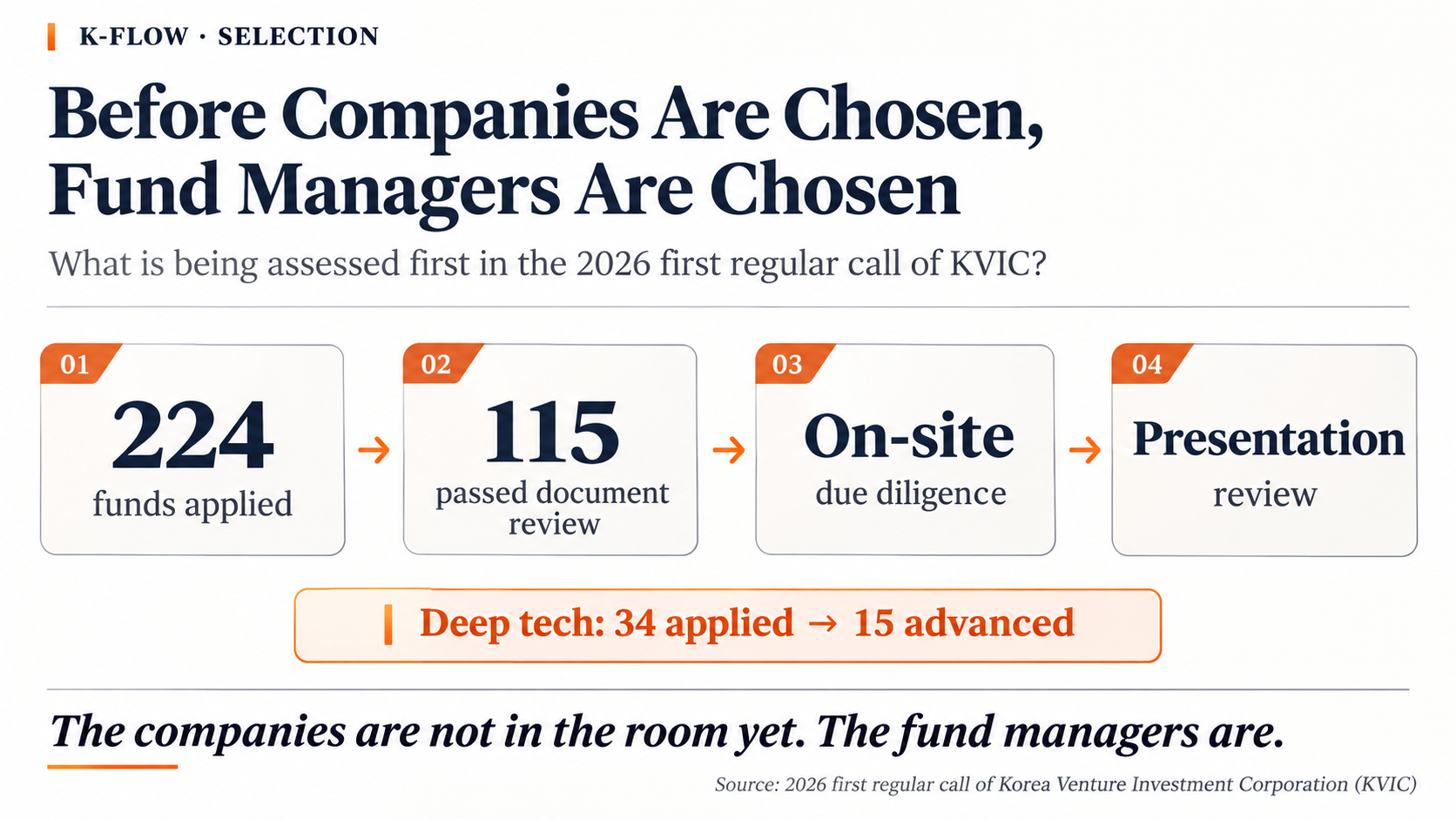
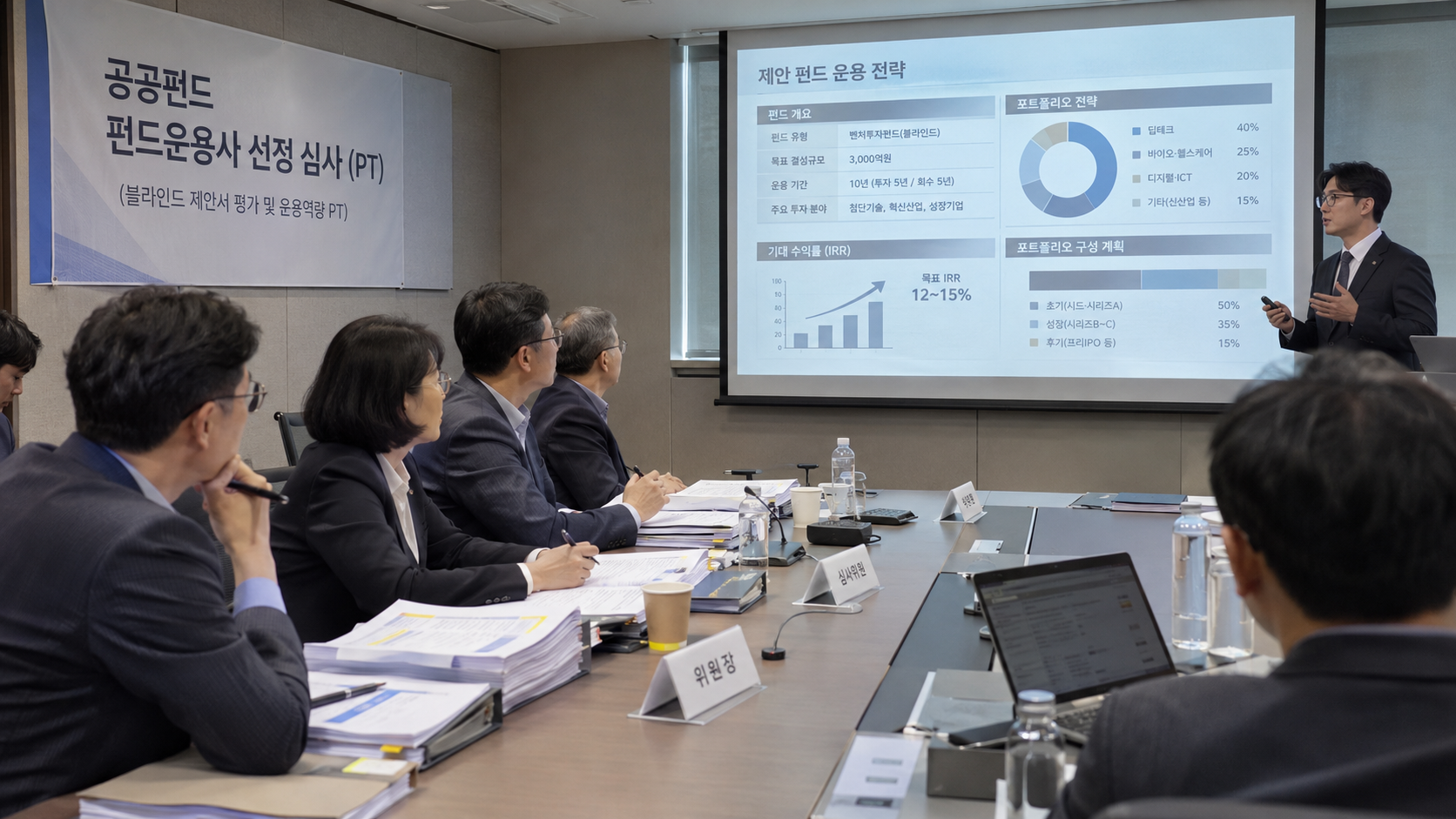
Illustration: a fund-manager selection presentation. The scene is illustrative and does not depict a specific KVIC review.
There is not a single start-up in that room. The ones presenting are venture capital fund managers. What is being assessed is not the company but the people who will choose the companies.
In a grant, a specific company and a specific project are what gets assessed for support and conditions. In a fund, the government does not choose every company itself. In Korea's 2027 budget proposal, the allocation to the Korea Fund of Funds rose from KRW 820 billion to KRW 1.3 trillion. That money goes into the Fund of Funds; KVIC, which manages the Fund of Funds, chooses the fund managers it will entrust the money to; and the fund managers choose the companies.
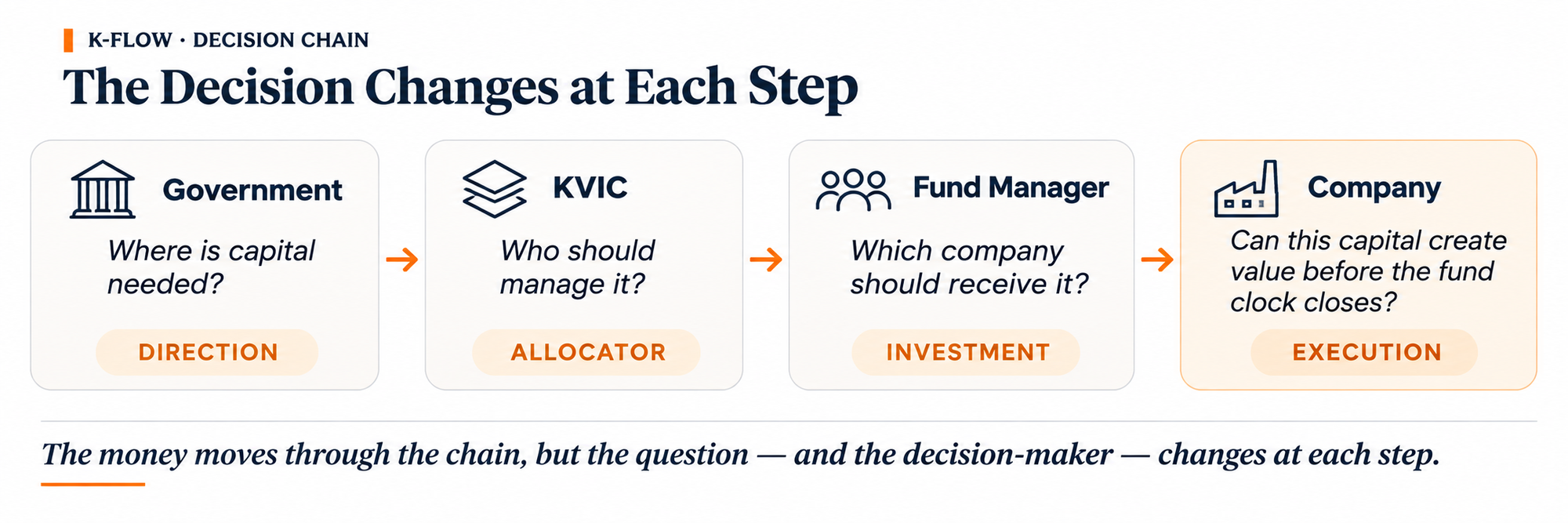
The money changes hands three times before it reaches a company, and each time the question changes. The government asks where money is lacking. KVIC asks who can manage that money well. The fund manager asks which company to back. What this episode follows is not simply the flow of money, but the movement of the right to choose. When public capital reaches a company, who actually holds that right?
What Does the Government Choose?
KVIC describes the Fund of Funds like this: the Fund of Funds invests in venture funds, and those funds invest in small and medium-sized and venture companies. It also states the reason in one sentence: “The government provides the investment capital, while investment decisions are handled by the specialist institution, Korea Venture Investment Corporation (KVIC)” (K-Welle's translation).
Even so, the government chooses a great deal. Of the KRW 1.3 trillion allocated to the Fund of Funds in the 2027 budget proposal, KRW 240 billion goes to early-stage start-ups, KRW 285 billion to regional growth and KRW 525 billion to next-generation unicorn projects, including new security, AI and deep tech. The government decided which growth stage to fund, which regions to support, which technologies to grow and how much to put in. The terms of investment and the criteria for selecting fund managers are also written into the call in advance. If the Fund of Funds commits KRW 30 billion in the small early-stage category, the fund manager must raise a fund of KRW 50 billion, bringing in the rest from other investors. Public money does not fill the whole fund.
What the government does not decide comes next: whether to invest in Company A or Company B, what valuation to put on it, on which terms to invest, and when to exit.
Before choosing any company itself, the government first chooses the market in which companies will be sought and the rules for seeking them. What it sets is not the name of a company but the boundaries within which the money flows.
Who Actually Picks the Companies?
Within those boundaries, choosing companies is the fund manager's job. The fund managers KVIC selected in the room described above go on to set up their funds, then find companies, carry out due diligence, value them and negotiate the terms of investment. Each investment decision goes through the fund manager's internal investment committee. As an investor, the Fund of Funds receives the fund's partnership agreement and reports, but it does not sit where the decision on which company to invest in is made.
The fund manager's work does not end with the choice. It joins boards, connects companies with the next investors, chooses which companies get follow-on investment and sometimes declines to put more money into investments that are not performing. And before the fund ends, it must sell its stakes and return the money to its investors. Choice and responsibility sit in the same hands.
The right to choose companies sits with those who manage the investment and answer for the follow-on decisions and the returns.
Why Divide the Choice?
A government can judge that deep tech matters. Judging continuously, among hundreds of companies, which team can turn technology into a product, whether today's valuation is reasonable and how an exit might be possible some years later is a different kind of work. The people who make that judgement again and again are venture capital fund managers.
Venture investing is not about eliminating failure. It is about weighing returns and risks across a portfolio in which some companies fail, some survive and a few large successes may decide the overall result. A decision looks different depending on whether you are accountable for one company's failure or for the performance of an entire portfolio. So the government sets the direction of an industry and the scope public money will cover, and within that direction it leaves to fund managers the question of which companies to back.
The government draws the map. Fund managers choose the companies on it.
What Does a Fund Need to Recover?
A grant shares part of a cost for a specific policy objective. A fund takes part in a company's growth and, in return, must be able to recover its money later as the company's value rises. A fund that includes public money does not look for lower returns. Money from the Fund of Funds is also money the fund must recover and pay back, and fund managers raise their next fund on the strength of those results.
The core exit a venture fund expects is to realise a rise in company value by selling its stake. There are broadly three routes: a stock-market listing, a sale to another company through a merger or acquisition, or a secondary sale of the stake to another investor. Whichever route it is, it has to open before the fund ends. Each fund sets a lifetime when it is formed, uses the first few years as its investment period and works on exits for the rest. A fund has its own clock, and that clock has an end date.
So fund managers look at more than a technology's potential. Will the market grow within the fund's time? Can the next stage of capital follow? Is an exit route visible? Even a good technology may not fit a fund if it takes too long to reach an exit, if its market is small, if follow-on capital is unclear or if its exit routes are weak. That is not a verdict that the technology is bad. It is a verdict that it does not fit the timing of this money.
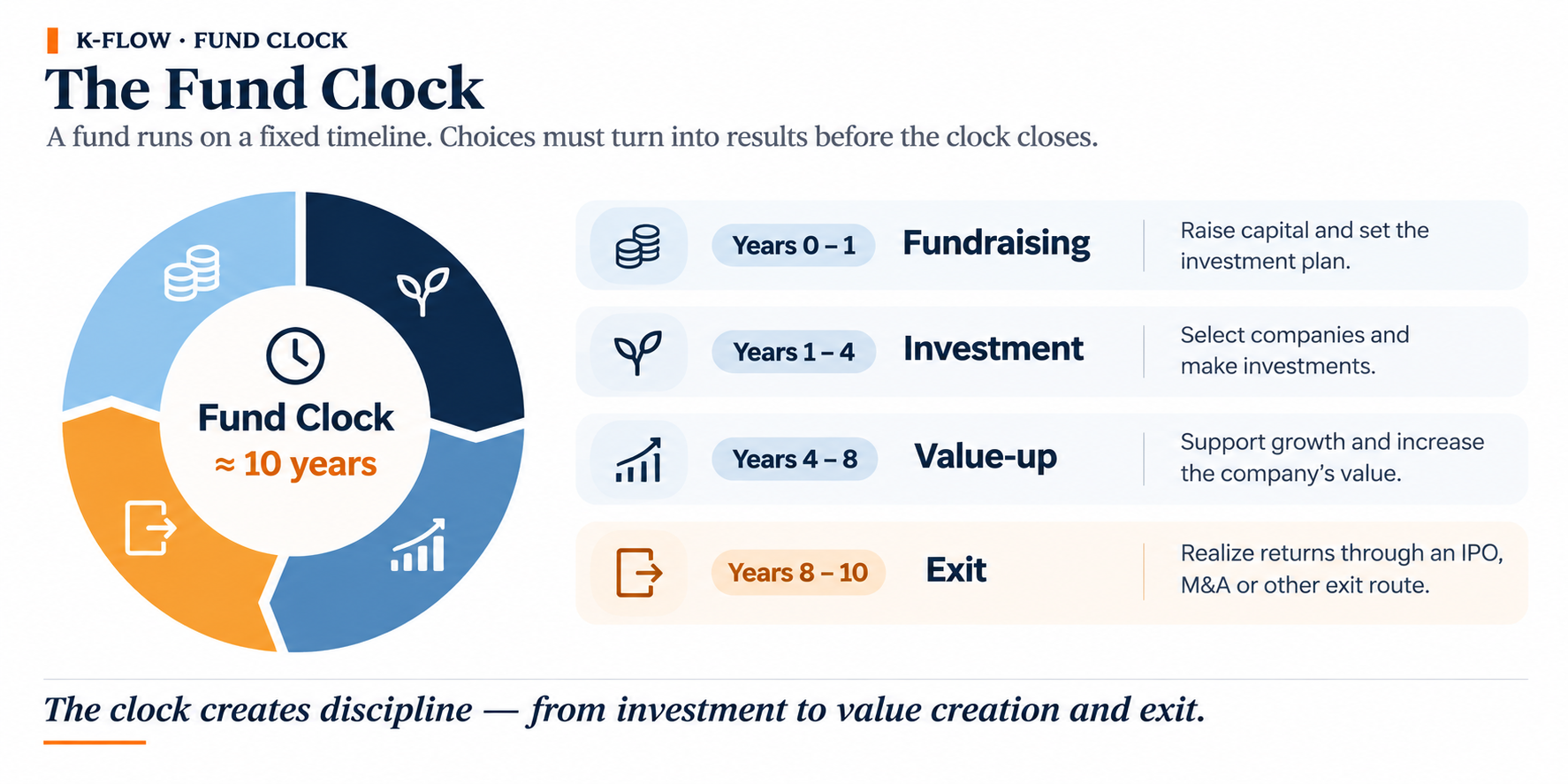
A fund looks not only at what a technology could do, but at whether that potential can become company value within the fund's time.
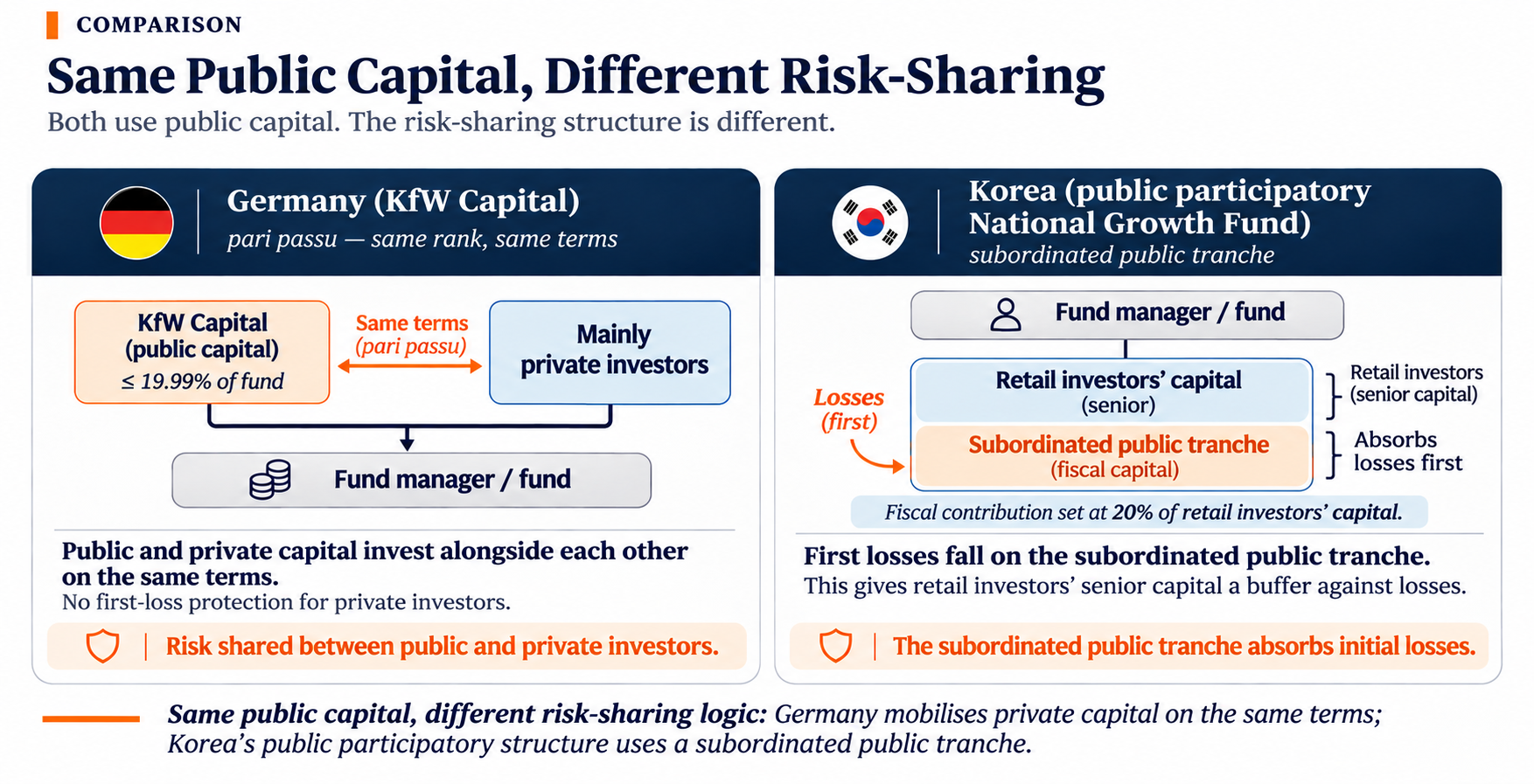
Same Public Capital, Different Risk-Sharing
Handing the choice to fund managers is not unique to Korea. Germany's KfW Capital takes money from the federal ERP Special Fund and the Future Fund (Zukunftsfonds) and invests it in venture funds. Its rules contain a Latin phrase: pari passu, “with equal step”. Public money enters a fund at the same rank and on the same terms as private money. It does not take its principal back first, and it does not push losses onto private investors first. Up to €25 million per fund, and up to 19.99% of capital and voting rights. The target fund should have mainly private investors, with no single investor holding a majority stake, and investment decisions are made by an independent private management team. There is one condition: the fund must invest at least the amount of KfW Capital's commitment in young, innovative, technology-oriented growth companies based in Germany. KfW does not decide which companies.
The same public money can also be designed differently. In the public participatory National Growth Fund (국민참여형 국민성장펀드), part of Korea's National Growth Fund, public money enters as a subordinated tranche and takes losses before retail investors' senior capital; the fiscal contribution is set at 20% of that senior capital. Public capital in the same kind of fund can enter on the same terms as private money, or it can enter as a subordinated tranche and reduce private investors' risk. This is not a claim that one approach is better. But in either case, the seat that chooses the companies stays with the fund manager.
Who Looks at My Company?
Government → Fund of Funds (KVIC) → fund manager → company. In this chain, the one who actually assesses a company founded by a research team is the last hand: the fund manager. The government's call for proposals tells you which stages and fields that fund manager is set up to look at; the fund manager's portfolio and the date its fund was formed tell you how much time that money has left.
But the chain does not always take the same shape. When the form of capital a technology needs changes, so does the person who holds the right to choose. In early-stage equity investment, the fund manager looks at company value and the chances of an exit. In large-scale equipment financing, policy finance institutions or deliberation bodies look at the sources of repayment and the business structure. Equipment, cash flow, supply chains and repayment structure enter the criteria. The National Growth Fund mentioned above is an example: it places indirect investment through private fund managers and direct judgement by a deliberation body within one scheme. Financing that looks at sources of repayment and business structure is covered later in the series.
K-Flow · Reader Tool Before approaching a fund Six checks to see who actually looks at your company.
Check these before you start the conversation:
- Who is the actual fund manager?
- Which stages does the fund invest in?
- Which industries does it look at?
- When was the fund formed?
- How much time is left before exit?
- What does its current portfolio already tell you?
A fund chooses companies within a time limit.
Closing
The government does not choose companies directly, but not because it has given up choosing. It divides different judgements among those best placed to make them. What matters is not whether the government picks companies, but which judgement it hands to whom, and at which stage.
If a research team founds a company and seeks investment, it is not enough to look at which funds the government has created. It needs to see who the fund managers making the actual investment decisions are, which stages and industries they look at, and within what time they expect to exit. Seeking public capital is not only a matter of persuading the government. It means reading the investment logic of the fund managers who hold the right to choose.
A public fund sets the direction. The choice of companies sits with those who must answer for the investment decisions and the returns.
The government can set a direction without choosing companies itself — through the name of a fund, or through its terms of investment. There is one more way to change direction without handing over money directly. The next episode turns to tax.
FLOW POSITION — Allocator · Selection
CHECK — Who actually chooses my company — and which stages, fields and exit timeframe is that person set up to look at?
NEXT → Ep.5 The Tax Clock — When Does a Benefit Become Real Money?
About This Reporting
In this article, “the government” is shorthand for the public sector that sets policy direction and public funding. In practice, investment and deliberation powers are divided among institutions: the ministry that drafts the budget, KVIC, KfW Capital, the Financial Services Commission (FSC) and the Fund Management Deliberation Committee, among others.
The structure and operating principles of the Fund of Funds follow KVIC's overview page. All 2027 figures follow the government budget proposal announced by the Ministry of SMEs and Startups (MSS) on 1 September 2026 and may change during National Assembly review. The total allocation follows the budget announcement; the amounts by category follow press reports of the budget briefing. The stages and figures of the first regular call of 2026 follow KVIC's application status and its notice of first-round document review results. The scene in the review room in the opening is an editorial depiction of the published procedure; K-Welle did not attend.
The internal investment committee and the fund manager's role after investing (“Who Actually Picks the Companies?”), the portfolio description (“Why Divide the Choice?”), and the exit routes and fund lifetimes (“What Does a Fund Need to Recover?”) are general descriptions of venture investing, not the wording of any particular institution; fund lifetimes and investment periods differ from fund to fund. KfW Capital's rules and conditions follow the basic terms of the ERP-VC programme on its programme page; exceptions for other programmes are not covered. The National Growth Fund's 2026 operating plan and the subordinated structure of the public participatory fund follow FSC material. The description of equipment financing in “Who Looks at My Company?” is general and does not refer to any particular deliberation case.
Some designs have the government look at companies directly and invest in equity; one example is the security-focused investment institution in the MSS 2027 budget proposal, which this article does not cover. Setting the two countries' structures side by side is an editorial arrangement; returns and performance are not compared. No fund manager is named. The research-team paragraph in the closing is the editors' generalisation, and the research team in the opening and closing is a hypothetical example.
Corrections: editor@k-welle.com
Sources
We consulted:
- Korea Venture Investment Corporation (KVIC) — Korea Fund of Funds: overview and operating structure — kvic.or.kr (in Korean)
- KVIC — Fund of Funds (MSS) 2026 first regular call: call for proposals, application status (26 February 2026) and first-round document review results (27 March 2026) (in Korean)
- Ministry of SMEs and Startups (MSS) — press release on the 2027 budget proposal (1 September 2026; total KRW 18.07 trillion, Fund of Funds KRW 1.3 trillion) (in Korean); allocations by category follow press reports of the budget briefing, including Newspim (1 September 2026) (in Korean)
- KfW Capital — ERP-VC-Fondsinvestments programme information — kfw-capital.de
- Financial Services Commission (FSC) — National Growth Fund 2026 operating plan and public participatory fund structure (in Korean)