The Tax Clock
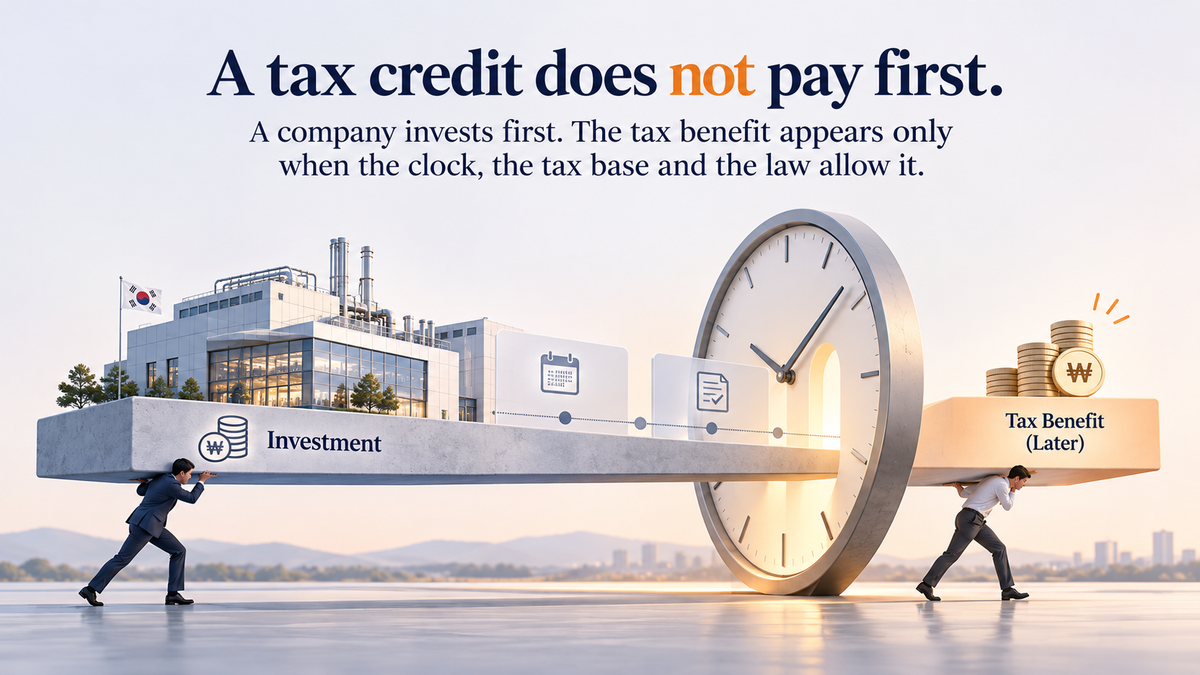
A tax credit does not fund the investment upfront. It lowers the after-tax cost later — and its value depends as much on timing, taxable income and eligibility as on the headline rate.

When does a benefit become real money?
Why This Matters
A company buys equipment. The government does not put money into its account; instead, the tax the company pays later goes down. In February 2025, Korea raised the basic investment tax credit rate for semiconductor National Strategic Technology facilities from 15% to 20% for large and mid-sized companies, and from 25% to 30% for small and medium-sized enterprises (SMEs).
But a credit rate is not cash. A company looking at a tax benefit should first ask not “What percentage?” but “When can I actually use it?”
The Company Pays First
- Recorded separately: forgone tax appears in the Tax Expenditure Budget, not in ordinary spending. For 2027, the government projects national tax expenditure of KRW 104.9 trillion, including KRW 23.7 trillion in investment and R&D tax credits.
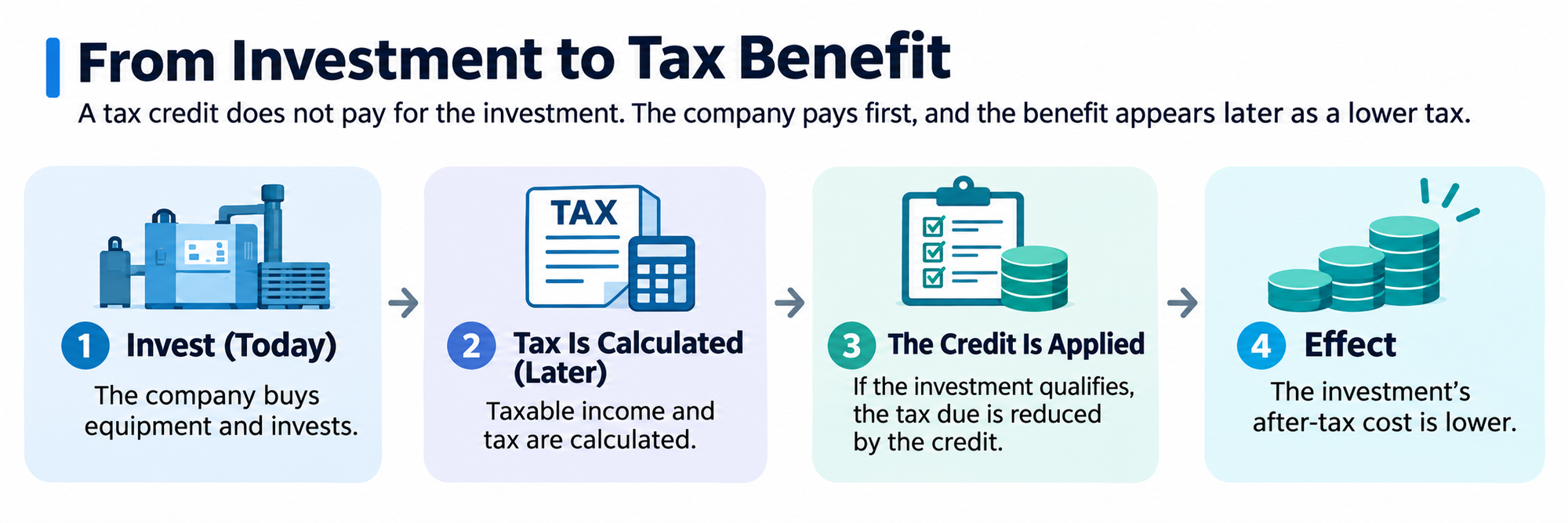
- Not a transfer: the company invests first; if it meets the legal requirements, the tax calculated later goes down. The government lowers the investment's after-tax cost rather than paying for it.
- Not in the funding share: in Korea's R&D statistics, government and public sources fund 21.2% of R&D. That figure captures direct funding flows, not support delivered later through tax incentives.
“Who spent the money first?” and “Who lowered the cost of that investment?” are different questions.
Same Rate, Different Value
The same credit rate does not mean the same money for every company. What differs is how much a company can invest, the rate that applies to it and, above all, whether it has tax to use the credit against. A loss-making early-stage company may hold the right to a credit but see no cash effect now. Unused credits can be carried forward under certain conditions, so the benefit is delayed rather than lost.
The value of a tax credit is not set by the rate alone. It also depends on when the credit can actually be used.
A Tax Benefit Has a Clock Too
A tax credit runs on two clocks:
- The application period: the window in which new investment or R&D costs can qualify. The National Strategic Technology investment credit applies until the end of 2029; R&D in semiconductor National Strategic Technologies has been extended to the end of 2031.
- The time of use: when the credit actually reduces tax. Unused credits can, under certain conditions, be carried forward for up to ten years.
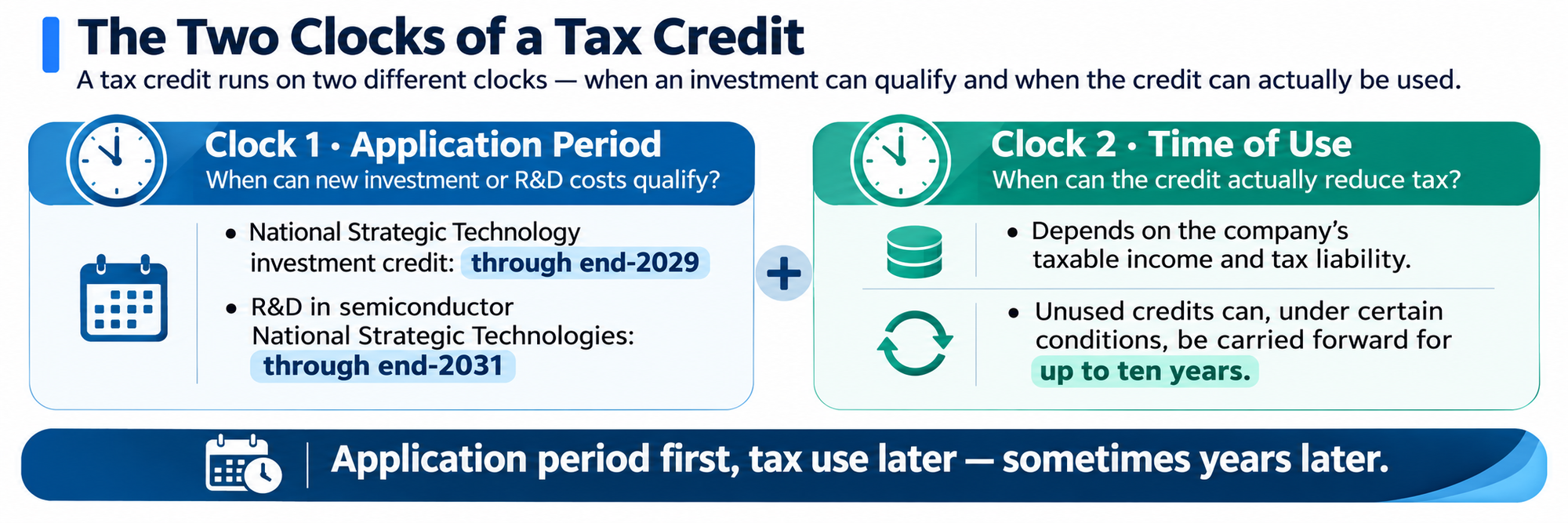
The two clocks sometimes turn in the same year, and sometimes run years apart.
THE QUESTION IS NOT ONLY
What is the credit rate?
IT IS ALSO
When can the credit actually reduce tax — and is cash needed before then?
Continue the Full Analysis
The full article shows how the law draws the boundaries first — technology categories, qualifying investments and conditions — and how companies step inside them.
It then sets Korea's tax credits beside Germany's declining-balance depreciation of up to 30%, and explains why a credit rate and a depreciation rate cannot be compared as they stand.
Finally, it asks when a tax credit does not fit — and what an early-stage company may need instead.
Sources and reporting notes are in the full analysis.
FLOW POSITION — Entry · Scale-up
NEXT → Ep.6 Where a Guarantee Sits — Whose Risk Does It Take On?