The Tax Clock

When does a benefit become real money?
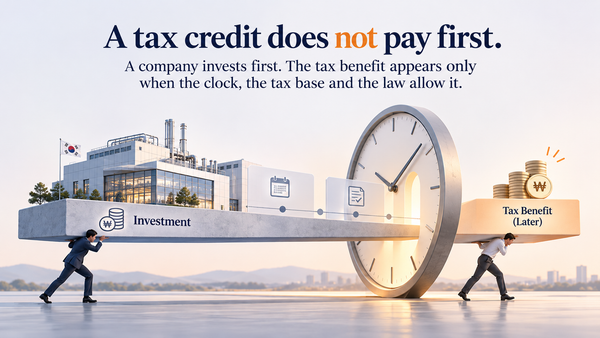
“A tax credit does not pay for the investment. It changes the after-tax price of the investment — and the time at which the benefit appears.”
— EPISODE KEYSTONE
PART I · LENS 5 · TIMING
Opening
A government can set a direction without choosing companies. With tax, it steps back further still. It does not choose which companies receive money; it decides which investments carry a lower price tag.
A company buys equipment. The government does not put money into its account. Instead, the tax the company pays later goes down. From the company's side, the price of the investment changes. The government handed over no money, and the company bought the equipment first. Yet this is still called support. Why?
In February 2025, Korea raised its tax credit rates for semiconductor investment again. For commercialisation and R&D facilities in semiconductor National Strategic Technologies, the basic investment tax credit rate rose from 15% to 20% for large and mid-sized companies, and from 25% to 30% for small and medium-sized enterprises (SMEs). Artificial intelligence and future mobility were also added to the National Strategic Technologies. The government did not decide to send money to any particular company. It decided to reduce part of the tax that qualifying investments would owe in future.
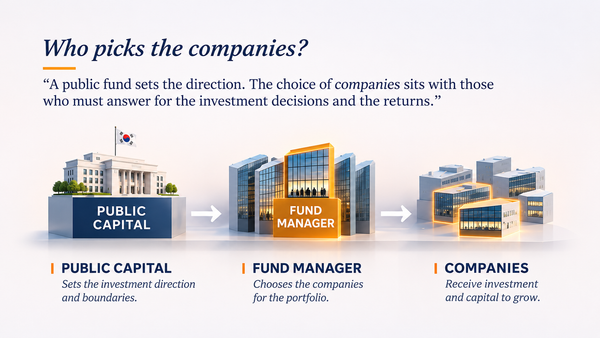
A grant assesses a specific project before support is awarded. A fund places public capital with managers who then choose the companies. A tax credit works differently again: no money moves from the government to the company. What changes is the after-tax cost of the investment — and it takes time for that difference to show up in the company's bank account. What this episode looks at is not so much the size of the credit rate as that time. A company looking at a tax benefit should first ask not “What percentage?” but “When can I actually use it?”
The Company Pays First
The tax a government forgoes is recorded separately from ordinary budget spending, in the Tax Expenditure Budget. For 2027, the Korean government projects national tax expenditure of KRW 104.9 trillion, up KRW 17.9 trillion from the 2026 projection of KRW 87 trillion. It attributed the increase to strong results at semiconductor companies and higher R&D and investment spending. Investment and R&D tax credits are projected at KRW 23.7 trillion of that total.
This is not the same kind of money as a subsidy. The company invests first; if it meets the legal requirements, the tax calculated later goes down. The government does not pay for the investment. Instead, it lowers the investment's after-tax cost by reducing the tax the company owes after investing.
To simplify: take an equipment investment of 100. With a tax credit, the company's after-tax burden changes. If a company can fully use a 20% credit on a semiconductor National Strategic Technology investment, the after-tax cost of that investment is lower than it would be without the credit. The government has not sent 20, but the return on investment the company calculates has changed. Actual credits vary with company size, caps and carry-forward, so these numbers only illustrate the structure.
Tax support and direct government R&D spending should therefore not be read as the same statistic. In Korea's R&D statistics, government and public sources fund 21.2% of R&D. That figure captures direct funding flows, not support delivered later through tax incentives. Even when a company is recorded as spending its own funds on equipment or R&D, government support through a later tax credit may be attached to that investment. That share is not in the 21.2%.
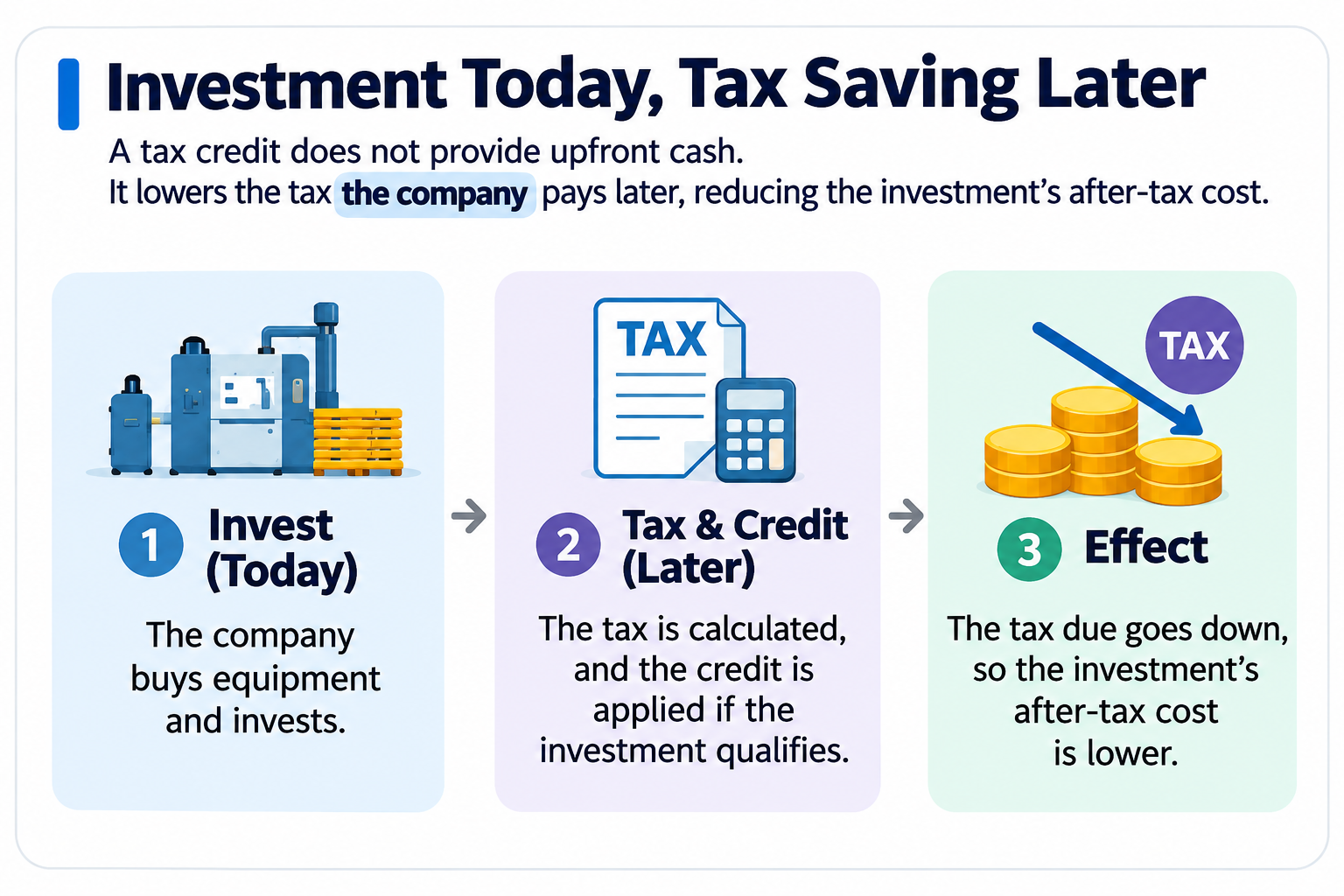
“Who spent the money first?” and “Who lowered the cost of that investment?” are different questions.
Same Rate, Different Value
The same credit rate does not mean the same money for every company. The first difference is how much a company can invest. To claim 20%, it must first be able to invest 100. A company investing KRW 10 trillion and one investing KRW 1 billion receive benefits of very different absolute size, even at the same rate. The second difference is the rate itself. For semiconductor National Strategic Technology facility investment under the 2025 amendment, the rate is 20% for large and mid-sized companies and 30% for SMEs. The scheme itself does not give large companies a higher rate.
The third difference matters more: is there tax to use the credit against? A tax credit comes off the tax a company owes. A company that already has taxable income and tax to pay, and that invests heavily in facilities, can use the benefit relatively quickly. The Tax Expenditure Budget shows this. Of 2027 national tax expenditure, KRW 24.6 trillion goes to large companies, and large companies' share of corporate tax expenditure rises from 16% in 2025 to 30.8% in 2026 and 49.9% in 2027. The government attributed this to stronger results from the semiconductor boom and higher investment and R&D credits. This does not show when any individual company used a credit, but it illustrates why aggregate tax expenditure can rise sharply when profits, investment and R&D spending rise together.
An early-stage technology company still making losses is in a different position. Even with the right to a credit, if it owes little tax now, the benefit does not appear as cash now. Amounts that cannot be credited in a given year because there is no tax to offset can be carried forward under certain conditions. So for a loss-making company the right to the credit does not vanish at once, but its actual cash effect can be pushed back. A company whose pre-tax profit falls just after a large investment faces the same problem. Three companies with the same credit rate can feel its effect at different times.
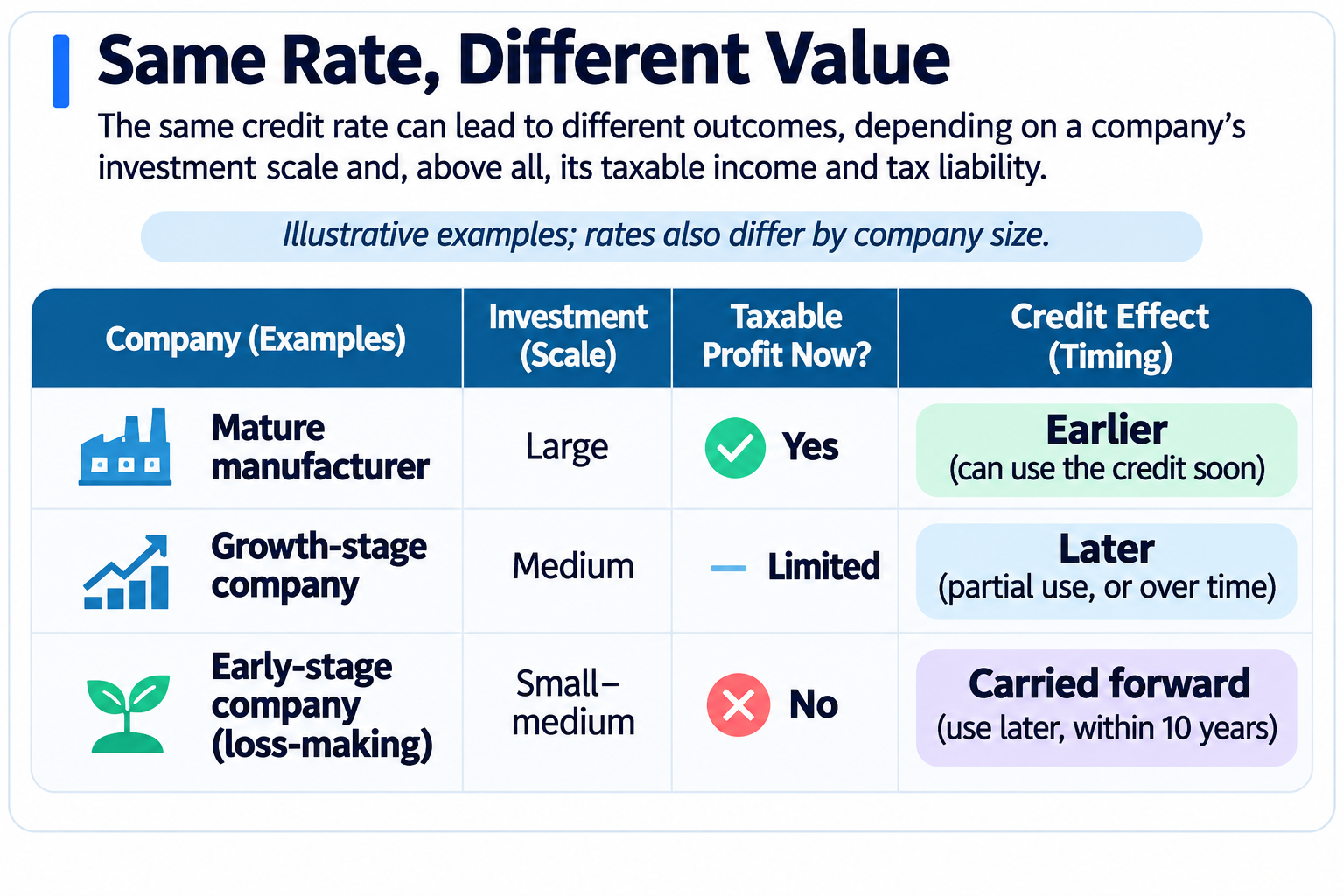
The value of a tax credit is not set by the rate alone. It also depends on when the credit can actually be used.
A Tax Benefit Has a Clock Too
A tax credit becomes money in four steps. The investment is made. Taxable income and tax are calculated. The credit is applied to the calculated tax. The company's tax outflow falls by that amount. The equipment investment happens today; the tax saving may appear later. The longer the gap between the two, the further a tax credit is from solving an immediate funding problem.
There is a second clock. The application period — commonly called the sunset — sets the window in which new investment or R&D costs can qualify. Under current law, the investment tax credit for National Strategic Technologies applies until the end of 2029, and the R&D expense tax credit also applies, in principle, until the end of 2029; R&D in semiconductor National Strategic Technologies has been extended to the end of 2031. Keeping these periods beyond that would require an amendment to the law. A credit earned within that window does not disappear just because it cannot all be used in the year it arises. Under current law, unused tax credits can, under certain conditions, be carried forward and used within ten years from the following tax year. A tax credit therefore has two times: the time when the right to the credit arises, and the time when that right is actually used against tax. Money runs on several clocks at once. The two clocks of a tax credit sometimes turn in the same year, and sometimes run years apart.
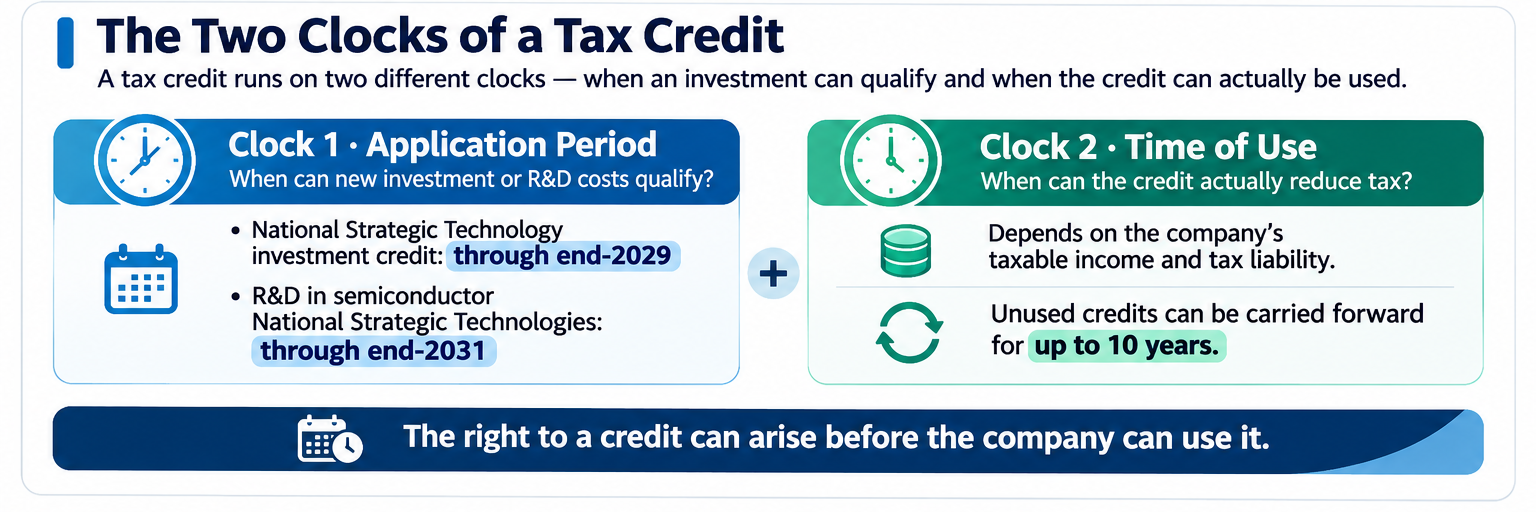
So the reader's question is not the credit rate. What is needed now — money for the investment, or future tax savings?
The Law Draws the Boundaries First
Tax credits involve choices too. First, technologies are sorted. Korea has a category called National Strategic Technologies and applies higher tax support to particular fields such as semiconductors, secondary batteries, displays, hydrogen and biotechnology. The 2025 amendment added artificial intelligence and future mobility to this category. Below it come New Growth and Source Technologies, and below those, general R&D and general facility investment. The same investment of 100 earns a different rate back in tax depending on the technology category, the type of investment and the size of the company. Next, the law sets which investments and costs qualify; finally, it sets an application period.
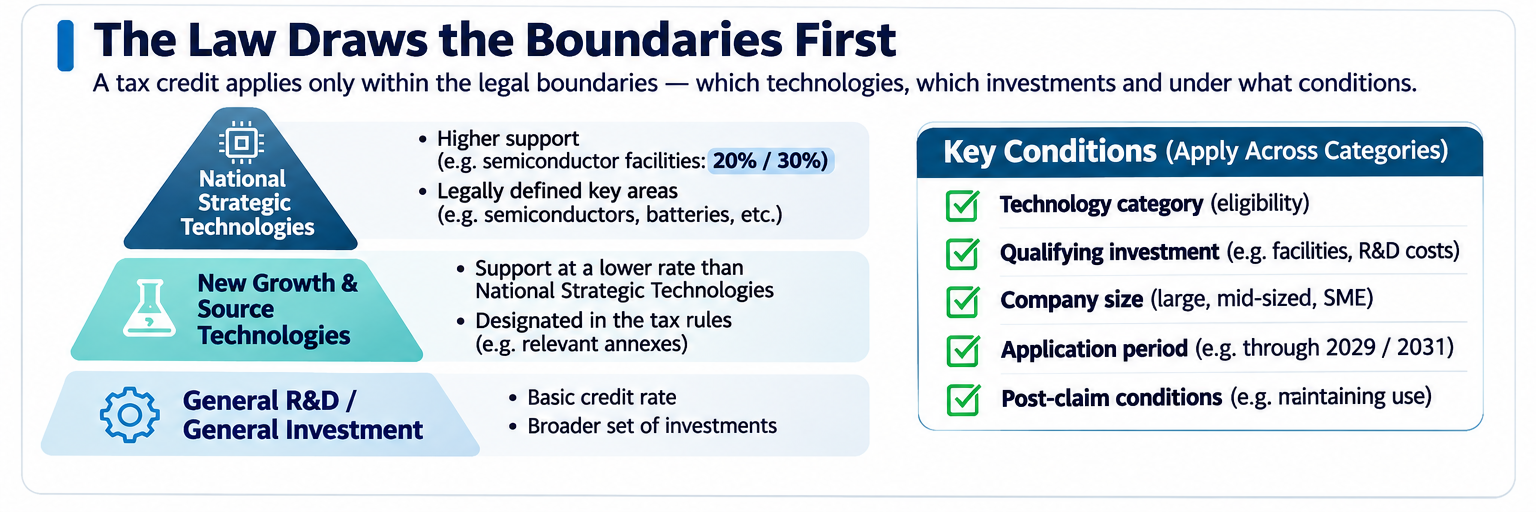
Some investment tax credits also carry post-claim rules. If a company breaches the requirements — for example by disposing of or leasing out the credited asset within a period set by law — it may have to pay back the credited tax.
That is as far as the government decides. Under ordinary tax credits, it does not allocate amounts company by company — so much to one large company, so much to a start-up. Any company that meets the legal requirements is subject to the same rules. A grant looks at a specific project; a fund looks at fund managers. With a tax credit, the law draws the boundaries first, and companies step inside them. That is why it can apply to many companies at once — and, conversely, why the government does not assess the technology, customers or returns of individual projects case by case. Aggregate data cannot easily show which plant was built because of a tax credit.
What the government chooses is not a company's name but the technology categories, the qualifying investments and the conditions of the credit. That is where the boundaries of tax support are drawn.
Same Tax Support, Different Time
Germany also used the tax system to accelerate investment in 2025. Its immediate tax investment programme (Investitionssofortprogramm) allows declining-balance depreciation, at a rate of up to 30%, for movable fixed assets acquired or produced from July 2025 to the end of 2027. The same law cuts the corporate income tax rate by one percentage point a year from 2028, to 10% in 2032.
Korea's 20% and Germany's 30% should not be compared as they stand. A tax credit rate and a depreciation rate are not the same kind of number. Korea's 20% is a share of the investment deducted directly from tax payable. Germany's 30% is a rate at which the cost of an asset can be written off earlier. Recognising costs earlier reduces taxable income now and pushes tax payments later. One reduces the tax itself; the other changes the timing of the taxable-income calculation. Which gives the larger benefit can only be compared once the investment amount, corporate tax rate, asset life, company profits and the time when the benefit can actually be used are held equal.
The two schemes also differ in resolution. Germany's declining-balance depreciation is not designed for a particular industry; it applies to companies investing in movable fixed assets in general. Korea gives National Strategic Technologies a higher rate than general facilities and, within that category, designs particular fields such as semiconductors separately. The German scheme is closer to bringing forward the timing of equipment investment across the economy; the Korean scheme is closer to giving higher benefits to specific strategic technologies and types of investment. In both, the company invests first, and the effect appears through the tax calculation.
When a Tax Credit Does Not Fit
There are situations in which a tax credit is unlikely to meet an immediate funding need: when a company has almost no tax to pay yet, when it is in early losses, when it needs cash now, and when funding is blocked before the investment can even begin. An early-stage technology company just out of the lab may face several of these at once. What it needs at that stage may be research funding or equity that arrives now, or equipment it does not have to buy. At the pilot and first-production stage, loans and guarantees can become important. For a company that already has taxable income and is investing heavily in facilities, the cash effect of a tax credit can appear relatively quickly.
In these cases, it is not that a tax credit offers no support; the support takes effect on a different timeline. A credit not used in a given year does not disappear at once — there is the carry-forward described in “A Tax Benefit Has a Clock Too” — but the point at which the benefit is actually used is pushed back, and that point may not match today's need for cash. As a technology's stage and a company's cash flow change, so does the form of capital that works. That is why governments use grants, funds, tax credits, loans and guarantees at the same time.
Closing
A subsidy gives a company money. A fund entrusts capital to those who will choose the companies. A tax credit sends the company no money; instead, it changes the calculation of the tax that remains after the company invests. So the question about a tax credit does not end with “How much did the government give?” How much can the company invest first? When will it make a profit? Which technologies carry a higher rate? Is the tax benefit cash today, or a benefit in the future? A tax credit is a form of support in which the time when the benefit can actually be used matters as much as the size of the rate.
If a research team has just founded a company and plans to buy its first equipment, it should look at its own company's clock before the table of credit rates. How many years until it makes a profit? Where will the cash it needs in the meantime come from? In which year will the tax benefit actually become money? Depending on the answers, a tax credit may reduce tax soon — or become usable only years later.
A tax credit does not pay for the investment. It changes the after-tax price of the investment — and the time at which the benefit appears.
A tax credit lowers the after-tax cost for companies that are able to invest, but it does not directly supply the cash needed now. Some companies have an investment plan and a source of repayment but cannot borrow because of their credit standing or lack of collateral. Then what the government changes is not tax but the credit the market sees. The next episode turns to guarantees.
FLOW POSITION — Entry · Scale-up
CHECK — Not what the credit rate is, but when I can actually use the credit.
NEXT → Ep.6 Where a Guarantee Sits — Whose Risk Does It Take On?
About This Reporting
In this article, “the government” is shorthand for the Ministry of Finance and Economy, which designs tax law, and the National Assembly, which passes it.
The 2025 amendments to the Restriction of Special Taxation Act follow the amendment bill passed by the National Assembly plenary session on 27 February 2025 and the press release of the Ministry of Economy and Finance (now the Ministry of Finance and Economy) on the bill's passage through the Strategy and Finance Committee (18 February 2025). Credit rates, application periods and the carry-forward period follow the Act in force as of September 2026 (Article 24 for the National Strategic Technology investment tax credit; Article 144 for carry-forward).
National tax expenditure, the projected investment and R&D tax credits, and large companies' amounts and shares follow the 2027 Tax Expenditure Budget submitted by the Ministry of Finance and Economy to the National Assembly with the 2027 budget proposal, as reported in the press. These are the government's projections. KRW 23.7 trillion is the projection for all investment and R&D tax credits, not large companies' share alone.
The 100/20 example in “The Company Pays First” is a simplification to show the structure; actual credits vary with company size, caps and carry-forward. The comparison of three companies in “Same Rate, Different Value”, the four steps in “A Tax Benefit Has a Clock Too” and the stage-by-stage description in “When a Tax Credit Does Not Fit” are the editors' generalisations. Because loss-making companies can use credits later through carry-forward, we have not written that credits disappear, only that their cash effect can be pushed back. Detailed carry-forward requirements and clawback periods are described without figures.
Germany's immediate tax investment programme follows the Federal Ministry of Finance's Monthly Report of August 2025. Korea's credit rates and Germany's depreciation rate work in different units and are not compared directly; the comparison of the two schemes' character in “Same Tax Support, Different Time” is the editors' interpretation. The statement that tax credits are not counted in government-funding statistics follows the OECD standard for R&D statistics.
No individual company's credits have been estimated. Whether the tax measures caused investment is beyond the scope of this article. The research team in the closing is a hypothetical example.
Corrections: editor@k-welle.com
Sources
we consulted:
- National Assembly — partial amendment to the Restriction of Special Taxation Act passed in plenary session (27 February 2025) (in Korean)
- Ministry of Economy and Finance — press release on tax law amendments, including a higher semiconductor investment tax credit, passed by the Strategy and Finance Committee (18 February 2025); the same release on Korea.kr (in Korean)
- Korea Law Information Center — Restriction of Special Taxation Act, Article 24 (Integrated Investment Tax Credit) and Article 144 (Carry-forward of Tax Credits) (in Korean)
- Ministry of Finance and Economy — 2027 Tax Expenditure Budget (attached to the 2027 budget proposal, submitted to the National Assembly in September 2026); reports by Korea Tax News and Newspim (31 August and 1 September 2026) (in Korean)
- Federal Ministry of Finance (BMF) — Investitionssofortprogramm / Wachstumsbooster, Monthly Report, August 2025 (in German)
- German Bundestag — vote on the Investitionssofortprogramm (26 June 2025) (in German)