
Good Technology Does Not Cross Borders on Its Own
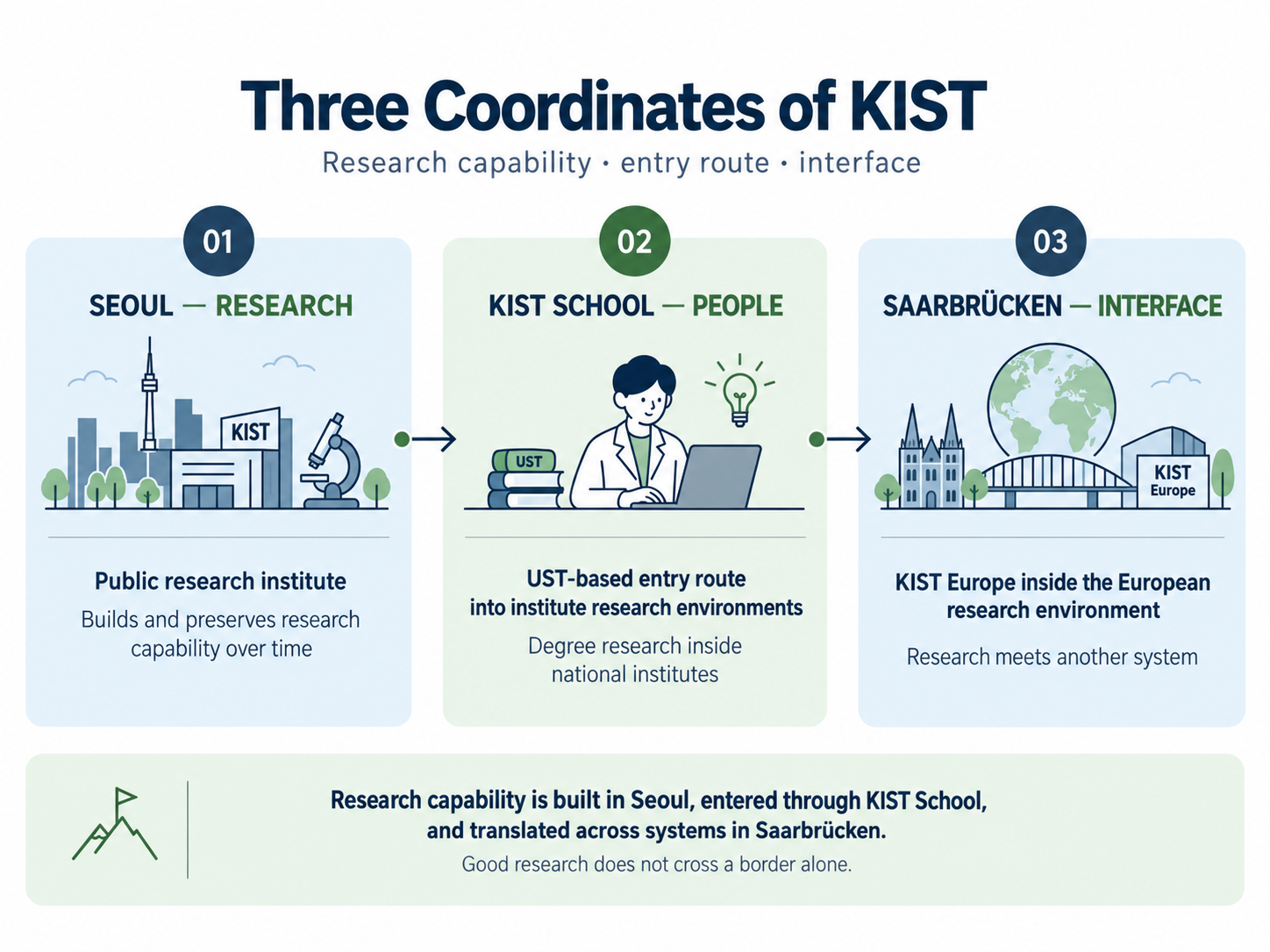
For STEM researchers exploring Korea, KIST appears in Seoul, at UST, and in Saarbrücken. Follow those three coordinates to see how research capability becomes cross-border collaboration.

Why KIST appears in Seoul, a graduate school, and Saarbrücken — and what that reveals about Korea–Germany R&D collaboration
K-Institute Part 1, Korea Innovation Bridge looks at what allows technology and people to move between Korea’s public research system and the German and European research ecosystem.
It is not a success manual for either side. It is a map for researchers, companies, and institutions trying to understand how the other system actually works.
Seoul — Where Research Capability Is Built / RESEARCH
The easiest place to begin understanding KIST is Seoul.
Here, KIST is neither a university nor a company. It is a public research institute designed to build and preserve scientific and technological capability over time.
European readers often try to understand Korean institutes by asking whether they are closer to Fraunhofer, Max Planck, Helmholtz, or another familiar model. That comparison can help, but only up to a point. The more useful question is not, ‘What is the German equivalent?’ It is: What function does this institute perform?
Universities generate knowledge and train researchers. Public research institutes also accumulate long-term capabilities that may need to survive beyond the life of a single project.
Take a hypothetical battery material. A paper may show excellent performance. But the next questions are different: Can the same result be repeated? Does it work with different equipment? Does performance remain stable at larger scale? What happens to cost and safety? Can it fit an existing manufacturing process?
Answering those questions requires more than one experiment. It requires people, instruments, data, and experience that remain after an individual project ends.
That is why one useful way to understand public research institutes is through the idea of research capability, not simply research projects. Seoul is the first position on this bridge. It is where the system builds what may later need to cross the border.
Capability has to remain.
KIST School — When a Research Institute Becomes an Entry Route / PEOPLE
For a young European researcher, another search result may be even more interesting: KIST School.
Why does a national research institute have a ‘school’? This is where another layer of Korea’s research system becomes visible.
UST — the University of Science and Technology — is a graduate university that uses the research environments of Korea’s government-funded institutes as part of its education system. Students do not only study on a conventional university campus. They can conduct their degree research inside national research institutes, working with their laboratories, equipment, researchers, and ongoing projects.
KIST School is therefore not another branch office of KIST. It is an interface between research capability and researcher entry.
That distinction matters for European STEM students considering Korea. When people search a research institute, they often begin with one question: ‘Are there research jobs?’ But for a master’s graduate, PhD candidate, or early-career researcher, the actual entry point may be somewhere else: a doctoral programme, research student position, internship, postdoctoral position, or joint project.
The better question is therefore not ‘Is KIST hiring?’ It is ‘What routes lead into KIST’s research environment?’ Once that question changes, the map changes with it.
Saarbrücken — Where Research Meets Another System / INTERFACE
The third coordinate lies outside Korea: Saarbrücken, in southwestern Germany, close to the French border.
KIST Europe has been based there since 1996. Its presence matters because it reveals something simple but often overlooked: good research does not automatically become international collaboration.
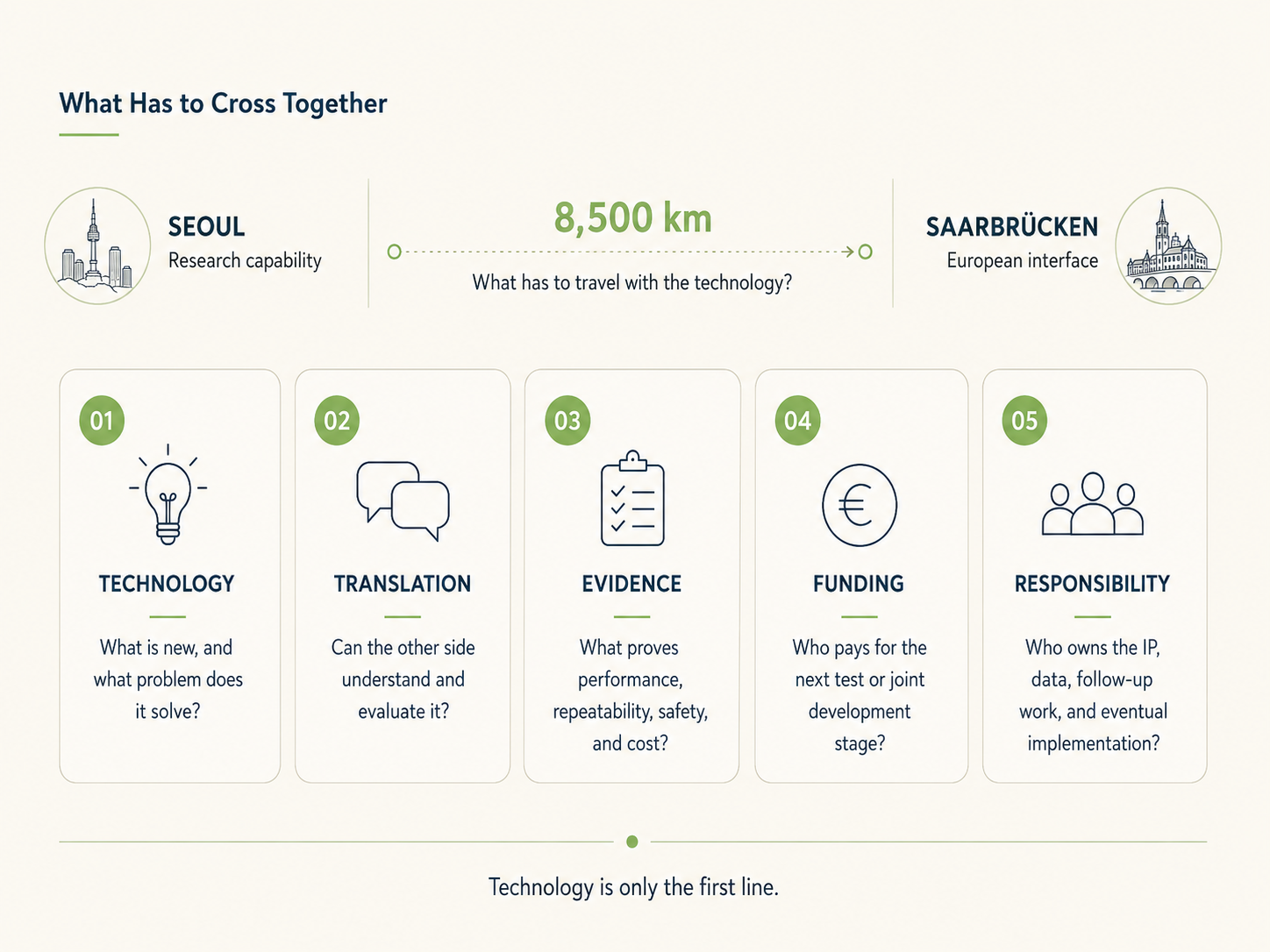
If strong papers and patents were enough, there would be little reason to build a permanent research presence thousands of kilometres from Seoul.
The moment a technology enters another research and industrial system, the questions change. Will it work on German equipment? Can its performance be described in terms a European industrial partner uses? What additional safety or environmental data are required? Who pays for the next test? Who owns the resulting data? Who takes responsibility after validation?
A paper does not answer all of these questions. That is why technology cannot cross a border alone. Several other things have to cross with it.
collaboration-ready technology.
“Translation” Does Not Mean Language Alone / TRANSLATION
In international R&D, the word translation can sound like a language problem. It is much more than that.
A Korean research team may say: ‘This material performs very well.’ A German industrial partner may immediately ask: Under which conditions? How many times was the result reproduced? Can it enter an existing production process? How much more expensive is it? What safety data are available?
The same applies in the opposite direction. A German research institute may present a technically mature solution. A Korean company may ask: When can we test it on a production line? Who will handle the customer response? Can this be linked to a Korean R&D programme? How long will the decision process take?
Both sides may be discussing the same technology. But they are often asking different questions.
This is why international collaboration needs more than an interpreter. It needs people who can translate technology, institutions, industrial expectations, funding logic, and time between two systems. That role does not belong to one type of organisation. Sometimes researchers do it. Sometimes companies do it. Sometimes a local research base or an intermediary platform does it.
KIST Europe and K-FAST Are Not the Same Bridge / CONNECTION
Another name appears once the search moves further into Korea–Germany research cooperation: K-FAST.
It can be tempting to place KIST Europe and K-FAST in the same category because both connect Korea and Germany. But they do different jobs.
KIST Europe is a local research anchor. It performs research in Europe and connects KIST with European institutions, networks, and research environments.
K-FAST is a coordination platform for Korea–Fraunhofer industrial R&D cooperation. It was launched in 2024 on the basis of Korea’s Global Industrial Technology Cooperation Center programme under the Ministry of Trade, Industry and Energy.
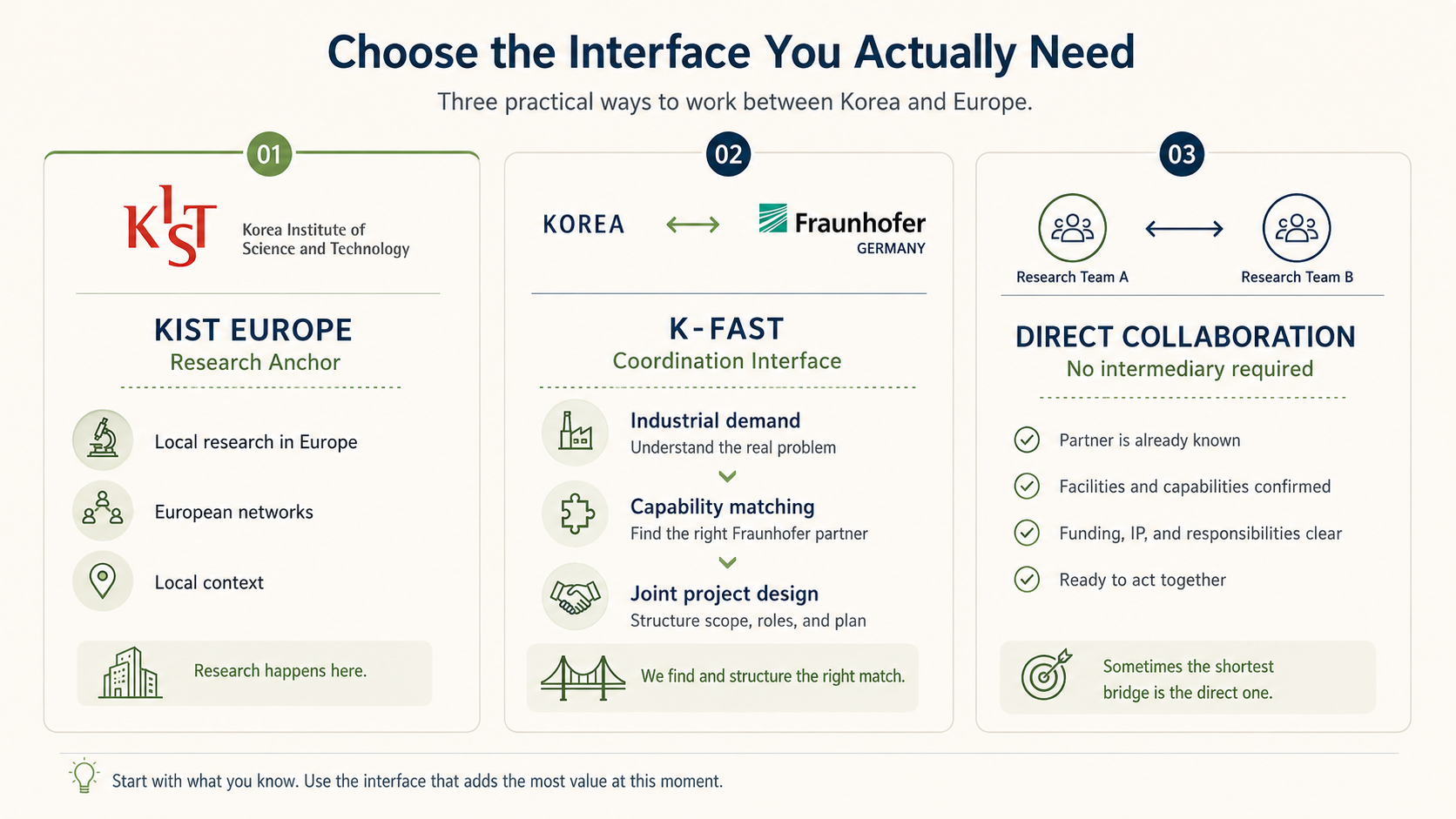
Its role is to help clarify industrial technology demand, identify relevant Fraunhofer expertise, translate expectations between the two sides, and structure potential joint R&D projects.
And sometimes neither is required. If two research groups already know each other, have the facilities they need, and can agree directly on funding, IP, data, and responsibilities, direct cooperation may be the better route. There is no single compulsory gateway to Korea–Germany R&D collaboration. The right interface depends on what has to happen next.
Do Not Start by Memorising Institution Names / NEXT PROOF
European researchers can also make the opposite mistake. They may ask: ‘What is Korea’s Fraunhofer?’ or ‘What is Korea’s Max Planck?’ Trying to match institution names one by one often creates more confusion than clarity.
A better question is: What evidence do I need next? Do you need new scientific understanding? Detailed materials characterisation? Repeatability under near-industrial conditions? A pilot-scale test? Customer validation? Standardisation or certification data?
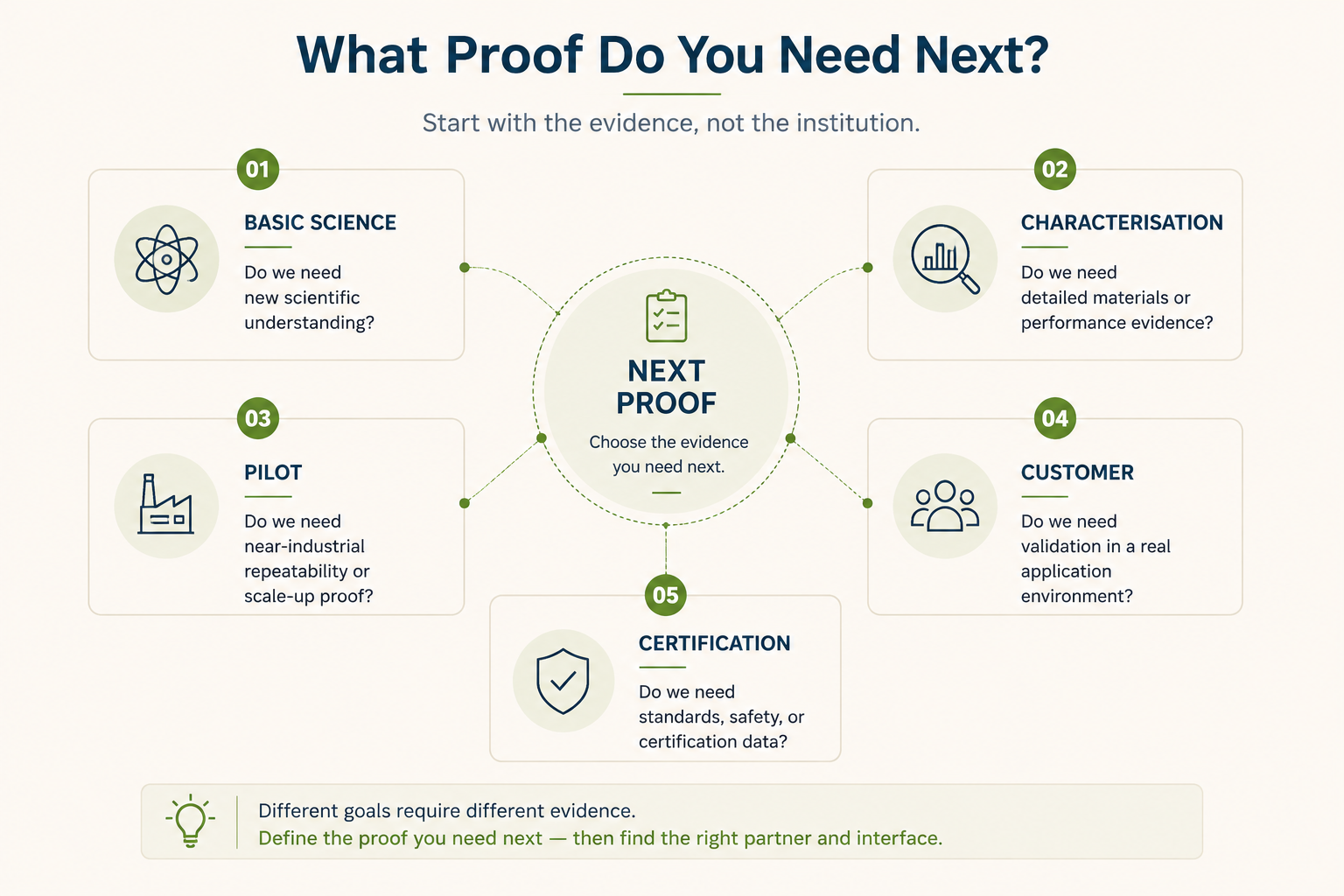
Once the next proof is clear, the relevant partner becomes easier to identify.
The same principle applies in Germany. Max Planck, Fraunhofer, Helmholtz, Leibniz, universities, and specialised research institutes operate under different missions and funding logics. Korea is also not a single block. KIST, KITECH, KIMM, KRICT, KIMS, and other public institutes have different missions and technical strengths.
The programme funding a specific collaboration may also come from a different ministry or agency than the one associated with the institute itself. So when reading another research system, two questions matter more than the logo: What problem was this institution built to solve? And where does the money for this specific collaboration come from?
The Bridge Can Start from Either Side / TWO-WAY BRIDGE
So far, the story may sound as if Korean technology always travels to Germany. That would be only half the picture.
The bridge works in both directions. A Korean battery material may need validation in a German pilot environment. A German manufacturing technology may need validation on a Korean production line. A Korean company may search for specialised German research capability. A German research group may need Korean manufacturing capacity, test facilities, or industrial partners.
There is also a third route. Sometimes neither country’s technology is the starting point. The starting point is a shared problem.
Consider battery recycling. Korean and German researchers and companies may first agree on the industrial problem, then jointly define target performance, cost constraints, test conditions, funding, IP, and responsibility.
In that case, the bridge does not begin in Korea or Germany. It begins with a problem both sides have agreed to solve. And the destination is not that one side has successfully ‘exported’ technology to the other. The destination may be new data, a pilot process, a prototype, a validated manufacturing route, or a product built together.
That is why one of the most useful units for understanding international R&D collaboration is not the country. It is the next proof.
Back to the Search Results / RETURN TO SEARCH
Return to the materials science PhD student in Berlin. The search results now look different.
Where research capability is built and accumulated.
A route through which new researchers enter that research environment.
A local European interface where that capability can meet another research system.
A coordination platform that helps connect Korean industrial R&D demand with relevant Fraunhofer capabilities.
KIST Seoul — a place where research capability is built and accumulated.
UST KIST School — a route through which new researchers enter that research environment.
KIST Europe, Saarbrücken — a local European interface where that capability can meet another research system.
And when the search expands further: K-FAST — a coordination platform that helps connect Korean industrial R&D demand with relevant Fraunhofer capabilities.
The important thing is not to memorise these names. It is to understand what problem each structure exists to solve. Once that distinction becomes clear, Korea’s public research system stops looking like a list of institutions. It starts to look like a pathway.
The Destination Is the Next Proof
Good technology does not finish its journey when it crosses a national border. A paper reaching another laboratory is not yet collaboration. An MOU is not yet industrial impact.
What matters is whether both sides can produce the next evidence together. That requires a language the other side can evaluate. It requires data, facilities, funding, responsibility, and people who understand how both systems work.
Seen from this perspective, the existence of KIST Europe in Saarbrücken is more than the story of an overseas research office. It reflects a deeper reality of international research: the system that creates a research result is not always the same system that allows that result to work somewhere else.
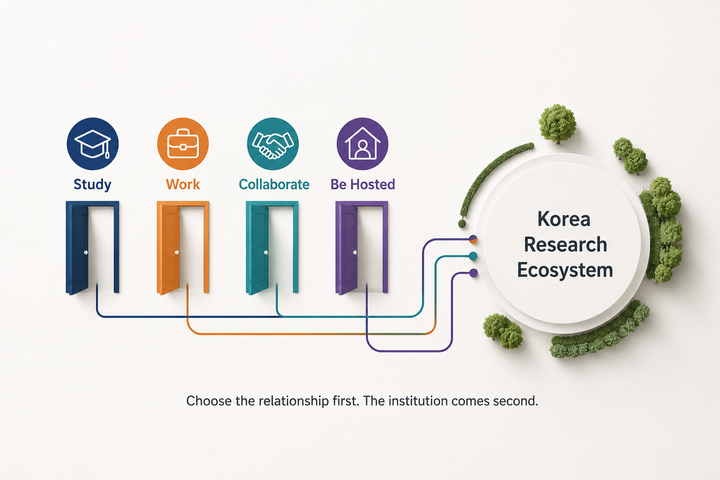
KIST in Seoul, KIST School within UST, and KIST Europe are not three branches of one identical organisation. But viewed together, they reveal three functions of a research ecosystem: building capability, bringing people into that capability, and connecting it to another system.
After that comes the most important question: What is the next proof we need to build together?
What research capability does this institute actually hold?
What routes exist for students, PhD candidates, postdocs, or researchers?
Which universities, institutes, companies, and international partners sit around it?
Continue Reading
Previous — What Comes After the University Lab?
How Korea’s public research institutes turn knowledge into national research capability and industrial technology.
Next — The Bridge Builder 〔Field Interview〕
Why good technology still needs a translator — a conversation with Dr. Han Tae-young on how Korea–Germany R&D cooperation is built in practice.
About This Reporting
This article is based primarily on publicly available materials from KIST, UST, KIST Europe, Fraunhofer, and related research organisations.
The ‘three coordinates’ framework and the sequence Research → People → Interface → Next Proof are K-Welle editorial frameworks designed to help readers understand the system. They are not official institutional classifications.
UST is an independent graduate university, not a subsidiary of KIST. KIST School connects UST’s graduate education system with KIST’s research environment.
KIST Europe and K-FAST are also different structures. KIST Europe is KIST’s European research base. K-FAST is a separate cooperation platform supporting Korea–Fraunhofer industrial R&D collaboration.
The comparisons in this article are intended to help readers navigate cooperation pathways, not to establish one-to-one institutional equivalents or rank the Korean and German research systems.