Subsidy: Where It Fits

Who takes the first investment risk?
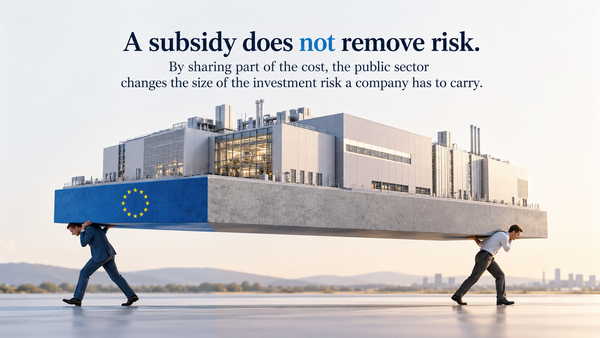
“A subsidy does not remove risk. By sharing part of the cost, the public sector changes the size of the investment risk a company has to carry.”
— EPISODE KEYSTONE
The Question Before the Money
A factory investment can involve both private and public money. But they do not bear the same risks. The company has to build the plant, install the equipment, hire the people and sell the product to recover what it invested. A government grant does not transfer the risks of demand, revenue, production and operation to the government.
A direct grant is one of the main ways public money can reach a company’s investment cost. But before the money arrives, a more important judgement comes first. How would the company’s decision change without support? And after support, which costs and risks still remain with the company?
The place of a subsidy lies between those two questions.
Public support does not take over the whole risk of a business. It can be a way for the public sector to bear part of the cost needed to change an investment decision — particularly where a policy objective creates additional costs or private capital alone would not carry the full burden. Which risks are addressed, through which route and to what extent differ from one scheme to the next. That is why investment support rarely asks only whether a project is good. It also asks whether support changes the decision, and what remains with the company afterwards.
A clear European example of that structure — the public taking on part of a cost to change an investment decision while leaving the business risks with the company — is Infineon’s new fab in Dresden. The company began work on a €5 billion investment before its final support was confirmed. About two years later, the European Commission approved a German State aid measure providing a direct grant of up to €920 million. The government did not take on the risk of the whole plant. The assessment asked what would have been different without support, and public money covered part of the cost recognised as necessary to make that difference.
This episode does not stop at one company’s grant. It uses the case to examine why the public sector takes on part of the cost of a private investment, where the boundary of that support lies, and how Germany and Korea address the same investment problem through different instruments.
The Company Moved First
On 16 February 2023, Infineon announced that it would invest €5 billion in Dresden — the largest single investment in the company’s history. The announcement came with a condition: the investment depended on State aid approval by the European Commission and on Germany’s final grant procedure. In the same announcement, the company said it had applied for about €1 billion in public support.
According to the same announcement, Germany’s Federal Ministry for Economic Affairs and Climate Action (BMWK) approved an early start to the project. This allowed the project to begin before the State aid review was completed. Construction started in 2023, with a groundbreaking ceremony that May. At that point, the EU review and Germany’s final grant decision were still pending; final approval came later. By starting the investment before final support was confirmed, the company took on one of the first risks itself.
Infineon also set out in its announcement why it was willing to take that risk. Once the fab is fully operational, it expects additional annual revenue of roughly the same size as the investment. The Dresden site had existed since 1994 and already employed 3,250 people. The new fab doubles the site’s production capacity.
On 2 July 2026, three and a half years after the investment decision, the fab opened. The company described it as the world’s largest plant for power semiconductors and analogue/mixed-signal semiconductors, with 1,000 new jobs. At the opening, Infineon said it could expand capacity twice as fast, depending on demand. If demand does not materialise, neither will the additional capacity. That risk, too, belongs to the company.
What matters here is that the subsidy did not replace the company’s decision. Infineon started the project before final support was confirmed, and responsibility for building the fab and expanding capacity remained with the company throughout. Even while government support was under discussion, the risks of starting, building, operating and finding demand did not disappear.
What Does a Subsidy Have to Change?
Step back from Dresden for a moment.
When a government considers support for a specific investment, the question it faces is broader than one company. Would the investment change without support — in scale, location or timing? Is public support necessary to produce that change? Is the support limited to what is necessary? And which ordinary business risks still remain with the company?
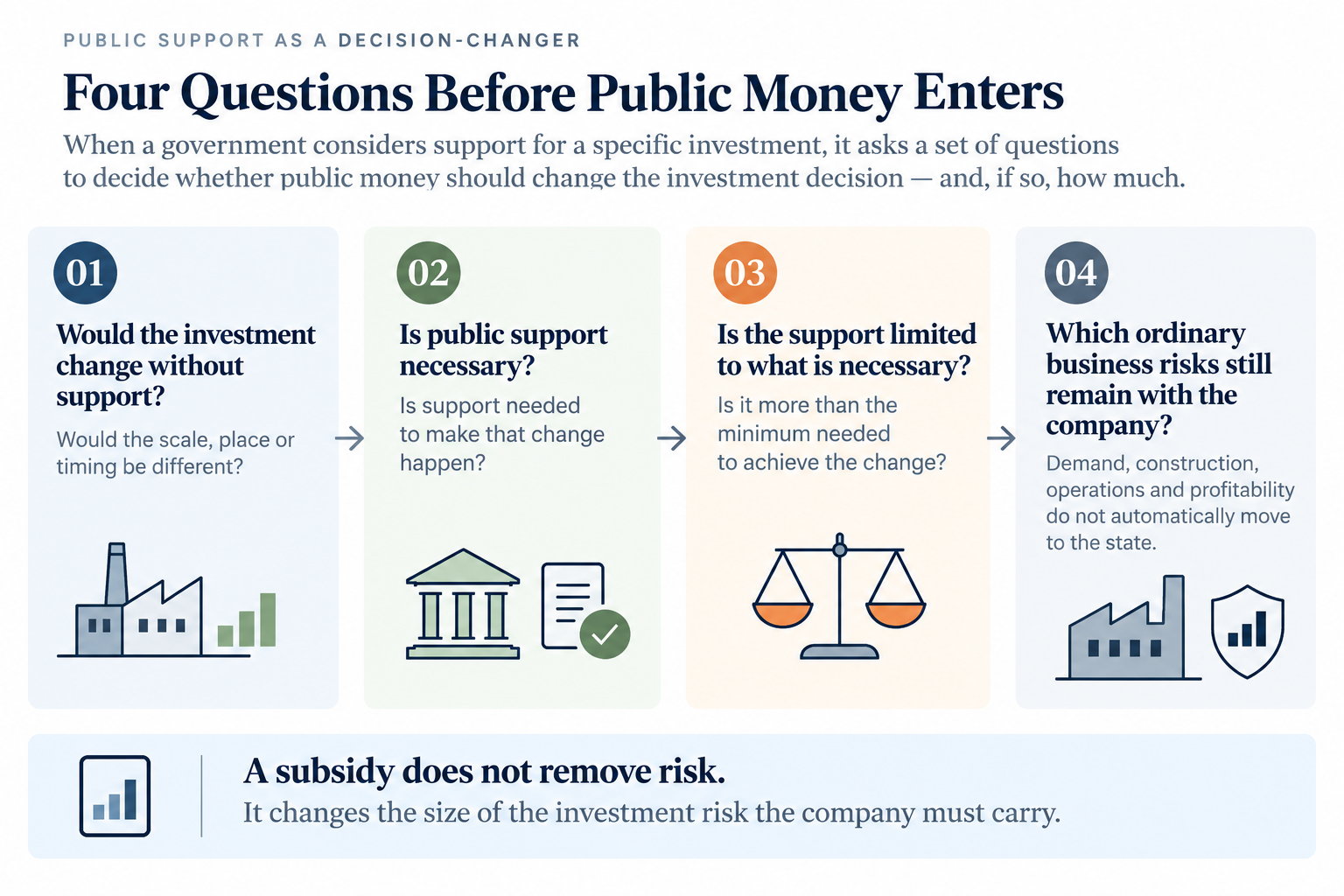
A grant for an investment that would have happened anyway, in the same place and at the same scale, does not change the investment decision. A grant that is needed for the investment to change does. That difference is what the case for investment support has to demonstrate.
These questions are broader than the Infineon case. They reflect the logic used in EU State aid assessments of investment support, although the exact legal tests and conditions vary by scheme.
In a 2022 decision on a loan-based regional investment aid scheme for small and medium-sized enterprises in Saxony, the Commission wrote that an incentive effect is present when aid changes the behaviour of an undertaking so that it engages in additional activity. It also stated that aid must not subsidise costs that an undertaking would have incurred in any event, must not compensate for the normal business risk of an economic activity, and must be limited to the minimum amount needed.
Outside the semiconductor industry, Germany also has cash-grant programmes for new and expanded business investment. The joint federal-state regional programme known as GRW provides cash grants for investment in new sites and production capacity, with support levels varying by region, type of investment and company size.
One distinction matters here.
Of the four findings published by the Commission in the Infineon case, the finding that the facility is a first-of-a-kind in Europe is a feature of this semiconductor investment assessment under the Commission’s European Chips Act Communication. Among the remaining findings, incentive effect, necessity and proportionality are questions that recur in other EU assessments of investment support.
Calculating a funding gap, using a direct grant to cover part of it and requiring the sharing of potential excess profits, however, are features of this case. They are not the structure of every German subsidy.
What can be generalised is narrower: the public sector can take on part of a cost to change an investment decision, while the ordinary risks of the business remain with the company.
Infineon: The Funding Gap
On 20 February 2025, the European Commission approved a German State aid measure providing Infineon with a direct grant of up to €920 million.
In the EU, a direct grant of this size for a semiconductor plant is not ordinary industrial support; the Commission reviews it case by case. Compressed into four questions, the Commission’s assessment reads like this.
First, is it new to Europe? Europe had no plant that could switch quickly between producing power semiconductors and analogue/mixed-signal semiconductors; in the Commission’s words, “the facility is a first-of-a-kind in Europe”.
Second, does the support actually change the investment? The Commission found that “the beneficiary would not carry out this investment in Europe without public support”.
Third, is the aid no more than necessary?
Fourth, do the effects spread across Europe?
The second finding applies the counterfactual question from Section 02 to one plant. The support was not approved simply because Infineon needed money to build a fab. The assessment found that, without public support, the investment would not take place in Europe on the same terms. This is the first boundary of a subsidy.
A finding that public support is needed does not mean the government pays for the whole plant. The next question is the minimum amount required to change the decision. The third criterion limits that amount: the aid is “limited to the minimum necessary based on a proven funding gap”.
In this case, the support was not set by multiplying the investment by a fixed percentage. It was limited by reference to the funding gap needed for the investment to go ahead in Europe.
That funding gap is not the profit or loss of the whole project. In our reading, based on the Commission’s general explanation, it is the amount needed to close the difference in economic viability between investing in Europe and the alternative investment scenario without support. In this case, the grant was limited to the part of the funding gap recognised as necessary to achieve the policy objective.
The company put its total investment at €5 billion, but the Commission’s decision links the €920 million in aid to an investment “amounting to €3.5 billion”. The published summary does not explain the difference between the two figures.
What public support targeted was not ownership of the fab, but the economic conditions needed to keep this production capacity inside Europe. What the government shared was part of that gap.
Money Comes With Conditions
In this case, Germany did not take an equity stake in return for the grant. Instead, the support came with conditions tied to the policy objective.
Infineon made four commitments. It will ensure that the project brings wider positive effects to the EU semiconductor value chain. It will carry out research and development on the next generation of chips in Europe. In a supply crisis, it will implement priority-rated orders under the EU Chips Act. And it will give SMEs and research organisations access to the new facility for testing and prototyping.
And there is one more.
The Commission’s summary of its assessment contains a sentence stating that “Infineon has agreed to share with Germany potential additional profits going beyond current expectations”. This sits outside the list of four commitments above, and how it is calculated has not been made public.
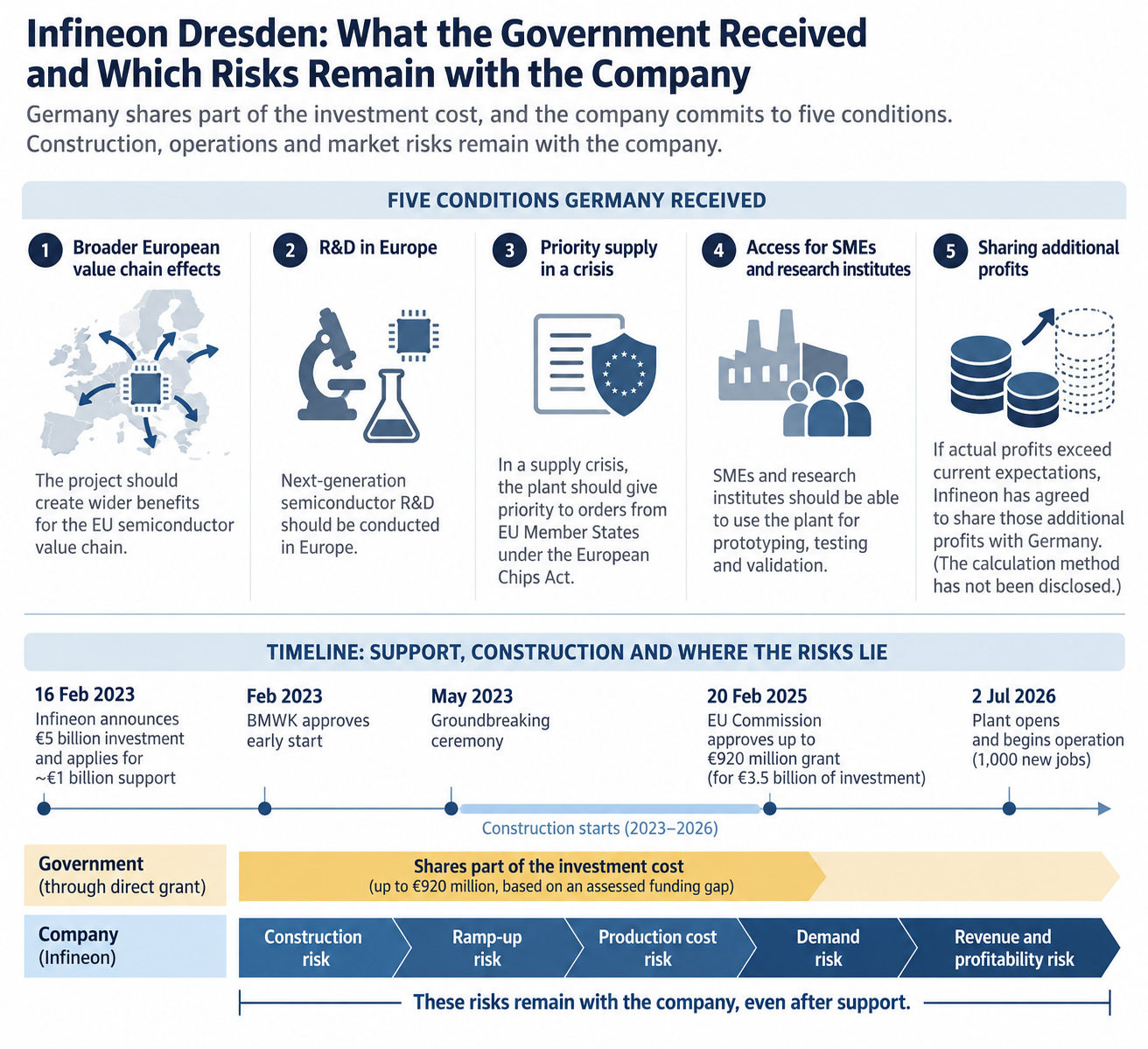
Read in one line, the five conditions say this: when the public sector shares part of the cost, the company in turn commits to the public outcomes the support is intended to produce.
Germany received no equity. Instead, the support carried policy conditions. Access for SMEs and research organisations, priority supply in a crisis, R&D in Europe and the sharing of profits beyond expectations were among them.
The published conditions show no mechanism for sharing losses with the government. The published terms indicate that downside risks — production disruption, weak demand and falling profitability — remained with the company.
Same Investment Problem, Different Instruments
The question for a Korean reader is not whether Korea also pays grants. It is this: which instruments does Korea use to address the same investment problem?
In Germany, the Infineon case runs along one chain: a specific fab; a State aid review that asks whether the investment would happen here without support; a direct grant; a funding gap; and attached conditions.
In Korea, the chain for a comparable corporate investment looks different. Depending on the nature of the investment, public support can take the form of tax credits, cluster and industrial infrastructure, R&D support, or direct support such as cash support for foreign investment, regional investment subsidies and investment grants for advanced strategic industries. These instruments change a company’s investment cost or operating environment rather than necessarily addressing the funding gap of one specific plant.
Germany / Korea — Different Routes
Germany
Infineon Dresden: State aid review → direct grant → funding gap + conditions
Specific investment
The support is tied to a particular project rather than to the industry as a whole.
State aid review
A central question is whether the investment would change without public support.
Funding gap
In the Infineon case, the aid was limited by reference to the funding gap recognised as necessary for the investment to take place in Europe.
Direct grant + conditions
Public money covers part of the recognised cost gap, while policy conditions are attached to the support.
Korea
Tax credits · infrastructure · R&D · targeted investment support
Tax credits
Tax relief can reduce the after-tax cost of investment and technology development.
Cluster & industrial infrastructure
Public investment in industrial sites and infrastructure can change the conditions in which private investment takes place.
R&D support
Public programmes can reduce part of the cost of technology development and collaborative research.
Targeted direct investment support
Defined investment categories can also receive direct support, including cash support or investment grants.
Same policy problem, different routes. Germany’s Infineon case shows a project-specific direct grant and funding-gap logic. Korea uses a broader mix of tax, infrastructure, R&D and targeted investment-support instruments.
The Semiconductor Special Act of February 2026 places a legal basis for subsidies alongside support for infrastructure, technology development and clusters. The 2026 tax reform proposal points in the same direction through a new production tax credit for items including semiconductors and secondary batteries, together with higher credit rates for national strategic technologies.
Among these instruments, the investment grant for small and mid-sized materials, parts and equipment companies in national advanced strategic industries, launched in 2025, shows that Korea also has a mechanism through which the public sector directly bears part of an investment cost.
Under the ministry’s operating rule, the programme provides a site grant or a facility grant for new domestic investment in supply-chain-critical items. National funding is capped at ₩15 billion per project and ₩20 billion per company, while the company must also contribute a share determined by company size and region.
What the rule does not show is the Infineon structure. It does not provide for a plant-by-plant proven funding-gap calculation comparable to the Infineon case, and the eligible companies, evaluation method, funding caps and policy purpose differ.
A third route exists as well. Support under the US CHIPS Act, including the award to Samsung Electronics in Texas finalised in December 2024, tied direct grant payments to construction and production milestones.
Germany’s Infineon case shows a direct grant tied to a specific investment and a State aid assessment. Korea lowers investment costs through tax credits and cluster infrastructure while also using grant and cash-support schemes for particular categories of investment.
The policy objective can be similar. The route by which public support changes the company’s cost structure is different.
For a Korean company, the question that follows is which instrument carries which part of its investment risk — a grant, a tax credit, infrastructure or a guarantee. The episodes that follow take those instruments one at a time.
What the Government Shared, What the Company Kept
Dresden’s answer is this.
What the German government took on was not the business risk of the whole fab. It was part of the viability gap recognised as necessary to keep this production capacity in Europe.
Whether construction would finish on time, whether the equipment would operate as planned, whether the production economics would work, whether market demand would materialise, and whether the plant could generate sufficient revenue and profit all remained the company’s concern.
More than who pays first, what reveals the structure of a policy is how far the public sector shares costs and which risks it leaves with the company.
A subsidy is less a way of moving risk to the government than a way for public finances to reduce part of the investment exposure a company must carry in pursuit of a policy objective.
A subsidy does not remove risk. It changes how much investment risk the company has to carry.
After the Grant
In the Infineon case, the government did not take on the risk of the whole fab.
First, the assessment examined how the investment would change without support. The support was then limited by reference to the funding gap recognised as necessary to keep the production capacity in Europe, with part of that gap covered through a direct grant.
In return, the company accepted conditions such as R&D in Europe, access for the wider ecosystem and response to supply crises. The risks of building and running the fab, of costs and demand, and of revenue and profit remained with the company.
A research team weighing its next experiment can ask the same question. Is it short of money for the next step — or is there an early risk that private parties would struggle to carry alone? The logic of a subsidy begins when one can explain what would be different without support.
The key question in subsidy policy is not simply, “How much does the government give?”
It is: What would be different without support? How much of that difference does the public sector pay for? And which risks remain with the company even after support?
A subsidy does not remove risk. By sharing part of the cost, the public sector changes the size of the investment risk a company has to carry.
Yet even after a subsidy, a technology company may still need growth capital. Then the question shifts from “Which costs does the public sector share?” to “Who will choose this company and put their own money in?”
In Dresden, a specific company and a specific plant were the subject of a State aid review. In a fund, the structure of choice is different. A government can set the direction of investment and choose the fund managers, while the managers make the actual choice of companies.
Why divide it that way?
The next episode turns to that question.
FLOW POSITION — Source · Vehicle
CHECK — Without support, what would change in the investment decision? Which costs should the public sector share — and which risks remain with the company even after support?
NEXT → Ep.4 The Fund’s Choice — Who Picks the Companies?
About This Reporting
This article does not explain any particular subsidy scheme or any company’s eligibility for support. It treats the Infineon Dresden fab as a clear European example of public support taking on part of a cost to change an investment decision while leaving the business risks with the company, and follows how a policy objective, a counterfactual investment decision, a funding gap, a direct grant and attached conditions came together.
Three layers are kept apart in the text. What can be said generally: a government may take on part of a cost that private investment alone would not carry in order to change an investment decision (Opening). What is particularly visible in the EU and Germany: the assessment of whether support changes the company’s behaviour and whether it exceeds what is necessary (Section 2). What belongs to the Infineon case: the €920 million direct grant, the €3.5 billion investment figure linked to the aid, the first-of-a-kind finding, the funding gap, the sharing of excess profits and the access conditions (Sections 3–4).
What Infineon took on follows its announcement of 16 February 2023 and its opening announcement of July 2026. The early-start approval and the application for about €1 billion in support are stated in the announcement of 16 February 2023. The Dresden site’s founding year and headcount follow the opening announcement and the company’s background material. Infineon has said the fab also receives support under the IPCEI programme in addition to support under the EU Chips Act; this article does not cover that track.
What the government supported, the assessment criteria and the conditions follow the European Commission’s English press release of 20 February 2025. The profit-sharing sentence appears in the assessment summary of the English press release as “Infineon has agreed to share with Germany potential additional profits going beyond current expectations”; it sits outside the list of four commitments and does not appear in the German summary (rechecked on 11 October 2026). We were not able to consult the original decision. The four assessment criteria are K-Welle’s arrangement of the press release’s statements. The explanation of the funding gap in Section 3 is the editors’ restatement, not the Commission’s wording.
The general principles cited in Section 2 — incentive effect, costs the undertaking would have incurred in any event, normal business risk and the minimum necessary amount — follow the Commission’s decision of 13 July 2022 in case SA.100616, a scheme of interest-subsidised subordinated loans for SMEs in Saxony assessed as regional investment aid. They are cited as an example of the Commission’s reasoning, not as the legal test applied to Infineon. The description of the GRW programme follows Germany Trade & Invest’s investment guide; no rates are quoted.
Support for Samsung Electronics in Texas follows the US Department of Commerce’s announcement of 20 December 2024. Korea’s Special Act follows MOTIR’s explanatory material of 29 January 2026 and the text of Act No. 21337. Cash support for foreign investment follows Article 14-2 of the Foreign Investment Promotion Act. The investment grant for materials, parts and equipment companies follows the operating rule of the Ministry of Trade, Industry and Resources (MOTIR) — Notice No. 2026-43, in force from 18 May 2026 — and KIAT’s 2025 call for applications, which had a national budget of ₩70 billion. The company contribution is set by an annex to the rule, so no percentage is given in the text; the 2025 call stated support of up to 50% of total investment. The comparison with the Infineon structure is the editors’ reading. The 2026 tax reform proposal, announced on 3 August 2026, follows the government policy briefing of 7 August 2026; it was still a proposal, not enacted law, at the time of writing.
Setting the different routes side by side is an editorial arrangement and does not imply that one approach is better than another. The final paragraph of Section 1, the downside-risk sentence in Section 4, the division of risk in Section 6 and the research-team paragraph in the Closing are the editors’ interpretations and generalisations drawn from public sources. Infineon is a large project in which the structure of a subsidy is unusually visible. This does not mean that SMEs receive support in the same way. The research team in the Closing is a hypothetical example.
Corrections: editor@k-welle.com
Sources
In addition to the material linked in the text, we consulted:
- Infineon — Infineon kicks off new Fab in Dresden; Completion planned for 2026; Smart Power Fab will generate 1,000 new jobs, 16 February 2023
- Infineon — Infineon receives approval for funding under the EU Chips Act – IPCEI funding drives innovation projects in Europe forward, 20 February 2025
- European Commission — IP/25/557, Commission approves €920 million German State aid measure to support Infineon in setting up a new semiconductor manufacturing facility , 20 February 2025
- European Commission — State aid SA.100616 (2021/N) — Germany (Saxony), regional investment aid scheme for SMEs, decision C(2022) 4838 final , 13 July 2022
- Germany Trade & Invest — Grants for Investments (GRW)
- U.S. Department of Commerce — CHIPS Incentives Award with Samsung Electronics, 20 December 2024
- Ministry of Trade, Industry and Resources (MOTIR) — passage of the Special Act on Strengthening the Competitiveness of and Supporting the Semiconductor Industry, 29 January 2026 (in Korean); Korea Law Information Center, Act No. 21337, enacted 10 February 2026 and amended 17 March 2026 (in Korean)
- Korea Law Information Center — Foreign Investment Promotion Act, Article 14-2, cash support for foreign investment (in Korean)
- Korea Law Information Center — Operating Rule for the Investment Grant for SME and Mid-sized Materials, Parts and Equipment Companies in National Advanced Strategic Industries, MOTIR Notice No. 2026-43 , in force from 18 May 2026 (in Korean); KIAT — 2025 call for applications for the same grant , 23 July 2025 (in Korean)
- Ministry of Finance and Economy, via korea.kr — 2026 Tax Reform Proposal, Part 01 , proposal announced 3 August 2026, briefing dated 7 August 2026 (in Korean)
- Infineon / Silicon Saxony — Opening of the Smart Power Fab in Dresden, July 2026