Lab Culture as Operating System
Why the Lab, Not the University, Decides the Outcome
In Korean graduate research, the basic unit is often not the university or the department.
It is the lab.
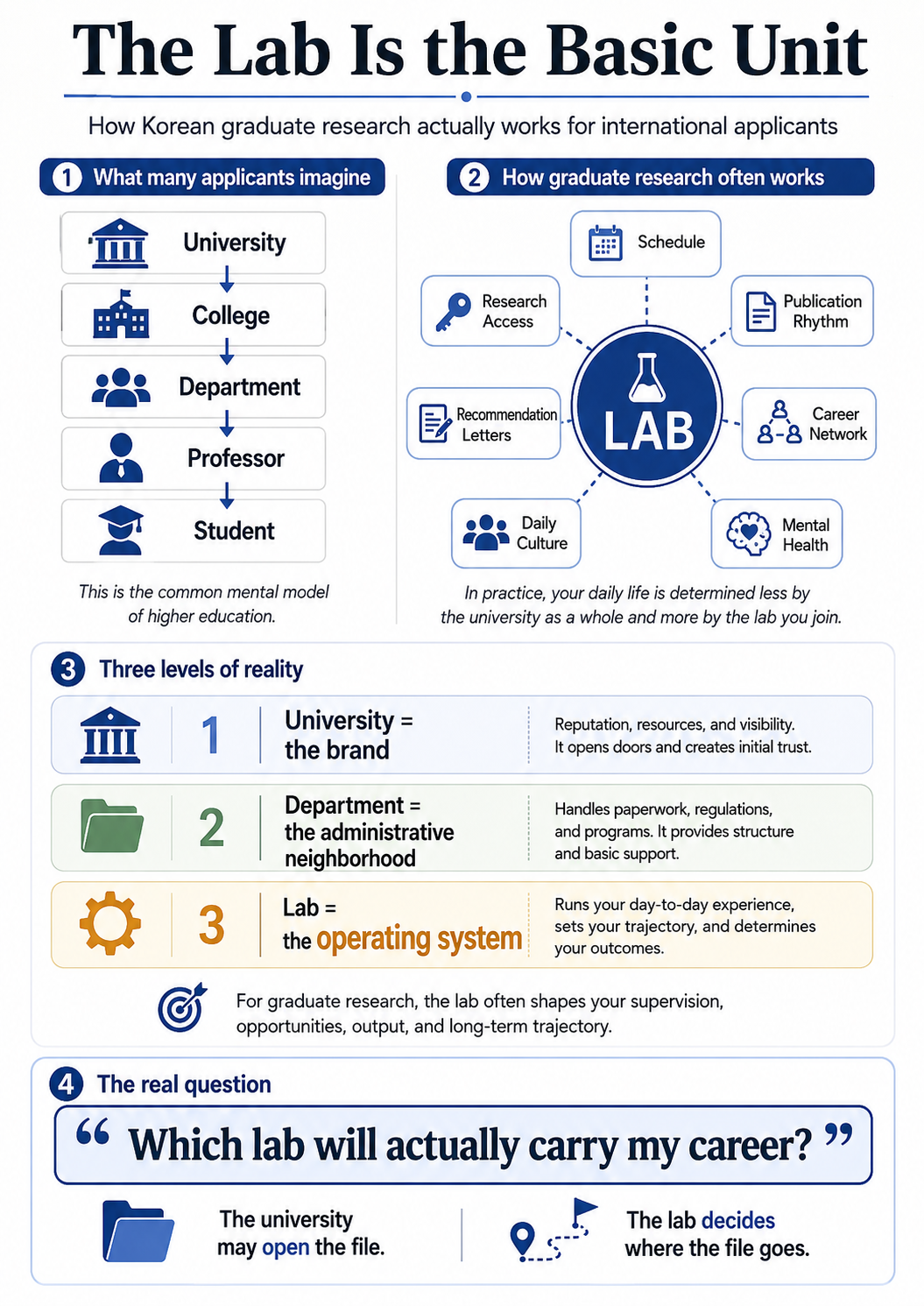
For international researchers, this is the first rule to understand. A Korean lab is not only a place where research happens. It is an operating system. It decides how information moves, who gets access to the professor, how authorship is negotiated, how funding is distributed, and whether a foreign student becomes visible inside the group.
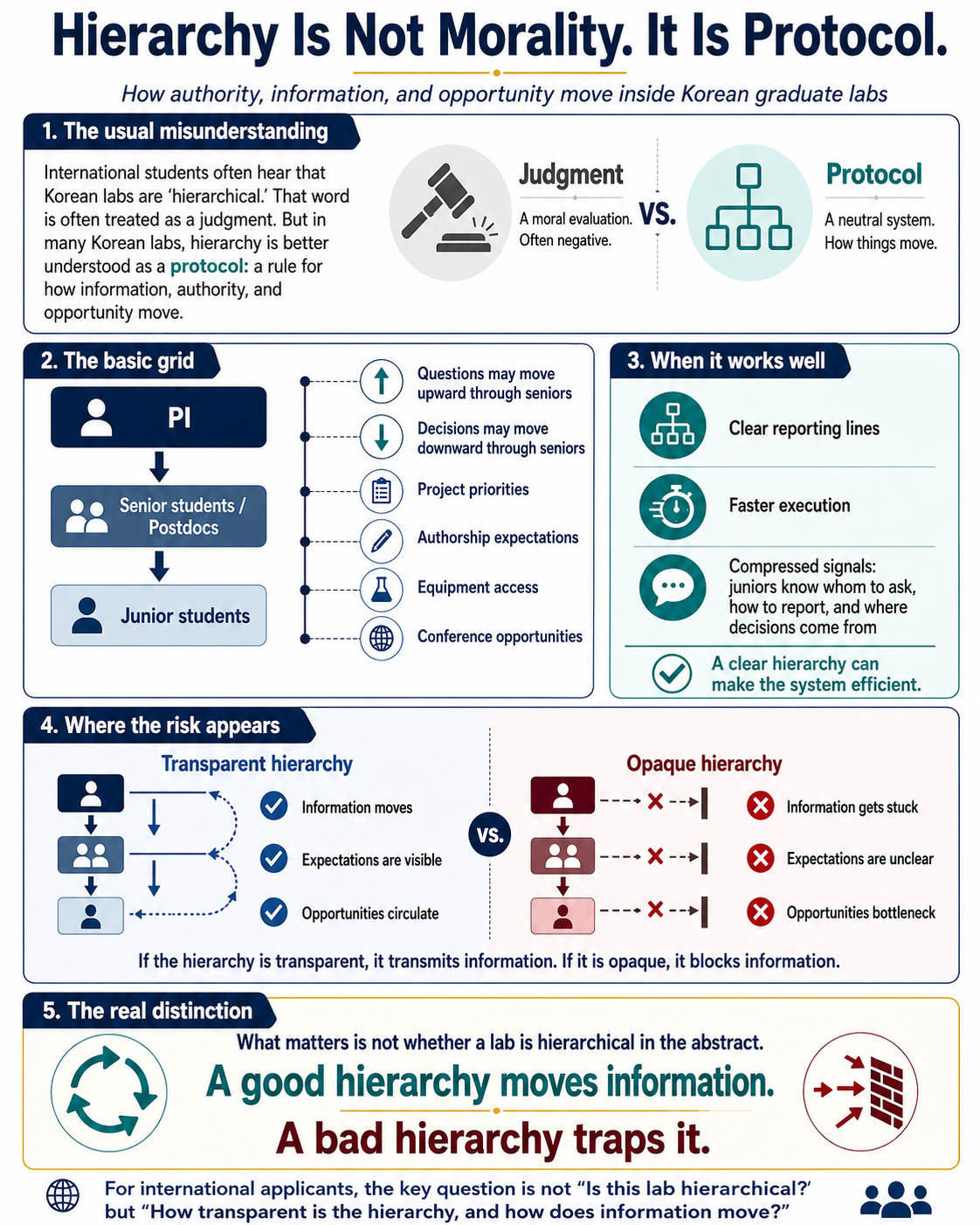
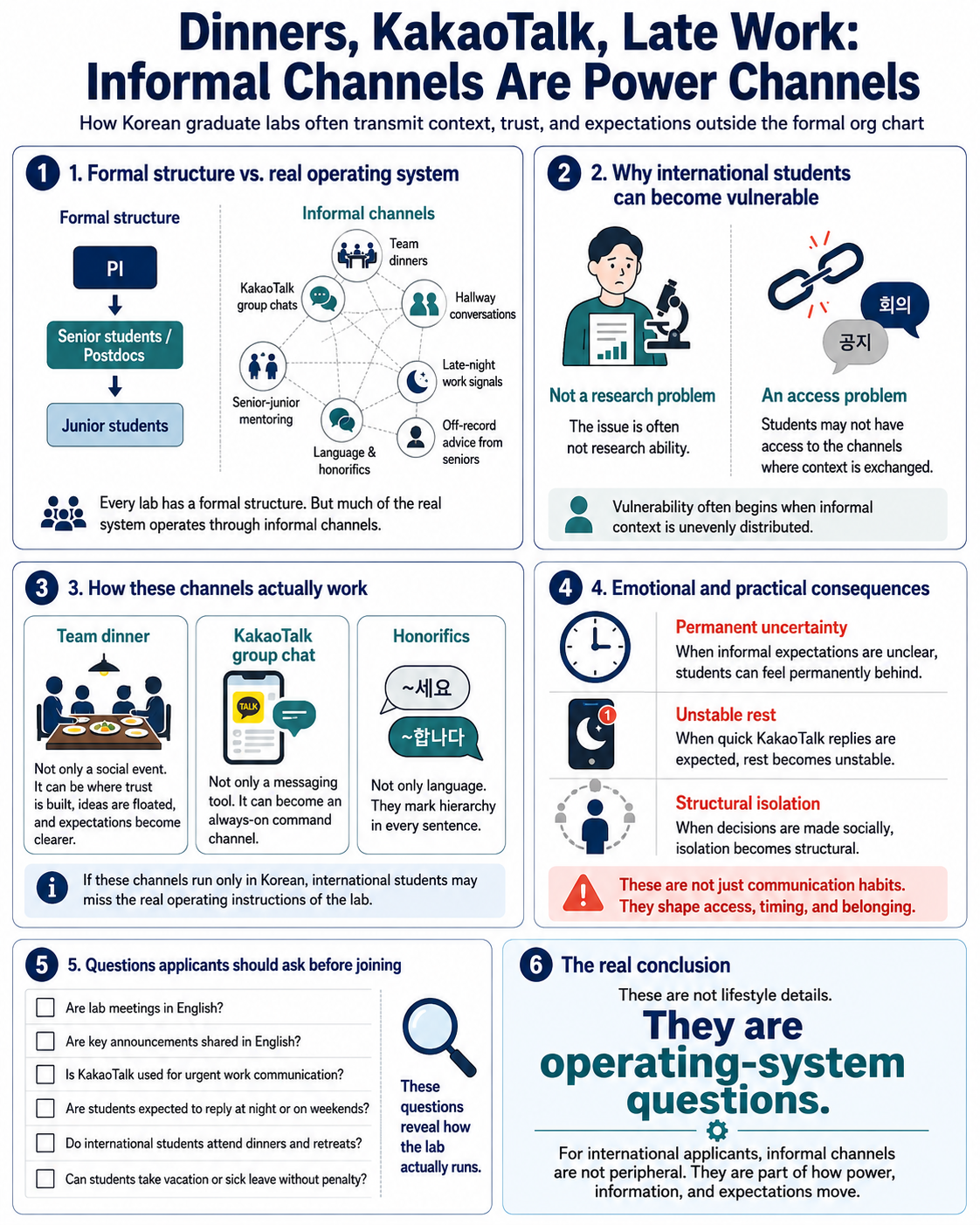
Hierarchy is central to this system. But hierarchy should not be read only as a cultural trait. In many Korean labs, it works as an information protocol. Decisions, feedback, opportunities, and warnings often move through a lattice of PI, postdocs, senior students, and juniors. When the system works well, this structure creates speed and mentorship. When it works badly, it blocks information and isolates newcomers.
This is why international students are not usually vulnerable because of weak research ability. They are vulnerable because the informal channels are difficult to read.
KakaoTalk messages, hallway conversations, lab dinners, senior-junior relations, and the language of meetings can carry as much practical information as official emails or written rules. A student who misses those channels may not miss the research itself, but may miss the context that determines projects, deadlines, credit, and trust.
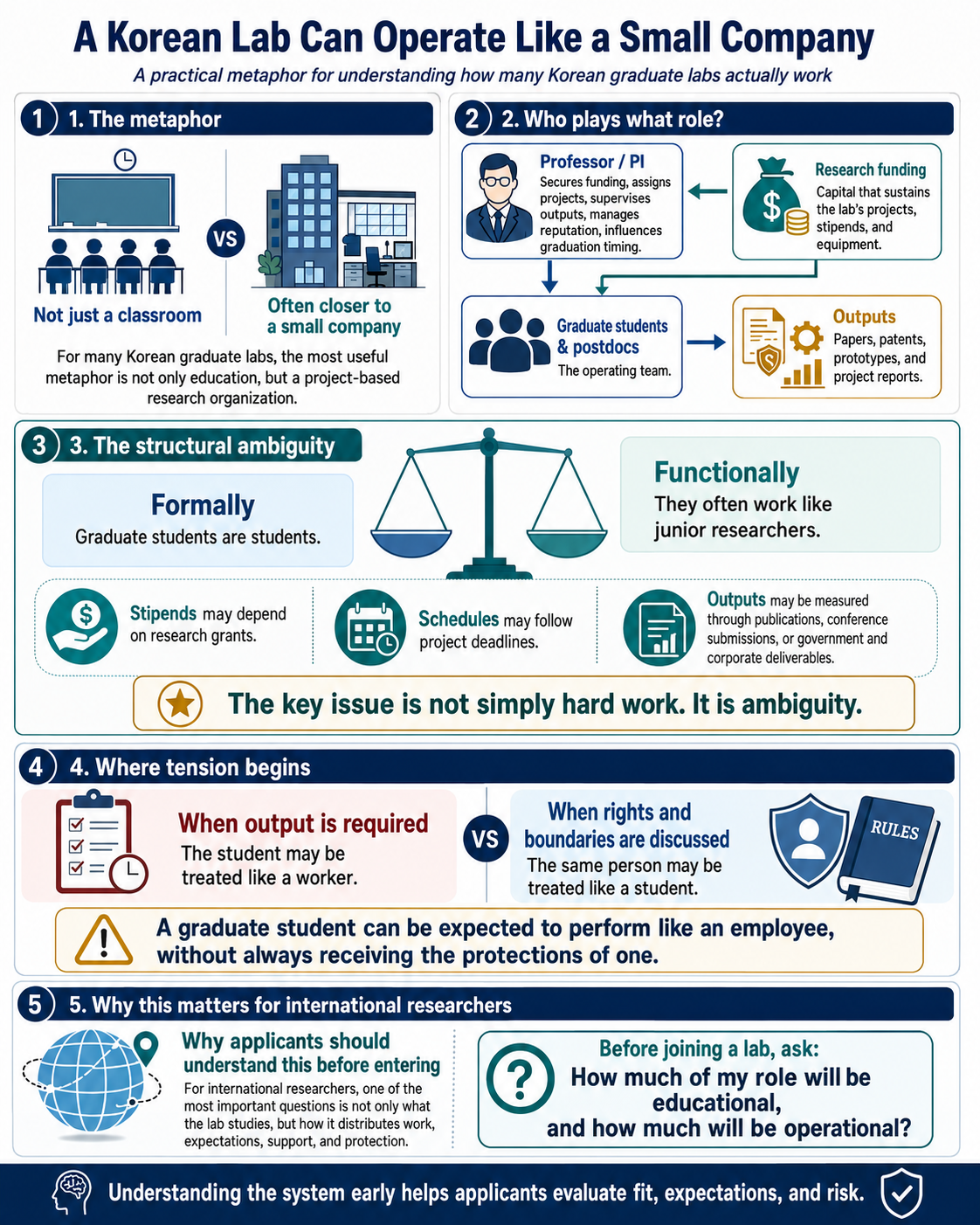
A Korean lab can also operate like a small company. The PI secures funding, assigns projects, manages timelines, approves publications, and shapes reputation. Graduate students are formally students, but functionally they often work as junior researchers. This student-worker ambiguity is one of the most important features of the Korean graduate experience.
The question, then, is not simply whether a lab does good research.
The sharper question is:
Can you function inside its operating system?
Good labs and risky labs usually leave signals before admission. Look at the last five years of publications. Are students first authors? Are there English-language papers and international collaborations? Where did alumni go? Are former international students visible on LinkedIn? Are lab meetings and paper reviews conducted in English? Are authorship rules explicit? Is the stipend structure transparent? Can students access the PI directly, or only through seniors?
These questions matter because the lab determines more than academic output. It shapes daily life, career mobility, recommendation letters, mental health, and the degree’s value outside Korea.
For German and European readers, the comparison is useful. Germany also has hierarchy through the Lehrstuhl system. A doctoral advisor can strongly shape a student’s path. The difference is status. In Germany, many doctoral researchers are employees with contracts, vacation, insurance, and formal protections. In Korea, graduate students are usually framed as students, while much of their daily work resembles employment. The hierarchy is therefore buffered less by contract and more by lab culture.
That makes lab selection critical.
A demanding lab can still be healthy if its rules are visible, its expectations are predictable, and its students graduate into strong outcomes. A prestigious lab can still be risky if information is opaque, authorship is unclear, and international students remain outside the informal loop.
The university starts the search.
The department narrows the field.
But the lab decides the daily reality.
For international researchers, the final question is not:
“Is this university good?”
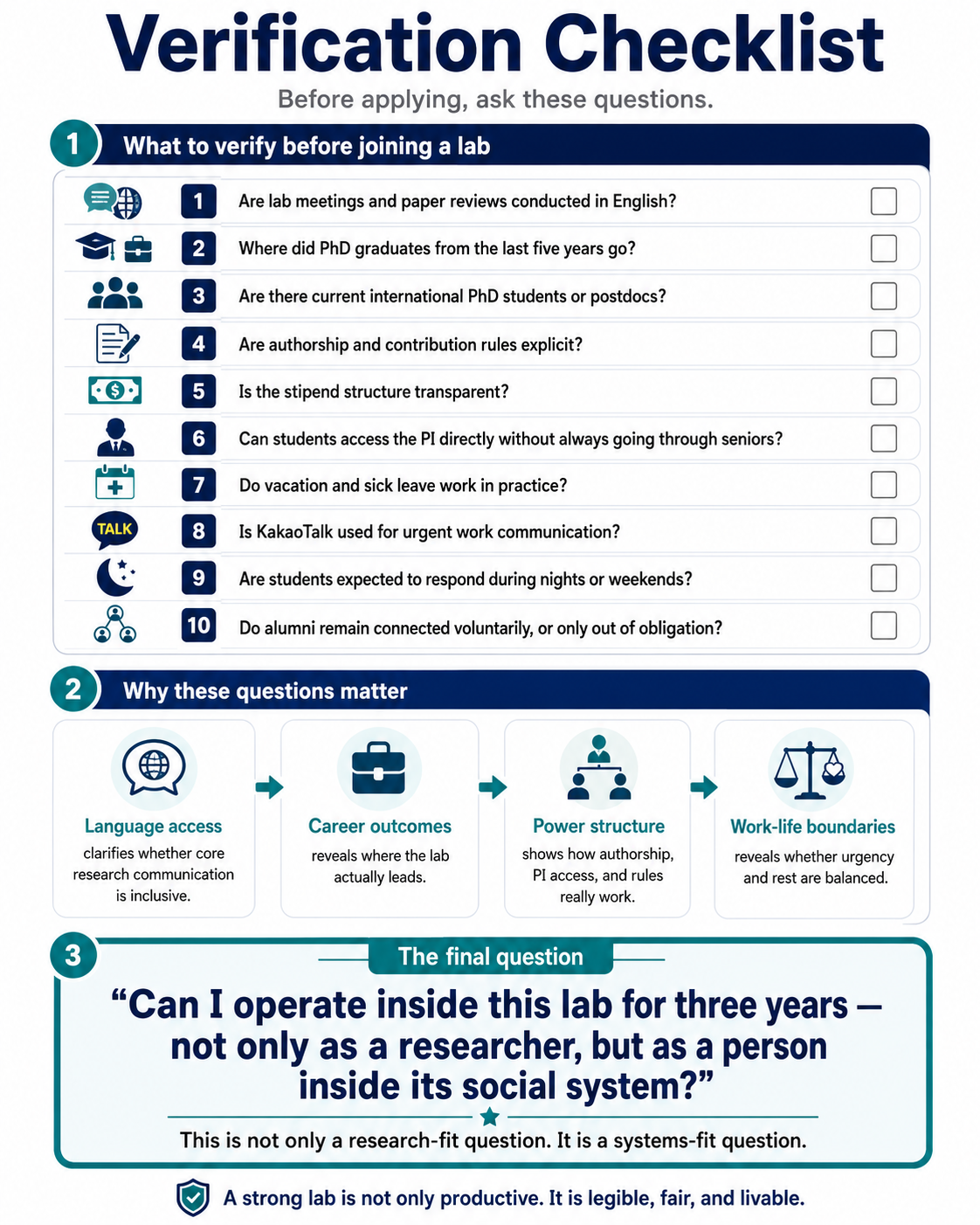
It is:
“Is this lab an operating system I can actually work inside?”
Read the lab before you enter it.
The degree depends on it.