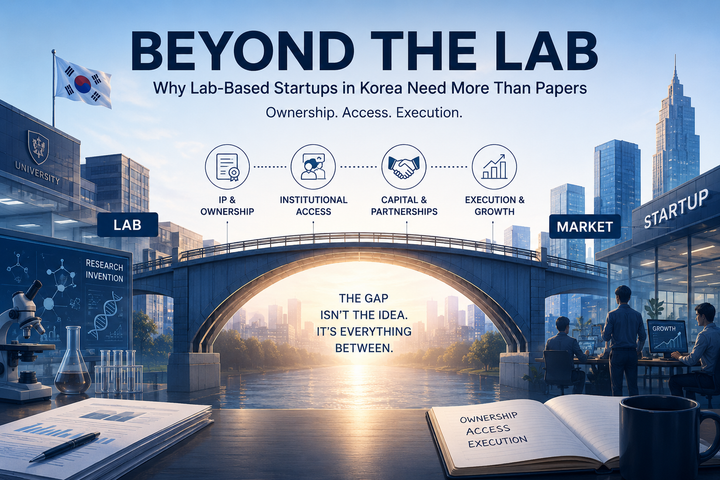

How Korea’s Military-Service Timeline Shapes STEM Labs, Research Continuity, and Foreign Researchers

The Obligation Does Not Apply to You. It Shapes the Lab.
Military service is not a personal obligation for most foreign researchers in Korea.
But it can still shape the lab they enter.
Korea’s military-service system is a civic obligation placed on Korean male citizens. The Research Service Personnel system exists to let some STEM talent fulfill that obligation through research rather than leave the research track entirely.
For foreign researchers, the point is not to judge the system as privilege or disadvantage.
The point is to read how this Korean-specific institution shapes lab composition, hierarchy, and research timelines.
You may stand outside the obligation.
But you may work inside the lab structure it helps create.
Korea has a system called Research Service Personnel, or 전문연구요원. In simple terms, it allows eligible science and engineering researchers to fulfill military duty through research work at designated institutions instead of ordinary active service.
These institutions may include graduate schools, government-funded research institutes, company-affiliated research centers, defense-related research organizations, or other designated research workplaces.
The service period is generally three years.
That sounds like a privilege.
It can be.
It allows some researchers to keep building technical skills instead of stepping out of the research track. It can preserve continuity for labs. It can also help Korea keep advanced STEM talent inside the research system.
But it also creates a clock.
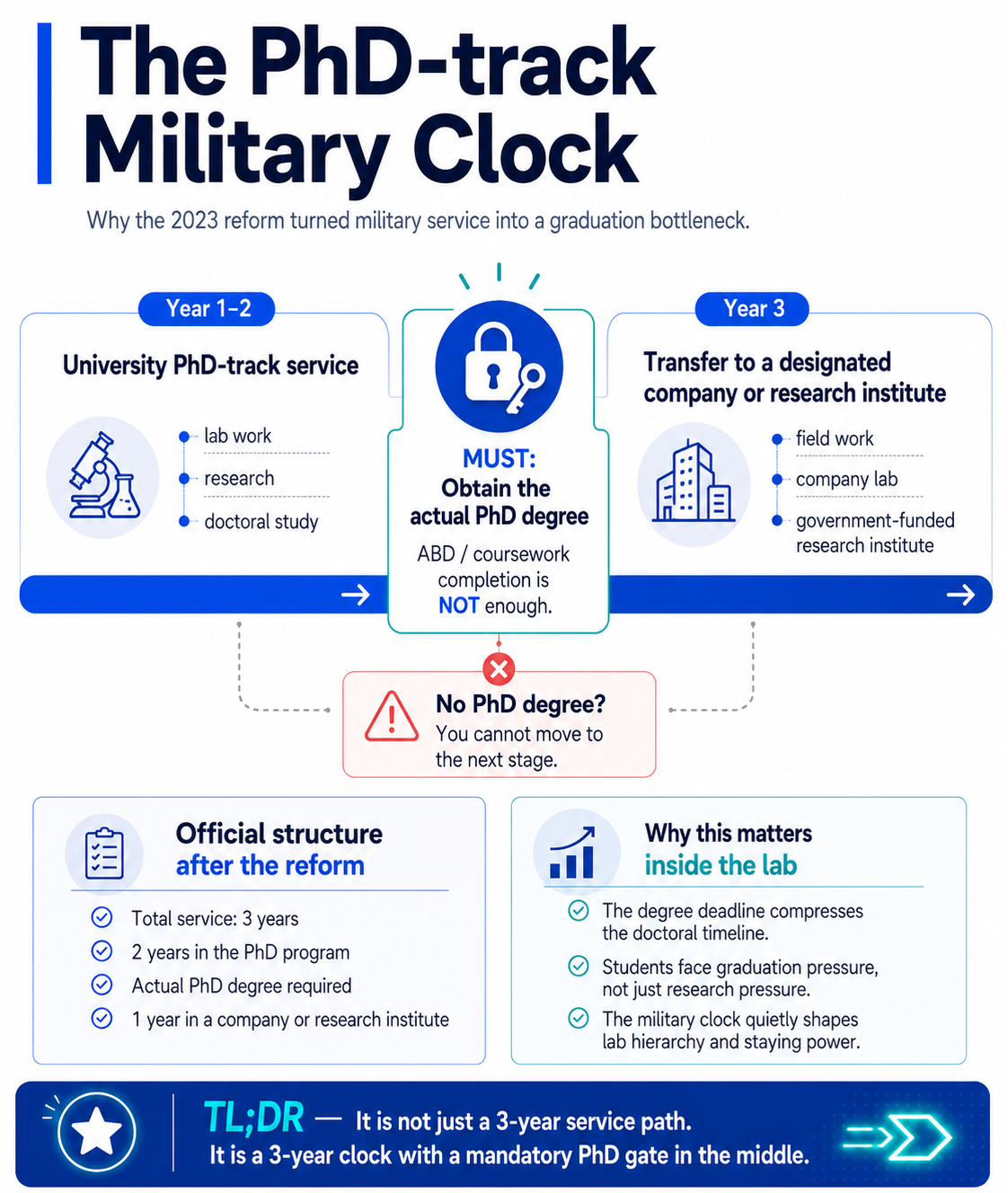
For doctoral-track researchers, the system changed for entrants from 2023 onward. Instead of a simple three-year graduate-school route, the doctoral-track structure is now commonly read as two years in the doctoral program, obtaining the actual PhD degree, and then one year of required service at a company research center, government-funded institute, or another designated research workplace.
The middle phrase matters.
It is not enough to be “almost done.”
It is not simply ABD in the American sense.
It is not only coursework completion or dissertation-stage status.
To move into the final one-year field-work stage, the researcher must obtain the actual PhD degree. If the degree is not obtained within the required period, an extension may be granted within a defined limit. But that extended period does not count toward the three-year service period.
Foreign researchers and Korean male researchers may sit in the same lab
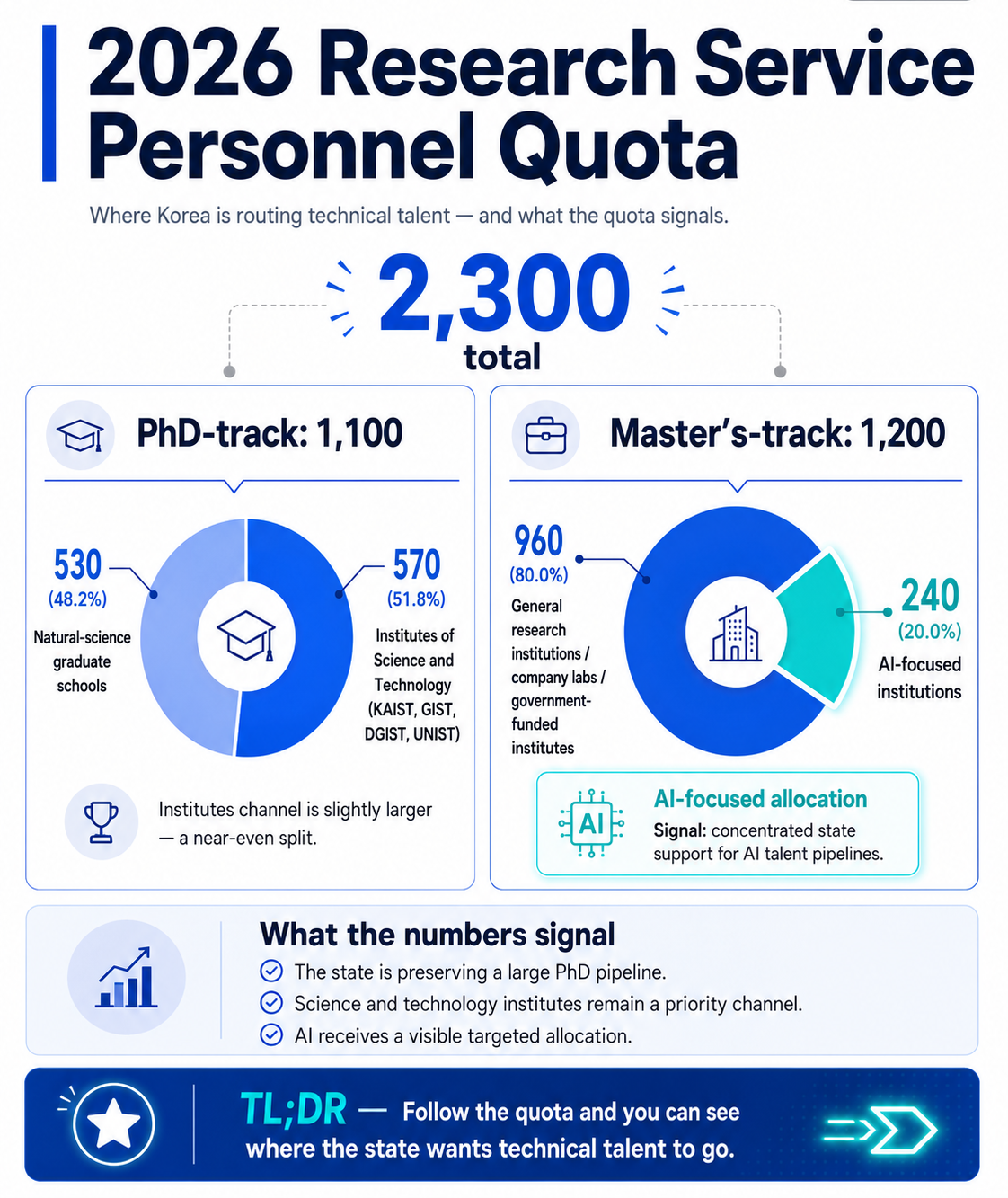
This is not only manpower administration.
It is a signal.
Doctoral researchers are kept inside the academic and science-institute track. Master’s-level researchers are routed more strongly toward industrial and applied research. AI receives a visible concentration.
For foreign researchers, the point is not to compete for this route.
The point is to read what it does to the lab.
It may not be passivity.
It may not be personality.
It may be timeline.
The lab is not only where a Korean male researcher studies.
It may also be where he serves.
If a Korean male researcher’s service status, institutional placement, transfer, field-work route, or administrative continuity is tied to the lab or designated institution, the PI’s influence becomes more than academic authority.
It becomes load-bearing authority.
This does not mean every professor misuses power.
It means the structure gives power weight.
Foreign researchers are usually free from the military-service layer.
But they still enter the hierarchy that layer helps reinforce.
That is why Korean STEM labs can feel unusually dense and difficult to exit. The hierarchy is not only cultural. It can be financial, administrative, and sometimes military.
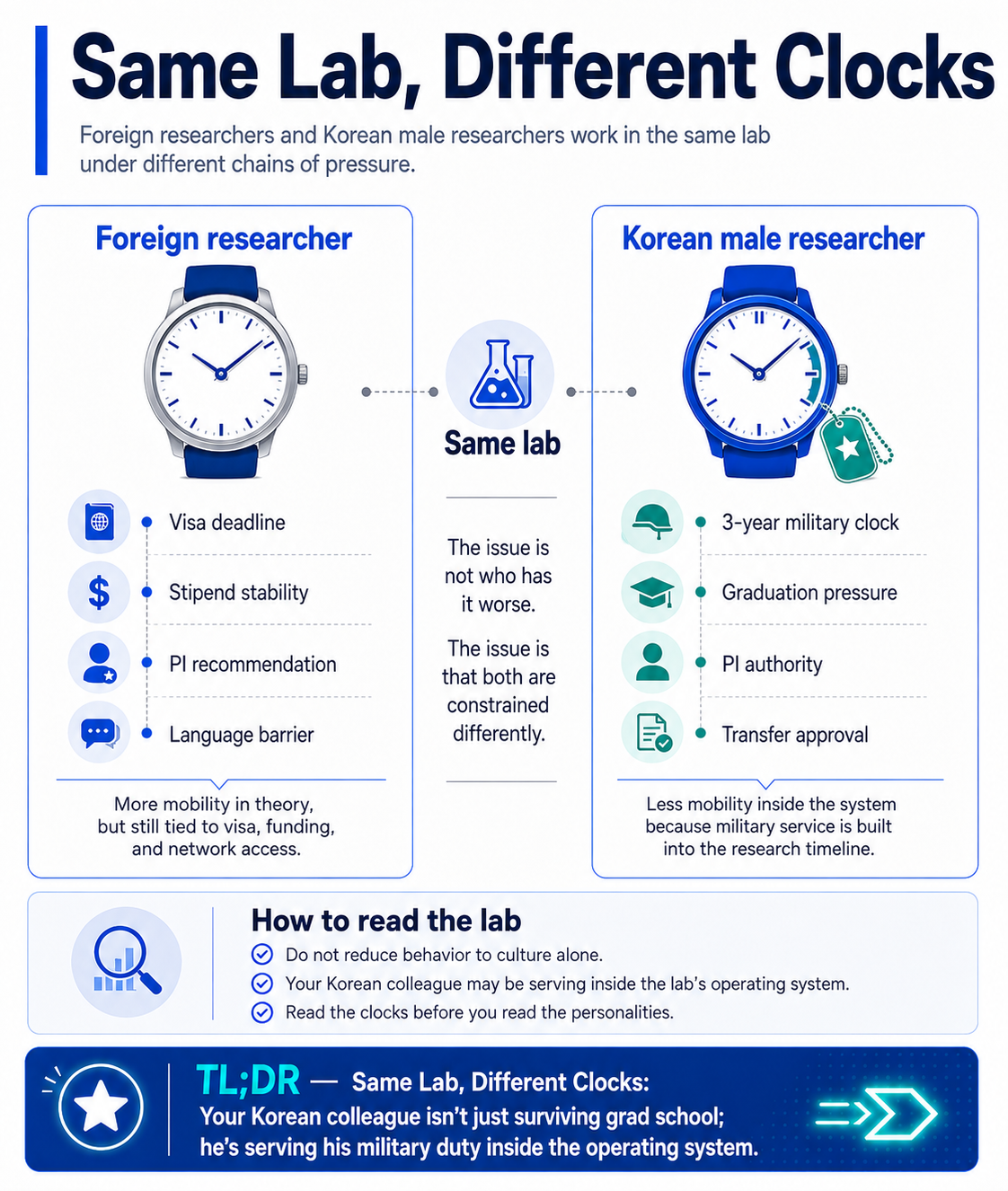
Foreign researchers and Korean male researchers may sit in the same lab.
They may work on the same project.
They may publish with the same PI.
But they may not be living under the same clock.
The chains are different.
The effect can look similar.
Both groups may become dependent on the lab, but for different reasons.
Foreign researchers may be outside the military-service obligation. But they are still inside Korea’s funding, visa, language, and hierarchy systems.
Research Service Personnel is also tied to Korea’s demographic problem.
As the number of military-age men declines, alternative-service systems have faced repeated public and policy debate. The research-service route has been adjusted, reduced in some categories, and defended in others as necessary for national research capacity.
That matters inside labs.
If research-service places become more scarce, Korean male STEM students may choose labs and programs more strategically. Designated institutions become more attractive. Stable routes become more valuable. Professors with strong projects and institutional standing become more important.
Scarcity changes behavior.
A lab with many research-service personnel may offer strong continuity because people are less likely to leave. Projects may move steadily. The lab may have stable manpower.
But the same lab may also carry tighter hierarchy, stronger graduation pressure, and less freedom to exit.
Stability and pressure can come from the same source.
That is the Korean contradiction here.
Military service is outside the foreign researcher’s body.
But it may be inside the lab’s operating system.
Policy instruments are not just bureaucracy. In this case, the quota is the map. It tells students which routes are protected, labs which manpower streams may remain available, companies where technical labor may be routed, and foreign researchers what kind of lab clock they may be entering.
Both matter: the continuity and the pressure.