Don't Trust the Ranking — Enter the Korean University Matrix
A Region × Type Map of Korean Universities for International Students
Korean media often talks about “regional university decline” and “Seoul concentration.” But that is an internal Korean debate. International readers are usually not inside that debate. What they need first is not a political argument. They need a map.
When international readers search for Korean universities in English, they usually arrive at three places:
- QS or THE rankings
- Wikipedia
- each university’s English admissions page
These are useful, but they show only the surface of the system.
The real structure sits underneath.
That structure has two axes:
- Region
- University type
In Korea, universities are not simply arranged as a hierarchy. They are arranged as a matrix.
This article gives you that matrix.
Core Question: Which Cell of the Matrix Are You In?
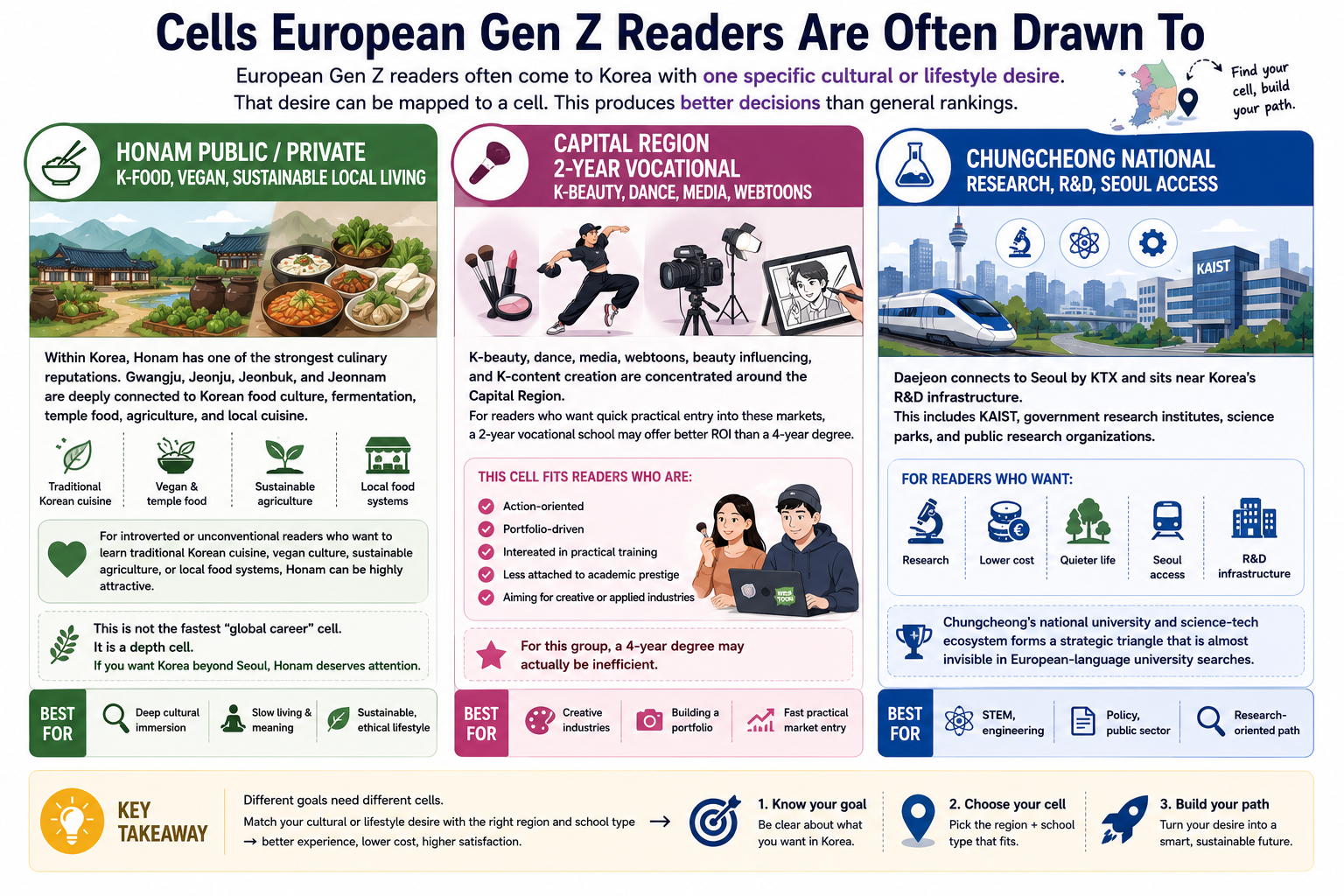
Inside Korea, the SKY · KAIST · POSTECH hierarchy functions as a powerful signal market. But for international readers, especially European and German Gen Z readers, the more useful question is different:
Which cell of the matrix does your purpose and field converge into?
Lined up in a row, Korean universities become a ranking.
Seen as a matrix, they become coordinates.
Your decision does not begin with “Which school is highest?”
It begins with:
Which region?
Which type?
Which purpose?
The Matrix: 6 Regions × 4 Types
Korean universities can be understood through six major regions and four institutional types.
| Six Regions | Four Types |
|---|---|
| Capital Region | 4-year national/public university |
| Yeongnam | 4-year private university |
| Honam | 2-year vocational college |
| Chungcheong | specialized university |
| Gangwon | |
| Jeju |
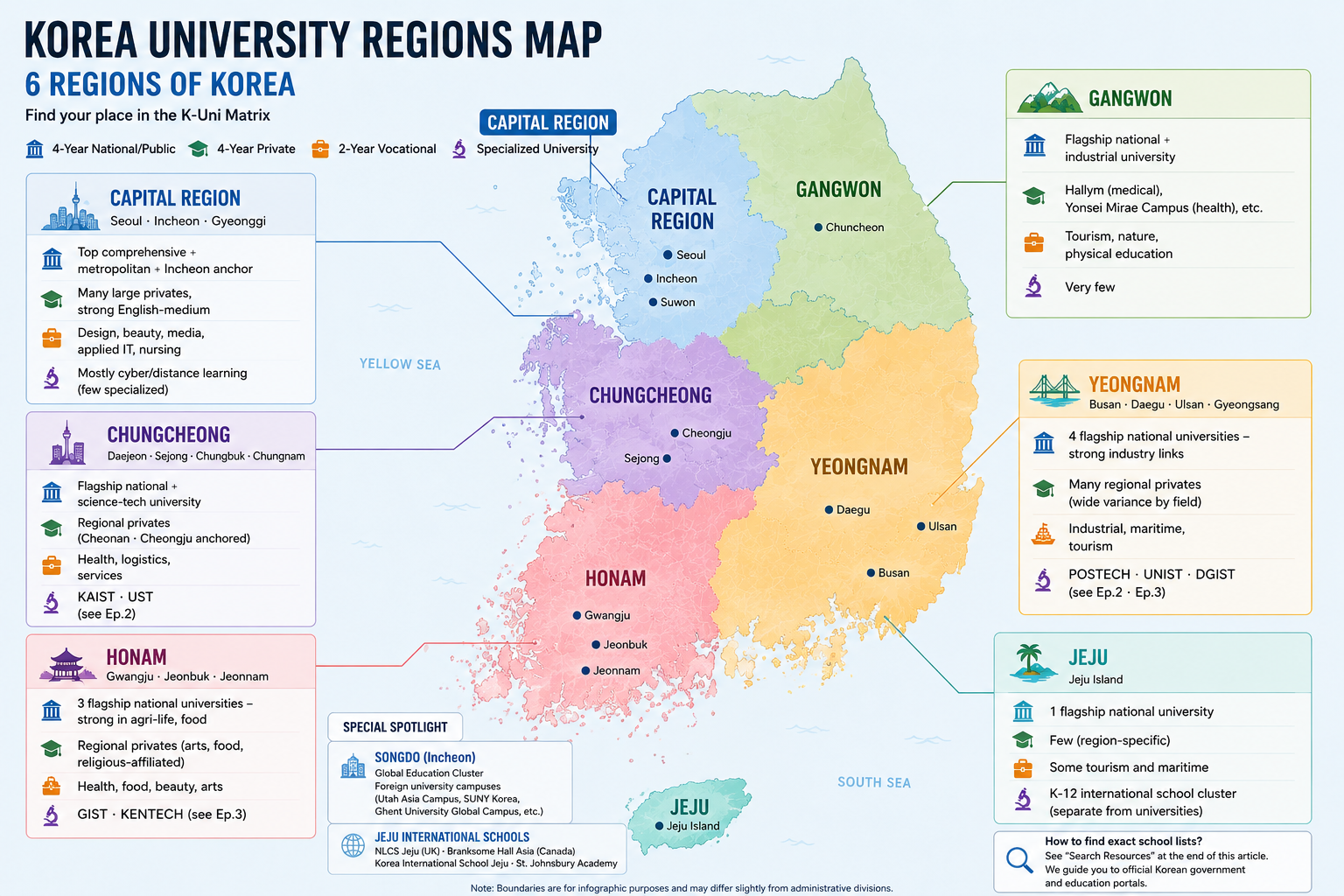
This matrix is the asset international readers usually cannot build from outside Korea.
English rankings overrepresent 4-year private universities and specialized universities. Wikipedia gives scattered school-by-school information. English admissions pages explain individual institutions, not the system.
But the Korean university system is not just a list of names.
It is a structure.
And the first task is locating your cell.
Issue 1: The Real Boundary of “Seoul”
International readers often hear “Seoul university” and imagine a school inside Seoul’s administrative borders.
But in Korea, the practical meaning is often broader.
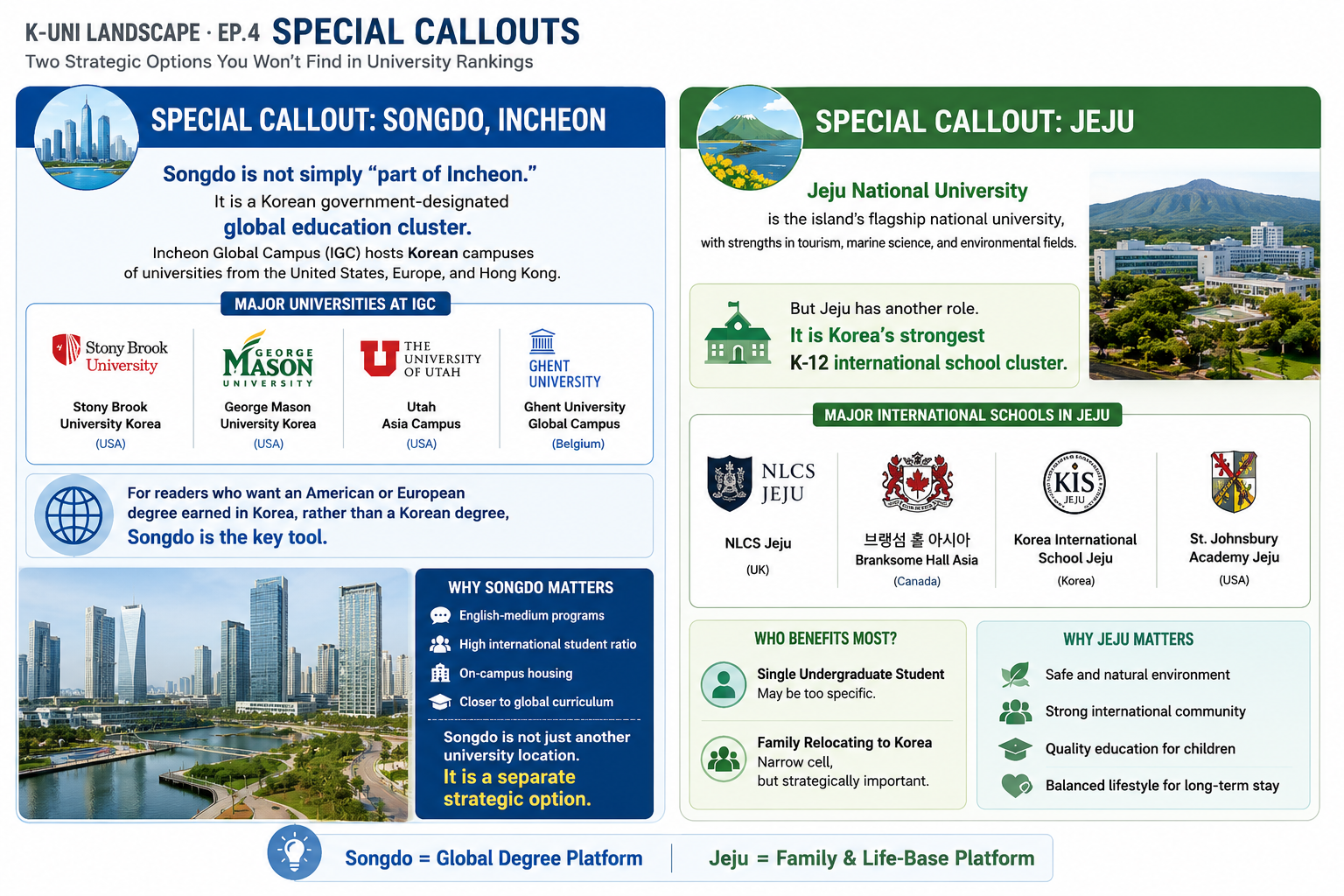
Many schools discussed as “Seoul-area universities” are actually located in Incheon or Gyeonggi Province.
The practical Korean definition is:
Capital Region = Seoul + Incheon + Gyeonggi
This is roughly the one-hour commuting radius around Seoul.
If you insist on “inside Seoul,” your options narrow sharply.
If you allow “Capital Region,” the matrix cell expands.
In Korea, a “Seoul university” is often defined by commute time, not by administrative address.
Issue 2: 4-Year National vs Private
Inside Korea, one of the most important differences is governance:
Is the university national/public, or private?
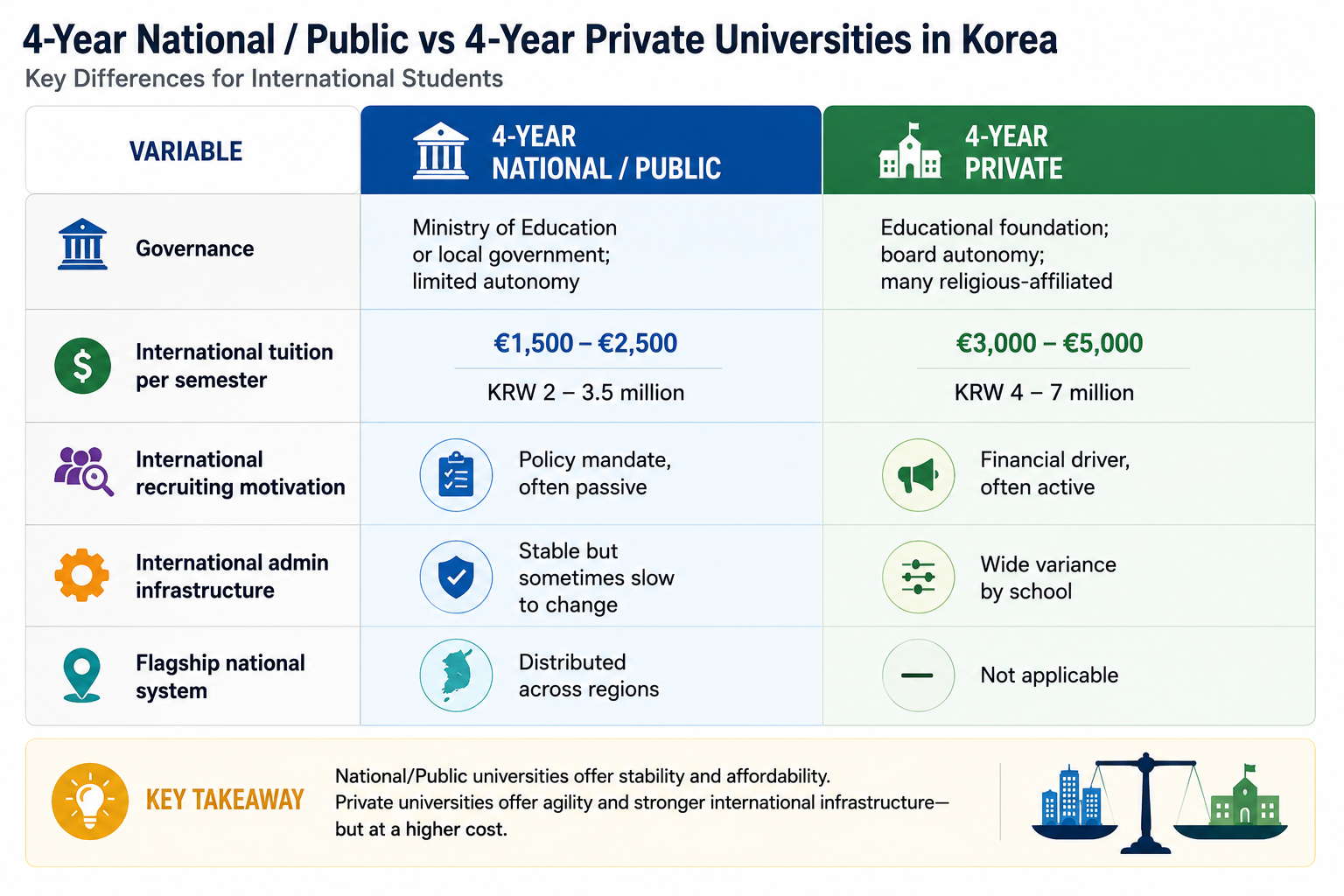
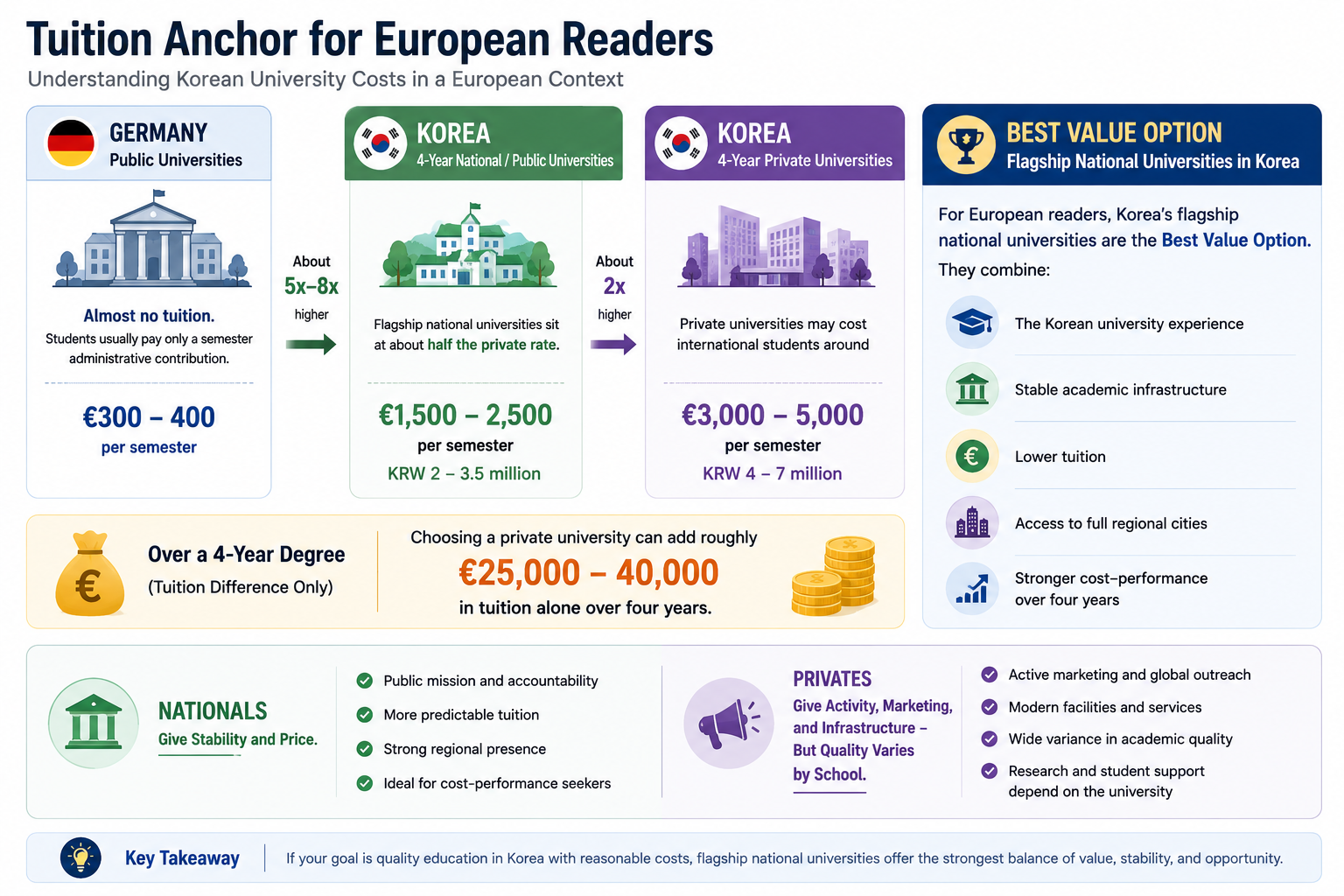
This affects tuition, administration, international student support, and daily life.
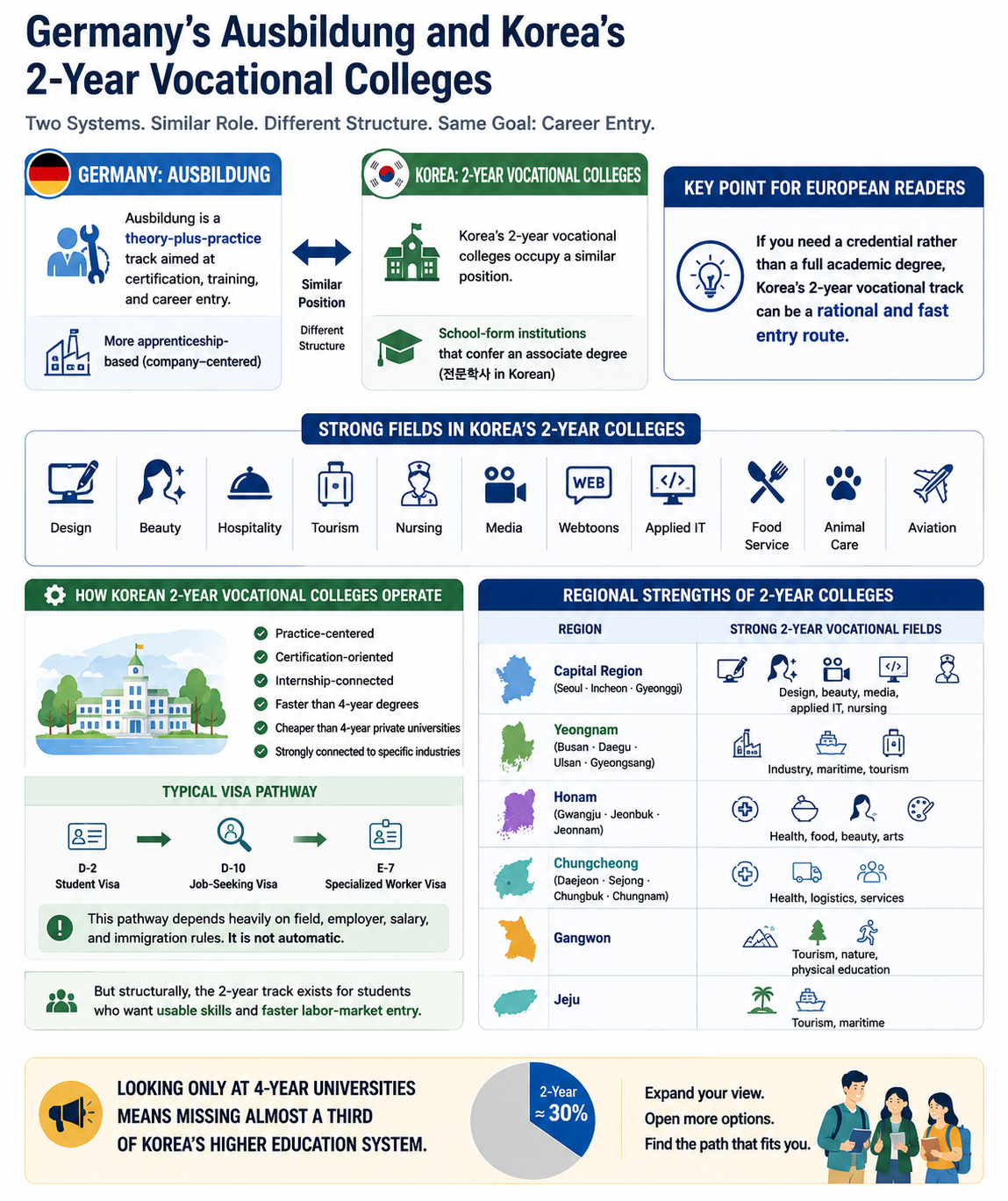
Issue 3: 2-Year Vocational Colleges
Focusing only on 4-year universities means missing a major part of Korea’s vocational education system.
Working Holiday Visa + 2-Year / Regional University Matching
The H-1 Working Holiday visa is relevant for many European Gen Z readers.
It allows young people from partner countries to stay in Korea for a limited period, often with legal part-time work.
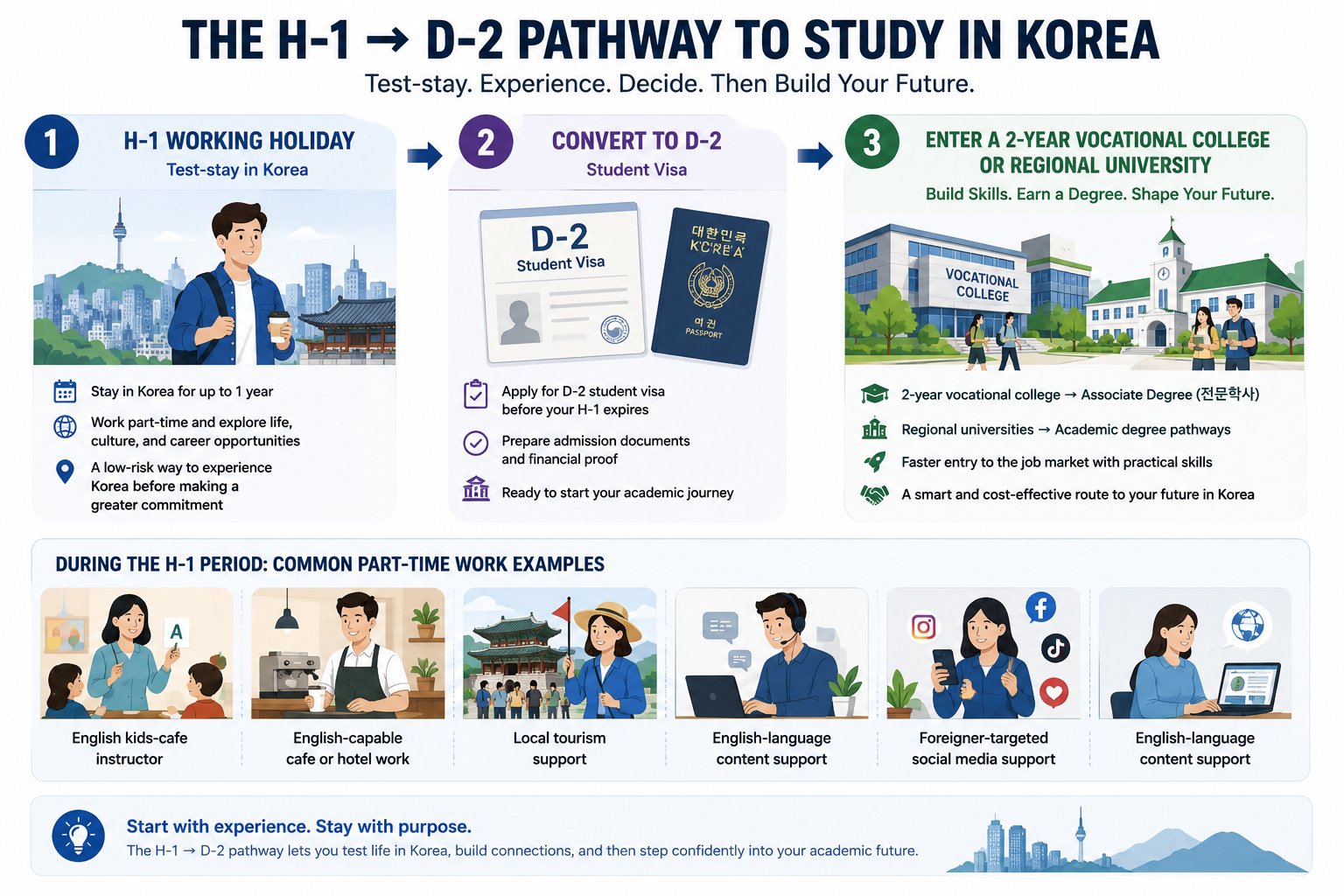
The Capital Region and Busan have the deepest English-capable part-time markets.
But regional universities can become attractive after the test-stay period because tuition and living costs are often far lower than private Capital Region options.
For cost-sensitive European students, this pathway deserves attention.
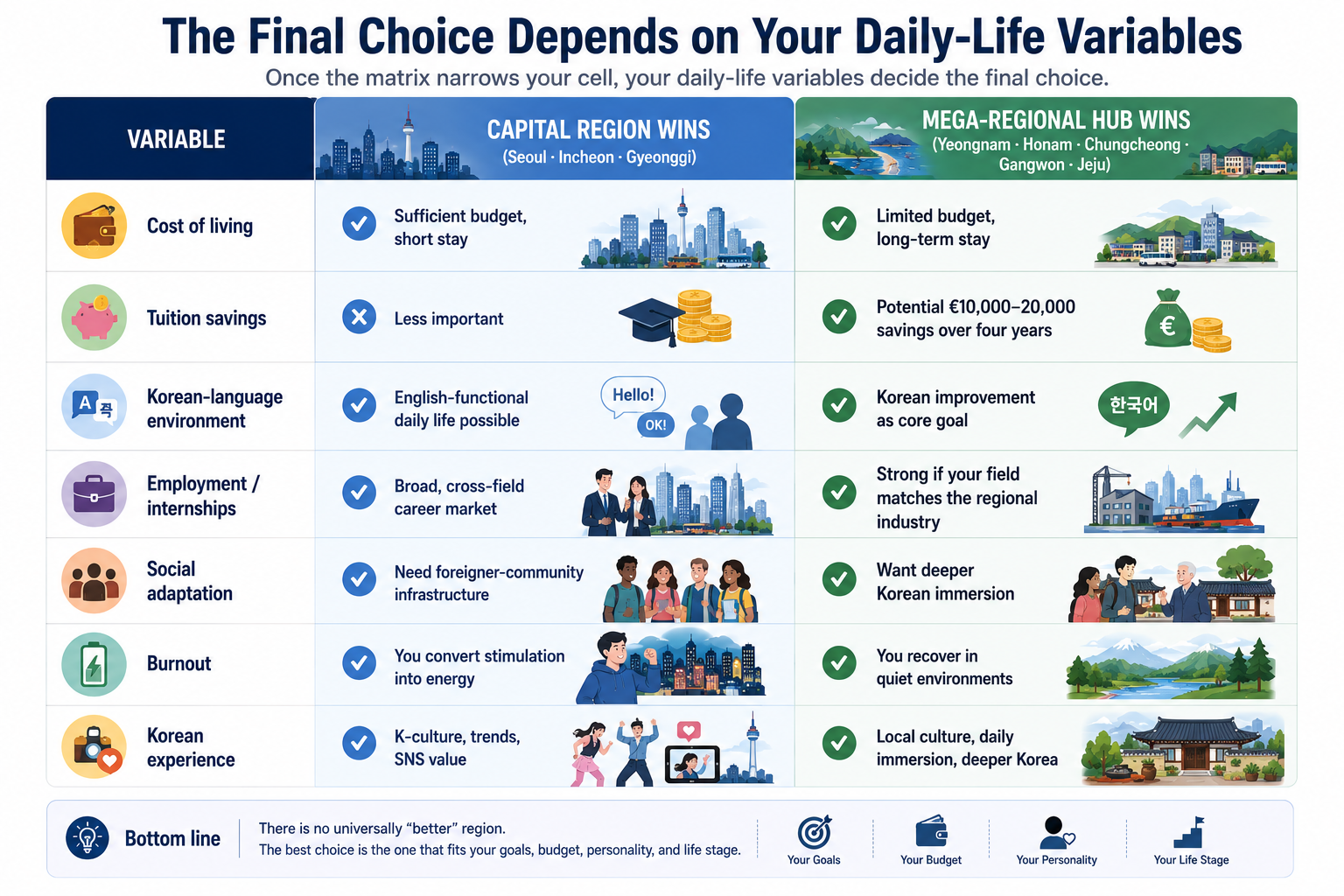
Issue 4: Korea’s “Regional” Does Not Mean Rural
In English and European contexts, the word “regional” can sound like rural, peripheral, or lower-tier.
That is not always the right interpretation in Korea.
Korea’s regional university ecosystem includes large cities with full infrastructure.
Examples:
- Busan — maritime mega-city of about 3.3 million people
- Daejeon — advanced R&D hub
- Gwangju — arts and culture center
- Daegu — major industrial city
- Incheon / Songdo — global education special zone
For this reason, it is more useful to think in terms of:
Mega-Regional Hubs
Not simply “regional universities.”
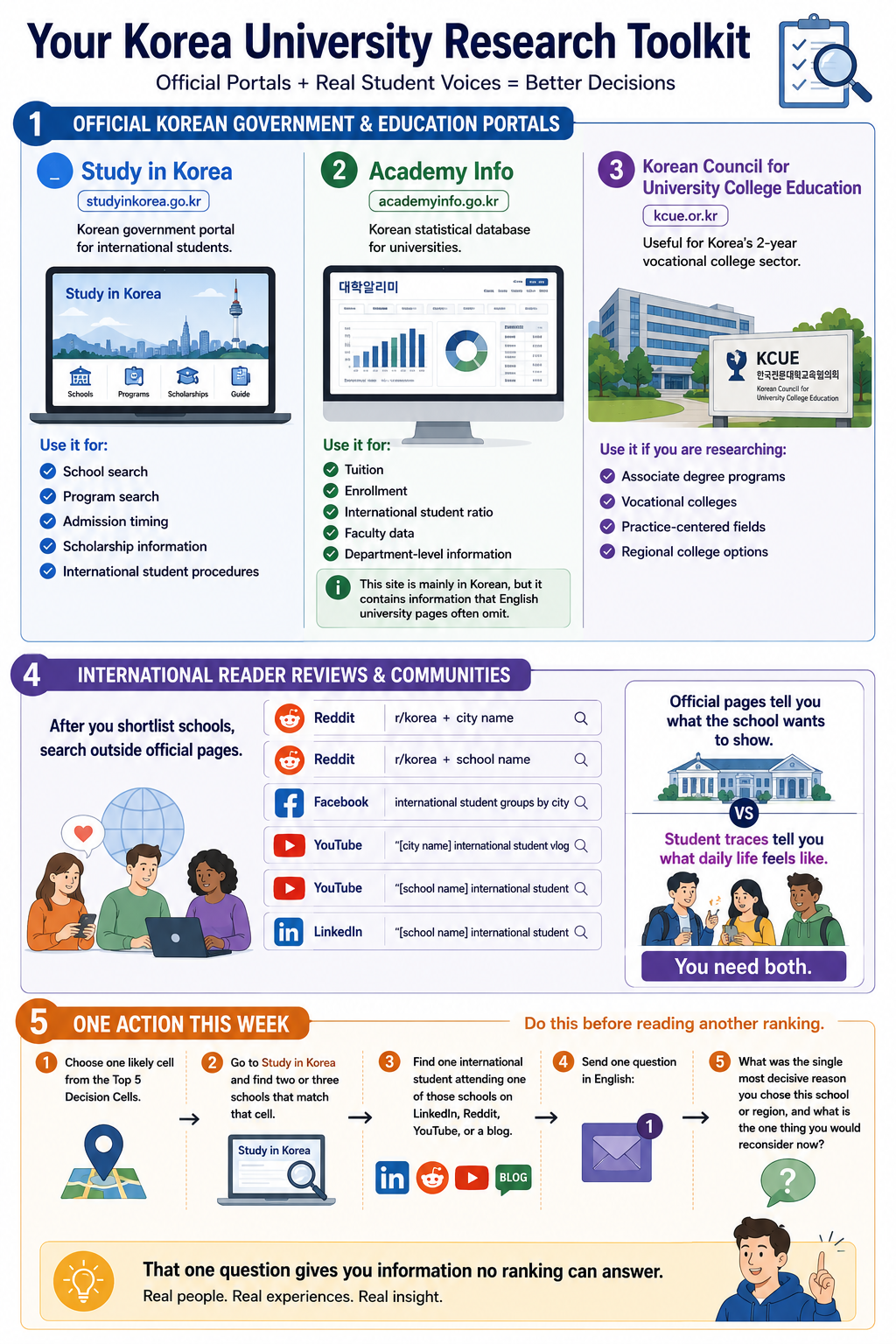
Verification Checklist: Korean University Search Resources
Once your cell is set, the next step is finding schools inside it.
This article does not list every school because the better tool is knowing where to search.
Use these resources.
The first tool for evaluating Korean universities is not a ranking.
It is the matrix.
Region and type locate your cell.
Your daily life, budget, language environment, field, and personality decide within that cell.
Korean universities are not a hierarchy.
They are coordinates.
Once you find yours, the decision begins.