
Who Chooses the System?
What should a researcher judge before crossing into another research system — and where does information stop and experience begin?
A research system is not only a system that selects talent. It is also a system being selected by talent.
Institutions evaluate researchers. Researchers evaluate institutions too.
We found the people who move technology. Now we ask what they judge when the decision is their own.
The Arrow Turns Around
Research mobility is usually described from the institution's side: vacancies, recruitment, visas, fellowships, selection.
But from the researcher's side, the process looks different. Before accepting a position, the researcher is also evaluating — the institution, the research environment, and the future that may follow from entering it.
Institutions ask whether the researcher fits the system. The researcher asks whether the system fits the work.
A Job Offer Is Not Yet a Route
Korea has many entry points for international researchers: universities, government-funded research institutes, corporate labs, joint research programmes, UST and postdoctoral positions. But for a reader outside the country, what matters is not only the number of positions. It has to be visible where a position leads.
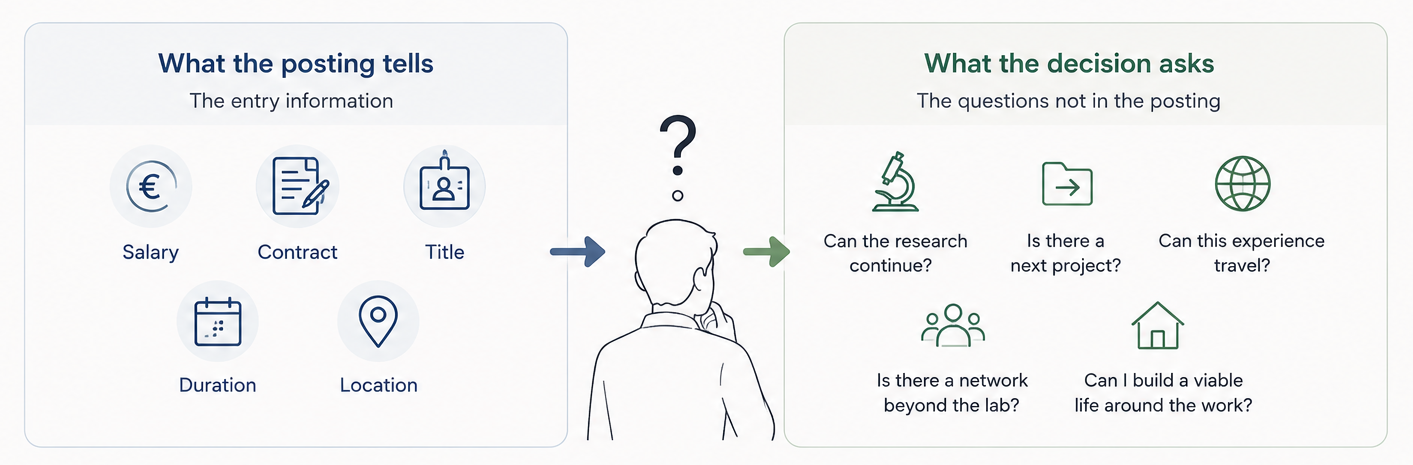
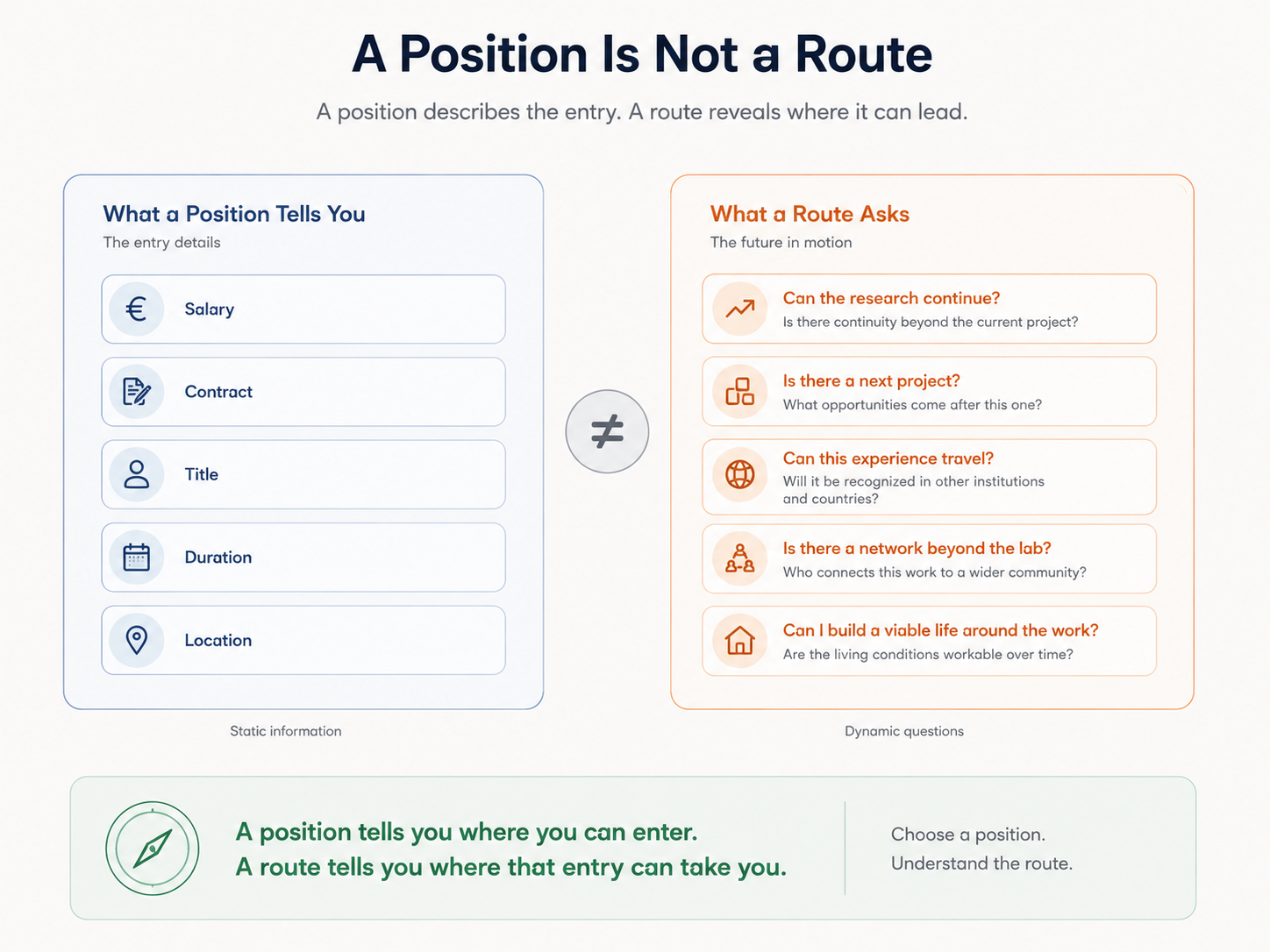
The difference matters most for researchers crossing a border. A local researcher can learn informally about an organisation's reputation, the character of a project, the network of a principal investigator. A researcher abroad cannot. What they can see is the public information — and what is not public does not remain a mere information gap. It is priced in as the risk of moving.
And beyond the position and the route, there is one more layer.
A route tells you how to enter. A career tells you why to stay.
Position, route, career. This article now climbs in that order.
What a Researcher Actually Judges
What, then, does a researcher read in a route? Across the reporting of this series, the recurring lines of judgement can be organised into four.
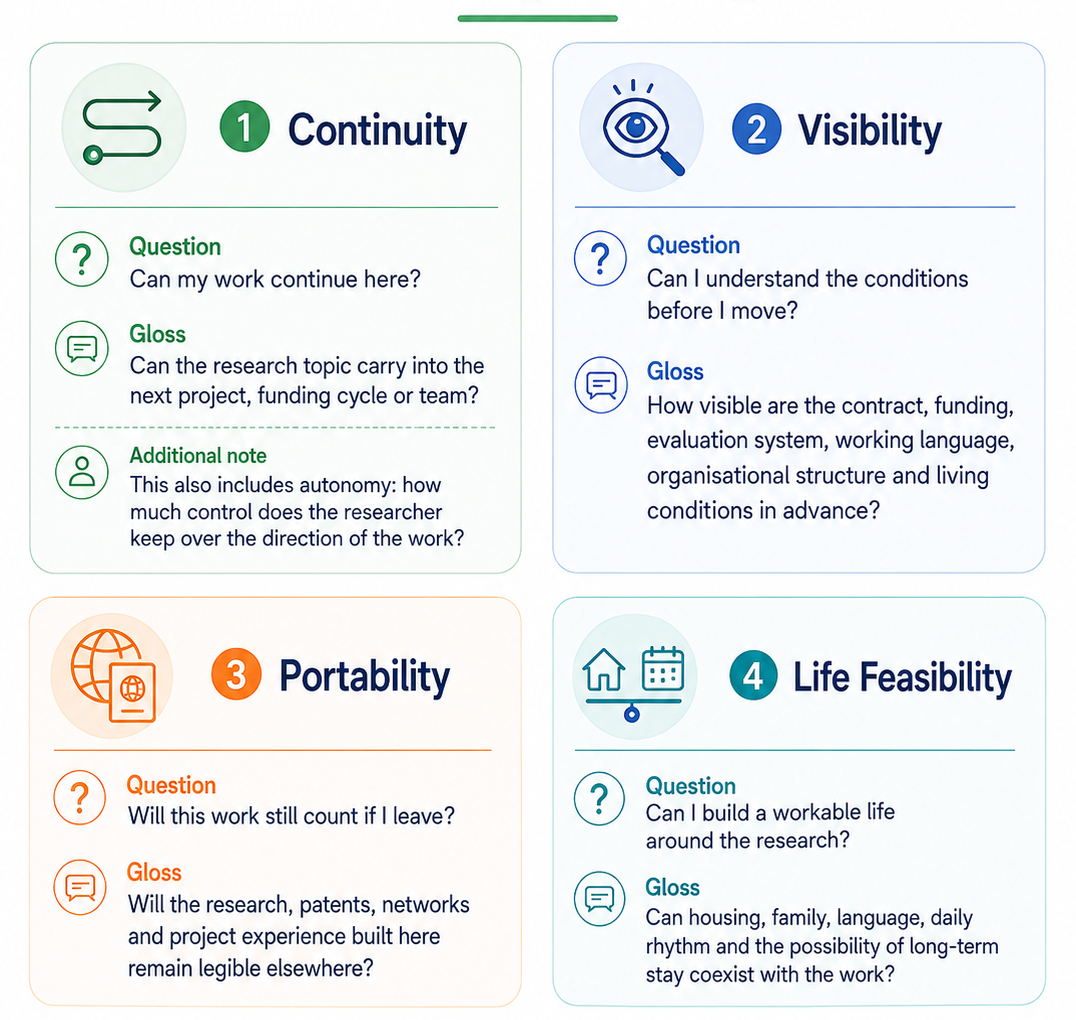
The four judgements are not abstract conditions. Step one level down, into how they become concrete inside Korea's system.
Positions are coordinates, not a ladder — the case of Korea's public research system
The positions through which a researcher enters Korea's public research system — UST student, postdoc or project researcher, contract researcher, permanent researcher, principal or senior level — are not a ladder that climbs automatically from one rung to the next. Each position is a different combination of three axes.
The contract period, and the conditions for renewal or conversion.
The greater the authority over research direction, the greater the responsibility for winning and sustaining projects.
Is the position funded by the institution, or tied to a specific project?
More stability, but growing responsibility for securing projects.
Can focus on one line of research, but the funding is bound to the project.
Belongs to a degree programme — a different status from a regular research career at the institute.
The question is not whether the offer is good in isolation. It is whether the researcher can see a future through it.
The Missing Evidence Is Human
Mobility often begins before relocation.
Joint research, a short research stay, a visiting programme, a bilateral project — there are many ways to experience another system before moving, and joint research can be a low-risk one.
But how the four judgements are actually weighed is preserved not in institutional information, but in a person's career.
Institutional data shows the conditions. A career shows how those conditions were weighted.
One career cannot explain a national research system. But it can reveal a sequence of decisions that institutional profiles rarely show.
So this article does not draw a conclusion. Instead, it prepares the next question.
The Mirror Route
The protagonist of the next story is a researcher who moved from Korea to Germany.
His route runs in the opposite direction from the one this series ultimately wants to understand. That makes his career not proof of why European researchers do or do not choose Korea. It makes it a mirror.
What did he judge before leaving? What made him stay? And were they the same thing?
He did not necessarily leave for the same reason he stayed.
And the most important question —
What makes a researcher believe that the work can continue on the other side?
Reader Route
Before you compare offers, write down two answers.
If you cannot answer either question, the position may still be attractive — but the route is not yet visible.
In the end, the two questions converge into one.
About This Reporting
This article is an editorial transition piece by K-Welle, written to connect the earlier reporting of Korea Innovation Bridge Part 1 with the field interview that follows.
The text does not rank the research environments of any country or institution. It presents the considerations a researcher may weigh when crossing a border — continuity of research, visibility of conditions, portability of career, feasibility of life — as questions for reading the interview that follows.
The “four judgements” and the “three axes” (employment security · research autonomy and project responsibility · funding source) are editorial frames by K-Welle, not official personnel classifications. The description of positions outlines the general structure of the system; actual conditions vary by institution, rank, project and laboratory.
The interviewee's move from Korea to Germany is not a case that directly explains why European researchers would move to Korea. The next article uses the experience of a move in the opposite direction to examine what researchers look at when they compare and choose research systems.
Partner institutions supported reporting access and had no role in the content.
Corrections: editor@k-welle.com