Where a Guarantee Sits
A guarantee does not create repayment. It changes who bears the loss, where credit is strengthened, and whether a lender is willing to provide the money.

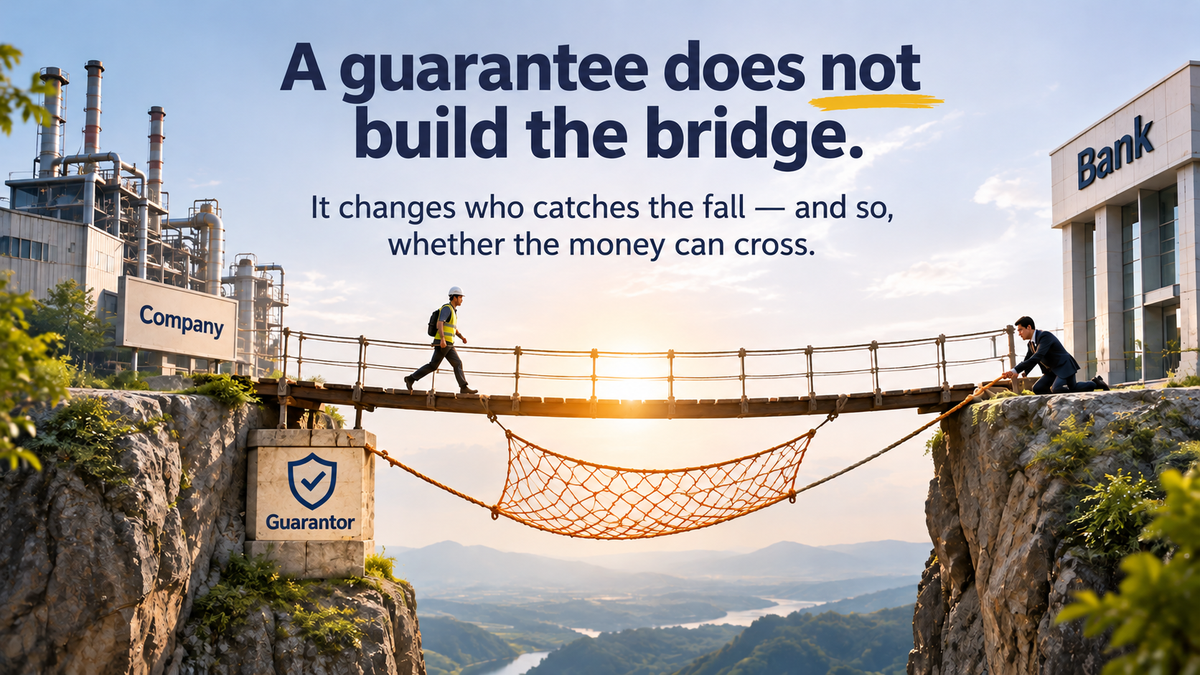
Whose risk does a guarantee take on?
“A guarantee does not create a source of repayment. It changes who bears the loss if a debt is not repaid — and with it, the terms on which the market will lend.”
— EPISODE KEYSTONE
Why This Matters
On 26 February 2026, the National Growth Fund's Fund Management Deliberation Committee approved two low-interest financing projects: a KRW 100 billion, ten-year loan for ISU Specialty Chemical's lithium sulfide plant, and KRW 2.5 trillion in low-interest financing for Samsung Electronics' P5 semiconductor fab, including KRW 500 billion from commercial banks. Neither company received a subsidy or a tax break. They borrowed.
The money for those loans is raised by the Advanced Strategic Industries Fund through bonds that the state guarantees. The guarantee does not sit on the companies' loans. It sits one level above, on the bonds the fund issues to raise the money it lends.
Borrower, Lender, Guarantor
- Borrower: takes the money and owes the principal and interest.
- Lender or creditor: puts the money up.
- Guarantor: promises to repay part of the debt if the borrower cannot.
A guarantee does not change the borrower. It changes the structure of loss-bearing that the creditor faces.
Three Questions Before the Guarantee
- Business risk: will the business generate cash?
- Repayment risk: is that cash enough to service the debt on time?
- Who bears the loss: if the debt still goes unpaid, who takes the loss? A guarantee — a form of credit enhancement — answers this question.
Three Questions Before the Guarantee
Does the business work?
Business risk
Can the cash repay?
Repayment risk
Who bears the loss?
Guarantee · Credit enhancement
A guarantee does not turn a business with no source of repayment into one that can repay. What it can address is a bottleneck in which repayment is possible, but money does not move because of the burden of credit risk.
When Does Government Money Actually Go Out?
A state guarantee is not current budget spending. For 2026, the ceiling for newly guaranteed Advanced Strategic Industries Fund bonds is KRW 15 trillion. If the company loans are repaid and the fund repays its bonds, the state pays nothing. Only if losses accumulate to the point where the fund cannot repay its guaranteed bonds does the state's liability become real. The KRW 15 trillion figure is an annual issuance ceiling; the projected year-end stock of guarantee obligations is a separate measure.
A subordinated tranche absorbs losses early in the capital stack. A state guarantee stands at the end of the repayment chain.
Where Does a Guarantee Attach?
Under the same word, who guarantees whom can differ:
- Between a company and a bank: a company credit guarantee, such as one from the Korea Credit Guarantee Fund (KODIT), strengthens the credit of the borrowing company. The company pays a fee, and the guarantor covers a set share of the loan.
- Between a financial institution and the capital market: a state guarantee on fund bonds strengthens the funding credit of the institution that lends the money on.
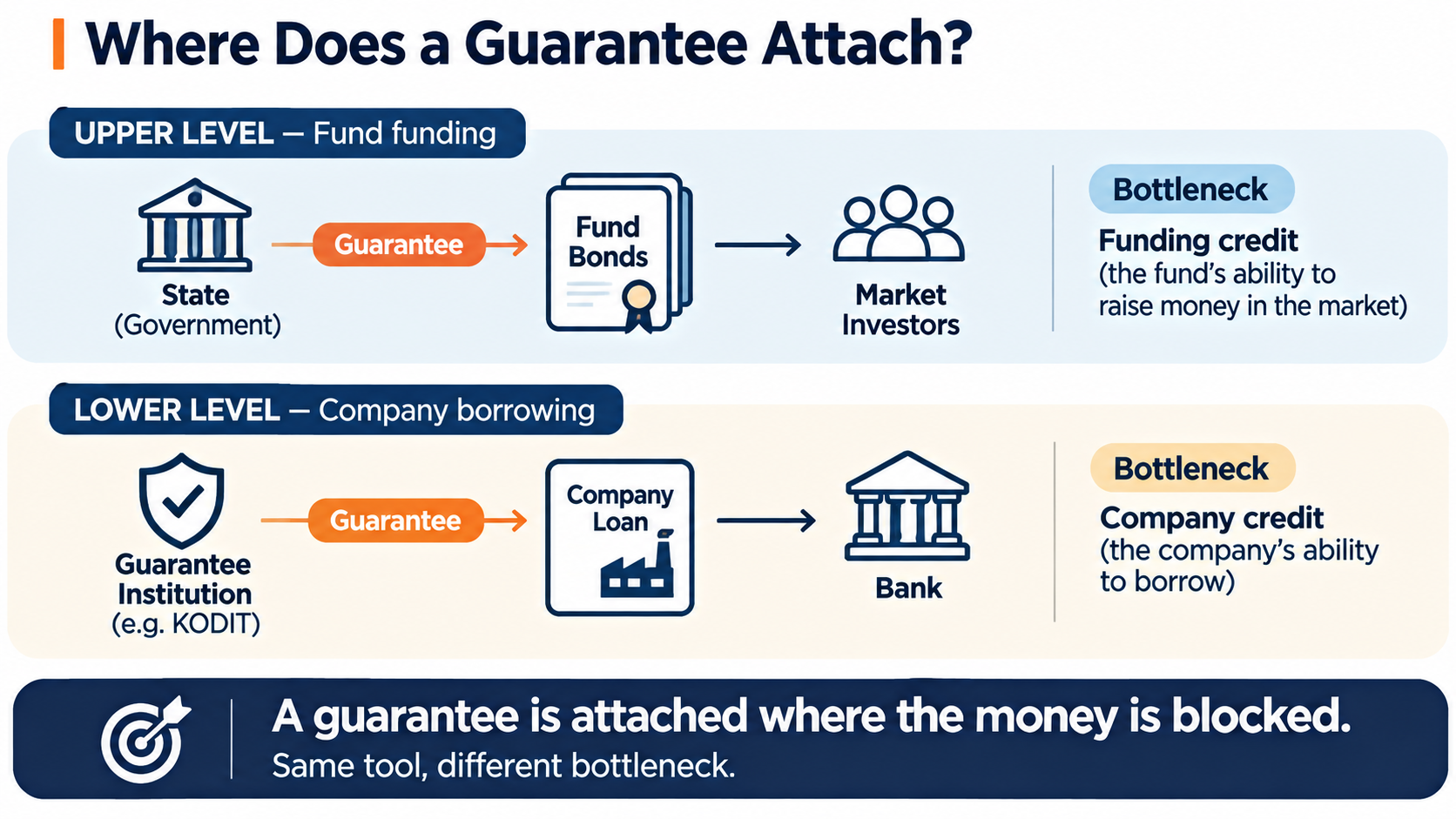
The Samsung Electronics P5 project illustrates both levels around the same industrial project. At the funding level, state-guaranteed fund bonds support the fund's market borrowing; at the company level, a KRW 200 billion KODIT special guarantee programme supports participating suppliers.
A guarantee is attached where the money is blocked.
THE QUESTION IS NOT ONLY
Is there a guarantee?
IT IS ALSO
Where is the guarantee attached, and whose loss does it change?
Continue the Full Analysis
The full article sets Korea's annual guarantee ceiling for fund bonds beside Germany's KfW, whose market funding carries federal liability built into law.
It then shows that a guarantee has a price — fees, partial cover, and state obligations that can grow before any cash goes out.
Finally, it asks when a guarantee does not fit: is there a source of repayment while credit is blocked, or no source of repayment yet?
Sources and reporting notes are in the full analysis.
FLOW POSITION — Vehicle · Entry
NEXT → Ep.7 Funding Fit — Which Money Fits My Technology Now?