Where a Guarantee Sits

Whose risk does a guarantee take on?
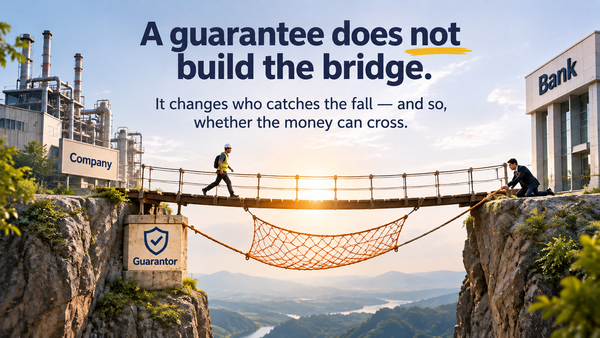
“A guarantee does not create a source of repayment. It changes who bears the loss if a debt is not repaid — and with it, the terms on which the market will lend.”
— EPISODE KEYSTONE
PART I · LENS 6 · CREDIT
Opening
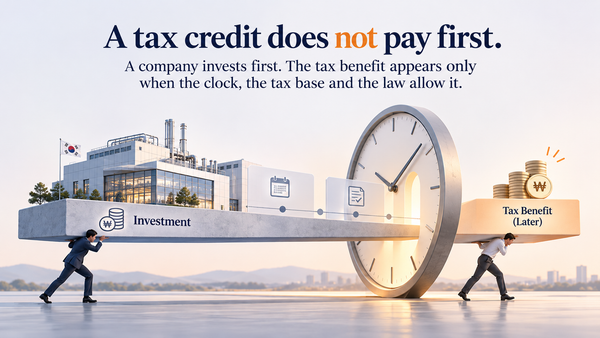
A tax credit lowers the cost for companies that are already able to invest. But some companies have an investment plan and the means to repay, yet still cannot borrow. If a company has a source of repayment but cannot raise money in the market at the scale, maturity and interest rate it needs, what is missing? It may not be money. It may be credit that the lender is willing to accept. In that case, what the government changes is not tax but the credit the market sees.
On 26 February 2026, the National Growth Fund's Fund Management Deliberation Committee approved two projects. One is ISU Specialty Chemical's expansion of its lithium sulfide plant in Onsan, Ulsan — a core material for all-solid-state batteries. The support is a KRW 100 billion, ten-year loan at an interest rate in the low 3% range. The other is Samsung Electronics' P5 semiconductor fab in Pyeongtaek, for which KRW 2.5 trillion in low-interest loans was approved: KRW 2 trillion from the fund and KRW 500 billion from commercial banks. Neither company received a subsidy or a tax break. They borrowed.
But we need to go one step further back. The money for those loans is raised in the market by the Advanced Strategic Industries Fund, on the strength of a government guarantee. The fund issues bonds, investors buy them, and the state guarantees repayment of their principal and interest. The guarantee here does not sit on ISU Specialty Chemical's loan. It sits one level above, on the bonds the fund issues to raise the money it lends. The 2026 limit on that state guarantee is KRW 15 trillion. What the companies received was a loan. What the bond investors received was the state's credit. The government itself has not yet paid out anything.
When a guarantee is attached, the money still comes from banks and investors. What changes is who promises to bear part of the loss if the debt is not repaid. This episode follows whose risk that promise covers, and where in the chain it is attached. If a research team is one day turned down for an equipment loan, the first thing to establish is whether the business itself cannot repay, or whether it can repay but the bank does not yet accept its credit.
Borrower, Lender, Guarantor
A guarantee involves three parties: the borrower, who takes the money; the lender or creditor, who puts the money up; and the guarantor, who promises to repay part of the debt if the borrower cannot. A company takes out a loan. A bank provides the money. A guarantee institution promises to repay part of it if the company cannot. That is the basic structure.
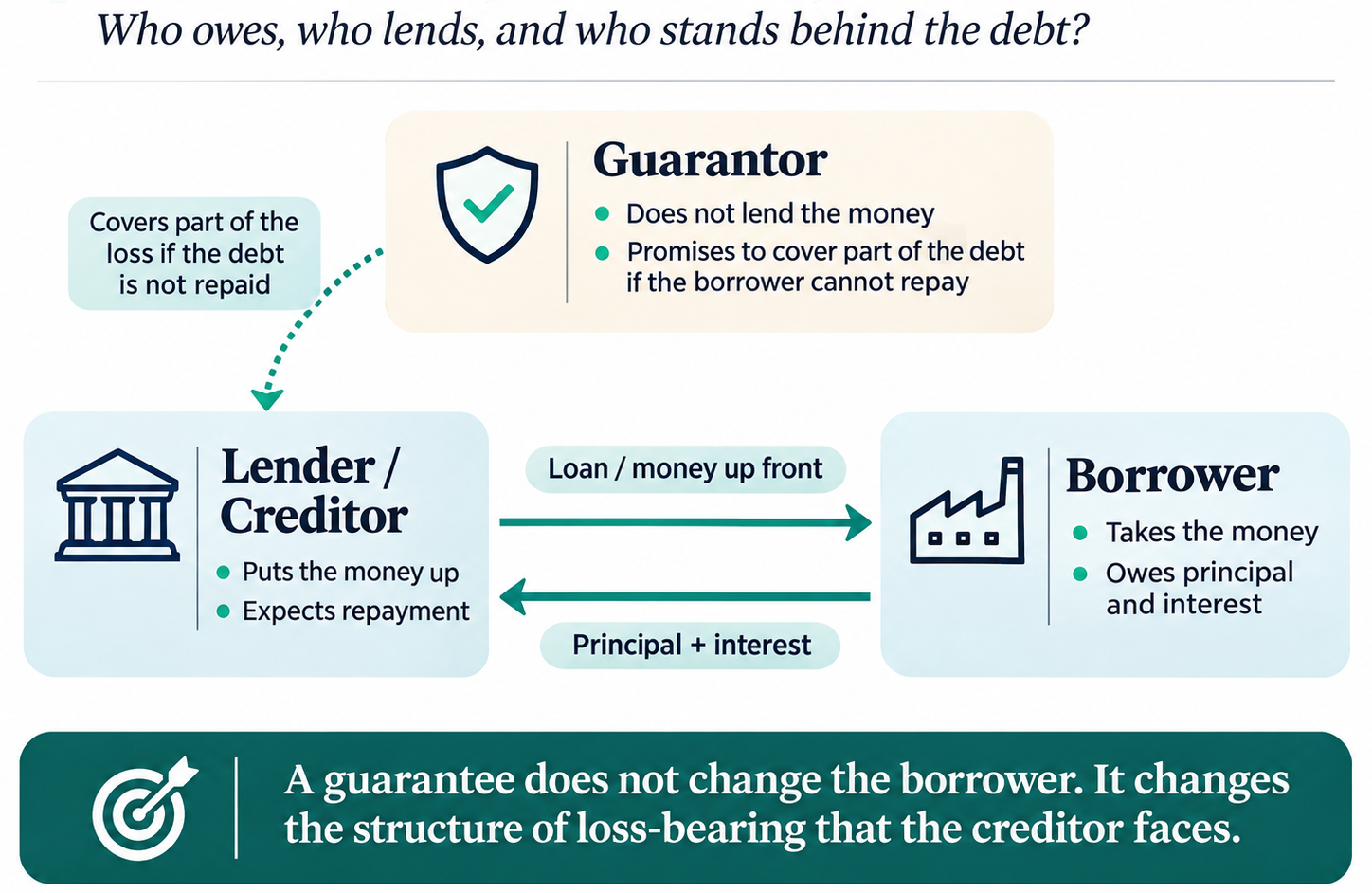
Now follow the money backwards. ISU Specialty Chemical borrows KRW 100 billion from the Advanced Strategic Industries Fund. To raise the money it lends to companies, the fund issues bonds. Market investors buy those bonds. The state guarantees their principal and interest. If the fund cannot repay the bonds, the state may become liable to pay under its guarantee. The important point is that the government does not guarantee ISU's loan directly. The state strengthens the credit of the fund's bonds when the fund raises money in the market. The credit assessment of the company loan remains as it is; what is added is the state's credit when the fund raises the money for that loan.
That difference changes the terms of funding. On the day of the approvals, the Financial Services Commission (FSC) described the fund's loans as carrying “low interest at the level of government bonds” (K-Welle's translation). The state guarantee raises the credit standing of the fund's bonds and so allows the fund to raise money in the market at relatively low cost. The fund then supplies that money again as long-term, low-interest policy finance. ISU was approved for a ten-year loan at an interest rate in the low 3% range.
A guarantee does not change the borrower. It changes the structure of loss-bearing that the creditor faces.
Three Questions Before the Guarantee
Suppose a company builds a plant. The first question is whether the business actually works: whether the equipment runs as planned, whether there are customers, whether the costs add up and whether sales come in. This is business risk.
Even if the business looks viable, a loan raises one more question: can the cash from that business repay the promised principal and interest on time? Here the lender looks at whether sales are sufficient, when cash flow arrives, how much debt the company already carries and whether the loan's maturity matches the timing of cash coming in. This is repayment risk. What a bank accepts as a source of repayment is covered later in the series.
Even after this review, a lender may still hesitate. Collateral may be thin, the company's credit history may be short, or the market may put a high price on the chance of loss in a new industry. This raises the third question: who bears the loss? This is where a guarantee comes in. Another party promises to take on part of the loss the creditor would bear if the borrower cannot repay. This is credit enhancement.
The three questions are not the same. A good business is not necessarily able to repay a loan, and a borrower that can probably repay is not one whose risk every lender will accept. Conversely, a guarantee does not make a business better or create new sales. Business risk asks whether cash will be generated; repayment risk asks whether that cash is enough to service the debt; a guarantee asks who bears the loss if the debt still goes unpaid.
A guarantee works when the bottleneck in funding lies less in the business itself than in how credit risk is allocated. In company lending, a loan can be blocked by thin collateral, a short track record or weak credit even when repayment is possible. In the funding of policy finance institutions, the credit terms the market demands can make it hard to raise enough money at the required scale or maturity. Unlike equity investment, lending turns not on a rise in company value but on what will repay the principal and interest. The five projects approved by the Fund Management Deliberation Committee in September 2026 were also debt financing — including project finance and low-interest loans — not equity. A guarantee is not a tool for turning a business with no source of repayment into one that can repay. What it can address is a bottleneck in which repayment is possible, but money does not move because of the burden of credit risk.
Whether ISU Specialty Chemical's plant succeeds is the company's business risk. Whether the company can repay the fund's loan is repayment risk. The state did not guarantee either directly. It attached its credit to the principal and interest of the bonds issued in the market by the fund that holds the loan. To see which risk a guarantee covers, look not at the name of the money but at where the guarantee contract sits.
When Does Government Money Actually Go Out?
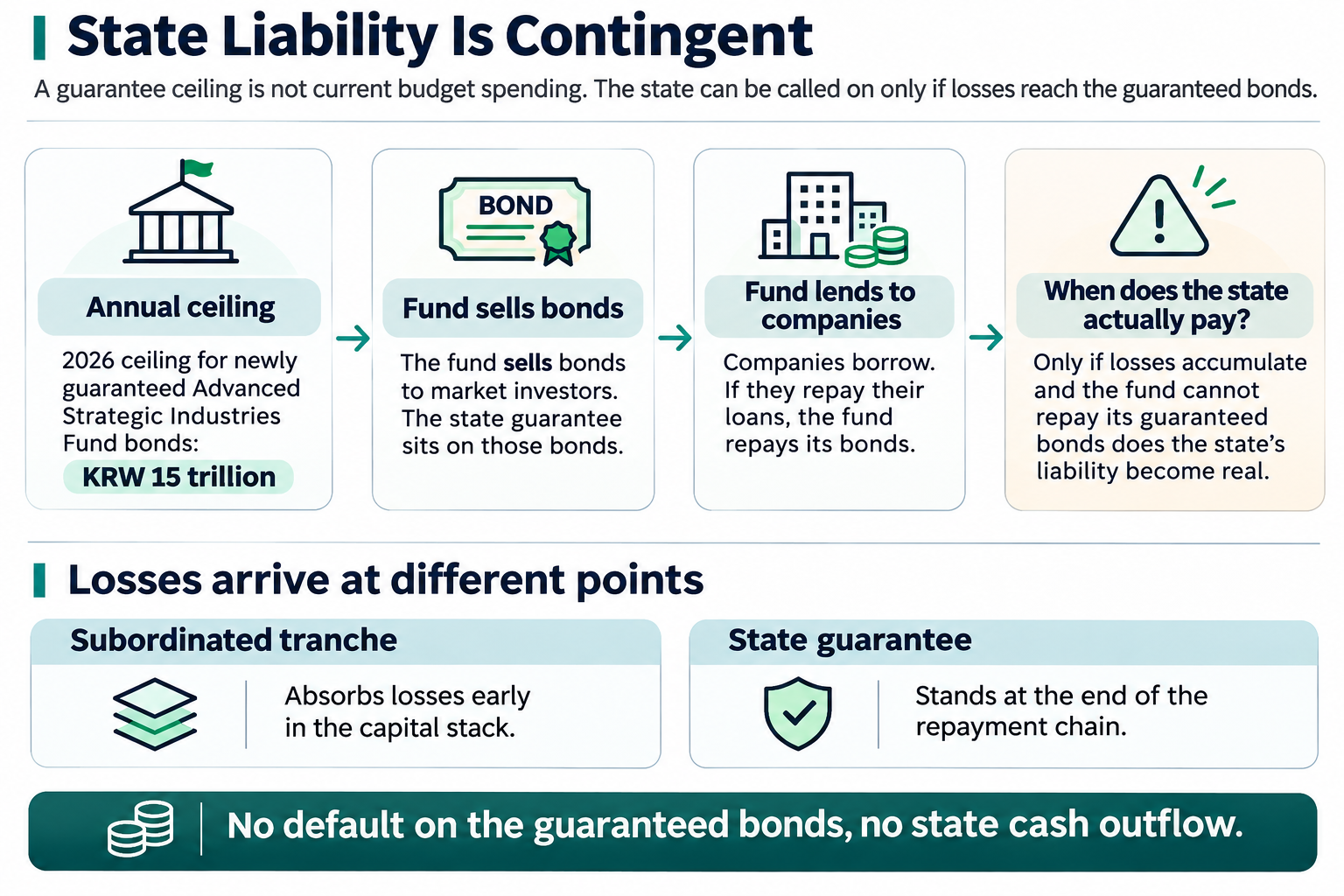
A state guarantee is not current budget spending. Until a payment obligation is triggered, it is managed as a contingent guarantee obligation. For 2026, the limit on the state guarantee for Advanced Strategic Industries Fund bonds is KRW 15 trillion. The National Assembly Budget Office (NABO) explains that KRW 13.6 trillion of this is for support projects in advanced strategic industries and KRW 1.4 trillion is a liquidity reserve. The same material gives the projected guarantee obligation on these bonds under the state guarantee obligation management plan as KRW 16.5 trillion. The KRW 15 trillion figure is the 2026 ceiling for newly guaranteed bond issuance; the KRW 16.5 trillion figure is the projected year-end stock of guarantee obligations, including the previous balance. Neither means the government will spend that money this year. A guarantee creates a future contingent obligation rather than present spending.
The condition is written as a sequence. If the company loans are repaid normally and the fund repays principal and interest on its bonds, the state pays nothing. A company's default can first appear as a loss on the fund's assets; if such losses accumulate to the point where the fund cannot repay principal and interest on the guaranteed bonds, the state's liability under the guarantee can become real. A guarantee does not remove risk. It decides in advance who bears the final liability to pay.
This order is the reverse of a subordinated fund structure. A subordinated tranche — such as the public money in Korea's public participatory National Growth Fund — absorbs losses early in the capital stack. A state guarantee stands at the end of the repayment chain: it does not take a company's first loss, but places a final payer behind the fund's bonds. That is why the state's guarantee obligations can grow even before any actual cash goes out. With a guarantee, the state takes on a future contingent obligation to pay in place of direct spending today.
Where Does a Guarantee Attach?
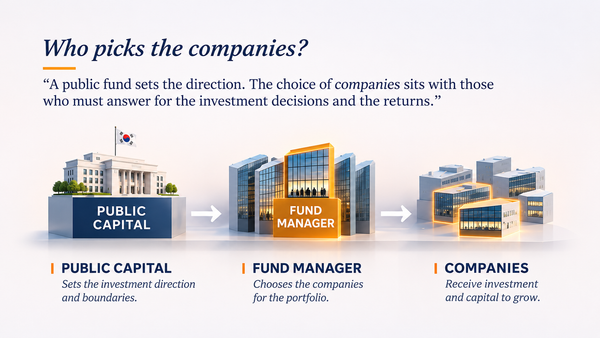
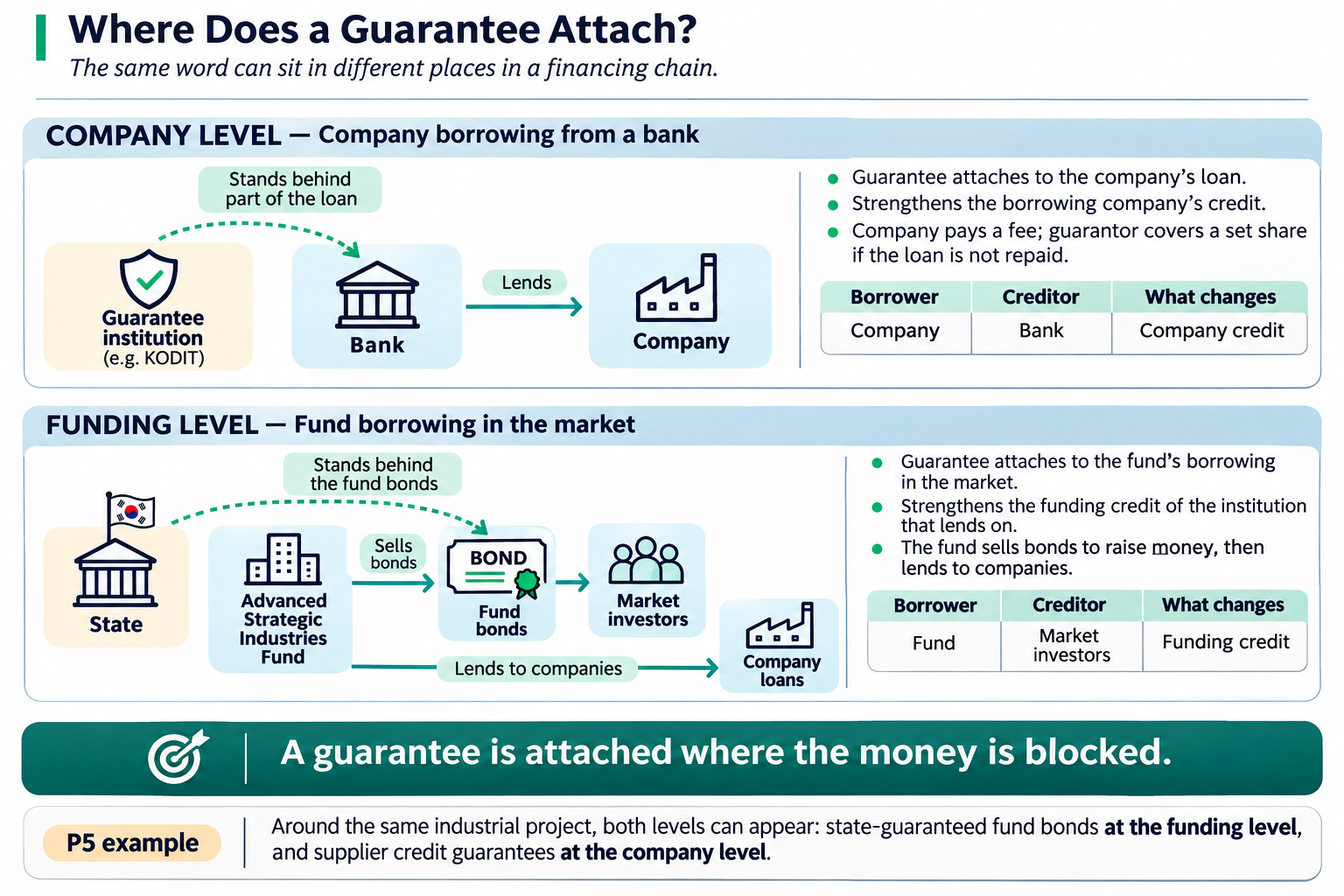
To understand a guarantee, ask first not “Who is guaranteed?” but “Which funding relationship is the guarantee attached to?” Under the same word, who guarantees whom can differ. A company credit guarantee is attached to an individual company's bank loan by institutions such as the Korea Credit Guarantee Fund (KODIT) and the Korea Technology Finance Corporation (KIBO). The company pays a guarantee fee, the guarantee institution guarantees a set share of the loan, and the bank assesses the loan with that guarantee in view. A state guarantee is different. The state's credit is attached to bonds issued in the market by a policy finance institution or fund, and that credit lowers its funding cost. One is attached to the credit of the company as borrower; the other to the funding credit of the institution that will lend the money on.
Apply the three questions from “Three Questions Before the Guarantee” to each, and the difference becomes clear. Under a company credit guarantee, both the business risk and the obligation to repay principal and interest stay with the company. But if the debt goes unpaid, the guarantee institution takes on part of the loss the bank would otherwise bear. Under the state guarantee on Advanced Strategic Industries Fund bonds, the business risk of individual companies stays with the companies; defaults on company loans can first appear as losses on the fund's assets; and the state stands behind the fund's liability to pay principal and interest on the guaranteed bonds it has issued.
The Samsung Electronics P5 project, announced the same day, illustrates both levels around the same industrial project. In connection with the P5 project, Samsung Electronics agreed to set up a KRW 200 billion special guarantee programme for its suppliers with KODIT. Samsung contributes the funds, and KODIT provides special guarantees on preferential terms to small and mid-sized suppliers taking part in P5. With those guarantees, suppliers can improve their access to bank loans and their borrowing terms. At the upper level, the state attaches its credit to the fund's bonds so that the fund can raise money cheaply. At the lower level, KODIT attaches its credit to suppliers so that individual companies can obtain bank loans. The name “guarantee” alone does not reveal this difference.
A guarantee is attached where the money is blocked. Some guarantees sit between a company and a bank; others between a financial institution and the capital market. If the problem is that the fund's bonds are hard to sell in the market, the fund's credit is strengthened. If the problem is that a small company cannot get a bank loan because it lacks collateral and credit, the company's credit is strengthened. It is the same financial tool, but the bottleneck it addresses is different.
Same Public Credit, Different Position
Korea and Germany both use public credit to draw in market money. But the state's credit is attached in different places. Korea's Advanced Strategic Industries Fund raises the money it needs by issuing fund bonds. The government guarantees repayment of principal and interest on the bonds to be issued in a given year, and the National Assembly approves that year's guarantee limit. Each year, the question “How far will the state stand behind the bonds this fund issues this time?” is decided again.
KfW is different. Under Section 1a of the KfW Law, the Federal Republic is statutorily liable for KfW's borrowing and debt securities, among other specified obligations. Rather than a separate state guarantee being attached each time KfW issues a bond, the principle that “the Federation's credit stands behind this policy finance institution when it raises money in the market” is built into the institution's legal structure. In Korea, the size of the guarantee itself is a policy decision each year; in KfW's case, federal liability works as a basic funding condition built into the law.
Even within the same public finance system, the positions differ. When KfW Capital invests in venture funds, it shares investment risk with private investors on the same terms (pari passu); KfW's own bonds and borrowing carry the federal government's statutory liability. One shares investment risk; the other strengthens funding credit. So the single sentence “The government bears the risk” is not enough. We need to see which risk it bears, at which stage and in what order.
Same Public Credit, Different Position
Korea and Germany both use public credit to support market funding. What differs is where that public credit sits in the financing structure.
| Question | Korea | Germany |
|---|---|---|
| Institution | Advanced Strategic Industries Fund | KfW |
| Where public credit sits | On bonds issued by the fund to raise money in the market | Behind KfW’s market funding, through federal statutory liability |
| How it is established | The National Assembly approves an annual state-guarantee ceiling | Federal liability is built into Section 1a of the KfW Law |
| Scope | Fund bonds issued in a given year, up to the approved ceiling | KfW’s borrowing and debt securities, among other specified obligations |
| What it strengthens | The funding credit of the Advanced Strategic Industries Fund | The funding credit of KfW |
A Guarantee Has a Price Too
A guarantee is not free risk. The company pays a guarantee fee. A guarantee institution guarantees only a set share of a loan, not the full amount, and caps how much it can provide to any one company. The rest of the risk stays with the bank, which asks for an interest rate and covenants to match its share. Under company credit guarantees, the usual structure is that the guarantee institution repays on the company's behalf and then claims that amount back from the company. The state guarantee at the upper level is not free either. The state's credit can lower the fund's borrowing costs, but the state carries the guaranteed debt as a state guarantee obligation.
A guarantee does not remove the borrower's business risk or its obligation to repay. In many cases, rather than directly changing a business's chances of success or its cash flow, it reduces the loss a creditor would actually bear if the debt goes unpaid. As a result, expected losses and funding terms can change. A guarantee does not remove credit risk; it changes who bears that risk, and how much. That is why the same business at the same company can borrow at a different price depending on which guarantee is attached. How that price is set again when money crosses borders is covered later in the series.
When a Guarantee Does Not Fit
There are situations in which a guarantee is unlikely to help: when there is no source of repayment yet, when the business model itself is uncertain, at the early R&D stage, when there is no cash flow yet, and when there is not enough capital to absorb losses. Guarantee institutions, too, assess guarantees for businesses and companies whose ability to repay can be recognised. At that stage, what is needed first may be a grant or equity investment, research infrastructure, or shareholders' capital that can absorb losses first.
What a guarantee addresses is not the whole risk of a business, but a bottleneck in which credit is not accepted by the market. So before looking for a guarantee, one distinction comes first: is there a source of repayment while credit is blocked, or is there no source of repayment yet? In the first case, a guarantee can ease the credit bottleneck. In the second, the money needed is not a guarantee but something earlier — a grant, equity or research infrastructure.
K-Flow · Reader Tool
Before asking for a guarantee
+
A guarantee helps only when the financing bottleneck is in credit — not when the business still lacks a viable source of repayment.
Is there a source of repayment?
Can the business generate enough cash to repay principal and interest on time?
Where is the block?
Is the problem in the business itself, the repayment structure, or the credit the lender is willing to accept?
Which funding relationship would the guarantee attach to?
A company-to-bank loan, or a financial institution’s borrowing from the capital market?
Closing
There are many routes by which money reaches a company. On the surface, all of them are government support, but the way money moves and the risk the government takes on differ. Direct spending shows up in the budget, tax credits in tax expenditure, and guarantees in state guarantee obligations.
A guarantee does not create a source of repayment. It eases a credit bottleneck by allocating part of the risk of loss to another party at the point where money is blocked. In the world of lending, a technology's promise is not enough; the repayment structure and the credit must be visible too. A guarantee does not prove that a technology will succeed. Instead, it moves the reference point for credit so that someone is able to lend. That is the distinction a research team should make before knocking on a bank's door with its first production line: is there no source of repayment, or is credit what is missing?
A guarantee does not create a source of repayment. It changes who bears the loss if a debt is not repaid — and with it, the terms on which the market will lend.
Once guarantees are in view, the six kinds of money in this part of the series turn out to be asking different questions. Is time short? Is equipment lacking? Is the early risk high? Is growth capital needed? Does the tax effect arrive too late? Is there a source of repayment but not enough credit? The question shifts from the name of the money to the state of the technology. The next episode sets the names of money aside for a moment and asks first what is actually missing for a technology now.
FLOW POSITION — Vehicle · Entry
CHECK — Is the block in the business, the source of repayment or the credit? And if a guarantee is attached, to which funding relationship?
NEXT → Ep.7 Funding Fit — Which Money Fits My Technology Now?
About This Reporting
In this article, “the government” is shorthand for the Ministry of Finance and Economy and the Financial Services Commission (FSC), which decide on guarantees, and the National Assembly, which approves the limits. The fund is managed, and its bonds issued, by the Korea Development Bank (KDB).
The support for ISU Specialty Chemical and Samsung Electronics' P5, the phrase “low interest at the level of government bonds”, and the creation and size of KODIT's special guarantee programme for suppliers follow the FSC press release of 26 February 2026. We could not confirm the guarantee ratio or fee level of the special guarantees from official sources, so we have described them only as “on preferential terms”. The approvals of September 2026 follow FSC material; details of individual projects are not given. The issuance structure of the fund's bonds follows KDB's notices; the KRW 15 trillion limit and its breakdown, and the projected year-end guarantee stock of KRW 16.5 trillion (from the 2025–2029 state guarantee obligation management plan), follow material from the National Assembly Budget Office. The first is an annual issuance ceiling; the second, an outstanding balance. KfW's federal liability follows Section 1a of the KfW Law.
The description of the three parties in “Borrower, Lender, Guarantor”, the three questions in “Three Questions Before the Guarantee” (including the sentence that lending turns on what will repay the principal and interest), the order of risk in “When Does Government Money Actually Go Out?”, the general structure of company credit guarantees in “Where Does a Guarantee Attach?” (fees, guarantee ratios, limits and recourse), the description of price in “A Guarantee Has a Price Too” and the stage-by-stage description in “When a Guarantee Does Not Fit” are general descriptions of guarantee schemes, not the wording of any particular institution. The terms of individual KODIT and KIBO products are not covered.
Public material does not specify the committee's actual assessment criteria. ISU Specialty Chemical's ability to repay and the viability of its business are not assessed, and the procedure when a guarantee turns into an actual loss is beyond the scope of this article. Setting the two countries' structures side by side is an editorial arrangement. The research team in the opening and closing is a hypothetical example.
Corrections: editor@k-welle.com
Sources
In addition to the material linked in the text, we consulted:
- Financial Services Commission (FSC) — results of the Fund Management Deliberation Committee (26 February 2026) (in Korean)
- FSC — call for National Growth Fund managers (15 January 2026); public participatory National Growth Fund (6 May 2026); results of the September Fund Management Deliberation Committee (17 September 2026) (in Korean)
- National Assembly Budget Office — analysis of the 2026 state guarantee obligation limits (KRW 15 trillion limit for Advanced Strategic Industries Fund bonds; projected year-end guarantee stock of KRW 16.5 trillion) (in Korean)
- Korea Development Bank — issuance notices for Advanced Strategic Industries Fund bonds (government-guaranteed); Newspim — first fund bond issue of KRW 300 billion (25 March 2026) (in Korean)
- Korea Credit Guarantee Fund (KODIT) — overview of guarantee schemes (in Korean)
- KfW — Our credit quality (investor information); Gesetz über die Kreditanstalt für Wiederaufbau, Section 1a (in German)