Korea’s Three Mega Projects: A New Industrial Map for Gen Z Engineers
Korea’s Three Mega Projects link semiconductors, physical AI, and AI data centers into one national industrial system. For global Gen Z engineers, the signal is not only the investment scale, but where Korea is building its next AI-era industrial map.
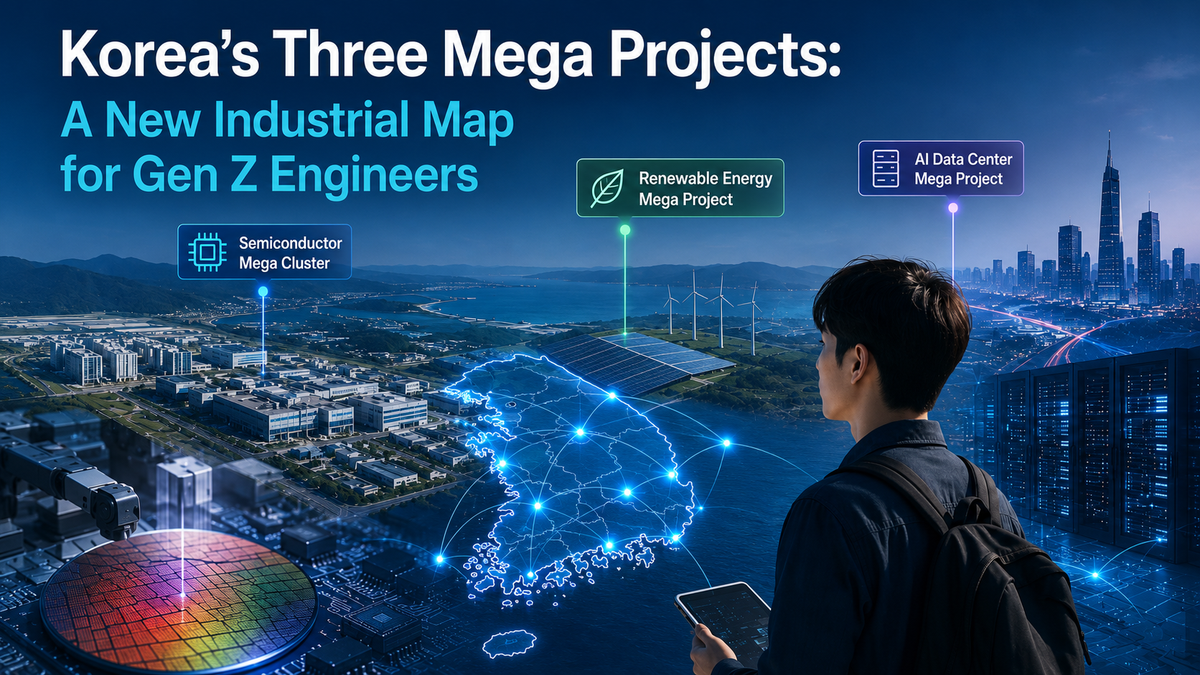
Chips, physical AI, and data centers together are redrawing Korea’s industrial map.
In late June 2026, the Korean government unveiled the “Three Mega Projects”: semiconductors, physical AI, and AI data centers.
At first glance, these look like separate policies. But Korea is presenting them as one industrial system for the AI era. Chips provide the computing foundation, AI data centers provide the infrastructure, and physical AI brings intelligence into robots, factories, vehicles, and industrial sites.
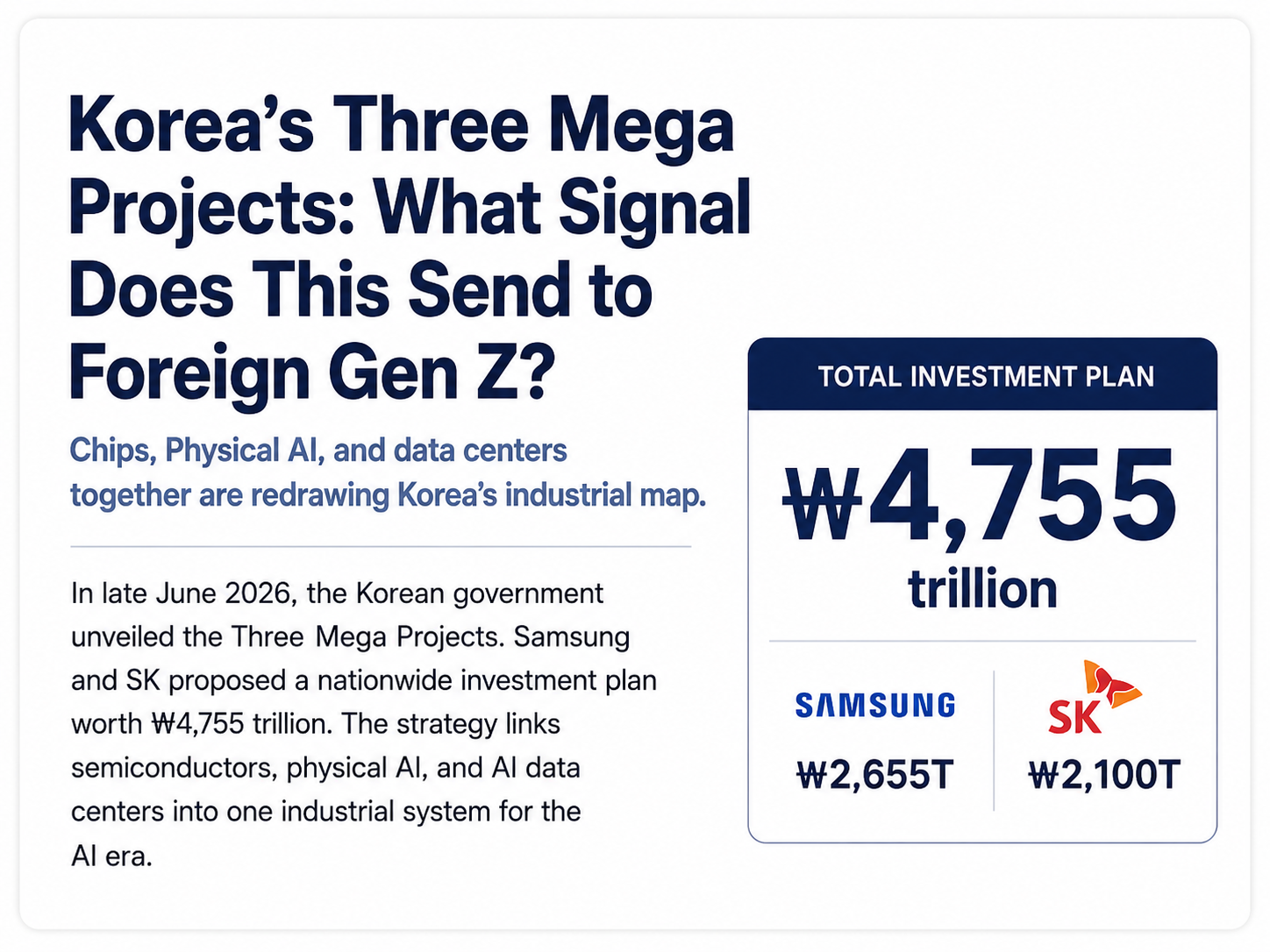
Samsung and SK proposed a nationwide investment plan worth about ₩4,755 trillion, roughly US$3.5 trillion. The size is striking, but the deeper signal is how Korea wants to reorganize its industrial map around the physical foundations of AI.
For foreign Gen Z readers in engineering, AI, robotics, materials, energy, or data infrastructure, this is not just Korean domestic news. It is a signal about where Korea wants its next industrial operating system to be built.
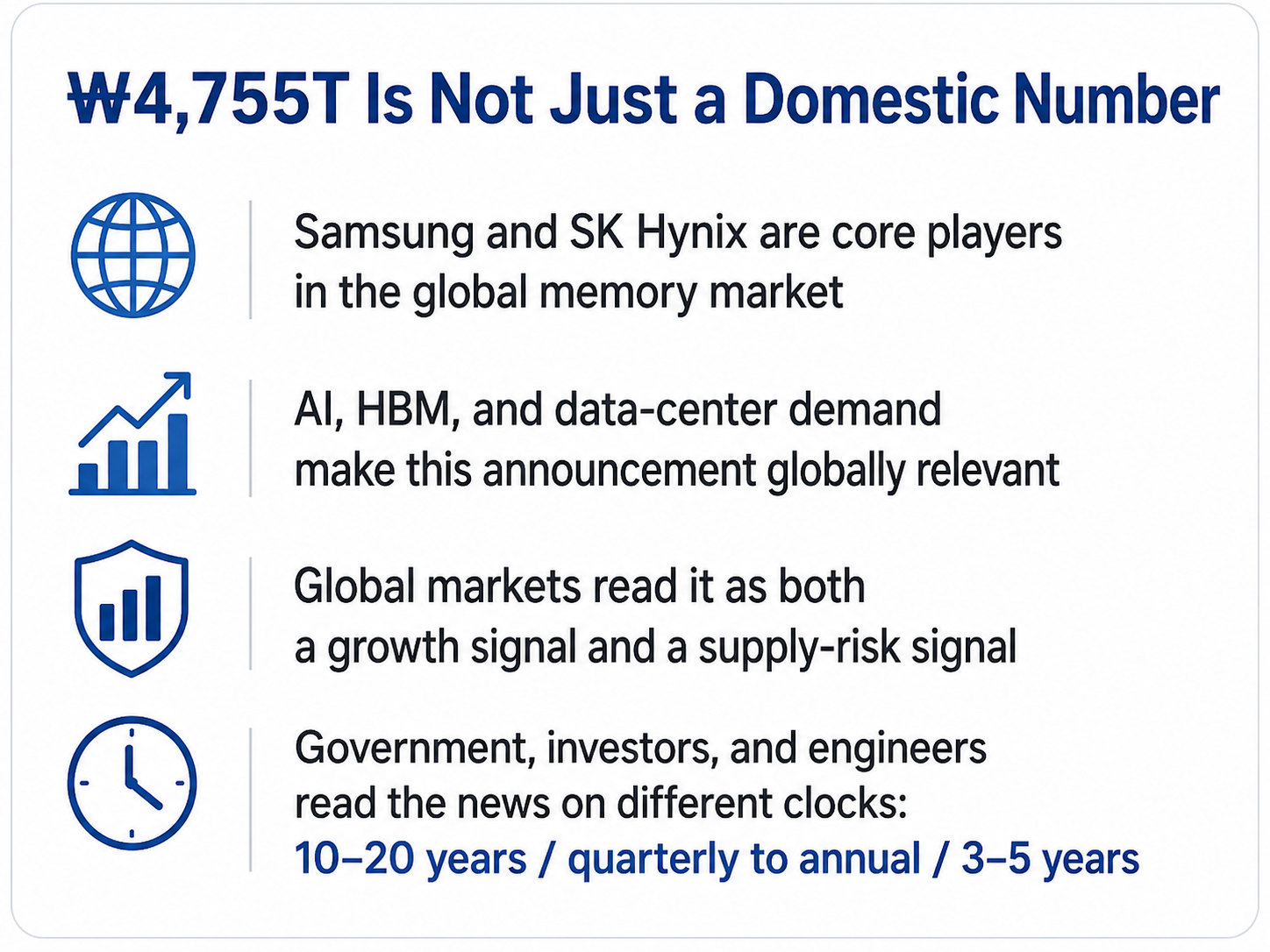
About US$3.5 trillion is not just a large number. Based on the ₩4,755 trillion nationwide investment plan announced around Korea’s Three Mega Projects, it signals a national attempt to align corporate investment, regional strategy, infrastructure planning, and technology priorities around the AI economy.
This matters because Samsung Electronics and SK Hynix are not only Korean companies. They sit inside the global memory and AI infrastructure supply chain. When Korea expands its chip and compute strategy, global markets read both the opportunity and the risk.
That is why the same announcement can be read in different ways. The government sees a 10- to 20-year industrial strategy. Investors see volatility, capital burden, and cycle risk. Engineers see a three- to five-year career map.
For foreign Gen Z, the useful question is not whether the headline number is impressive. It is where this system may create demand for skills, labs, internships, visas, and early career routes.
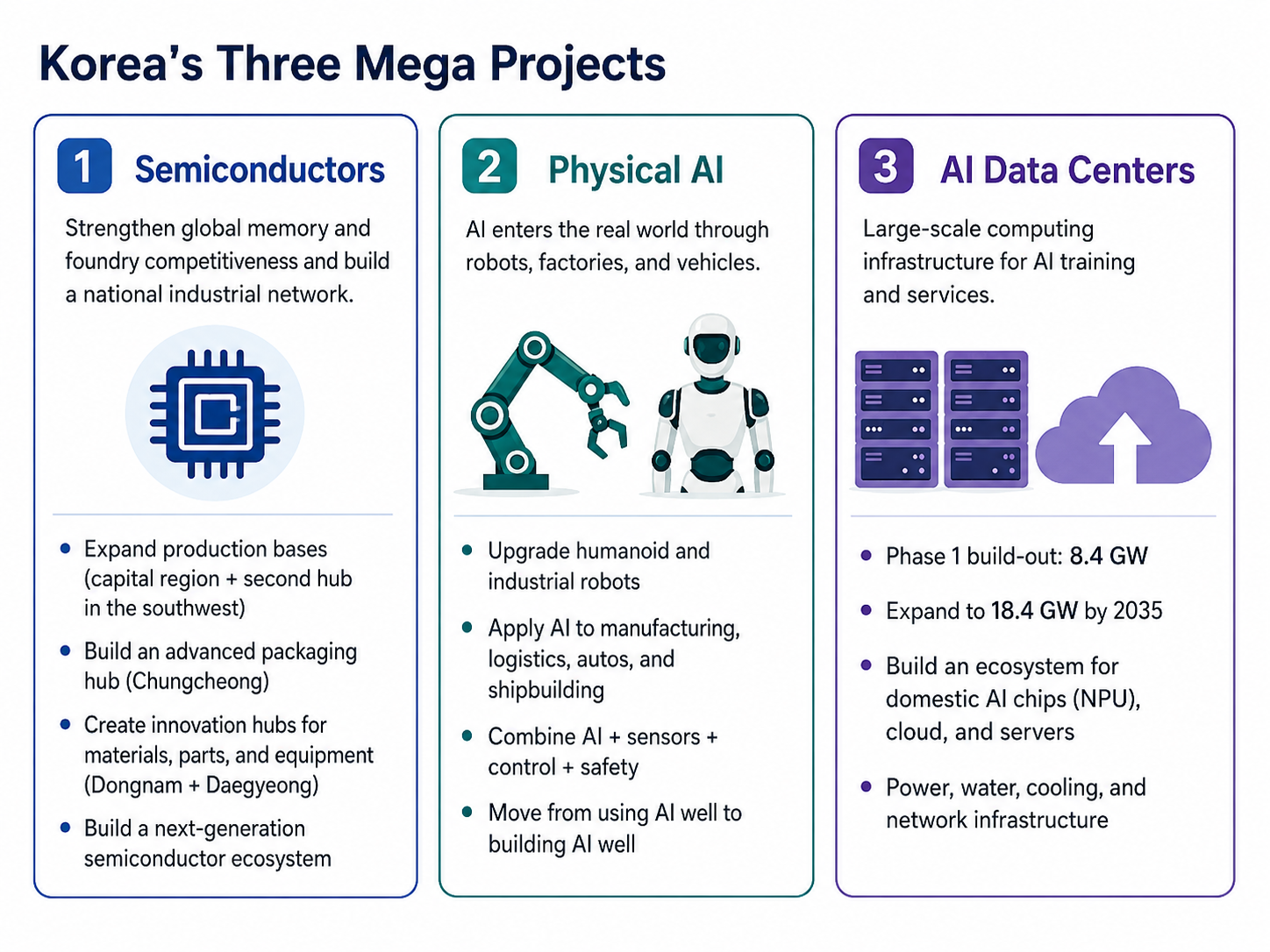
These three projects form a chain.
Semiconductors are the brain.
AI data centers are the compute infrastructure.
Physical AI is the body that brings AI into the real world.
Korea is trying to connect the brain, the infrastructure, and the body.
That is the operating logic of the announcement.
Semiconductors: Korea is widening the chip map
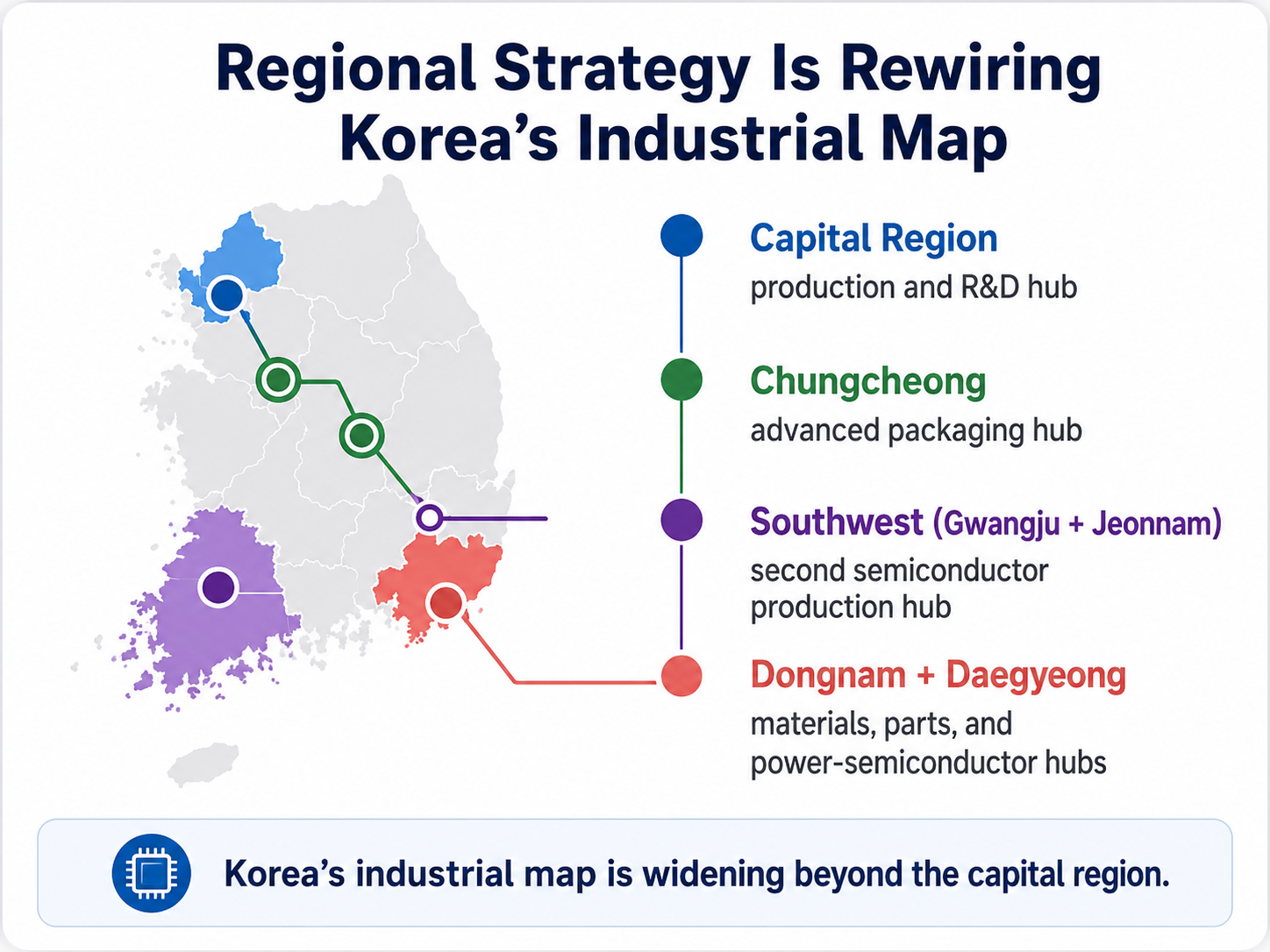
Korea’s semiconductor geography has long been concentrated around familiar names: Pyeongtaek, Yongin, Icheon, and Cheongju. For foreign readers, these places may not be immediately meaningful, but they matter because they form the core of Korea’s existing chip belt around the capital region and central Korea.
The new plan widens that map.
The capital region remains the core production and R&D base. Chungcheong is positioned as an advanced packaging hub. The southwest, especially Gwangju and Jeonnam, is being presented as a second semiconductor production hub. Dongnam and Daegyeong are tied to materials, parts, equipment, and power-semiconductor roles.
This is not just regional politics. It is an industrial geography strategy.
Semiconductor fabs need land, power, water, suppliers, logistics, engineers, and local acceptance. The more Korea expands chip production and AI data-center infrastructure, the harder it becomes to concentrate everything near Seoul and the existing chip belt. A wider industrial map becomes necessary.
For foreign Gen Z engineers, this changes how Korea should be read. Korea is not only Seoul. It is not only a few elite universities. It is not only the headquarters of large conglomerates. Many future opportunities may be located where factories, data centers, packaging lines, suppliers, and regional universities meet.
The map matters.
Physical AI: Korea wants AI to enter the factory floor
Physical AI is the least familiar part of the announcement for many foreign readers, but it may be the most Korean part of the strategy.
Korea is a manufacturing economy. It has strong industries in semiconductors, electronics, batteries, automobiles, shipbuilding, machinery, displays, and industrial equipment. These sectors already use automation, but physical AI is not just traditional automation. It is the integration of AI models, sensors, robots, control systems, industrial data, safety logic, and real production environments.
In simple terms, physical AI means AI with a body.
That body may be a humanoid robot, but it can also be a welding robot, a logistics robot, a smart factory system, a shipyard automation tool, an autonomous inspection system, or an AI-controlled production line. The important point is that AI is no longer only a software layer. It becomes part of industrial operation.
This is why physical AI fits Korea’s industrial profile. Korea may not yet dominate the global humanoid robotics platform market, but it has dense manufacturing environments where physical AI can be tested, adopted, and scaled.
For Gen Z engineers, this expands the relevant skill map. Robotics, mechanical engineering, embedded systems, sensors, control theory, computer vision, industrial AI, safety engineering, manufacturing data, and human-machine interaction all become part of the same field.
The signal is clear: in Korea, AI will not be only about apps or models. It will be about factories.
AI data centers: compute becomes industrial infrastructure
The AI data-center project shows another part of Korea’s thinking. AI requires compute, and compute requires physical infrastructure. Servers need chips. Chips need power. Power requires grids. Data centers need cooling, land, networks, cybersecurity, and operations teams.
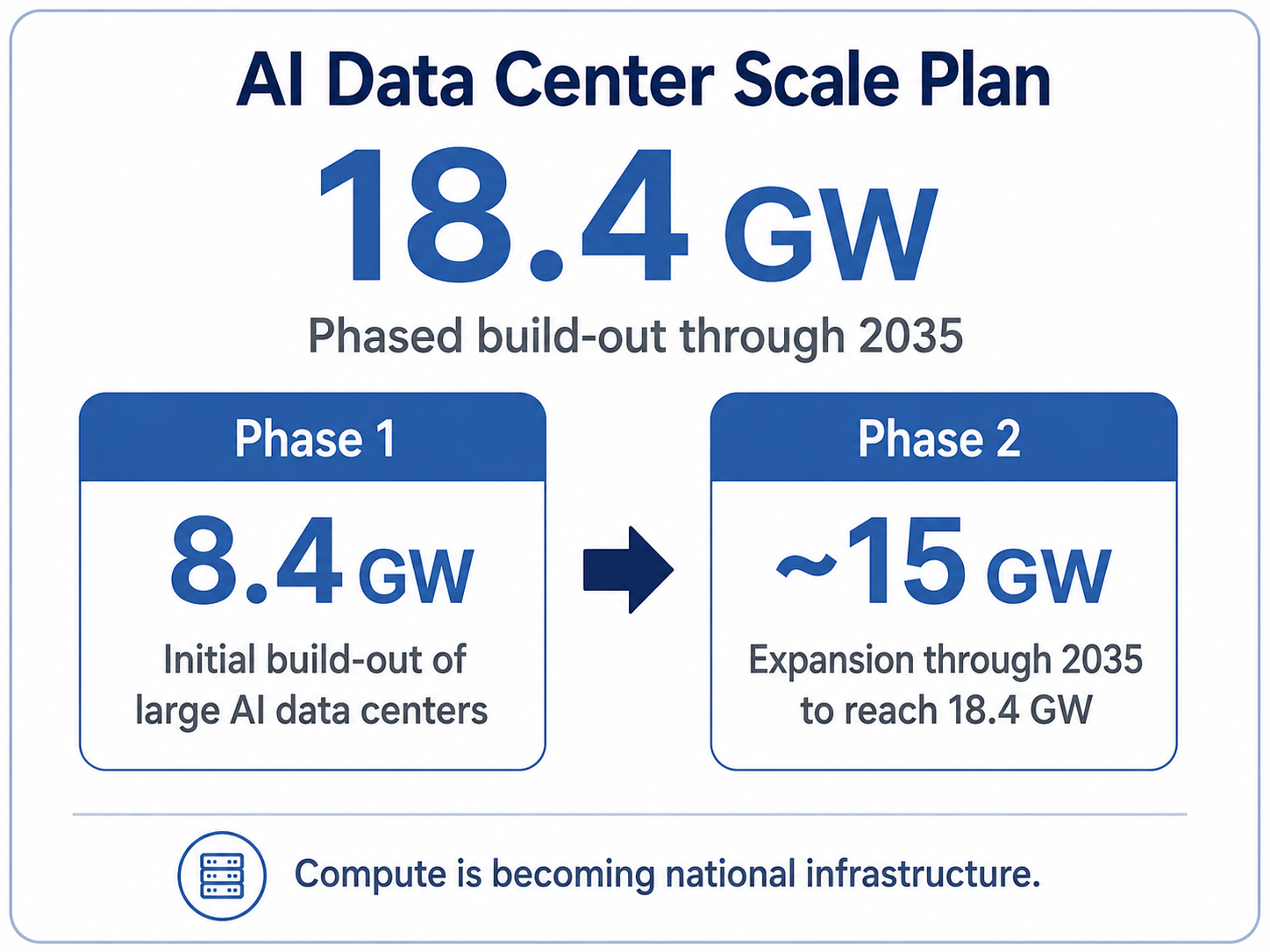
The Korean government’s plan points to an initial build-out of 8.4GW in large AI data centers, with expansion toward 18.4GW by 2035. These numbers are not just about server rooms. They show that Korea is treating compute capacity as strategic industrial infrastructure.
This matters because the AI race is often described as a race for models. But models do not exist without infrastructure. A country that wants AI capability must secure chips, data centers, electricity, cooling, networks, and skilled operators.
For foreign Gen Z engineers, this opens a broader career field. AI data centers are not only for computer science graduates. They need electrical engineers, network engineers, cloud operators, cybersecurity specialists, cooling system experts, power engineers, NPU specialists, data governance professionals, and sustainability engineers.
Compute is becoming a factory.
And like a factory, it depends on infrastructure.
The infrastructure clock: announcement is not production
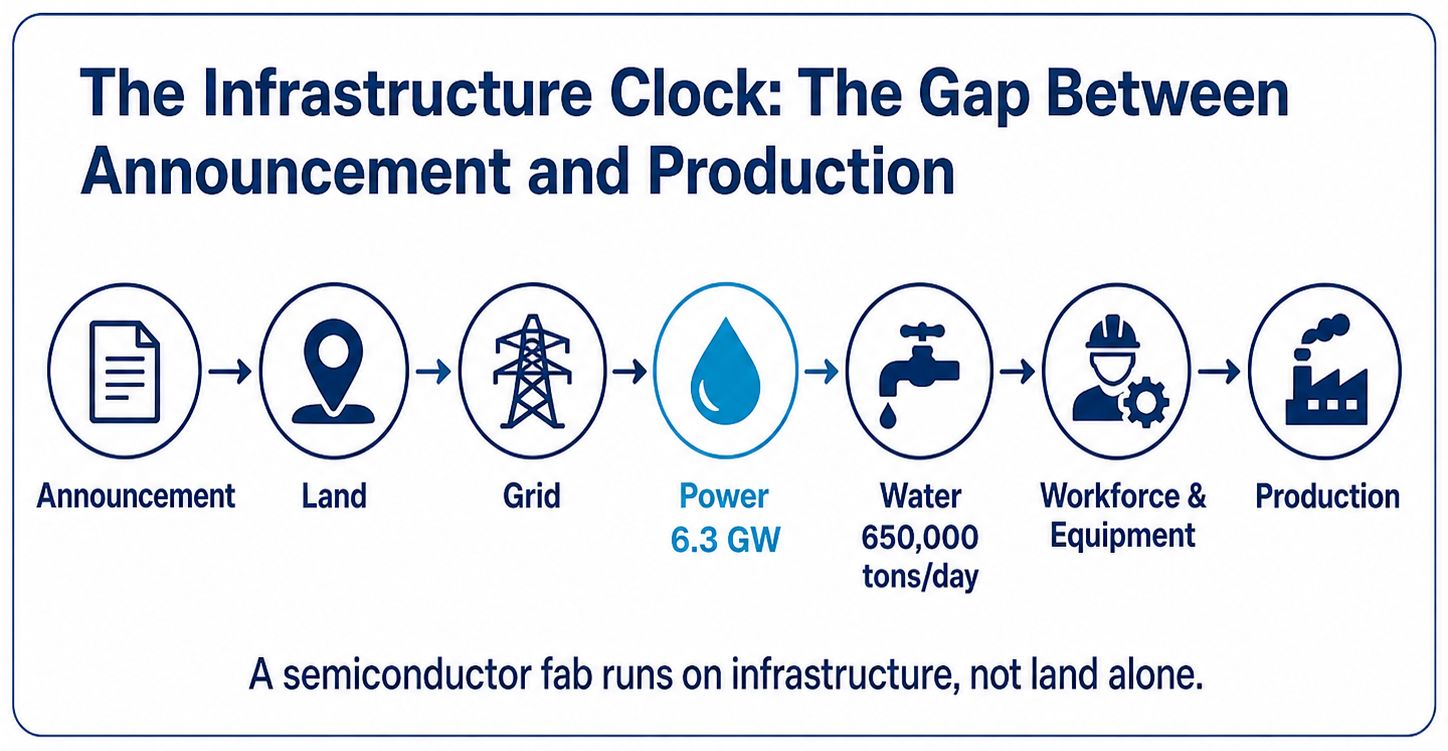
A mega-project announcement does not automatically become a functioning industrial system. Between announcement and production, there is an infrastructure clock.
For semiconductors, the sequence is long: announcement, land, permits, grid connection, power supply, water supply, wastewater treatment, equipment installation, workforce training, supplier coordination, and only then production.
For AI data centers, the clock is also physical. They need electricity, cooling, land, network links, server supply chains, environmental approvals, and local infrastructure. For physical AI, the clock includes not only robot development but also factory adoption, safety standards, integration with existing production systems, and workforce readiness.
This is why foreign readers should avoid two mistakes.
The first mistake is to read the announcement as if jobs will appear immediately.
The second mistake is to dismiss the announcement because implementation will take time.
Both views miss the point.
In Korea, industrial policy often works through signals. Once the state, conglomerates, universities, and regions align around a strategic sector, universities may adjust programs, local governments may compete for clusters, firms may look for suppliers, and students may reposition their skills.
The announcement is not the final outcome. It is the beginning of a system moving.
This is not one major
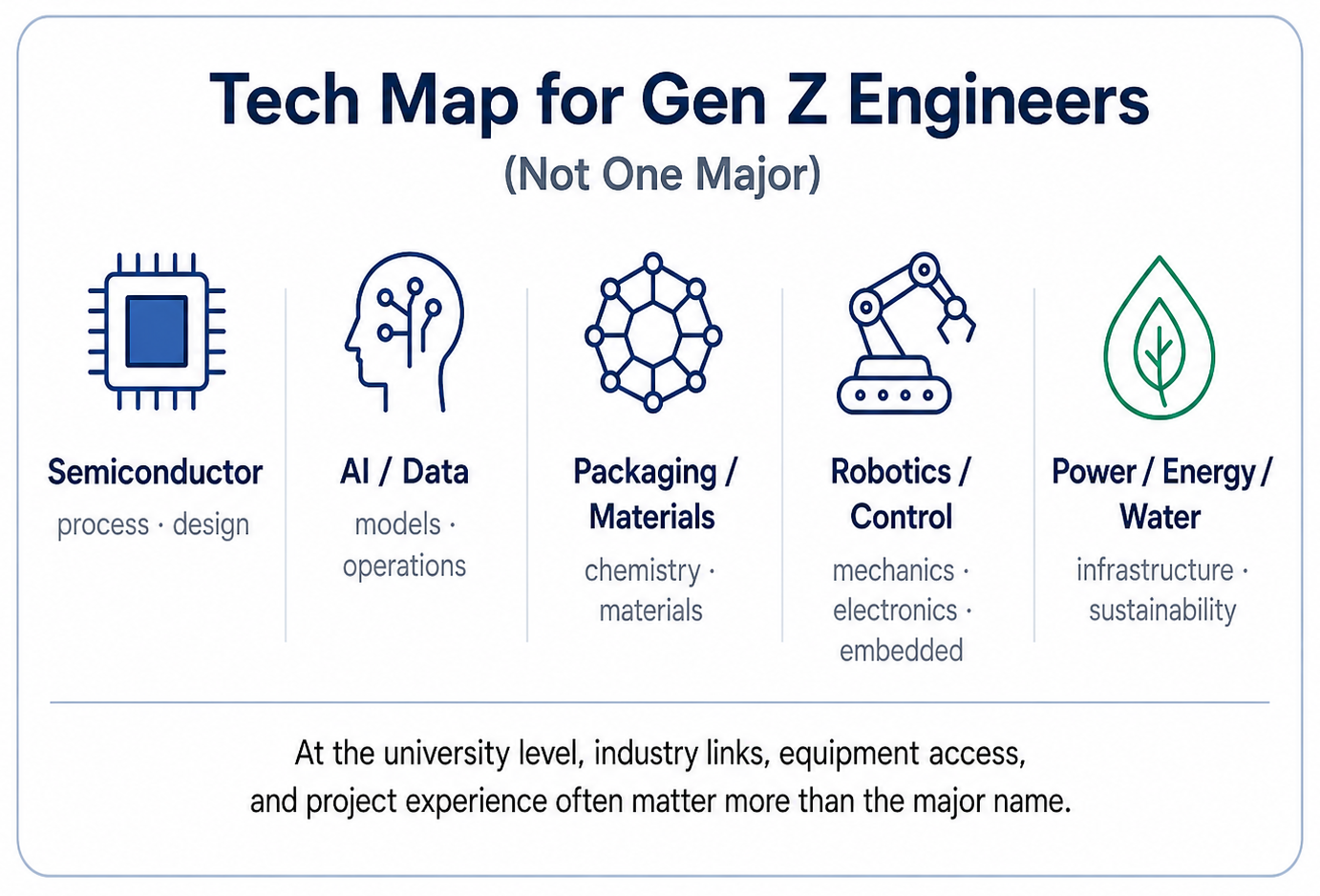
For Gen Z engineers, the most practical lesson is simple: this is not one major.
Semiconductors are not only electrical engineering. They connect to materials science, chemical engineering, mechanical engineering, industrial engineering, precision equipment, process control, and design.
Physical AI is not only robotics. It connects to mechanical systems, embedded electronics, sensors, AI models, safety engineering, manufacturing data, control systems, and industrial operations.
AI data centers are not only computer science. They connect to power, cooling, cloud operations, cybersecurity, networking, chip design, data governance, and infrastructure engineering.
This changes how students and early-career engineers should read Korean opportunities. The question is not “Do I have the exact major name?” The better question is: “Where does my skill sit inside the value chain?”
At the university level, school ranking can matter, but it is not enough. Industry links, equipment access, project experience, internships, lab infrastructure, and regional cluster connections may matter more than the major name itself.
A foreign student studying AI in Korea should ask whether the program connects to data centers, NPUs, manufacturing AI, or robotics. A mechanical engineering student should ask whether the department connects to robots, semiconductor equipment, factory automation, or cooling systems. A materials student should ask whether the curriculum connects to packaging, chips, batteries, or sensors.
The signal is not only academic.
It is industrial.
Open doors and remaining barriers
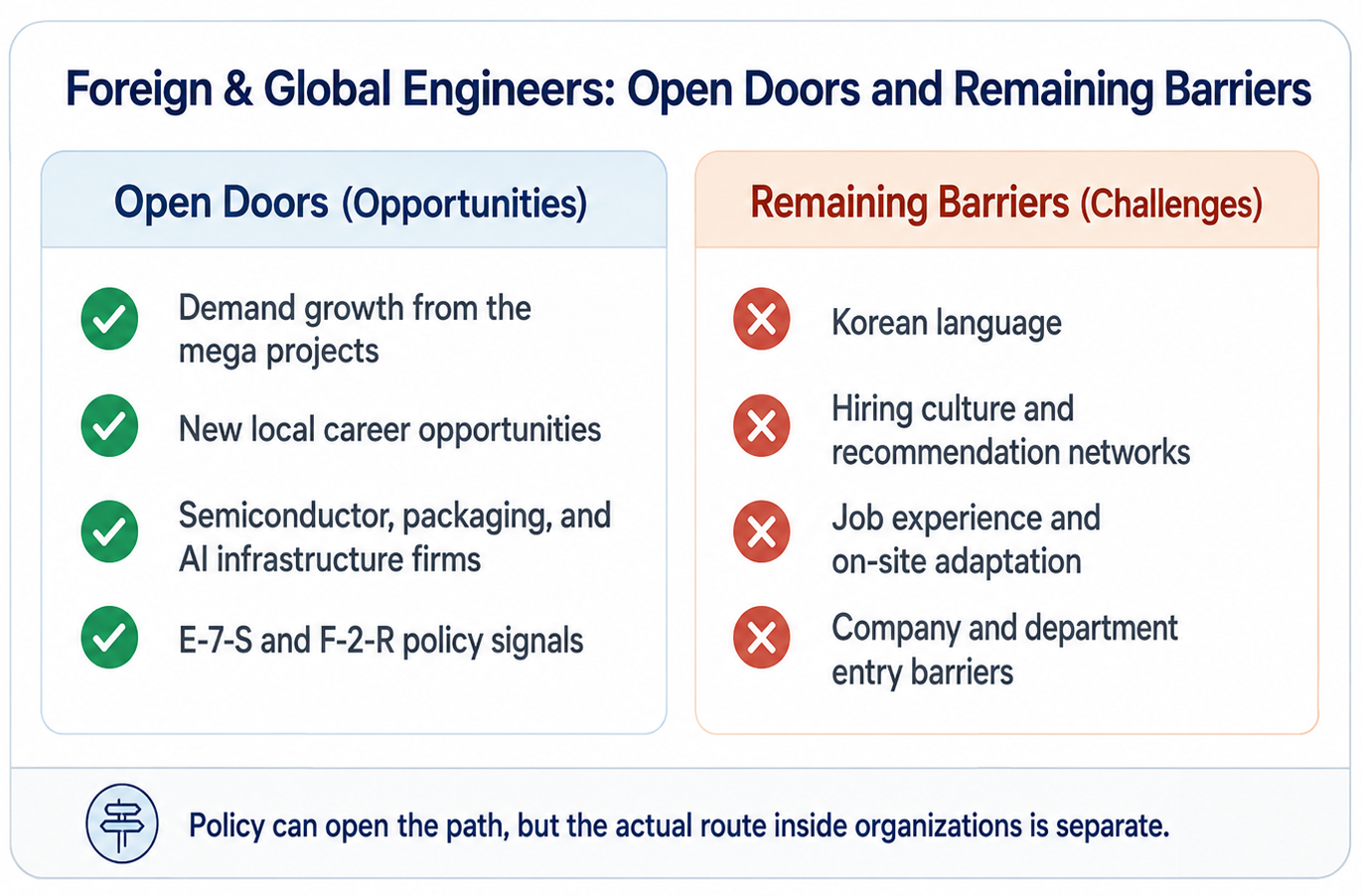
Korea’s Three Mega Projects can create new opportunities for foreign and global engineers. Large industrial systems need talent, and Korea’s demographic pressure makes foreign talent more important over time.
The open doors are visible. There may be more regional internships, more local industry projects, more demand from semiconductor suppliers, packaging firms, AI infrastructure companies, robotics firms, and data-center operators. Visa pathways such as E-7-S and F-2-R also show that the government is trying to connect high-skilled foreign workers and regional industries.
But open doors are not the same as open routes.
The remaining barriers are also real. Korean language ability still matters, especially in manufacturing, equipment, process, quality, and on-site operations. Hiring culture can depend on networks, recommendations, team fit, and company-specific procedures. Some organizations may work globally in English, while others may expect Korean workplace communication from the beginning.
Foreign engineers should therefore avoid a narrow strategy. Targeting Samsung or SK directly may be one path, but it is not the only path. Suppliers, packaging companies, automation firms, AI data-center operators, robotics companies, local R&D centers, and university-industry projects may offer more realistic first entry points.
Policy can open the path, but the actual route inside organizations is separate.
That is the core distinction.
Decision Note — Read the system, not only the number
Korea’s Three Mega Projects are not just about the headline number. The larger signal is that Korea is trying to connect semiconductors, physical AI, and AI data centers into one industrial system.
For foreign Gen Z readers, this news should not be read only as a policy announcement. It should be read as a map. Where is Korea placing chip production? Where is it building compute? Where will physical AI enter real industries? Which regions will gain new industrial functions? Which skills will become more valuable?
The important question is not whether Korea is investing a lot of money. It is how that money is being arranged across chips, compute, robots, regions, universities, and infrastructure.
The number is the headline.
The system is the story.