
Korea Can Bring Researchers Back. Can It Make Them Stay?
Korea can bring researchers back through Brain Pool, BP+, and fast-growing fields. But returning diaspora researchers reveal a harder test: whether lab culture, funding structures, and quality of life make people stay.

Korea often looks like a highly competitive country.
Its manufacturing base is strong, its companies compete globally, and its R&D intensity is among the highest in the world. These indicators show the strength of the Korean system.
But national competitiveness and talent competitiveness measure different things.
One measures the power of the system.
The other asks whether highly skilled people want to work inside that system — and stay.
That is where Korea’s signal is weaker.
This is not a contradiction.
Korea can train people, fund research, and produce technology. But retaining those people requires another kind of strength: workplace culture, research autonomy, quality of life, decision-making openness, and long-term career viability.
A strong industrial system and a weak talent-retention signal can exist at the same time.
One group reveals this gap better than almost anyone else.
Returning Korean diaspora researchers.
Korea Produces Talent. Keeping It Is Harder.
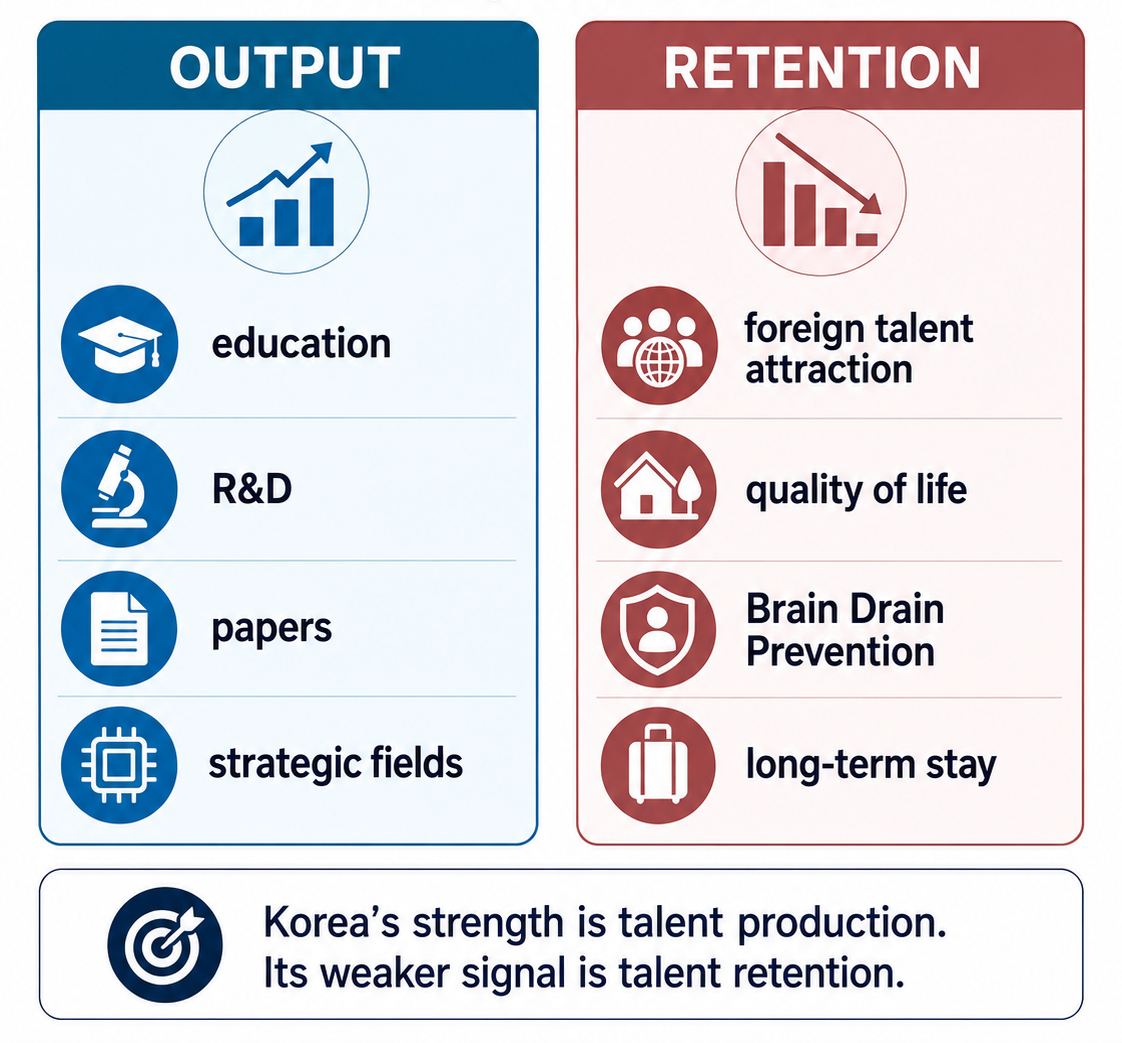
Korea’s strengths are real.
It has strong education infrastructure, major national research investment, and universities and research institutes that absorb industrial research priorities quickly. In AI, semiconductors, batteries, and biotechnology, public policy and corporate investment often overlap, creating visible research opportunities.
But talent rankings tell another story.
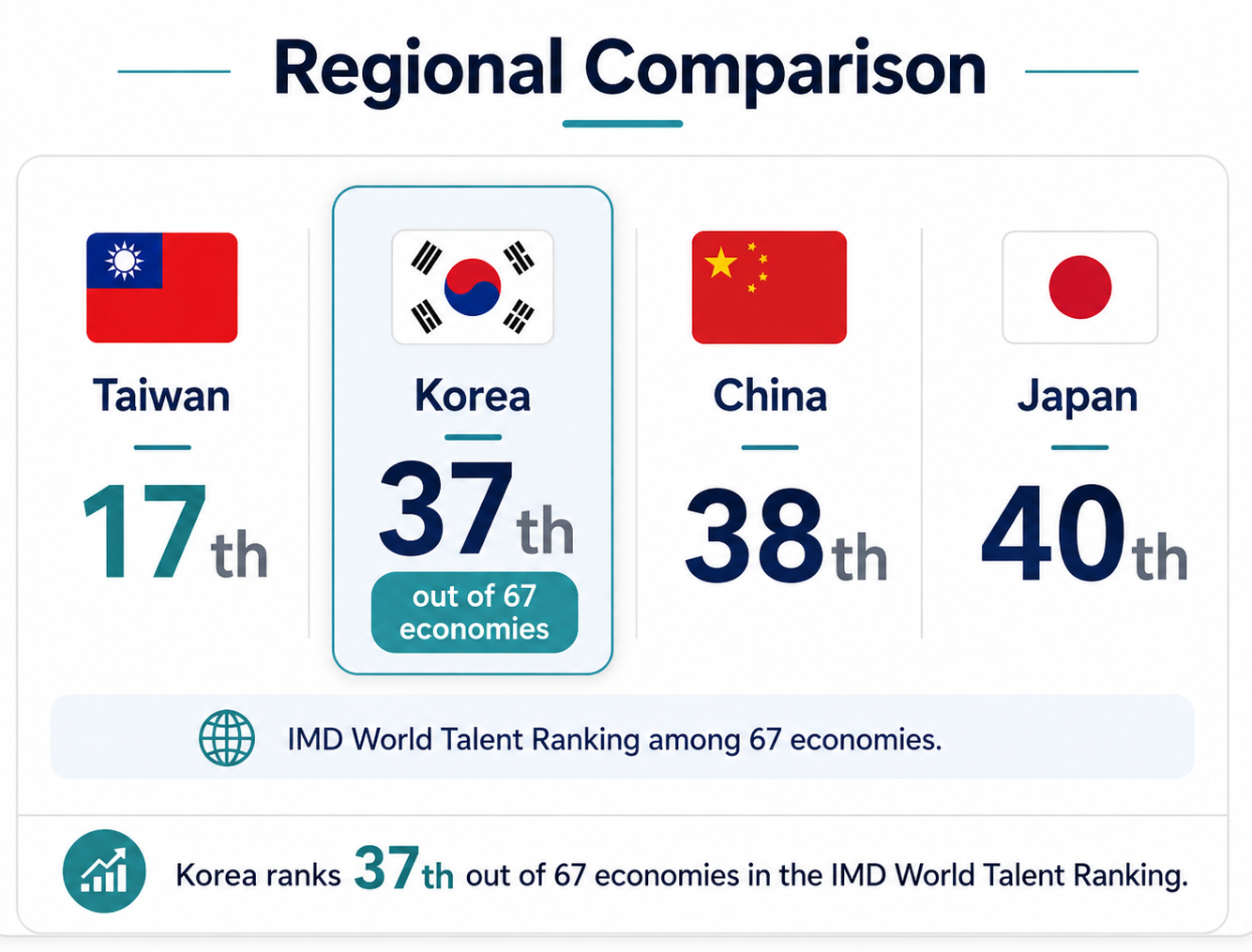
In the IMD World Talent Ranking 2025, Korea ranked 37th out of 67 economies, down from 26th the previous year. Its Brain Drain indicator fell from 28th in 2020 to 48th in 2025. Attractiveness for Foreign High-Level Talents ranked 61st. Quality of Life ranked 48th. Brain Drain Prevention ranked 58th.
Korea is strong at training people.
Its weaker signal is whether global talent wants to stay.
This resembles the commercialization gap discussed in the previous article. Korea can produce research output, but the bridge to the market can be narrow. Likewise, Korea can produce and attract talent, but the environment that retains talent is weaker.
Output is strong.
Retention is weaker.
Why Diaspora Researchers Return: The Pull Is Not Salary Alone
Even with a talent outflow problem, Korean diaspora researchers still return.
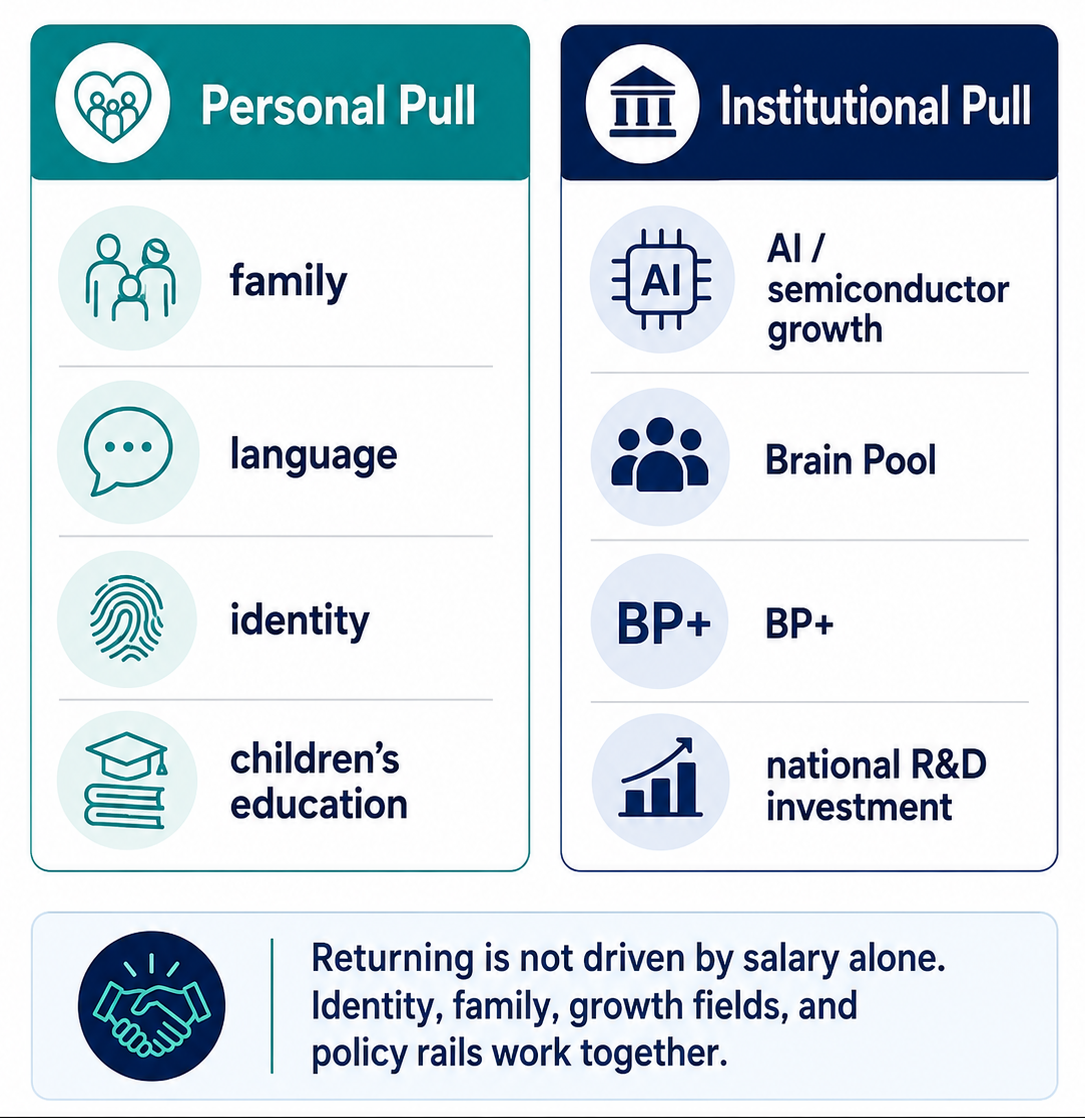
The pull is not salary alone.
There is family.
Parents.
Children’s education.
A Korean-speaking environment.
A sense of identity.
A desire to reconnect research and life with Korea.
Fast-growing fields also matter.
In AI, semiconductors, batteries, and biotechnology, Korea’s public investment and corporate investment often overlap. When research funding, equipment, data, corporate collaboration, and policy missions concentrate in specific fields, returning to Korea can become attractive.
Policy also matters.
The Brain Pool Program, Korea’s overseas scientist attraction program, brings foreign-based PhD-level researchers into Korean research institutions. The individual Brain Pool track supports selected researchers with salary and research funding. In 2026, the track is structured around roughly 80 new selections, up to about ₩350 million per researcher per year, and up to three years of support.
In 2026, BP+ also appeared.
Global Leader Research Team Attraction Support, or BP+, is a new institutional team-attraction track. It is designed to bring overseas research teams or top-tier global talent into Korean institutions. It offers up to about ₩3 billion per year for up to five years, structured as two years plus a possible three-year extension after evaluation.
Returning is not just emotional.
Identity and family create the pull.
Growth fields and policy programs turn that pull into a route.
Why Some Leave Again: The Push Is Environmental
Returning is not the end of the story.
Some researchers leave again.
Based on the working fact-check for this draft, Korean science-policy tracking data suggest that a significant share of high-level early-career returnees and returning diaspora researchers may leave Korea again within three to five years. The draft uses a range of roughly 40% to 45%, which should be footnoted carefully before publication.
The important point is not only the number.
It is the reason.
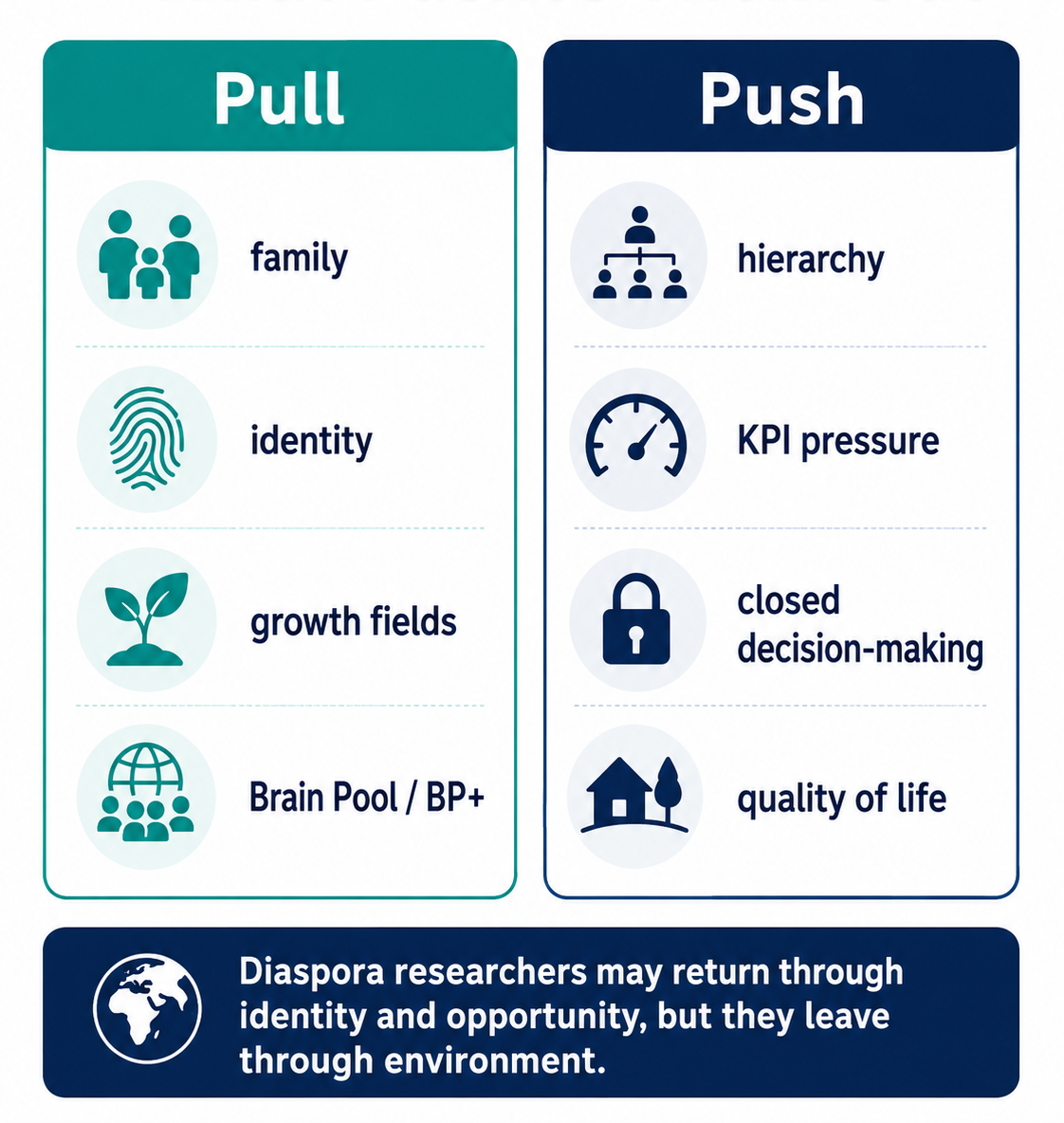
Family, identity, and growth fields may bring people back.
But environment can push them out again.
Rigid hierarchy.
Short-term quantitative performance pressure.
Closed decision-making.
Lab culture.
Quality of life.
Researchers trained in more horizontal lab cultures may feel this friction more strongly. Korea may offer attractive research topics and funding opportunities, but long-term stay becomes difficult when decision-making, workplace culture, and life conditions do not align.
This creates an asymmetry.
The pull factors may be personal.
The push factors may be structural.
And those structural factors can be stronger for foreign researchers.
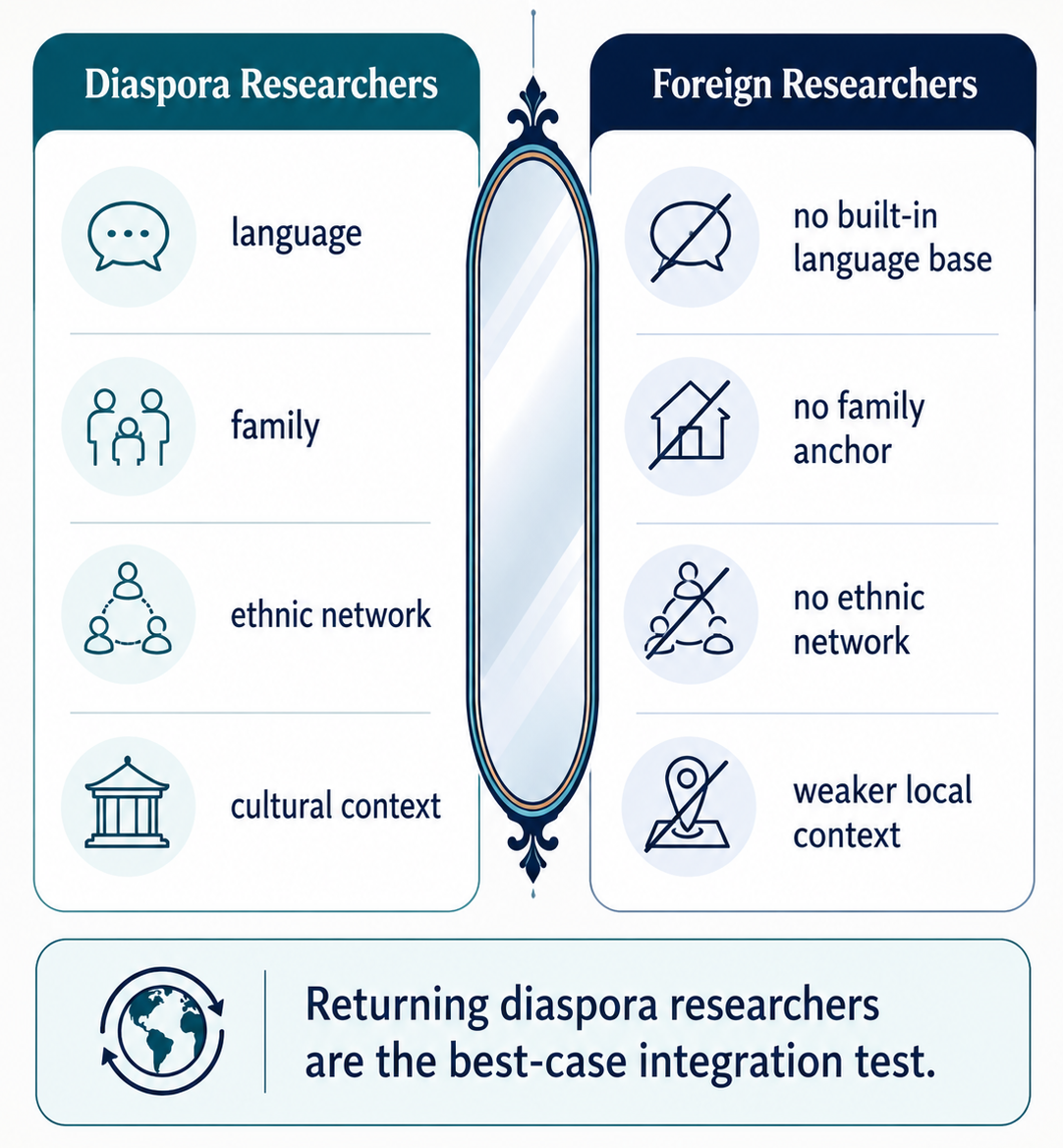
Foreign researchers usually do not have the same family anchor, Korean-language base, ethnic network, or identity pull. The same environment that pushes returning diaspora researchers away may operate even more strongly against them from the beginning.
Diaspora Researchers Are the Best-Case Integration Test
Returning Korean diaspora researchers have integration assets that foreign researchers usually do not.
Language.
Family.
Ethnic networks.
Cultural context.
A faster ability to read Korean institutions and relationships.
That makes them the best-case integration group.
They have more reasons and more tools to stay than most foreign researchers do.
If even they struggle to remain in Korea, the issue cannot be explained only by personal adaptability.
The environment has to be examined.
For foreign researchers, diaspora experience becomes a preview signal. If returning diaspora researchers stay, that suggests the environment may be able to retain talent. If they leave again, foreign researchers may need stronger preparation and clearer expectations.
This should not be read as a hierarchy of people.
It is a baseline signal of friction.
If an environment is difficult even for researchers with language, family, and local networks, it may create greater friction for people without those assets.
The Same Door Can Open for Foreign PhDs
There is also a positive side.
The Brain Pool Program is not a diaspora-only system. Foreign-based PhD-level researchers can apply regardless of nationality. A route built partly to attract Korean diaspora researchers can also be open to foreign PhDs.
This matters.
Korea does not keep foreign researchers completely outside its research system. Under the right conditions, there are real institutional doors.
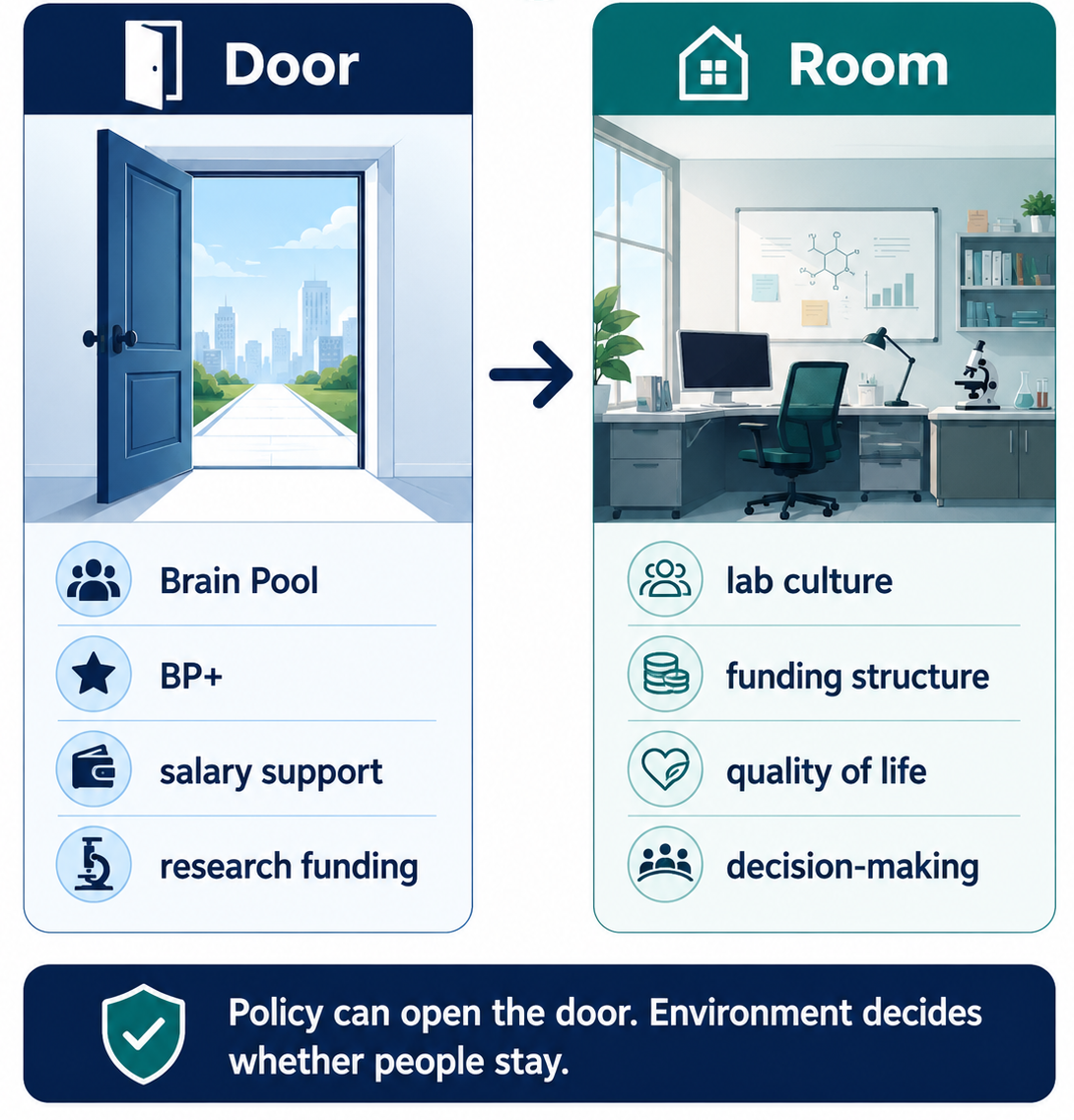
Brain Pool can bring individual researchers.
BP+ can bring overseas research teams or top-tier talent at the institutional level.
In fast-growing fields such as AI, semiconductors, biotechnology, and batteries, these doors may widen.
But entry and retention are different.
Brain Pool can bring a researcher to Korea.
What makes that researcher stay is lab environment, funding structure, decision-making, and quality of life.
Policy opens the door.
Environment builds the room.
An open door does not mean a comfortable room.
Taiwan’s Different Answer: Brain Circulation Requires an Ecosystem
Taiwan offers a different answer to the same problem.
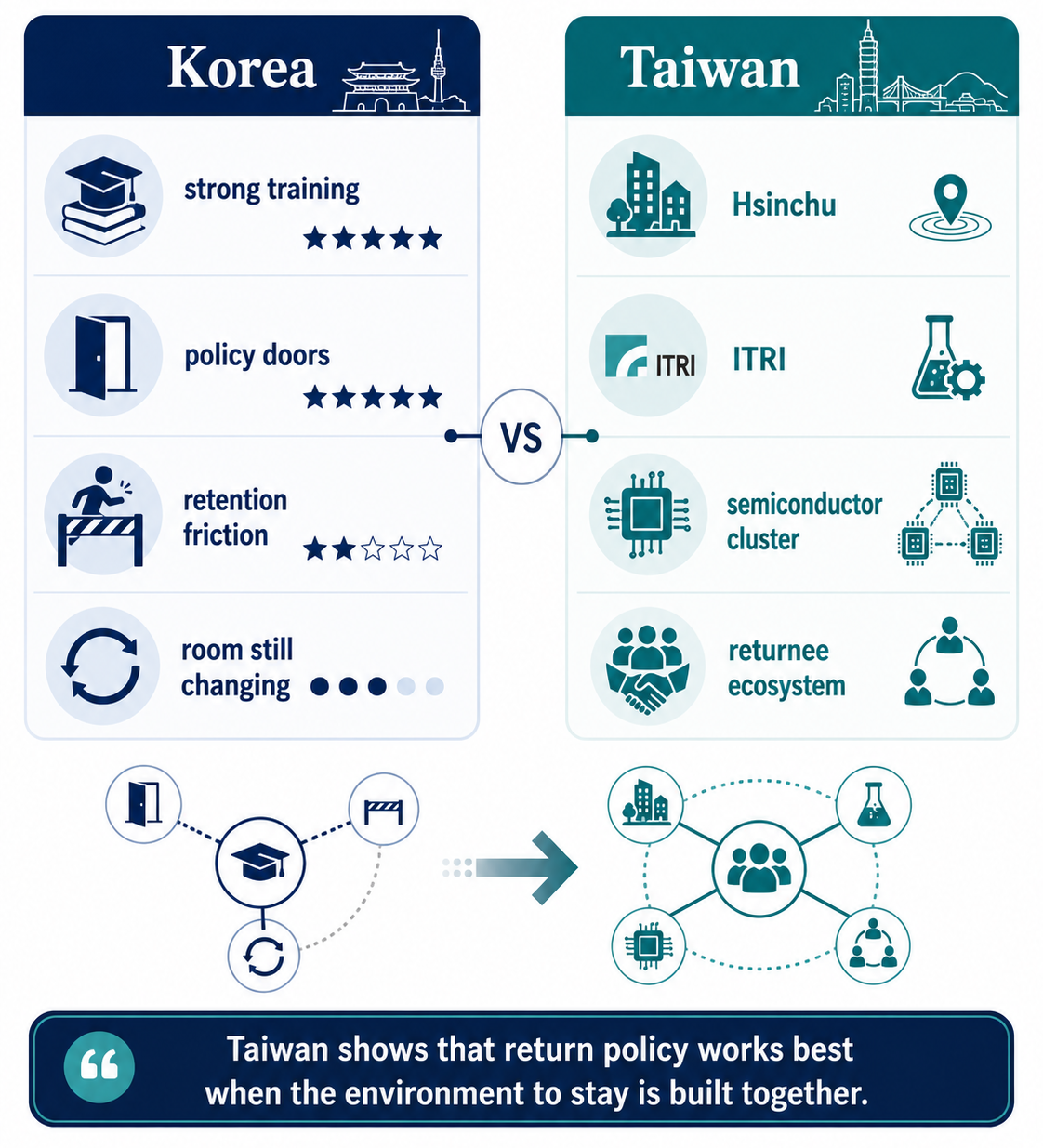
In the 1970s and 1980s, Taiwan-trained researchers who had studied or worked in the United States returned to Taiwan. Many entered the Hsinchu Science Park, the Industrial Technology Research Institute, or ITRI, and the broader semiconductor ecosystem.
That return flow became part of the foundation for Taiwan’s semiconductor rise, including TSMC.
The key difference was not only money.
The environment to stay was built together.
Research institutes, science parks, companies, policy, capital, and global markets were connected. Returning researchers could continue their careers inside an ecosystem that gave their expertise a destination.
In the 2025 IMD ranking, Taiwan ranked 17th. Korea ranked 37th.
This comparison is not about praising one country and diminishing another.
It shows that return policy works best when the environment to stay is designed at the same time.
A country needs doors that bring talent in.
But it also needs rooms where talent can work, live, and build.
Taiwan’s case shows that brain circulation becomes powerful when return policy connects to an industrial ecosystem.
Korea’s challenge is similar.
The speed of changing the room may matter more than the speed of adding new doors.
Korea is becoming better at opening doors for talent.
Brain Pool exists.
BP+ has been added.
AI and semiconductor fields attract global researchers.
Returning diaspora researchers come back through family, identity, language, and networks.
Some institutional doors are also open to foreign PhDs.
But the room changes more slowly.
Lab culture.
Funding structure.
Hierarchy.
Short-term KPI pressure.
Quality of life.
Decision-making.
If these conditions do not change, attraction does not automatically become retention.
Korea is becoming a country that wants global talent.
To become a country where global talent stays, the room matters more than the door.
Cross-read
Ep.11 — Who Owns the Lab Technology?
Ep.12 — Korea Can Bring Researchers Back. Can It Make Them Stay?
Ep.13 — (Next post) Women Researchers in Korean STEM