The Five Judges
Who decides whether a technology moves from research to PoC, joint R&D and market — and where does the handover still break?
Five Judgement Points Between Research and Market — and Where the Handover Breaks
Before you accept a result, a pilot, a partnership, a technology — who is actually making that judgement?
Only the market can call a technology finished — that is how the previous article ended. But the market is an abstraction. The structure of cooperation, as most readers see it, looks like this:
Research → PoC → Joint R&D → Scale-up → Market
Clean arrows. But no arrow has ever moved on its own. Behind each one is a question. Is this technology worth another look? Does a company recognise it as a real problem? Who pays for the PoC? Is there enough evidence to justify joint R&D? Are the IP terms acceptable? Will it be taken to production and customer testing?
And the person who says Yes or No to each of those questions is different.
Five Judgements on the Chain
Imagine one technology lying in the middle of a table. The Korean researcher says: "I want to run a joint project with the German institute." The company asks: "What is the business value for us?" The public institute asks: "Can this become a government R&D project?" The German institute asks: "How is our researchers' funding covered?" The German company asks: "What about IP and market access?" The government asks: "How does this relate to national strategic technologies?"

All six questions are legitimate. They are not arguing about the same question — they are answering different questions.
So far, these are people's voices. Now turn the same table onto the axis of time. What appears is not individuals but seats of judgement — positions with the authority to say Yes or No at each stage. A seat can be one person (a company's CTO), several people sitting together (a joint steering committee), and the same person can move between seats.
The six questions are not six stages. They are six perspectives pressing on the same technology at once. Spread them along the order in which a technology moves, and they regroup into five seats — not one question per seat, but the same questions returning at several of them. IP, for example, is asked at matching, at responsibility, and again at adoption.
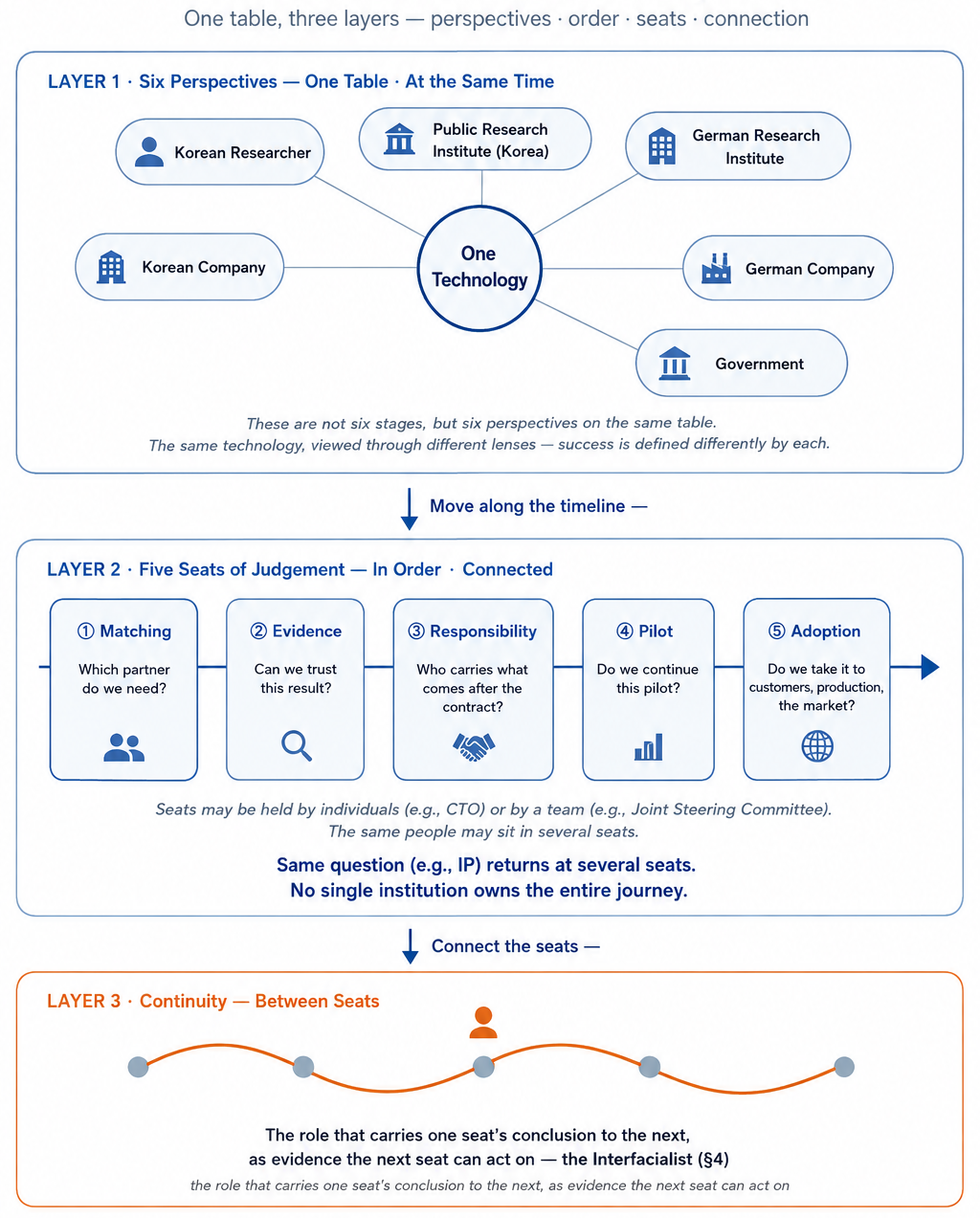
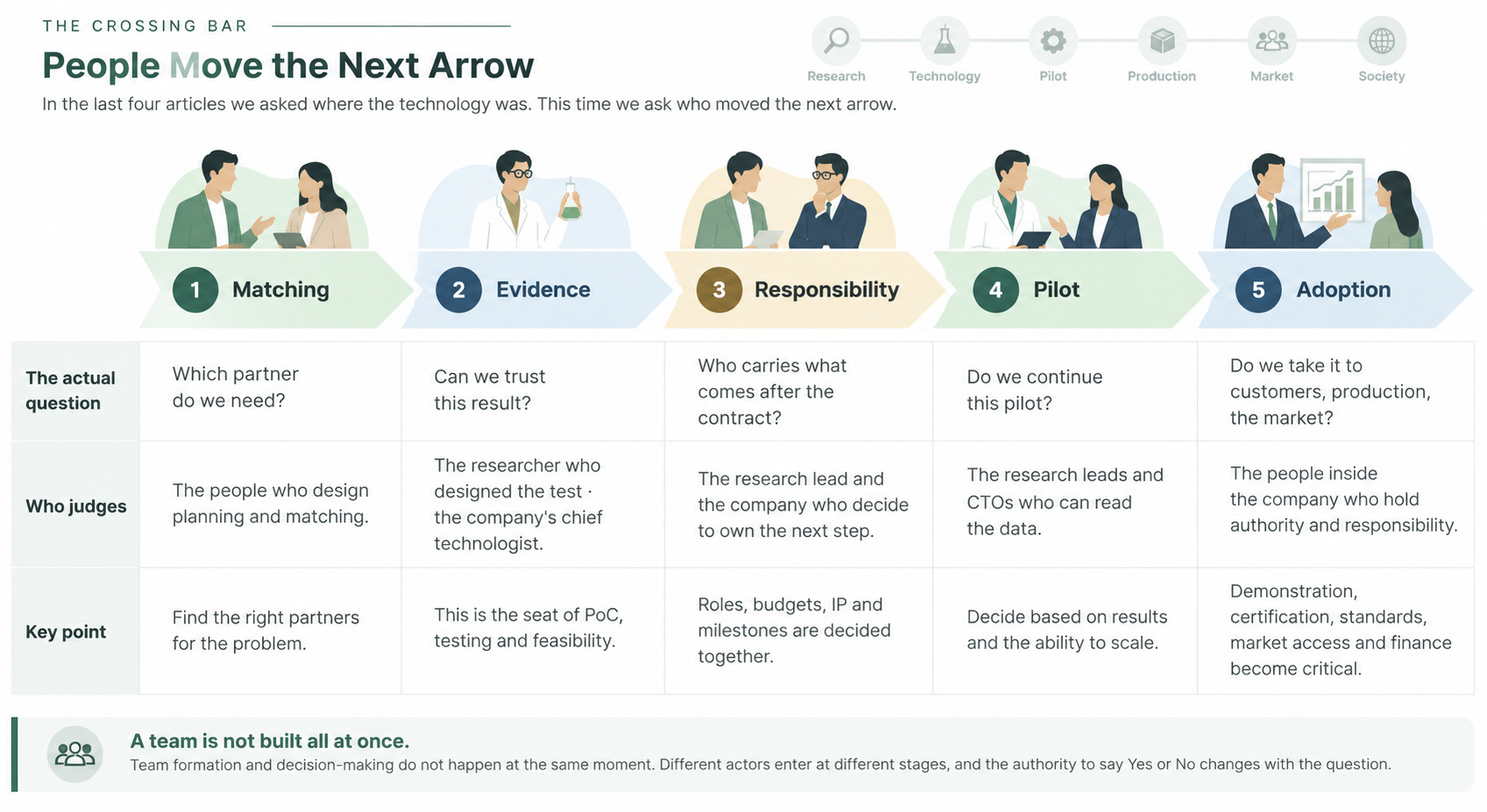
The table carries one message. No single institution owns the entire journey.
And this separation is a principle, not a defect. The technical go/no-go belongs to the people who can read the data; the business judgement to the company; the budget judgement to government. A decision becomes actionable when information, authority and responsibility meet around the same question — they do not have to sit in the same person.
5 A team is not built all at once +
Team formation and decision-making do not happen at the same moment. Different actors enter at different stages, and the authority to say Yes or No changes with the question.
Problem Discovery
Korean company ↔ German company / research institute
“What are we trying to solve?”
The industrial problem comes first. A four-party consortium is unnecessary at this point.
Technical Validation
+ Korean public research institute
“Does it actually work for this problem?”
This is the seat of PoC, testing and feasibility.
Joint R&D
Korean company + Korean institute + German institute + German company
“What should we develop — and should public money support it?”
Roles, budgets, IP and milestones are bound together. The project team decides what to develop; government separately decides whether public funding should support it.
Commercialisation
Korean company ↔ German company
“Are we willing to own the commercial risk?”
The decision returns to the companies. Research organisations remain as technical and validation partners.
Expansion
Government / funding agencies
“What is the next bottleneck?”
Demonstration, certification, standards, infrastructure, market access and finance are added when a concrete next barrier appears.
That is the answer to the question in the title. The judges exist. The real problem comes next.
The Hardest Moment Is the Translation
Why does the chain still break when every judge is in place? Not for lack of technology. Because each of them calls something different success. The researcher looks at publications and technical maturity; the company at products, customers and exclusivity; the public institute at R&D outcomes and transfer; the government at policy results; the German partner at research quality and lasting cooperation.
Everybody may support "collaboration," but they are not necessarily supporting the same outcome.
So the hardest moment in cooperation is not the moment a technology is discovered. It is the moment when the result of one stage must become evidence the next decision-maker can act on. A researcher's excellent paper does not convert automatically into a company's investment case. A successful PoC does not automatically become a case that a funding programme can approve. The stalling points this series has followed — the rooms of evidence, the gap after the contract, the valley of the pilot, the threshold of adoption — were, in the end, places where this translation failed.
The role of carrying that translation is not unheard of. In The Bridge Builder, Dr. Taeyoung Han defined it in his book The Collaboration Equation as the Interfacialist — someone who does not stop at introducing people, but designs the structure in between, so that cooperation actually works. But this role does not make the judgements. The owner of the decision changes with the question — and who owns the continuity between the decisions is written nowhere on the chain.
Who Owns the Question Mark?
And the map has grown. In July 2025, Korea became an Associated Country to Pillar II of Horizon Europe. A door opened for Korean researchers and institutions to take part in Pillar II under almost the same conditions as organisations from EU member states. The two doors do not compete.
K-FAST
The German door
A mechanism for finding and building a trusted bilateral partner and project around Germany’s Fraunhofer network.
find and build a trusted bilateral project
Horizon Europe
The European door
A mechanism through which that project can expand into a larger European multinational R&D ecosystem — Pillar II Associated Country, July 2025.
enter a larger multinational R&D ecosystem
The two doors do not compete — one provides an anchor, the other opens scale.
The early part of this map is already at work: K-FAST, a cooperation office that identifies Korean technology demand, matches it with capabilities across the Fraunhofer network, and supports joint projects through planning and application. But draw this map honestly, and a question mark remains at its centre.
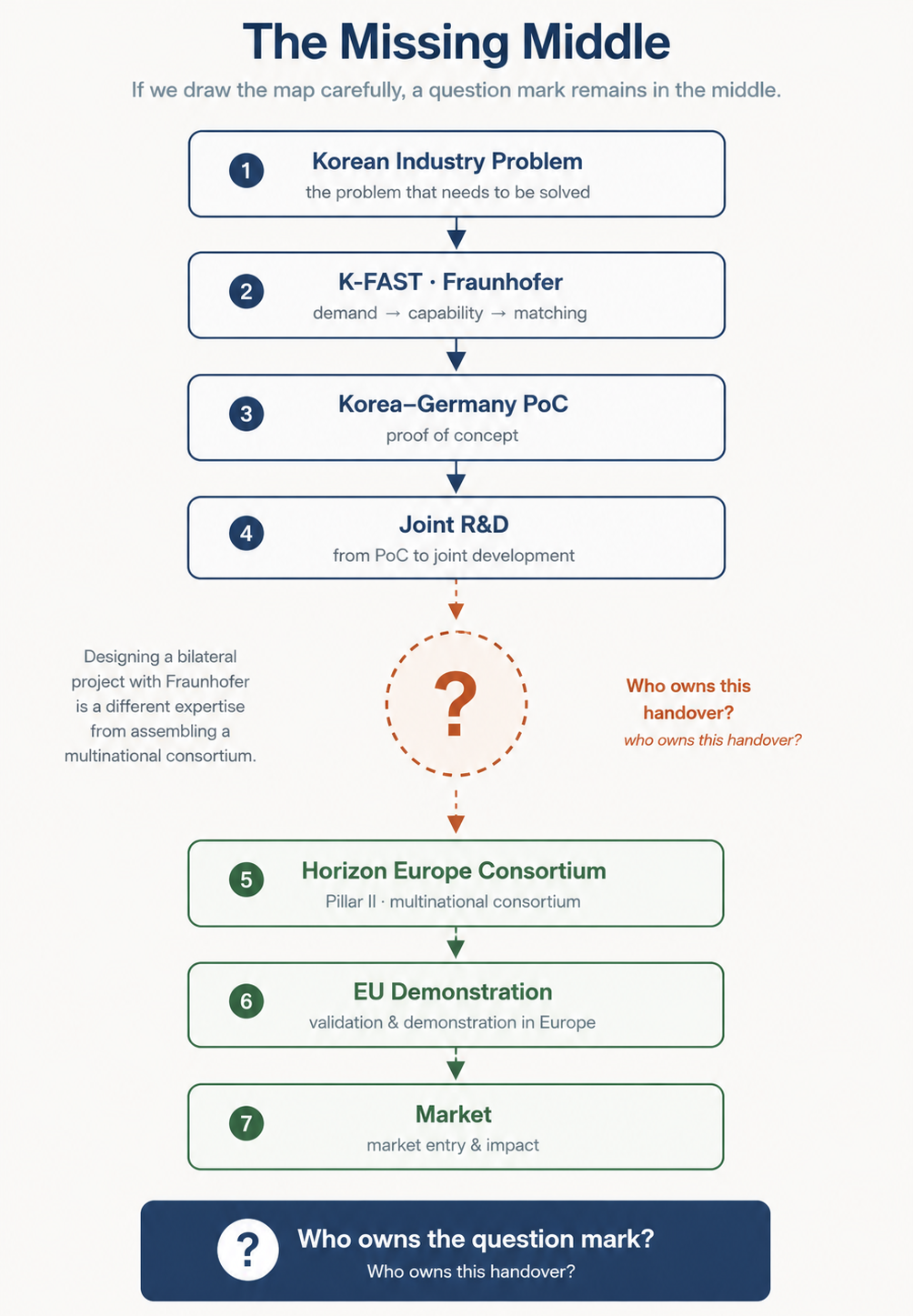
As of verification, no public case yet shows a K-FAST project reaching Horizon Europe demonstration. That handover is the open frontier.
Redesigning a Korean–German project to fit a European call, and expanding it into a multinational consortium, is a different expertise from building a bilateral project. As of this article's verification date, no publicly documented case could be confirmed in which a Korean–German project initiated through K-FAST had progressed through Horizon Europe selection and into European demonstration. What can be confirmed is that K-FAST is expanding the scope of its collaboration model beyond bilateral matchmaking and joint R&D. And the place to ask again what role a Korean public research institution based inside Europe — such as KIST-Europe — can play is right next to that question mark.
This article stops at the question mark. Because institutions alone do not hold the answer. Long before institutions fully resolve that question, some people have already crossed the gap in the course of their own careers.
Reader Route
Seven questions before you look for a partner
+
Do not ask only “Which institute should I contact?” Ask what decision must be made next, who has the authority to make it, what information that person needs — and who can connect you to them.
About This Reporting
Editorial method, verification notes and sources
+
This article draws on material confirmed and published in the earlier articles of Part 1 and on official materials from K-FAST, Fraunhofer, the European Commission and KIST-Europe. The “five judgements” and the “missing middle” are editorial frames by K-Welle, reconstructed from reporting and public materials, not official classifications. “Interfacialist” is a concept defined by Dr. Taeyoung Han in his book The Collaboration Equation, re-referenced from The Bridge Builder. Statements about K-FAST and KIST-Europe are limited to functions confirmed in public materials; unconfirmed outcomes are not stated. Partner institutions supported reporting access and had no role in the content.
- Korea Innovation Bridge — The Bridge Builder · the four articles of The Crossing
- Taeyoung Han, The Collaboration Equation — definition of the Interfacialist (previously published reference)
- K-FAST — official materials (Fraunhofer / KIAT)
- European Commission — Korea’s association to Horizon Europe (Pillar II, July 2025)
- KIST-Europe — official institutional profile