After the MOU
Three researchers answer the same six questions about what happens after an MOU — where cooperation begins, where it stops, and who must carry the next decision.

Three People, Six Questions, One Bridge
After the MOU, where does cooperation become real — and where does it stop? Three interviewees answer the same six questions from different positions on the bridge.
An MOU records the intention to cooperate. What comes after it records whether the cooperation is real.
An MOU is the starting point that confirms the will to cooperate — not the result that a technology has actually moved. For joint research to grow into industrial cooperation, an industrial problem has to connect to the right partners, follow-on funding, pilot evidence, customer validation and a clear owner for commercialisation.
Key Takeaways
- Cooperation begins when repeated contact turns into owned actions.
- The three interviewees locate the stopping point at different links of the chain.
- Technology, funding and market access are not enough without trust and a structure of responsibility.
- The next-stage decision-makers need to enter before the current project ends.
Method
The same six questions were put in writing to the three interviewees. The answers are edited crosswise — organised by the convergences and divergences that appeared under each question, not listed person by person. Unanswered items were not filled in from other sources.
This series met, one by one, three people who work on the bridge.
The one who connects partners — Dr. Taeyoung Han (Fraunhofer IKTS, Managing Director of K-FAST). The one who proves materials — Dr. Songhak Yoon (Fraunhofer IWKS, K-FAST steering committee). The one who navigated the systems — Dr. Jung Han Choi (Fraunhofer HHI, Deputy Director of K-FAST).
The three stand on the same bridge, but in different places: at the entrance of matching, at the test bench of materials and processes, on the sea route of a researcher's career. The experiment of this final article is simple. Put the same six questions to the three positions — where do the answers converge, and where do they part?
Where they converge may point to a shared logic of cooperation. Where they part — that itself may be the map of the bridge.
When Does Cooperation Begin?
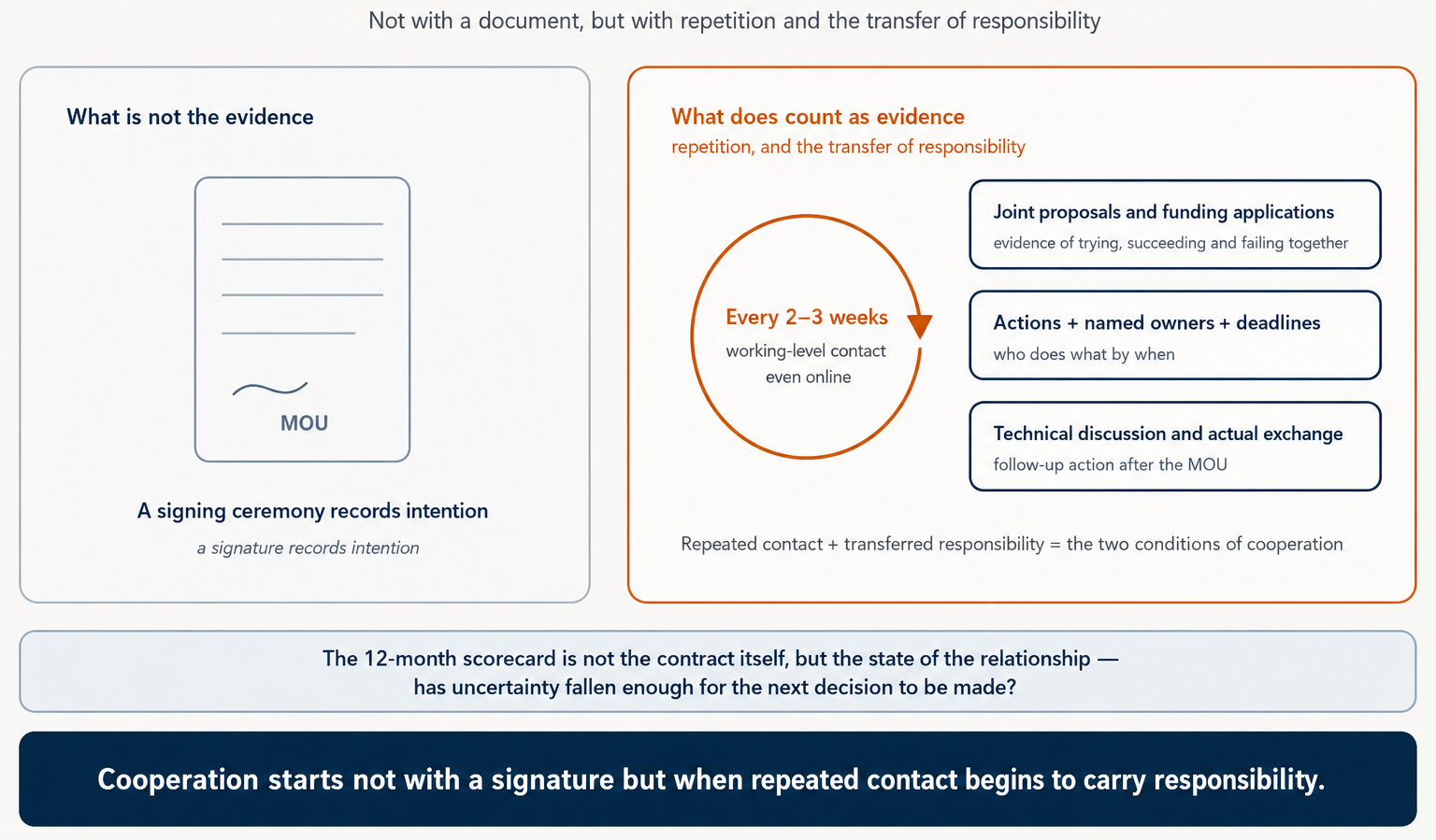
The photograph of an MOU signing ceremony is not evidence of cooperation. Then what is?
Dr. Songhak Yoon's answer was a clock.
When regular meetings begin to happen — every two or three weeks, even if only online — I think you can judge that real cooperation has started.
Dr. Jung Han Choi's answer points in the same direction.
It is when actual exchange and technical discussion follow the MOU.
Dr. Taeyoung Han adds a different axis: not the repetition of meetings, but whether responsibility has started to move.
The smallest piece of evidence is not both sides expressing the wish to meet again, but a concrete next action being given an owner and a deadline. Cooperation is confirmed less by the number of meetings than by the movement of responsibility. The moment the conversation changes from 'that is a good idea' to 'who will do what, by when' is the real starting point of cooperation.
On what should remain twelve months later, the answers continue along the same grain. Dr. Yoon named the record of joint funding applications — successful or not.
“I believe there has to be a result — applying together for international cooperation programmes funded by each country's ministries, whether the application succeeds or fails.” — Dr. Songhak Yoon
“Discussion of follow-up action items, actual exchange, and discussions of international joint research.” — Dr. Jung Han Choi
Dr. Han sums up the twelve-month criterion as a state.
Not every MOU needs to grow into a large joint project within a year. But the two sides must have tested what they can and cannot do together, and there must be grounds left for deciding whether to go to the next stage or to stop. A successful start is not necessarily a big result — it is a state in which uncertainty has decreased and the next decision has become possible.
Lay the three answers over each other and a law of beginnings emerges. Cooperation starts not with a signature but when repeated contact begins to carry responsibility — recurring meetings, proposals written together, and actions that have begun to carry owners and deadlines. Repetition of contact alone does not move a project; but assign responsibility without a continuing relationship and cooperation stops too. Relationship and responsibility are the two conditions of cooperation. And the twelve-month report card is not a contract but a state — has uncertainty decreased, and has the next decision become possible?
Where Does It Stop?
Matching → joint project → pilot → customer validation → contract. Where on this chain does cooperation stop most often?
Here the three answers part — and this parting is the most important finding of this article.
Dr. Songhak Yoon pointed at the pilot.
What I learned at Fraunhofer is how difficult and how important the pilot stage is. Projects run well up to the joint research, but there are very many technologies that never reach commercialisation.
Dr. Jung Han Choi pointed one stage earlier.
The joint project. The most frequent cases are where things stop after a joint project, or where a failed funding application ends any further push.
Dr. Taeyoung Han pointed at the transition between two stages — and named its cause.
In my experience, cooperation stops most often at the step from the joint project into the pilot and customer validation. The problem that usually surfaces at this stage is not technical performance but a vacuum of responsibility. The research institute considers the research finished; the company judges the technology not yet sufficiently validated; and the public funding agency may see it as beyond the scope of the existing project. In the end there is no one who owns and answers for the next stage, and the cooperation stops.
Had the three pointed at the same place, the conclusion would have been simple — "here is the bottleneck." But the actual answers divided: at the door of the joint project (failed applications), between the joint project and the pilot (the vacuum of responsibility), and at the pilot itself (the difficulty of demonstration).
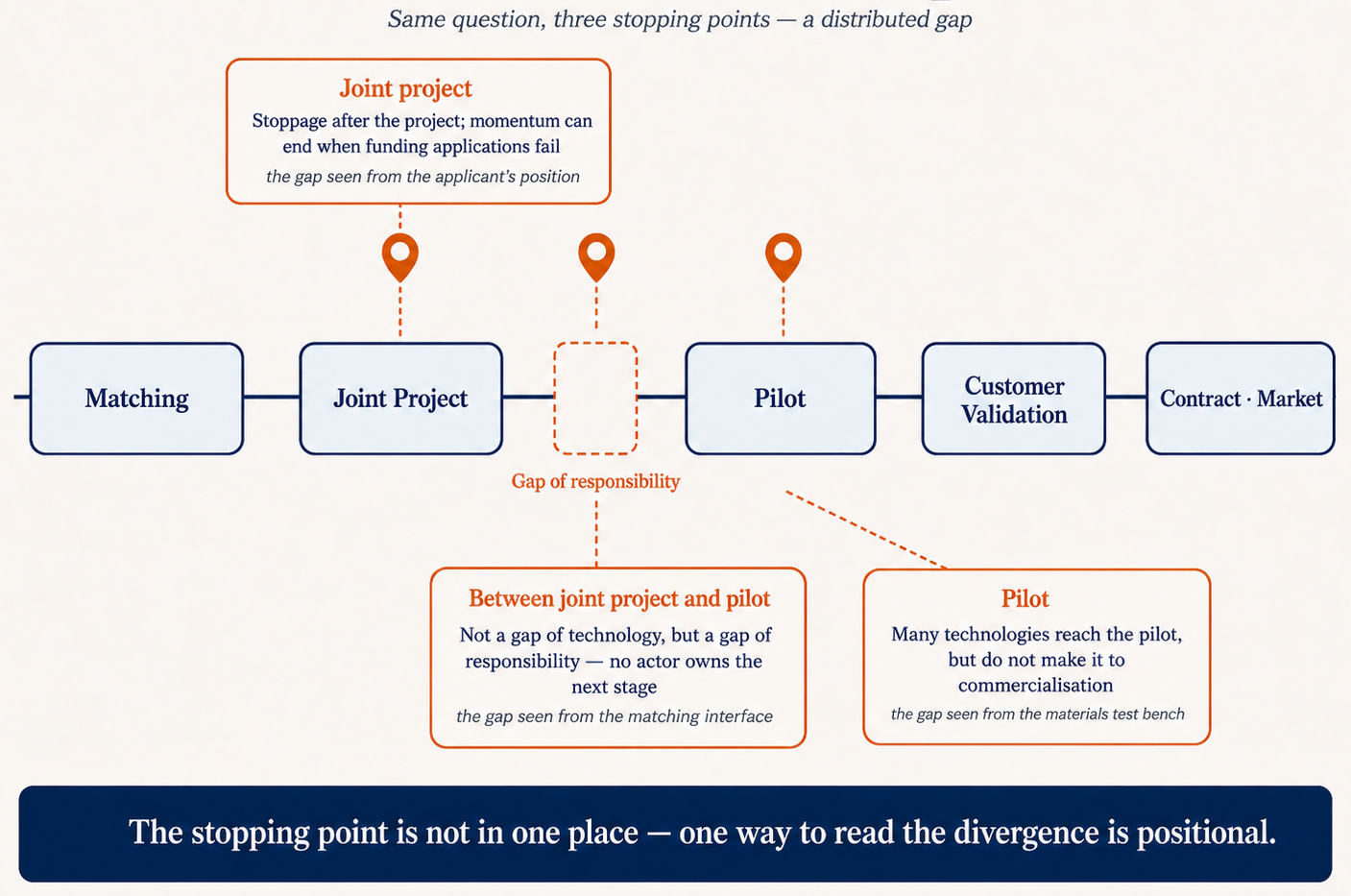
First, the stopping point is not in one place. Gaps are distributed along the whole chain, and cooperation can break at any link. It is not a problem you fix by finding a single bottleneck.
Second, one way to read the divergence is positional. From the perspective of project funding, the door of project selection becomes visible first; from the materials test bench, the pilot; from the matching interface, the handover of responsibility. The diagnoses differ not because someone is wrong, but because the positions on the bridge are different.
So the real lesson of this question is not statistics but design. Dr. Han's prescription is exactly that — "The owner, the costs and the decision criteria of the pilot and customer validation must be set not when the research ends, but from the early design of the project." When you design a cooperation, assign the next owner to every link in advance, not to one.
Who Brings What — and Who Takes Over?
What must both sides put on the table for a project to succeed? Stack the three answers and three layers of assets appear.
The first layer is tangible.
“Funding programmes, and opportunities for commercialisation and market entry.” — Dr. Jung Han Choi
Dr. Taeyoung Han fills in both sides of this layer concretely.
The Korean side must provide not only competitive technology and research talent, but data that objectively shows the technology's current level, samples, process information and the will to continue development. The German side must provide Europe's industrial demand, an understanding of standards and regulations, testing and demonstration infrastructure, and networks of local companies and customers.
The second layer is intangible.
“In international joint research, I believe trust built on honesty and transparency matters most. When institutions that do not know each other well are matched, concession and understanding on intellectual property become very difficult. The core asset to put on the table is honesty and transparency.” — Dr. Songhak Yoon
And the third layer — what Dr. Han places on top of the other two — is structure.
“The most important joint asset is not information or equipment but a trustworthy structure of responsibility. Only when it is clear what each side provides, which decisions each has the authority to make, and who will mediate when problems arise, can the assets of both sides combine into actual results.” — Dr. Taeyoung Han
Technology, funding and market make cooperation possible. Honesty and transparency make them shareable. And a structure of responsibility combines them into results. Remove any one layer and the table is incomplete.
Then who decides — and when — on the costs and responsibility of the pilot and customer validation that follow joint research? Here the three answers assemble into a single timetable.
“Deciding after the joint research has ended is too late. At the planning stage, the basic principles must be agreed: if the results are positive, what pilot will follow, who provides samples, equipment, processes and customer contacts, and how costs and intellectual property will be shared. Joint research must include not only the people who carry out the research, but the people who will make the decisions that come after it.” — Dr. Taeyoung Han
“Pilot and customer-validation costs are a question for when the joint research has succeeded. After a successful project, the pilot is best funded by the company itself or by government programmes. The optimal timing is for the company to make its internal decision just before the joint research ends.” — Dr. Jung Han Choi
Dr. Songhak Yoon answered this question honestly — he does not know. He added one condition: the participation of an authoritative institution that all parties can recognise.
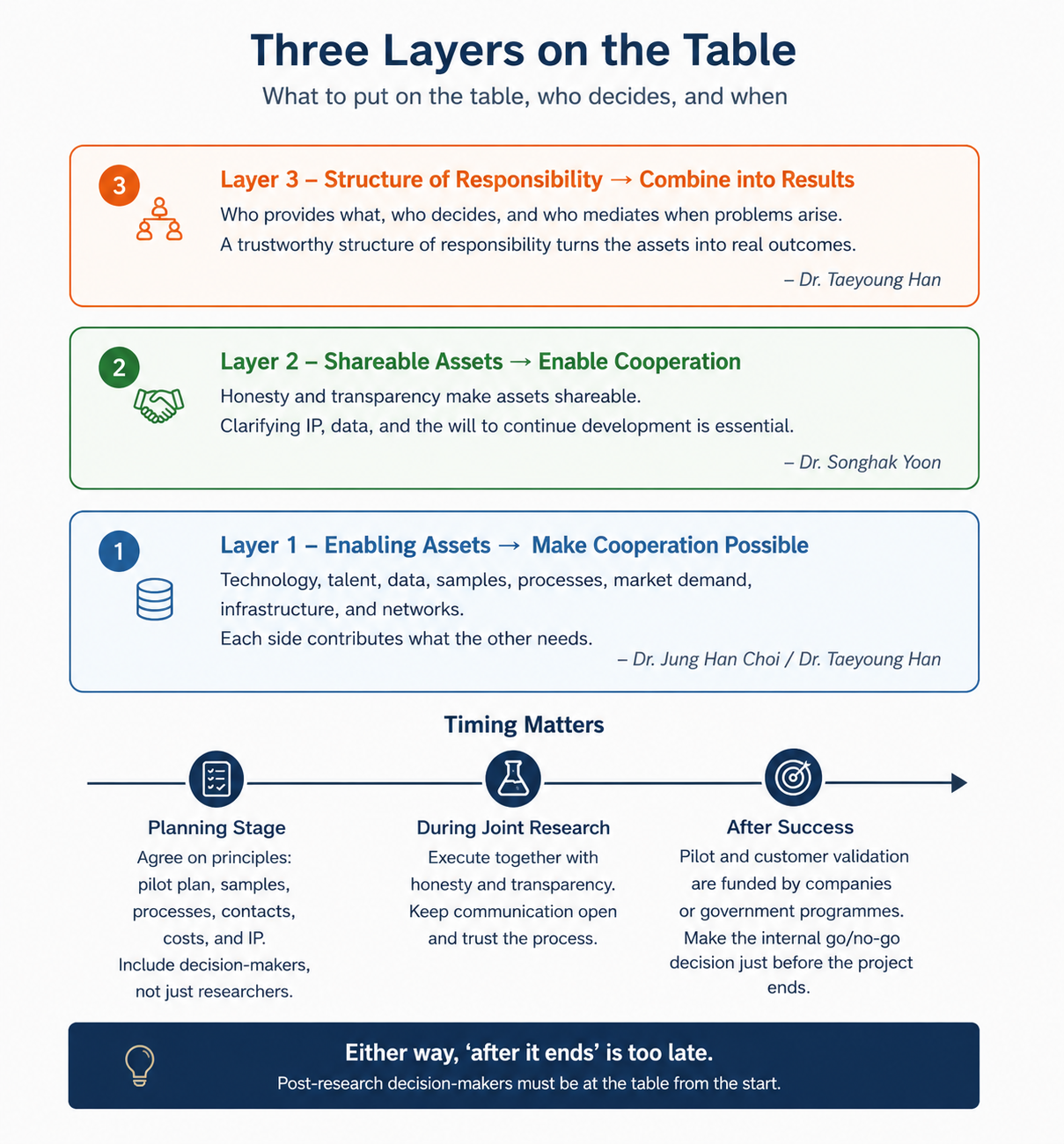
The answers are not identical, but they can be placed on the same timeline. Dr.Han sets the principles at the planning stage; Dr.Choi places the company's final commitment near the end of a successful project; Dr. Yoon adds the need for a trusted institutional reference point. Either way, "after it ends" is too late — the people who will make the post-research decisions must sit at the table from the start. Public support can reduce the technical risk of the early pilot; but industrial adoption needs a staged structure in which costs and responsibility shift toward the company and its prospective customers.
Translate the three sets of answers into operational language, and seven items need names when a cooperation is designed.
The Seven Names
What are we trying to solve? A cooperation with a technology but no concrete industrial problem never gets onto the chain.
What data, samples and process information can the next decision-maker trust and act on — and who produces them?
Whose is the go/no-go at each stage? The people who will decide after the research sit at the table from the start.
Who carries the cost of the next stage? Principles at the planning stage; the company's final decision before the close.
The rules of ownership and access. Without honesty and transparency, cooperation stops here.
Which company will own the pilot and the adoption? From the point where research ends, the company is the owner.
Who carries one decision to the next, and who mediates when problems arise?
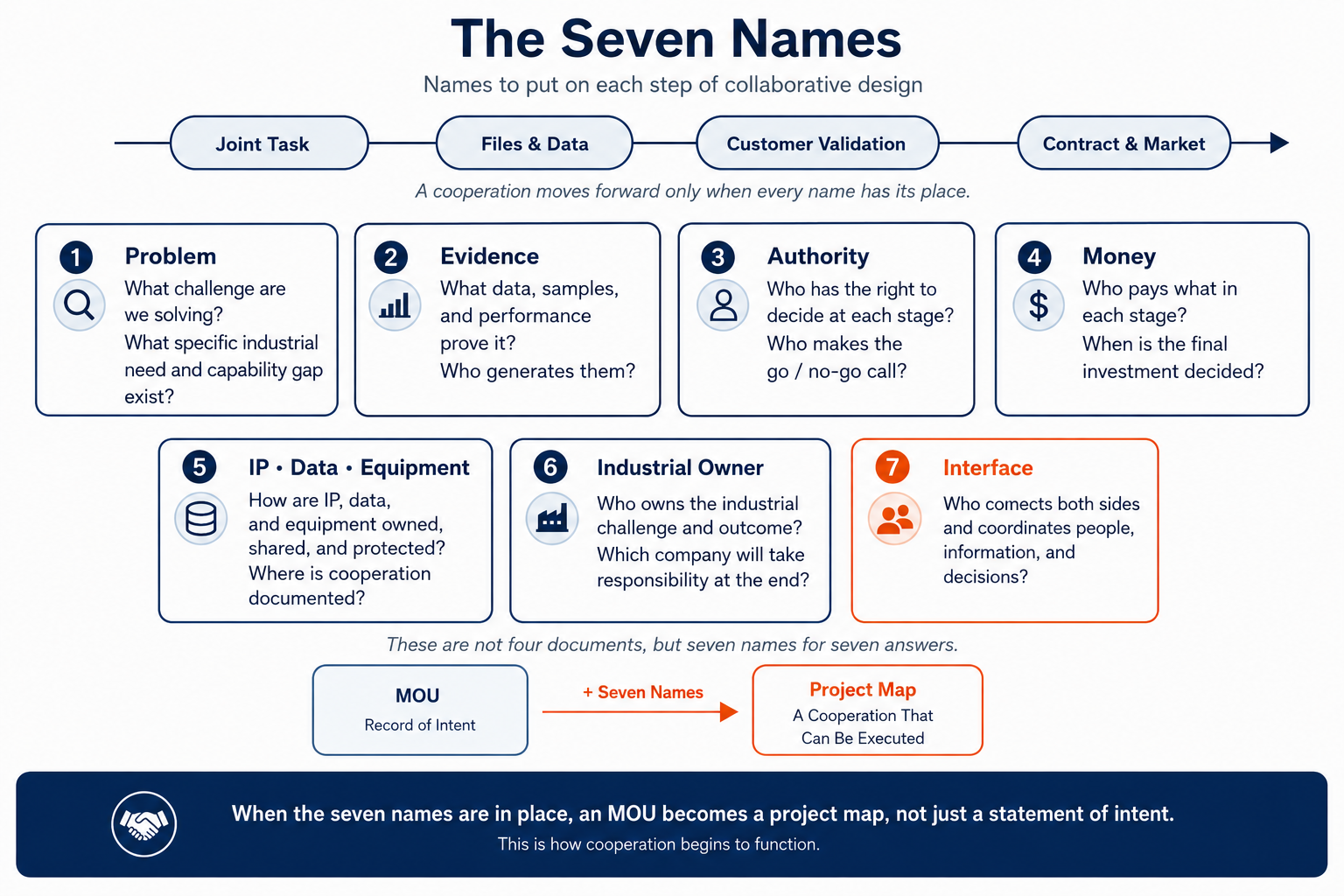
The seven names are not a new theory but an index of the three answers. When these seven names are attached to an MOU, the document begins to function as a project map rather than a statement of intent.
If You Could Change One Thing
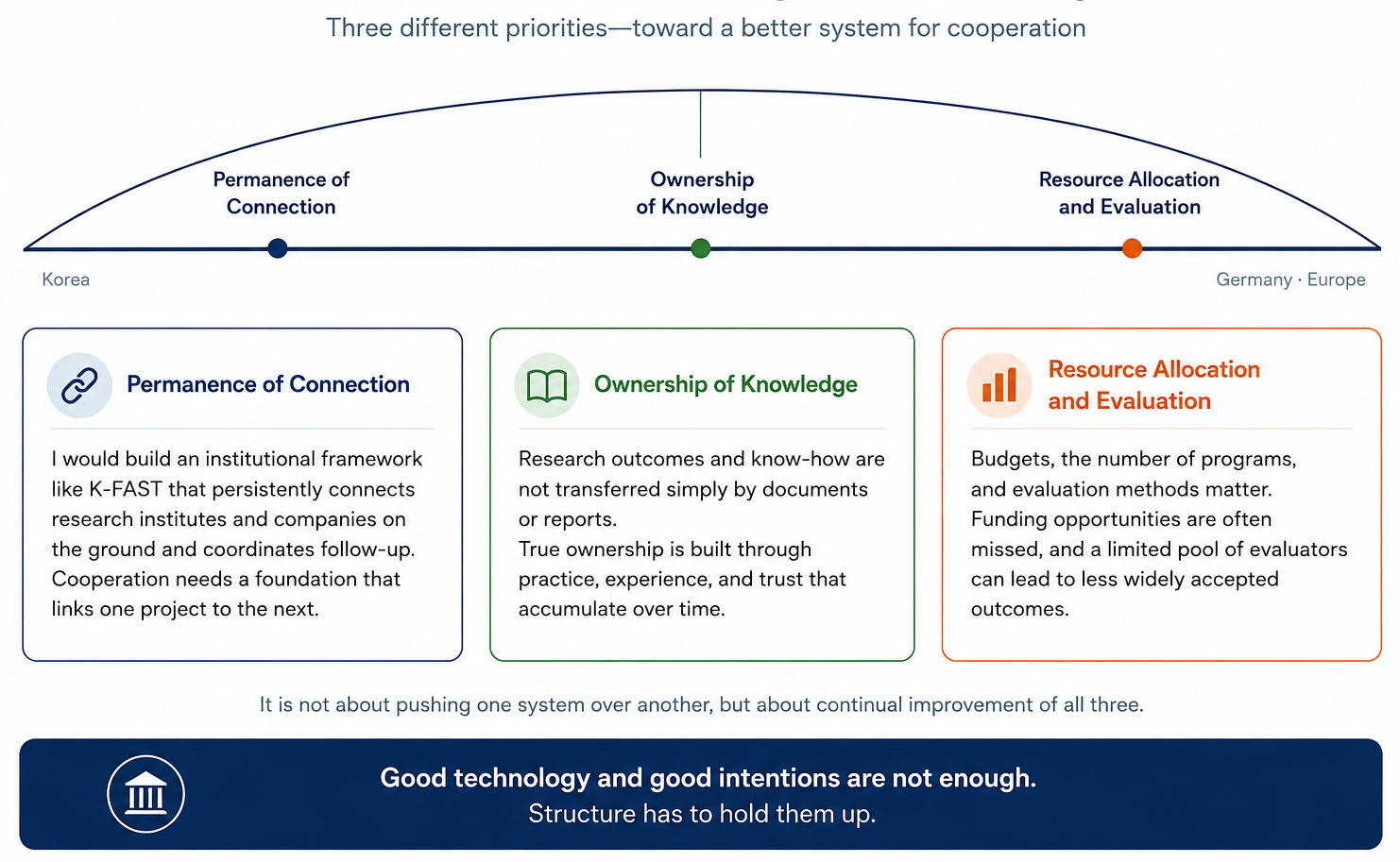
The last question asked each for one institutional wish. The three answers became a map of three positions on the bridge.
Dr. Taeyoung Han chose the institutionalisation of a permanent cooperation base.
“If I could change one thing, I would create an institutional framework for operating, over the long term, a cooperation base like K-FAST that continuously connects the research institutions and companies of both countries on the ground and coordinates the follow-up. International technology cooperation is not completed by one event, one partner-matching, or one two-to-three-year joint project. Cooperation needs not only budgets for projects, but a foundation that connects one project to the next.”
Dr. Songhak Yoon's answer touches the most fundamental layer.
“I wish the patent system could be abolished. I hope a broad discussion can begin on whether the patent system is still a necessary instrument.”
Dr. Yoon's answer is the most radical of the three. Taken literally, it challenges the patent system itself. In the context of his other answers, it also points to a recurring friction in international cooperation: how knowledge, ownership and trust are negotiated.
Dr. Jung Han Choi pointed at the operation of resources and evaluation.
“I would change two things. First, the size of budgets and the number of approved cooperation programmes. Even when a joint research idea is world-class, funding opportunities are often missed because approvals are distributed across fields and regions. Second, the evaluation method. The pool of evaluators for Korean government projects is small, which can make evaluation outcomes less widely accepted.”
Set the three wishes side by side and they expose three different institutional frictions: continuity of the cooperation platform, ownership of knowledge, and the allocation and evaluation of public R&D resources. Not one institutional prescription but three fronts of improvement — and all three are different phrasings of the sentence this series has carried from the beginning. Good technology and good intentions are not enough. Structure has to hold them up.
Season Conclusion — A Bridge Is Not Finished by a Contract
Fold the journey of eleven articles into one sentence and it reads:
Good technology does not cross borders on its own. It moves only when translation and evidence, funding and responsibility cross together — and what carries them across, in the end, is the people who work on the bridge.
The crossed answers of the three added the final stroke to that sentence. Cooperation begins not with a signature but with actions that carry owners and deadlines; it can stop at any link; it demands tangible assets, intangible trust and a structure of responsibility together; and the decision-makers of the next stage must sit at the table from the start.
And above all of this stands the conclusion the series has reached.
The value of Korean–German cooperation lies not in placing one system above the other, but in combining different processes, materials, infrastructures and industrial networks to create results neither side could achieve alone.
A bridge is not finished by a contract. It is finished by the technologies and people, the evidence and the responsibility that cross it — and that traffic continues after this series ends.
Then what is a bridge built of?
A bridge is not built by connecting institutions. It is built by connecting decisions.
Not a stack of institutions, but a sequence of decisions that different people are able — and authorised — to carry forward.
About This Reporting
This article is based on the answers to the six questions put in common, in writing, to Dr. Taeyoung Han, Dr. Songhak Yoon and Dr. Jung Han Choi. The answers are edited crosswise, organised by the convergences and divergences under each question rather than person by person. Unanswered items were not filled in from other sources, and an answer of “I don’t know” is printed as such.
Statements concerning the patent system and evaluation systems are the personal views of the interviewees, not the positions of their institutions. In the discussion of pilot financing, the role of public support is attributed to the interviewees’ proposals; the editorial conclusion is limited to: “public support can reduce the technical risk of the early pilot, but industrial adoption needs a staged structure in which costs and responsibility shift toward the company and its prospective customers.”
The “distribution of stopping points,” “three layers of assets,” “two moments and one condition,” and “seven names in the design of a cooperation” are K-Welle’s editorial analysis derived from crossing the answers, not official classifications.
Quotations have been edited for rhythm and orthography without changing their meaning; before publication, each of the three interviewees will be asked for final confirmation of their quotations, including the English translations, and the facts. Partner institutions supported reporting access and had no role in the content.
Corrections: editor@k-welle.com
Sources · Linked on publication
- Written interview with Dr. Taeyoung Han (common questions) — K-Welle, received July 2026
- Written interview with Dr. Songhak Yoon (common questions) — K-Welle, received August 2026
- Written interview with Dr. Jung Han Choi (common questions) — K-Welle, received August 2026
- Korea Innovation Bridge, articles 1–10 — internal series references