
What Comes After the University Lab?
For STEM students and young researchers considering Korea, public research institutes reveal a world of strategic technologies, advanced facilities and research beyond the university campus.
Korea’s public institutes turn knowledge into national missions, industrial technology and shared infrastructure.
After the University Lab
K-Uni, the previous K-Welle theme, followed how Korea produces researchers and knowledge: universities, laboratories, research funding, industry collaboration and campus start-ups.
The next question follows naturally. Where does knowledge go after the university lab?
Some is consolidated in papers and further academic research. Some becomes the basis of patents or start-ups, or moves toward products through joint research with companies. But not every research result can jump straight from a university bench to a production line.
Some technologies are too early for corporate investment, yet demand more time and equipment than a single university laboratory can sustain — repeated experiments, follow-up research, reliability assessment, pilot facilities. And some capabilities — measurement standards, supercomputing, research data — are better owned by no single company at all, and shared by the nation and its industries instead.
This is where Korea's government-funded research institutes come in.
The Public Capability Layer
Seen from abroad, Korea's technology landscape shows two kinds of names first. On one side, universities such as Seoul National University (SNU), KAIST and POSTECH. On the other, global companies such as Samsung, LG, Hyundai and SK.
These two pillars alone cannot explain how Korea accumulated its capabilities in semiconductors, telecommunications, batteries, advanced materials and manufacturing. Alongside — and often overlapping with — these two pillars operate government-funded research institutes, specialised public research organisations, national research facilities and agencies supporting research and industrial technology.
Three Actors in Korea’s Research Ecosystem
Table 1Universities
Role: education, basic research, and researcher training.
Outputs: papers, degrees, and foundational knowledge.
Public Research Institutes
Role: national missions, applied research, shared facilities, and industry support.
Outputs: technologies, standards, validation, and infrastructure.
Corporate R&D
Role: product development, mass production, and market competition.
Outputs: products, processes, revenue, and market share.
These categories show primary institutional roles. In practice, research, infrastructure, and industrial development often overlap.
Yet describing the institutes as a mere "middle stage" would also be inaccurate. Not all of their research begins at a university. New research starts inside the institutes themselves. They also pursue fields considered strategically necessary before clear market demand has emerged. They are more than a channel that passes university technology to companies.
They are not simply a bridge between knowledge and use. They are a public capability layer with their own missions.
Three Functions, One Map
Korea's public R&D system turns knowledge into capability in three broad ways. This is not an official government classification, but a functional map developed by K-Welle for international readers — a functional map is easier to navigate than a list of institutional acronyms.
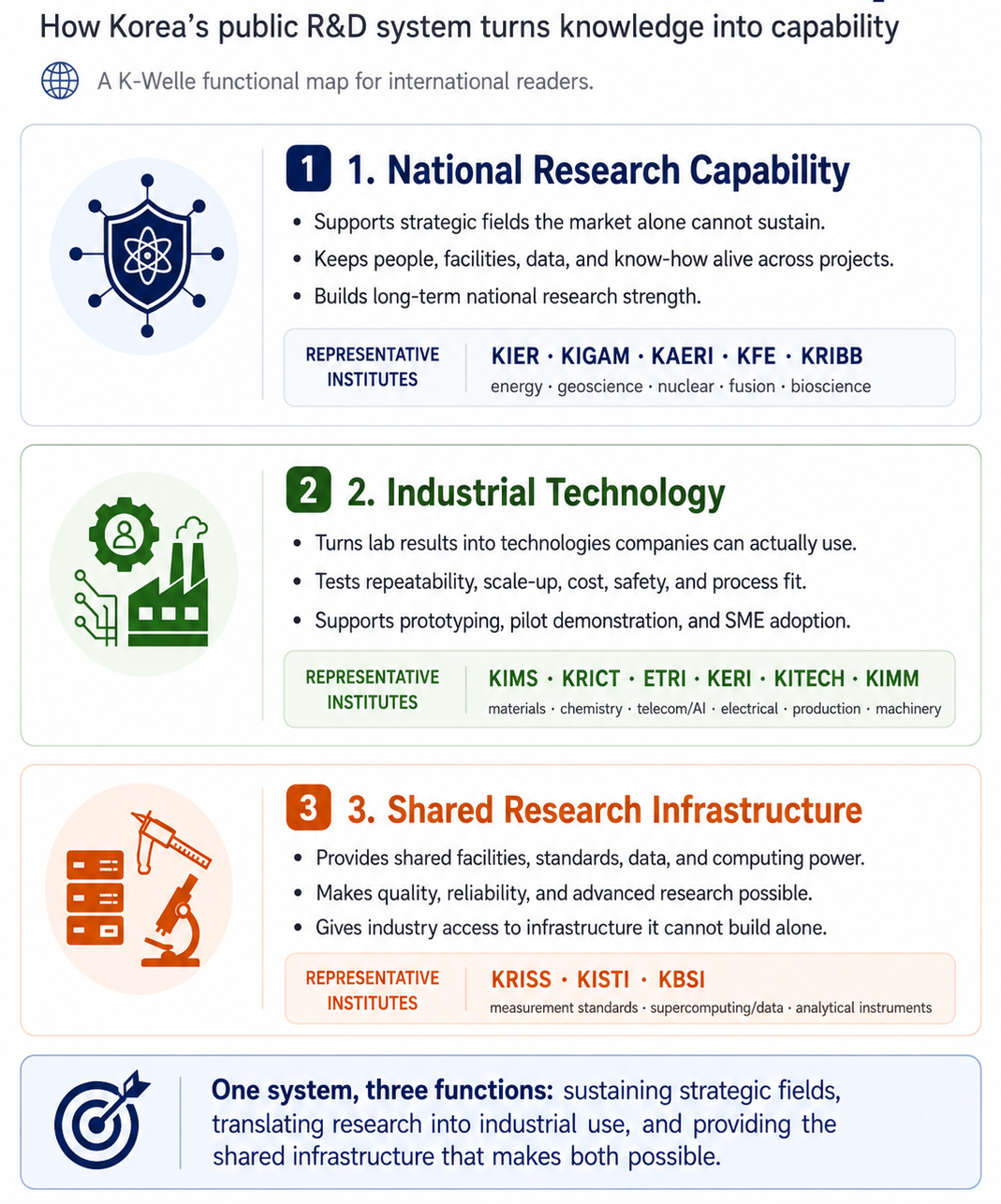
Public infrastructure allows separate laboratories and companies to trust the same result.
Find a Korean Public Research Institute
Institute MapEnter an acronym such as KIST, KIMS, or KRISS to see where the institute is located and which function it represents in Korea’s public R&D system.
Korean R&D Cities from Seoul
Transportation & research functions · selected institute highlighted
- KITECH
- Production technology · SME support
- KIMS · Materials
- KERI · Electrotechnology
- Energy & resources — KIER · KAERI · KFE · KIGAM
- Bio · Chem · ICT · Machinery — KRIBB · KRICT · ETRI · KIMM
- Shared infrastructure — KRISS · KISTI · KBSI
Locations refer to the main institute or representative headquarters used for reader orientation. Some institutes also operate regional branches, campuses, or specialized centers. Travel times are approximate KTX references from Seoul.
Where KIST Sits
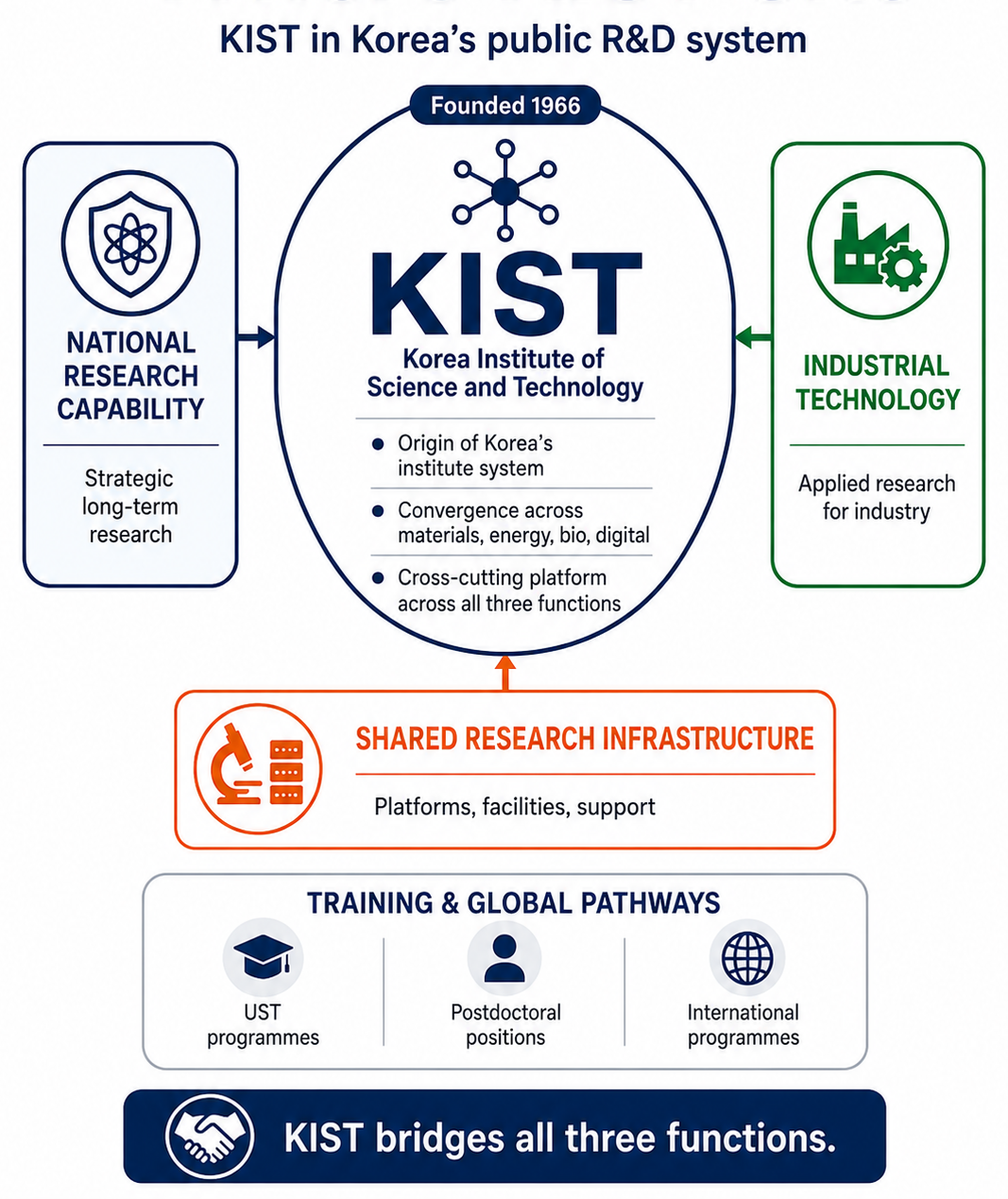
Not every institute fits neatly into one function. Founded in 1966, KIST is the origin point of Korea's modern institute system and a convergence research organisation cutting across materials, energy, bio and digital fields. It is best understood not as a member of one cluster but as a cross-cutting research platform spanning all three functions. KIST also trains researchers through UST degree programmes, postdoctoral positions and international research programmes.
Not a Single Pipeline
It is convenient to draw Korea's research ecosystem as a straight line: University → Public Institute → Company. Real technology rarely moves in that order.
Some technologies transfer directly from universities to companies. Some research begins with a company's industrial problem and proceeds jointly with an institute. University researchers may also contribute to technologies developed inside the institutes. Several institutes may each contribute materials, analysis, process or measurement capability to a single industrial problem.
Consider a hypothetical battery material. A chemistry institute might develop the process; a materials institute might characterise its properties and safety; a production-technology institute might adapt it to manufacturing. The resulting material may then be tested against measurement and reliability requirements before moving towards joint development or technology transfer. This is not a fixed pipeline. It is an illustration of how capabilities distributed across Korea's public R&D system can combine around one industrial problem.
What matters is not the number of institutes.
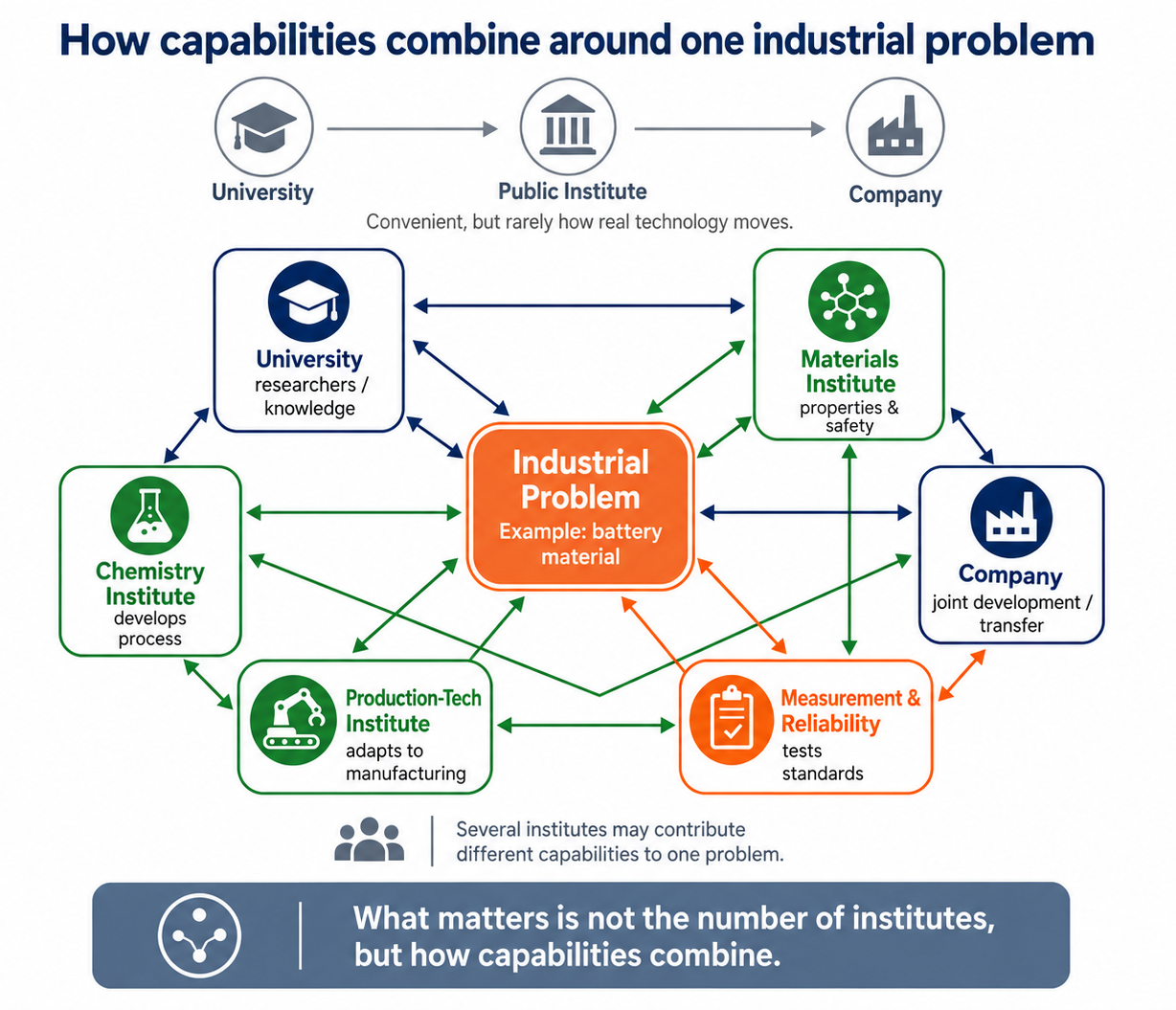
When a problem emerges, which capabilities need to connect — and who can connect them?
Who Decides?-Three Layer
No institute operates in isolation when setting its direction. Three layers operate.
Government and ministries. The government and its ministries set national science and technology policy, strategic priorities and the overall direction of budgets. NST operates under the Ministry of Science and ICT, while its 23 institutes fall within the Council's remit — but not all of Korea's public research does. The Ministry of Trade, Industry and Energy and other ministries run their own specialised institutes and support programmes.
NST. The National Research Council of Science and Technology supports, fosters, oversees and evaluates its 23 institutes, and coordinates collaboration and convergence research among them. NST is not one giant laboratory made of 23 parts; each institute operates with its own mission and organisation.
Individual institutes. Each institute converts national missions into concrete research programmes — designing topics, deploying research staff, operating facilities and conducting joint research with universities, companies and overseas partners. The primary role of organisations such as KISTEP, NRF and KIAT is not laboratory research. They shape the system through planning, funding, evaluation and industrial-cooperation programmes.
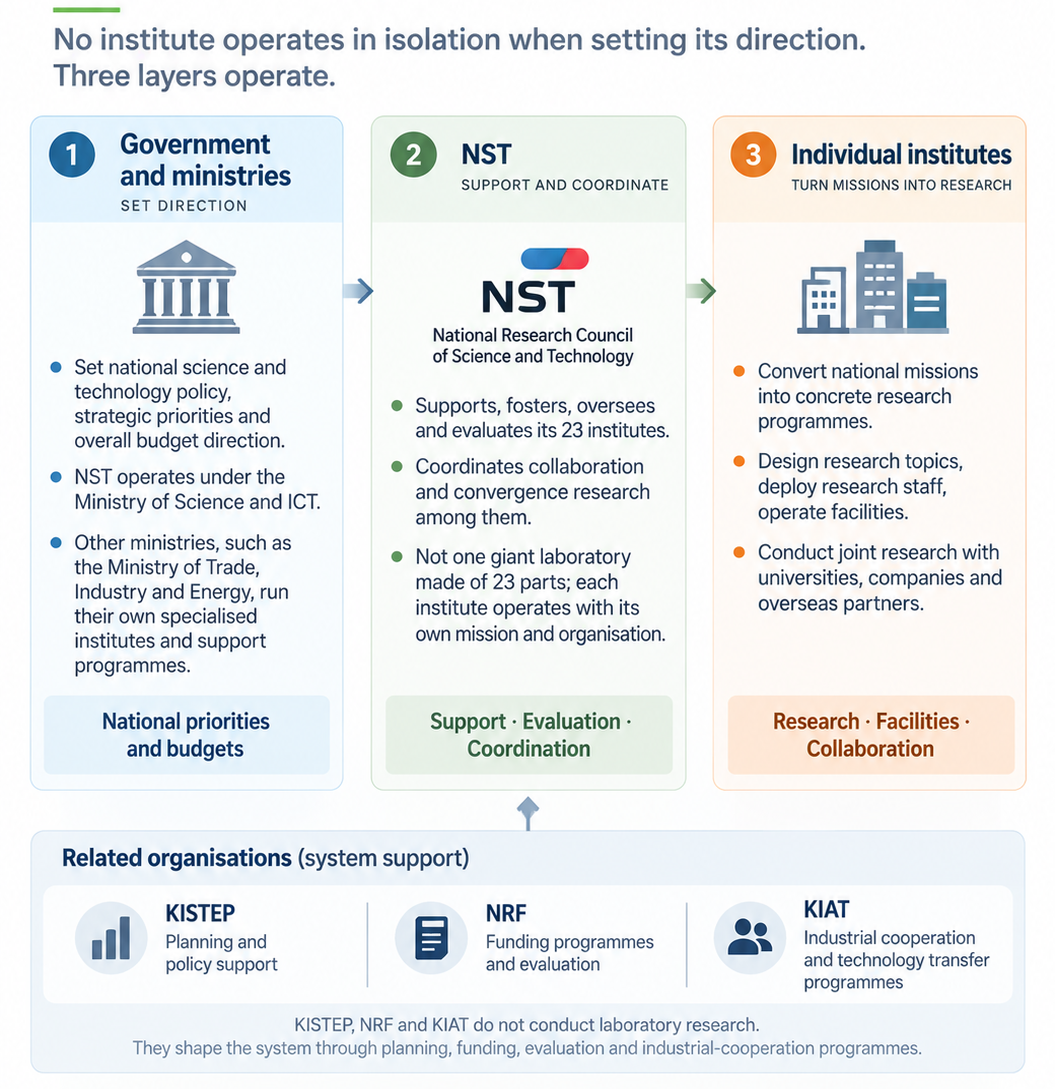
K-Institute, as K-Welle uses the term, is not a legal classification. It is an editorial category for reading together the organisations and platforms that actually move Korea's research funding, industrial technology, public infrastructure and international cooperation.
Two Funding Clocks
Research at the institutes runs on two financial timetables.
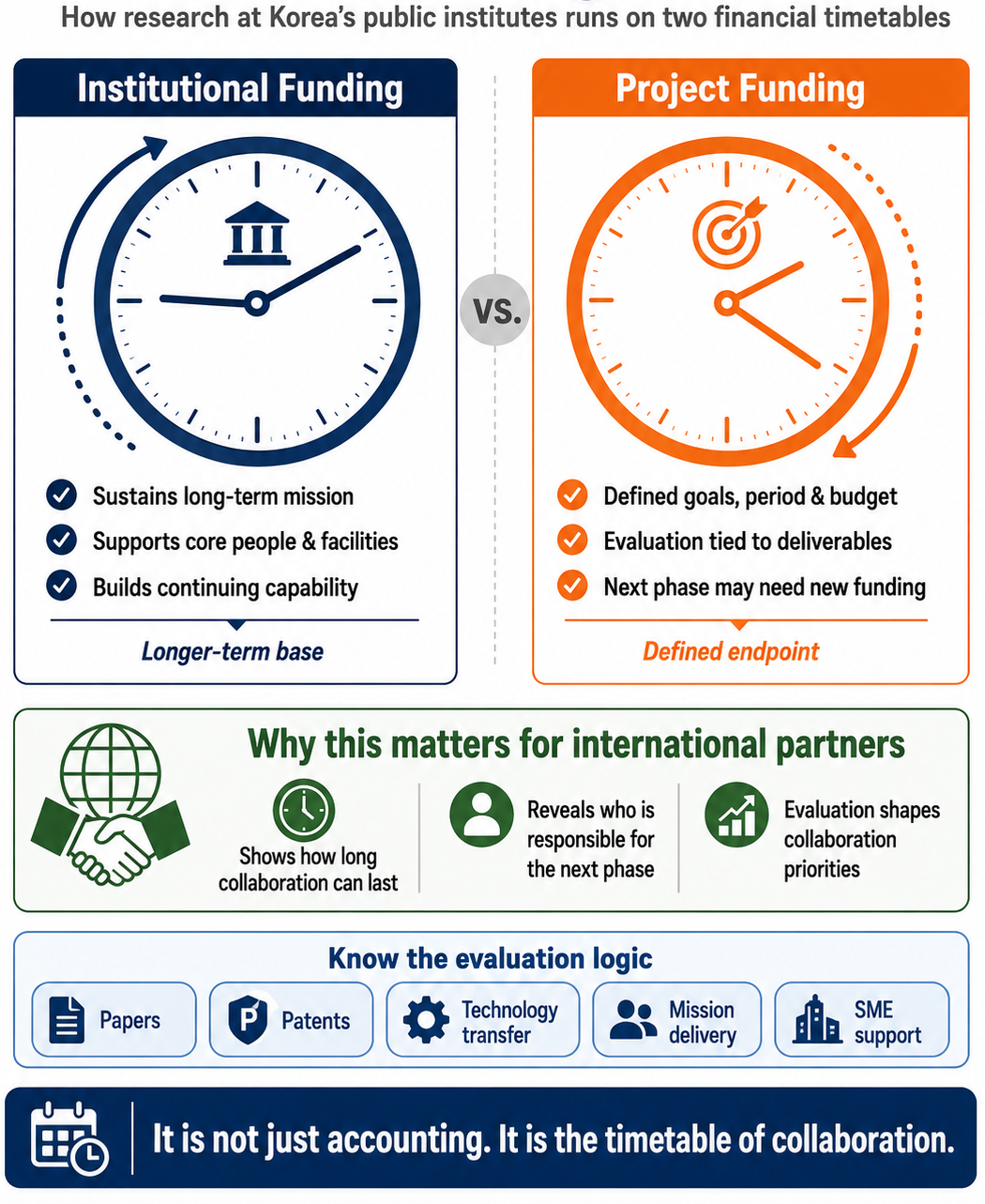
For an international partner this is not mere accounting. It is a timetable showing how long a collaboration can last. Evaluation shapes behaviour, too: know whether your Korean partner is judged on papers, patents, technology transfer, mission delivery or SME support, and you will better understand what kind of collaboration they are able to prioritise.
A Global Reference — Not a Copy
For a European reader, the most accessible reference is Fraunhofer: applied research connected to industry, facilities and expertise companies can use, joint research, testing and technology transfer. But not every Korean institute can be called "the Korean Fraunhofer."
Fraunhofer gathers its institutes inside a single non-profit organisation, where central governance and each institute's industrial network operate together. Germany separately maintains Max Planck for basic research, Helmholtz for large facilities and national missions, and Leibniz for field-specific public research.
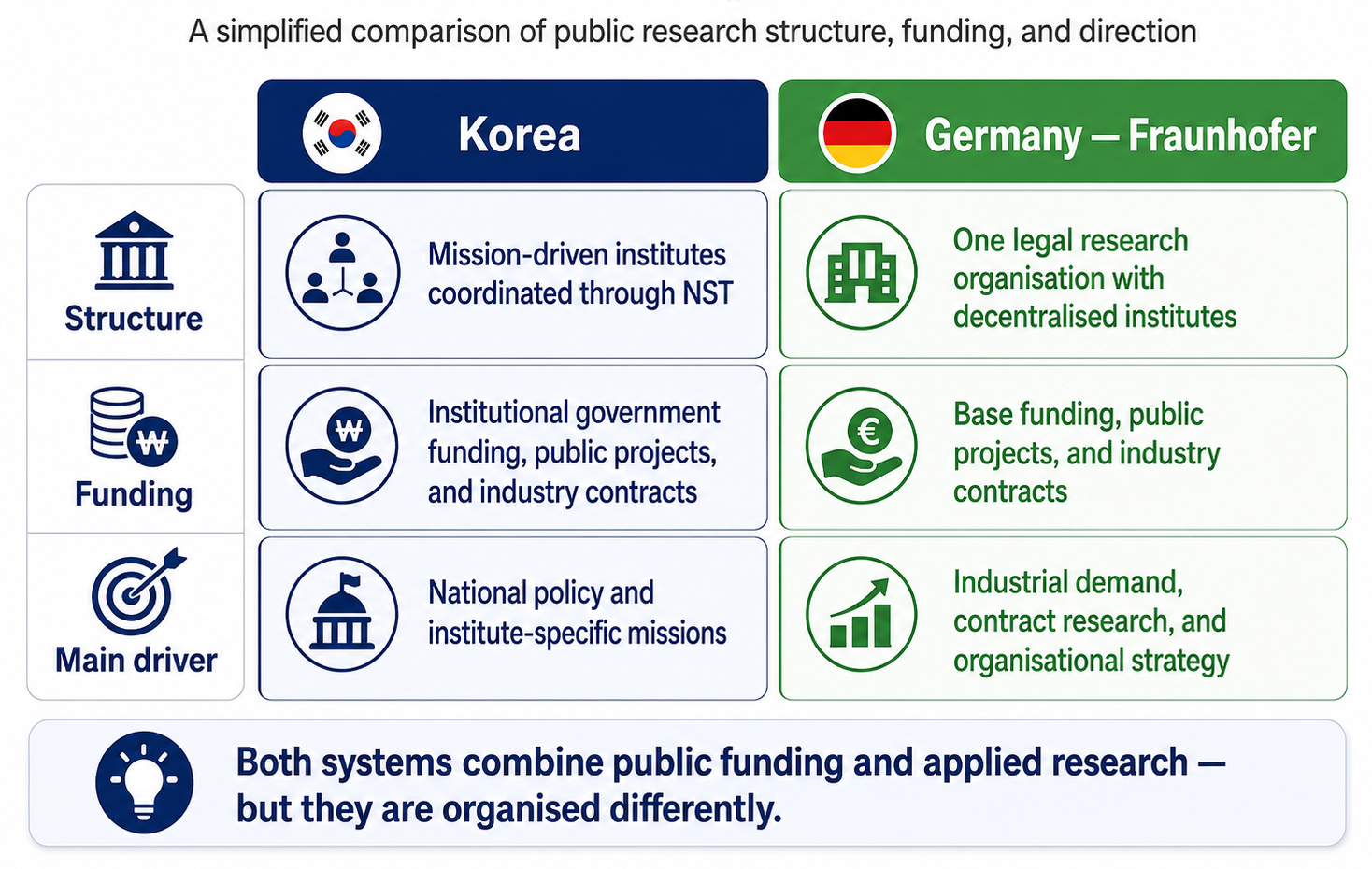
The purpose of comparison is not to attach a foreign label to each Korean institute. It is to compare four dimensions:
- Mission — which public problem does it solve?
- Governance — who runs and oversees it?
- Funding — under what financial structure does it research?
- Industry interface — how does it connect to companies?
[링크 카드: How to Navigate Korea's Public Research System — a quick-reference table matching functions to their nearest international coordinates]
How to Read the System
You do not need to memorise every institute's name. Check three things first.
Find the mission. Locate the authority. Check the funding clock.
About This Reporting — This article is based on official materials from the government and the research institutes. It distinguishes between policy directions and systems currently in force; budget, funding and programme information subject to change is re-verified immediately before publication. The three functional groups and international comparison used in this article are K-Welle editorial frameworks, not official institutional classifications. Partner organisations facilitated access but had no editorial role. Corrections: editor@k-welle.com