
The Scale-up Scientist
Inside battery black-mass recycling, what deep-tech scale-up must prove before reaching production.
What Korean deep tech must prove before Europe will put it into production
The five gates, seen from inside the black powder
Featured Interviewee: Dr. Songhak Yoon · Fraunhofer IWKS / K-FAST
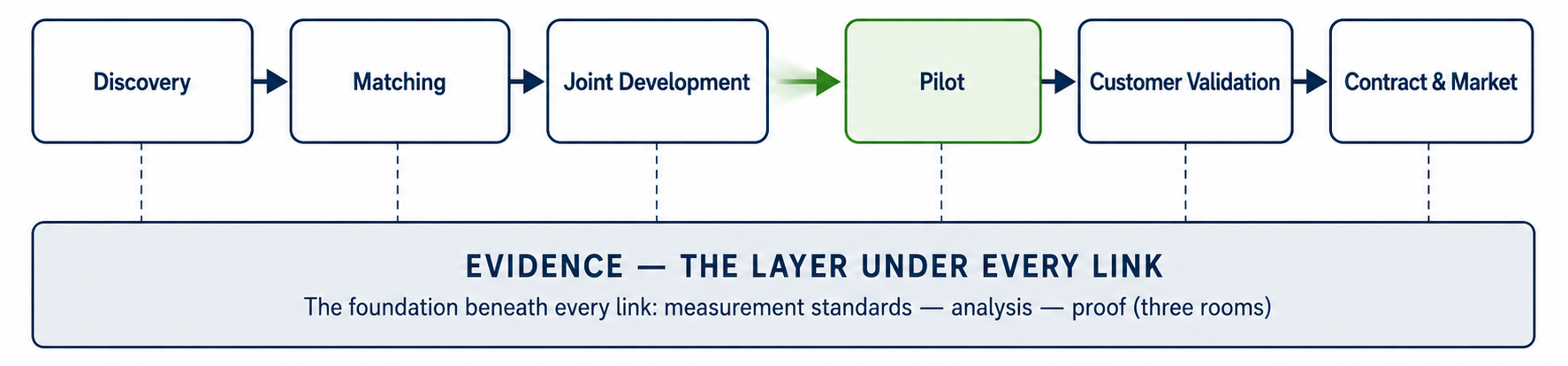
Dr. Songhak Yoon's technology is in the middle of that chain right now — in the valley between laboratory proof and pilot scale.
The Problem Inside the Black Powder
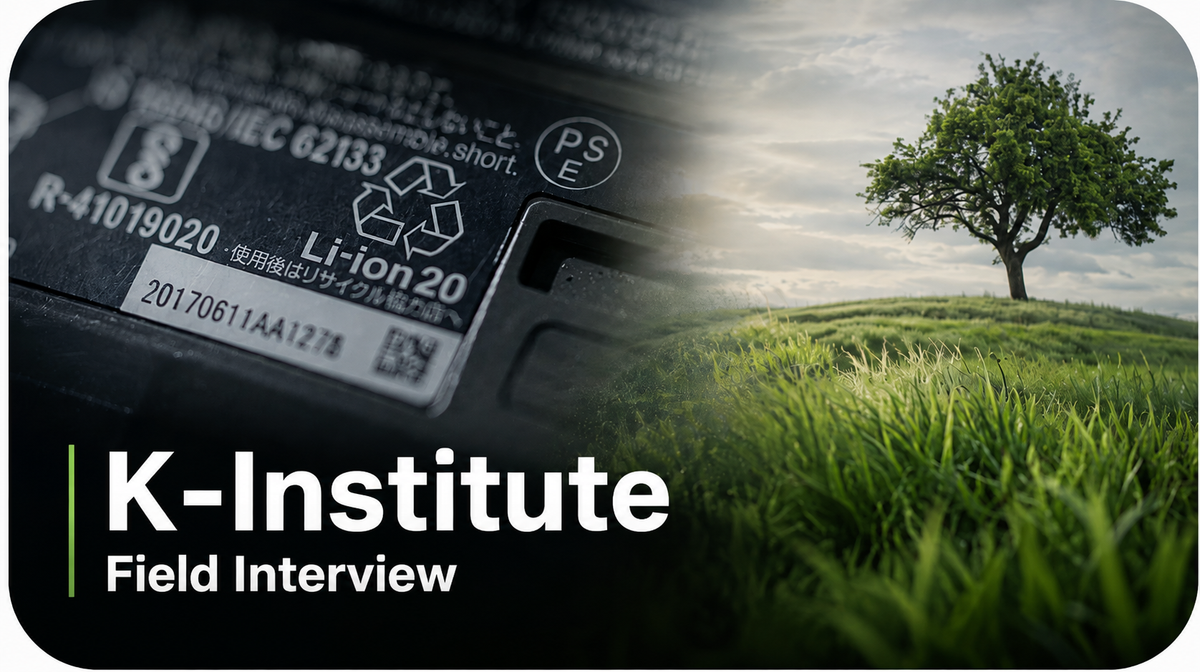
Spent lithium-ion batteries pass through collection and sorting, dismantling and mechanical pre-treatment, and leave behind an intermediate material in the form of a black powder — "black mass." Inside it, materials from cathodes and anodes are mixed together: lithium, nickel, cobalt, graphite.
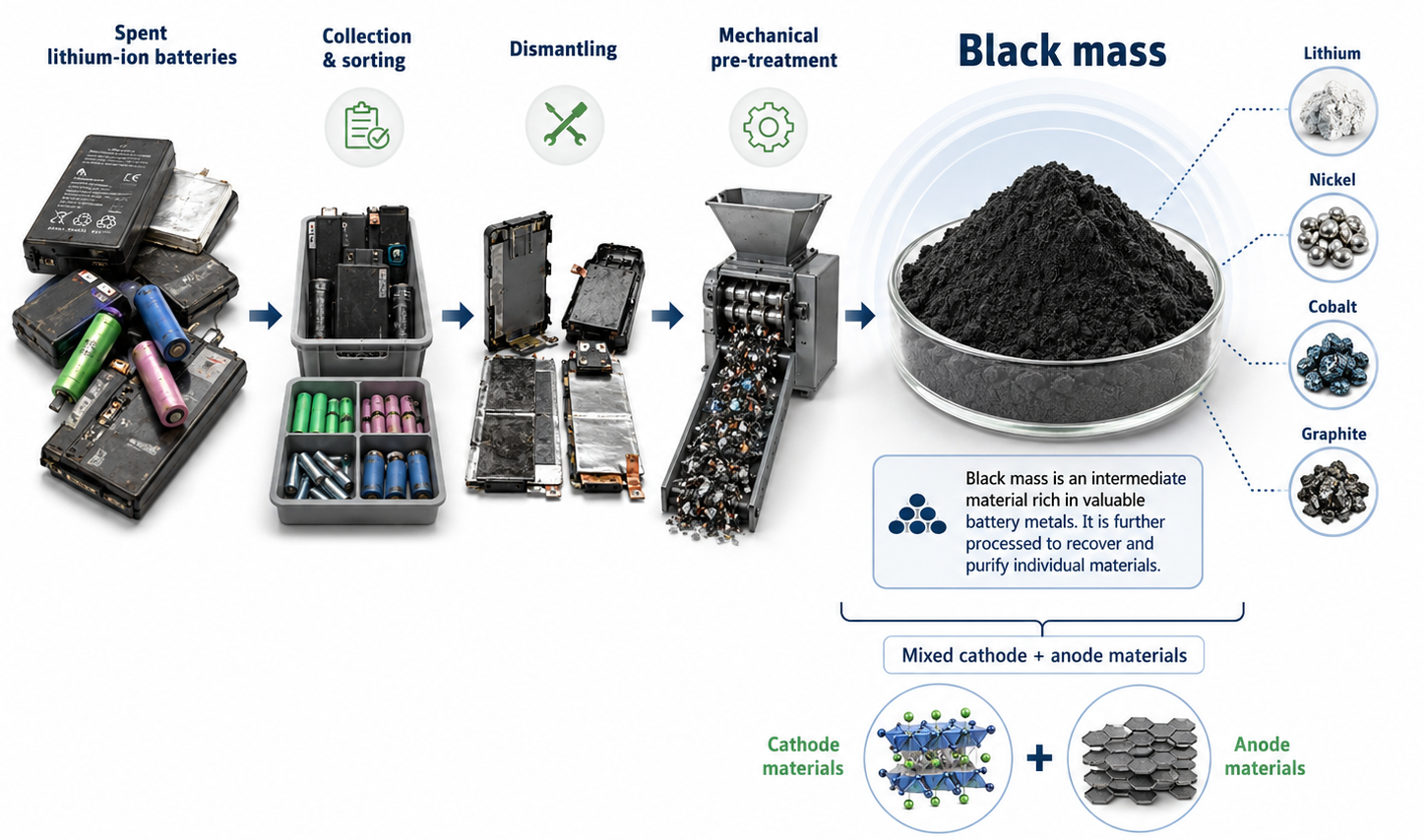
At first glance, black mass is a collection of valuable materials to be recovered. But to use it again as battery material, knowing what is in it is not enough. What matters is which impurities are present and in what quantity, whether they can be removed reliably, and whether the same quality can be secured batch after batch.
This is also where Dr. Songhak Yoon saw the distance between laboratory results and industrial results.
“In battery recycling, I did not fully appreciate at first how important it is to produce high-purity black mass in the mechanical crushing stage of pre-treatment. It was while researching at Fraunhofer that I learned how difficult and how critical a condition impurity control really is.”
He explains that a variety of experimental results at low technology readiness levels (TRL) can be sufficient to publish papers. But for industrial application, several conditions must be met at once: purity, repeatability, process compatibility, environmental performance and cost.
This is the first point where a good laboratory result and a result industry can actually use begin to diverge.
INTERVIEWEE
Dr. Songhak Yoon
Fraunhofer IWKS · K-FAST Steering Committee
Materials science → battery recycling → industrial scale-up
Read full profile
Dr. Songhak Yoon received his doctorate in materials science from POSTECH (Pohang University of Science and Technology) in 2007. He then spent two years as a postdoctoral researcher at Forschungszentrum Jülich in Germany, about five years at the Swiss Federal Laboratories for Materials Science and Technology (Empa), and three years at the University of Stuttgart.
In 2019 he joined the Fraunhofer Research Institution for Materials Recycling and Resource Strategies IWKS, where he now researches the direct recycling and regeneration of lithium-ion-battery black mass from an industrial perspective.
He also serves on the steering committee of K-FAST and of the Global Industrial Technology Cooperation Center (GITCC) of the Ministry of Trade, Industry and Energy and KIAT.
Fraunhofer IWKS's official profile likewise describes his recent research as focused on sustainable recycling processes for lithium-ion batteries — in particular the direct recycling and direct regeneration of black mass.
Fraunhofer IWKS profile →A Good Result Is Not Yet a Usable Result
Direct recycling is an approach that preserves, as far as possible, the structure and value of existing active materials for reuse — instead of breaking battery materials all the way back down to elements or salts. It has the potential to reduce energy and chemical use, but laboratory-scale possibility does not immediately mean industrial feasibility.
Fraunhofer IWKS also explains that commercialising direct recycling requires further validation from an industrial perspective. The black-mass market is still at an early stage, and questions of economics, environmental footprint, complex separation processes and infrastructure investment remain open together. Fraunhofer IWKS ICRC 2024
Asked what is hardest to secure for industrial application, Dr. Yoon named impurity management and energy-environmental performance.
“Even when new environmentally friendly technologies are developed, in almost all cases they lack economic viability. For a new impurity-removal technology to be adopted by industry, I believe legal measures are needed to underpin its economics.”
The answer shows why scale-up cannot be seen as simply making the equipment bigger. A technology has to answer at least five questions.
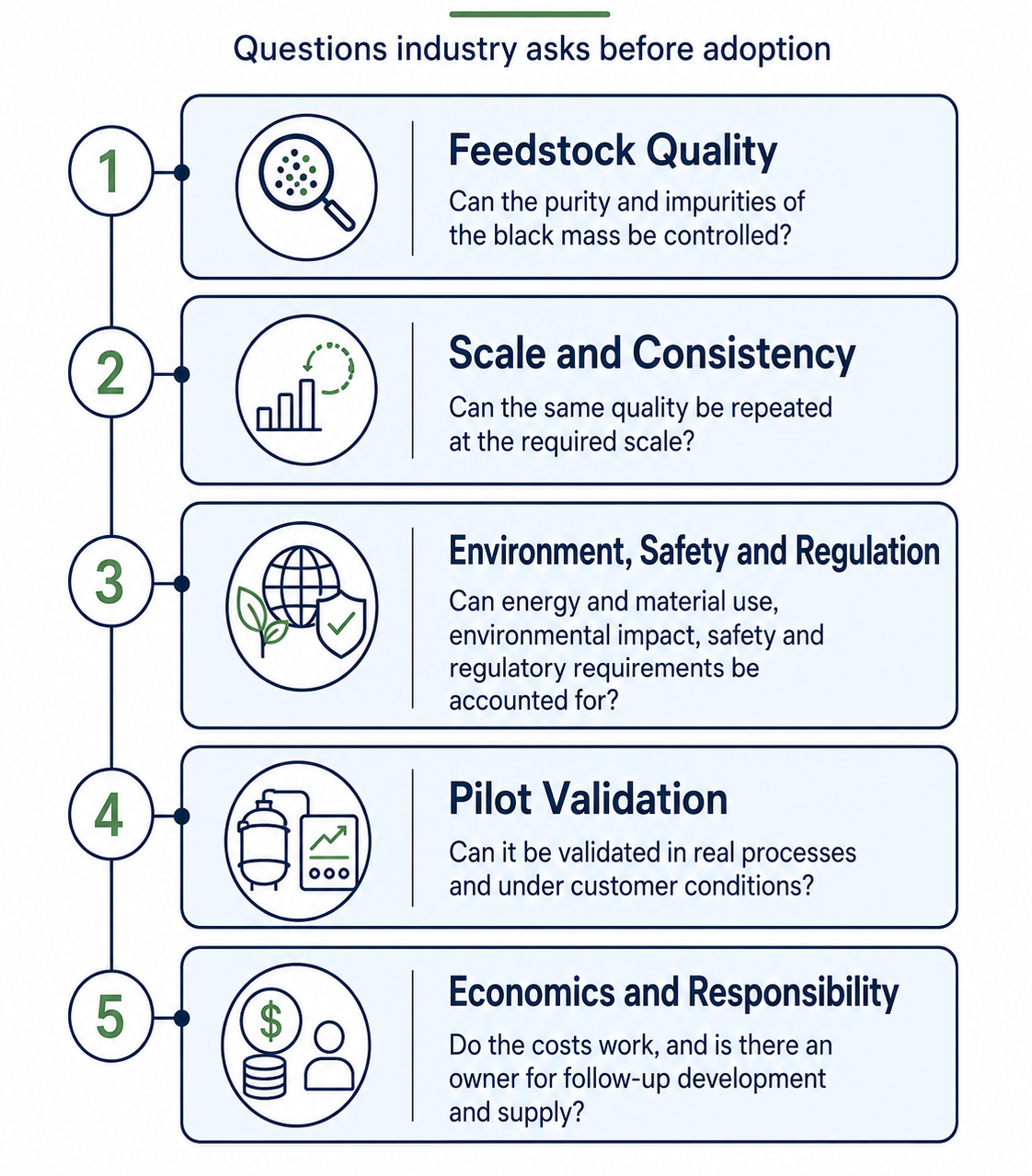
These gates do not move in a simple sequence. They interact. Removing more impurities may raise costs or energy use; improving environmental performance may reduce throughput or yield.
Scale-up is not the enlargement of a successful experiment. It is the reconciliation of quality, cost, regulation, customers and responsibility.
Not Korea to Germany, but a Shared Value Chain
Korean–German technology cooperation is often described as a flow in which Korea provides technology and Germany reviews and validates it for the European market. Since K-FAST connects the technologies of Korean institutes and companies with the Fraunhofer network, that direction certainly exists.
But the project Dr. Yoon takes part in shows a different structure.
“Germany produces raw materials through recycling, and Korea uses those raw materials to develop the component materials that go into battery cathodes. Korea concentrates on battery-materials technology and Germany concentrates on recycling processes, and together we are drawing the larger picture of a circular economy.”
In this cooperation, one side is not the technology provider and the other not a mere validator. Germany contributes recycling-process capability; Korea contributes battery-materials capability. Together, they cover different stages of the same value chain.
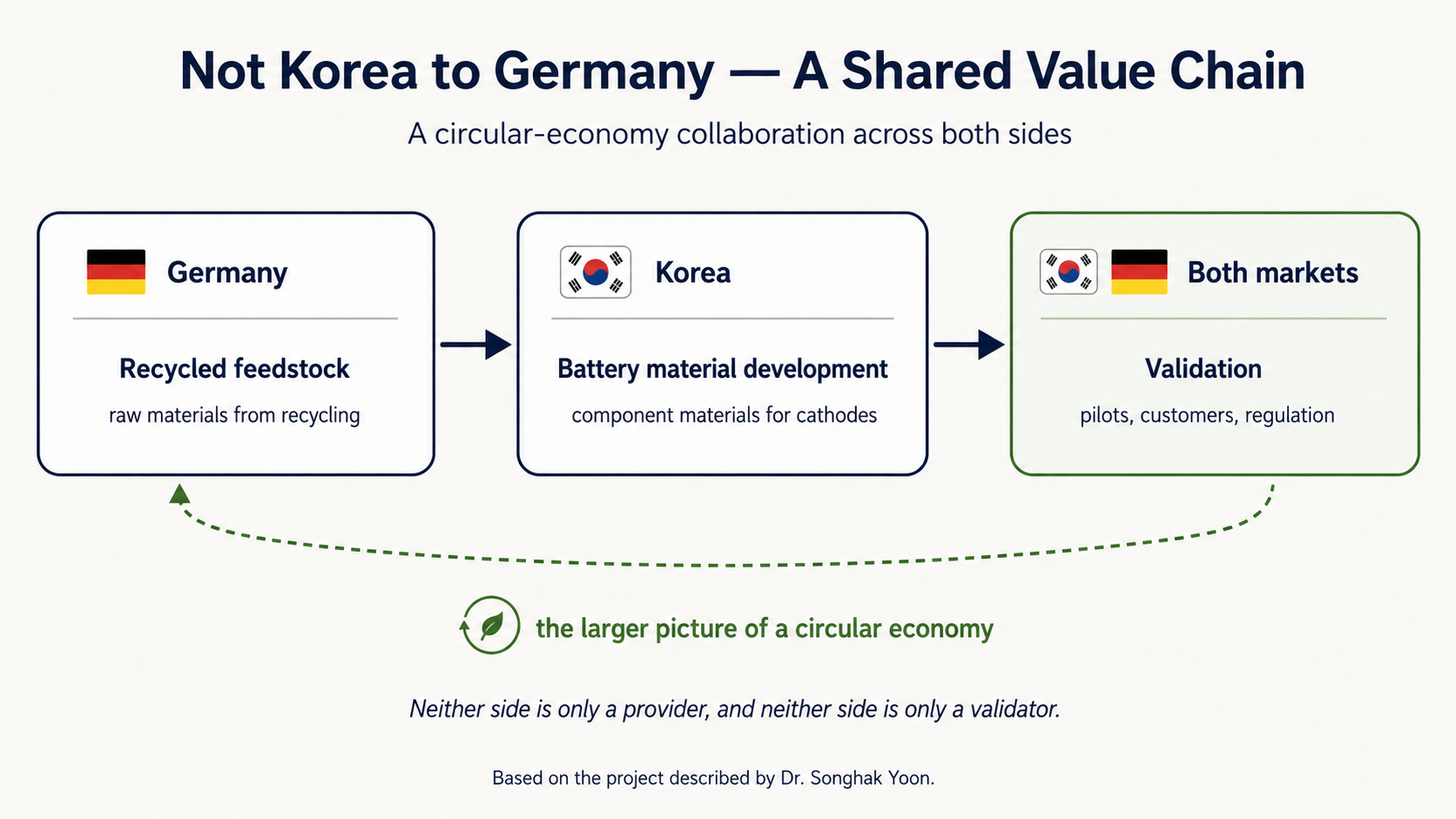
This case cannot be generalised into the standard form of all Korean–German cooperation. The project name, the participating organisations and the specific technology level have not been disclosed. But it shows at least one thing.
The strategic value of Korean–German cooperation does not lie in judging whose technology is superior. It lies in connecting different industrial capabilities to build process and materials systems that no single institution — and no single country — could easily complete alone.
“What matters is finding projects where the two countries can cooperate and complement each other, rather than compete.”
The Valley Begins After Feasibility
Dr. Yoon described the point the cooperation has reached as "the stage of having proven that the concept we envisioned is feasible."
Three tasks come next:
- Scale-up — moving the process to larger volumes
- Securing economic and environmental performance at the same time
- Demonstration under real conditions in both Korea and Germany
The distinction matters. Proving that a concept is feasible means the research did not fail. It does not mean the technology is ready for products or production processes.
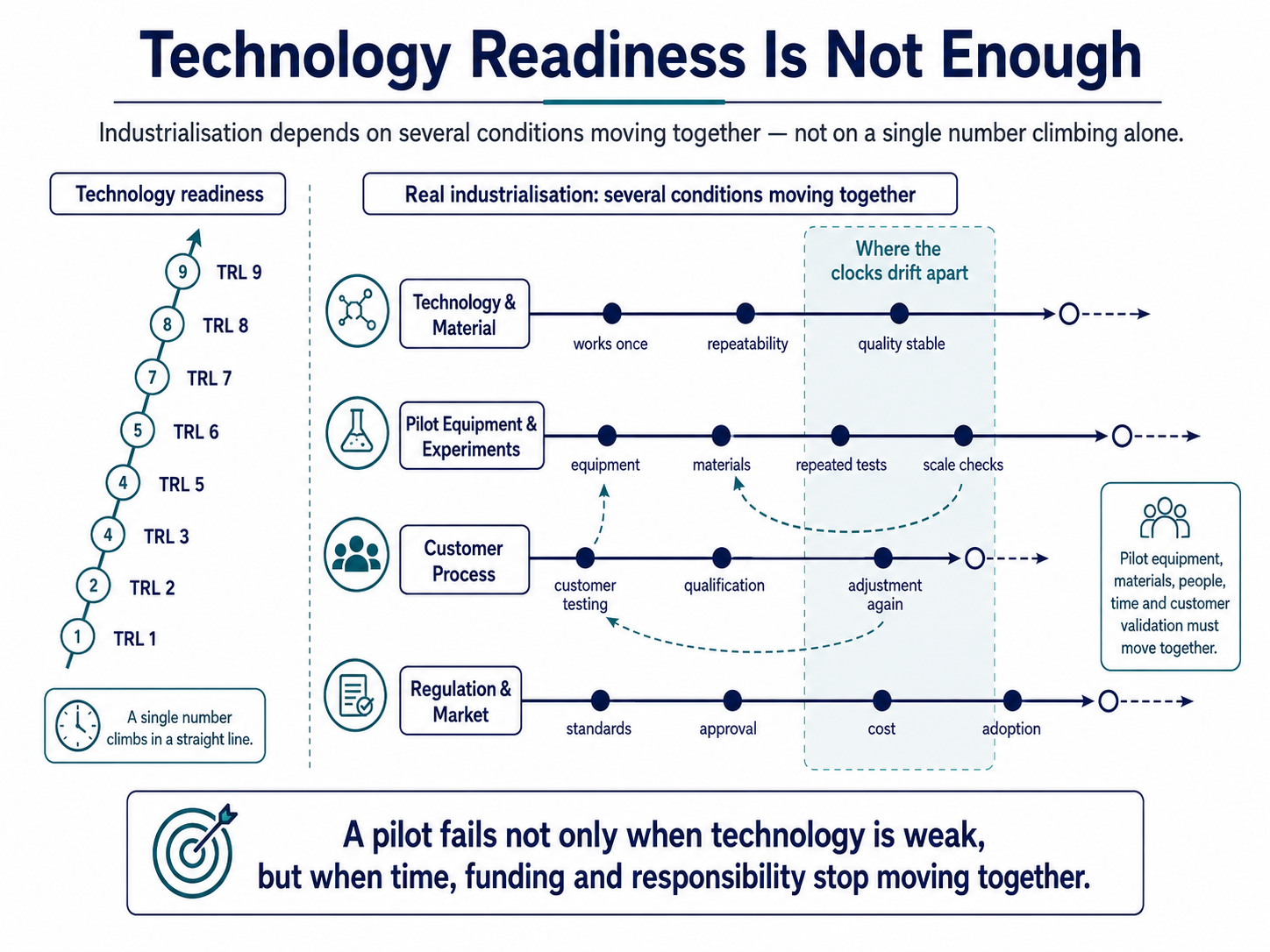
Technology readiness is expressed as a linear number that climbs one level at a time, but in real industrialisation, conditions beyond the technology have to move together. Pilot equipment and materials are needed, and people and time for repeated experiments. Potential customers must test the material in their own processes — and if the results fall short, process and material must be adjusted again. This is exactly the stretch where the three clocks drawn in the previous article, From Research to Industrial Proof — the research project, the pilot, regulation and the market — begin to drift apart.
Dr. Yoon says the step into the pilot is far harder than starting a joint project. Across different institutes in different countries and fields, he has repeatedly seen technologies that progress well through joint research but never reach commercialisation. As the most important lesson he learned at Fraunhofer, he also named just how difficult and how important the pilot stage is.
The valley of death, then, is not a single canyon that suddenly appears when research ends. It is a series of gaps that open between proof of concept and industrial application as funding, facilities, customers and responsibility fall out of sync.
Who Pays for the Pilot?
A research institute can prove what a technology can do. But pilots and customer validation require more: larger equipment, repeated batches, cross-border testing, and environmental and economic proof.
This is where interests diverge. Institutes want to move forward, while companies and customers often wait for stronger validation. Funding ends, costs rise, and no support window guarantees the next step.
Dr. Yoon proposed that when the current project moves to its next stage, Korean government-funded research institutes take part in the validation. On cost, he expressed the view that rather than leaving it to the participating institutions and companies alone, a follow-up national project funded by the German or Korean government is needed.
“I want to say that technological innovation truly requires full and consistent government support.”
This is a researcher's proposal, not a confirmed funding structure. But it puts its finger precisely on the fact that the pilot gap is not only a technical problem.
More important than who developed the technology is who bears the cost of the next proof — and who will use its results.
If follow-up funding and an owner of responsibility are not designed in from the start of joint research, even technically successful research can stop at proof of concept.
Europe's Regulation Is Part of the Technology
Asked what Korean companies preparing for the European market most often miss, Dr. Yoon pointed first not to the complexity of the rules but to time.
“The first thing to keep in mind is that preparing the business takes far longer than expected. Delays often come from places you did not anticipate.”
The EU Battery Regulation (Regulation (EU) 2023/1542) does not deal with battery performance alone: it covers the battery's entire life cycle, from carbon footprint and hazardous substances to recycled content, collection and recycling. EUR-Lex summary For a technology, the consequence is simple: regulation changes what data must be generated before the technology can be judged.
Environmental regulation is therefore not a final checklist consulted after development ends. It is a condition of technology development — shaping which process is chosen, which data is collected, and how energy and material flows are recorded.
Dr. Yoon advises meeting experts with European market experience through multiple channels and listening to their actual experience first. This means more than finding one consultant to interpret the regulations. It means having researchers, regulatory experts, industrial partners and potential customers review the technology from their different perspectives.
Nor is the documentation for entering Europe complete with a list of regulations.
- Composition of feedstock and impurities
- Process repeatability and recovery rates
- Energy and material inputs
- Environmental impact and waste
- Applicability in the customer's process
- Unit cost and production scale
- An owner for follow-up supply and quality
Only when these data are connected within a single account of the technology can a European partner judge a research result to be a "reviewable technology."
A Technology Still in Motion
Asked about cases where technically meaningful results did not lead to industrial application, Dr. Yoon answered that he "does not consider it stopped yet."
Research in battery recycling continues, and if new projects and demonstration opportunities are created, the technology developed at IWKS can pass through pilot and customer validation and be commercialised.
The answer warns against the success-or-failure binary so often used in technology-commercialisation reporting. A technology is not a failure because research did not move straight to the market. Continued research, by itself, does not mean the technology is moving closer to market.
What matters is whether the current position and the next gate can be stated concretely.
In Dr. Yoon's answers, the current position is fairly clear. The feasibility of the concept has been confirmed. Next come scale-up, environmental and economic performance, and demonstration in both Korea and Germany. And the companies, government-funded institutes, government programmes and responsibility structures that will move those stages have yet to be connected.
The Valley Has No Owner Yet
The valley after the laboratory is not created by a lack of technology.
The valley appears when the next proof has no clear owner.
Korean–German cooperation does not end with introducing good research. Its value lies in connecting complementary capabilities, moving laboratory results into pilots and customer validation, and ensuring that responsibility has an owner at each next step.
EDITORIAL NOTE
About This Reporting
Interview basis, editorial treatment and sources
Read
This article draws on a written interview with Dr. Songhak Yoon (received July 2026) and on official materials from Fraunhofer IWKS and the EU.
Cases whose project names and participants have not been disclosed are not generalised, and statements on government support are identified as the interviewee's views.
The “five gates” are an editorial frame by K-Welle based on the interview and official materials, not an official classification. “The Crossing” progress marker is a K-Welle editorial frame that reuses the chain of transition (From Research to Industrial Proof) as the shared coordinate of the four articles published together.
Quotations have been edited for sentence flow and typographical errors within the bounds of preserving meaning, and the interviewee is asked to confirm facts and quotations before publication. Partner institutions supported reporting access and had no role in the content.
Corrections: editor@k-welle.com
Sources · Linked on publication
- Written interview with Dr. Songhak Yoon — K-Welle, received July 2026
- Fraunhofer IWKS — speaker profile, Dr. Songhak Yoon (ICRC 2024)
- Fraunhofer IWKS — ICRC 2024 Session 4: Direct recycling
- EUR-Lex — Sustainability rules for batteries and waste batteries (summary of Regulation (EU) 2023/1542)