
The Infrastructure Few Companies Can Build Alone
How shared research infrastructure turns laboratory results into evidence that partners across borders can compare, trust and use.

How Can Two Laboratories Trust the Same Result?
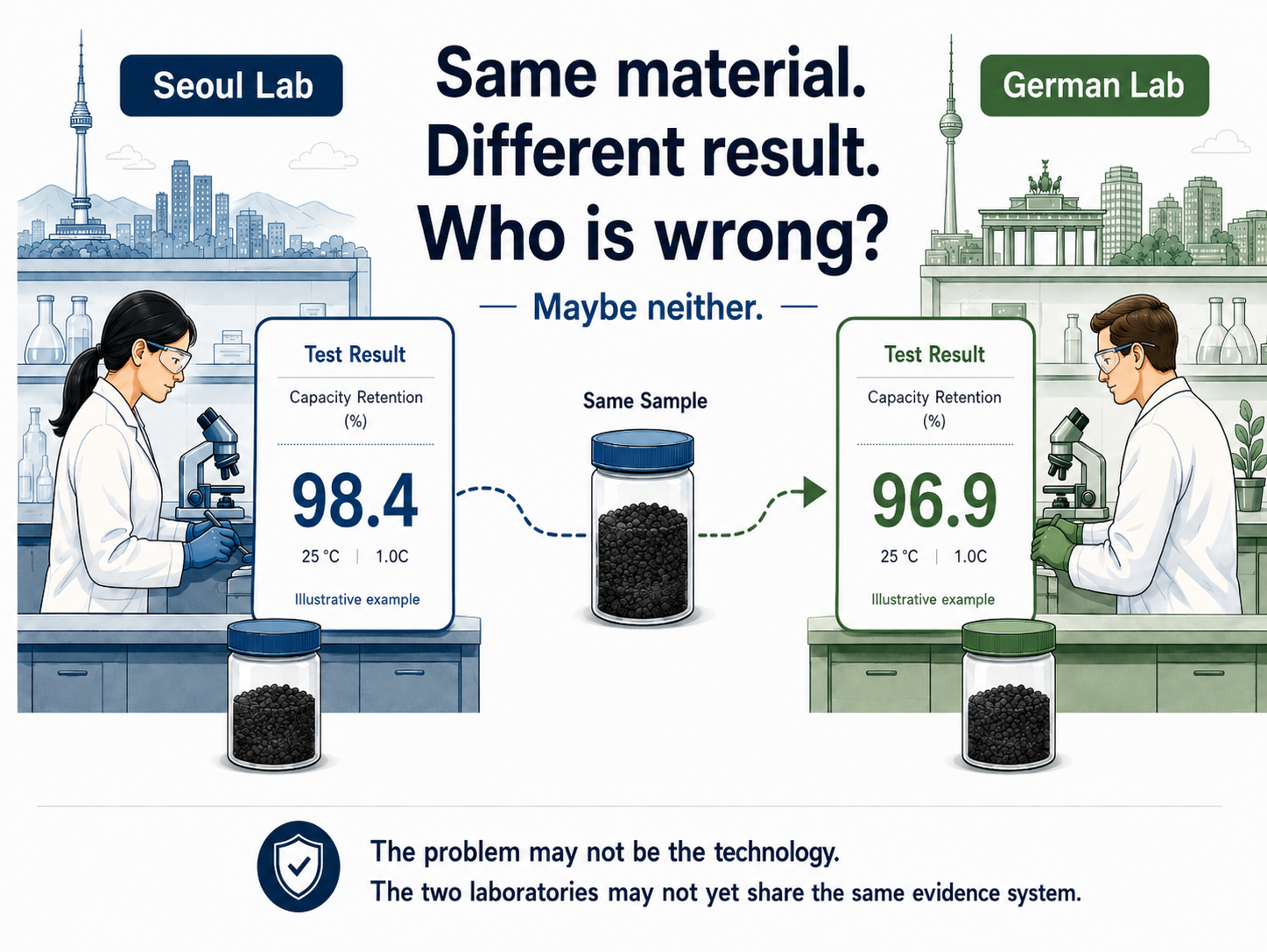
The same sample produced different numbers in two laboratories. That does not necessarily mean either side was wrong.
Measurement crosses borders when it is connected to a common reference. This article looks at where that foundation is built — and by whom.
In The Bridge Builder, Dr. Taeyoung Han explained that finding the right partner must extend to confirming equipment, data and the capacity for follow-up validation. Once a partner is confirmed, the next question is this: where is the evidence made that both sides can trust?
Why Shared Infrastructure Exists
Humanity has known this problem for a long time. From 1889 to 2019, the kilogram was defined by the mass of the international prototype — a platinum–iridium cylinder kept at the International Bureau of Weights and Measures (BIPM) in Sèvres, France — and each country's mass standards were connected to that prototype through national standards and calibration chains. Since 2019, the kilogram has been defined by a fixed value of the Planck constant. The way the unit is defined has changed fundamentally; what remains is the requirement that different measurement results must be comparable through a common reference and a traceable chain.
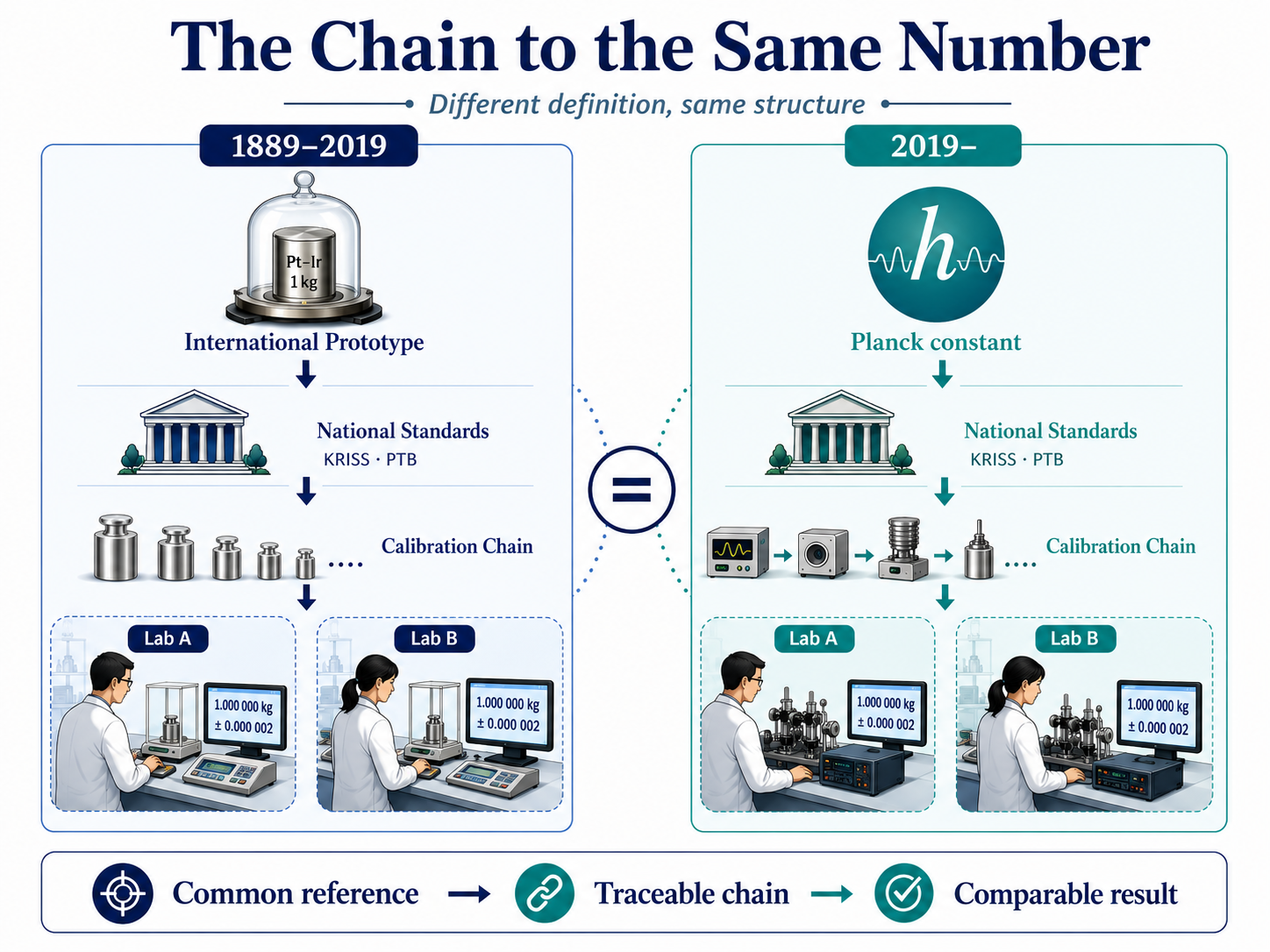
Some facilities are too costly for one company to build and operate alone. Others gain value precisely when many researchers and companies use them together and connect to the same reference: nanometre-scale measurement standards, advanced instruments that determine a material's elemental composition and microstructure, pilot lines that carry laboratory results towards process scale.
Companies run their own measurement rooms, analytical facilities and test lines. But for internal results to carry weight with supply chains, regulators and foreign partners, they must connect to external references. Public research institutes, national metrology institutes, accredited testing and analysis laboratories and shared-use facilities do not replace a company's capability; they provide the common ground on which results from different organisations can be compared.
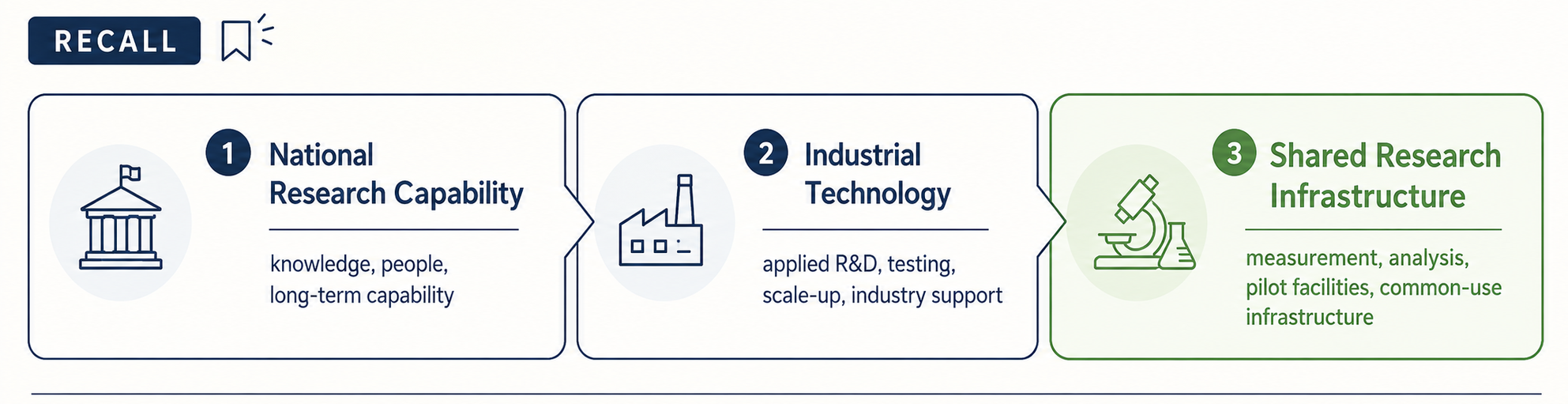
Among these, shared research infrastructure is the function that carries this role. This article reads that infrastructure as three rooms. Each room answers a different kind of question.
Shared standards and validated methods turn one laboratory's result into evidence another can use.
Trust does not come from who owns the facility. It comes from calibrated instruments, agreed test methods, known measurement uncertainty and reproducible results.
| Room | Korea | Germany | What it confirms |
|---|---|---|---|
| Measure | KRISS | PTB | Units · traceability · uncertainty |
| Analyse | KBSI · institute facilities | BAM · Helmholtz user facilities et al. | Composition · structure · impurities · methods |
| Prove | KITECH · KIMM · field testbeds | Fraunhofer pilot facilities · FFB | Repeatability · throughput · integration · scale |
Three Rooms of Evidence
The "three rooms" are an editorial frame by K-Welle. In practice, institutional functions overlap, and a single institute may measure, analyse and validate under one roof.
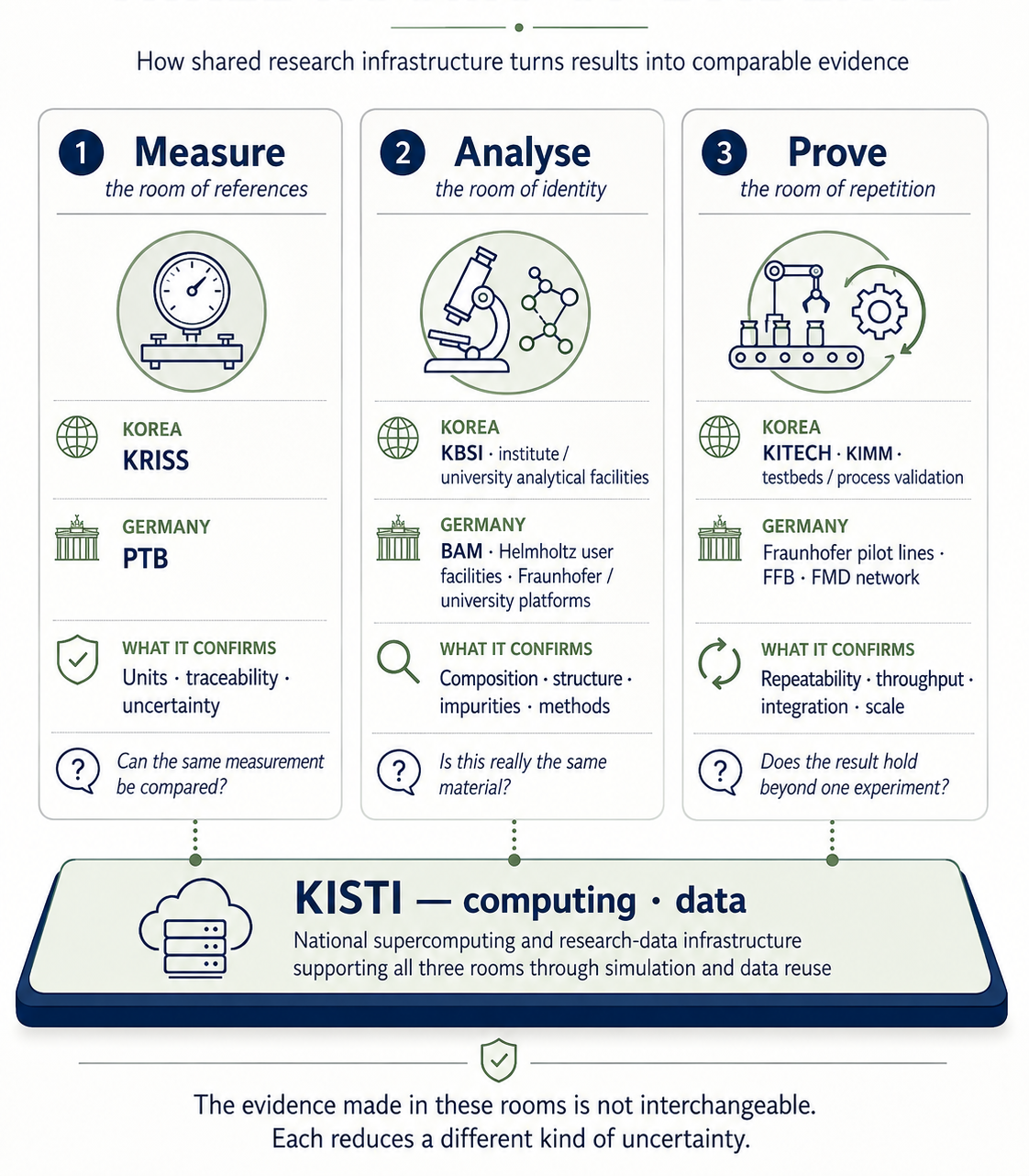
Which institutions carry each room, the diagram and table above already show. The text below covers only what each room confirms — and what becomes impossible without it.
Measure — the room of references. What this room provides is not simply the same unit: it is metrological traceability — showing which standard a measurement result connects back to — and measurement uncertainty, which states the range within which that value can be trusted. Without this foundation, it is hard to say within what margin a "1 volt" in a Korean laboratory can be compared with a "1 volt" in a German one. That is why joint research begins by re-aligning measurement methods and calibration status before the technical discussion starts.
Analyse — the room of identity. Even identical measurements mean nothing if the samples differ. Without this room, it is difficult to judge whether the sample a partner sent is the material its specification claims, or whether a performance gap originates in the material itself or in process conditions. In fields like battery recycling, where trace impurities can affect downstream processes and product performance, the analytical method, sample preparation and — where needed — reference materials must be confirmed together.
Prove — the room of repetition. This is where a result obtained once in the laboratory is tested for whether it repeats at larger scale, whether throughput and yield hold, and whether it can be integrated into existing equipment and processes. Two German examples need a caveat: at Fraunhofer FFB in Münster, work centres on the PreFab while the larger FFB Fab is still under construction as of August 2026; and the FMD in microelectronics is not a single fab in one building but a cross-location cooperation connecting 13 Fraunhofer institutes and 2 Leibniz institutes.
The evidence made in these three rooms is not interchangeable — an accurate measurement does not prove scalability, and a precise analysis does not guarantee process repeatability or economics. The three rooms reduce different kinds of uncertainty.
And one more foundation runs beneath all three. KISTI's national supercomputing and research-data infrastructure narrows experimental conditions through simulation and makes research data reusable, connecting the results of measurement, analysis and validation through computing and data.
How Trust Crosses Borders
The graphic blow lays out the layers. The text adds only three distinctions.
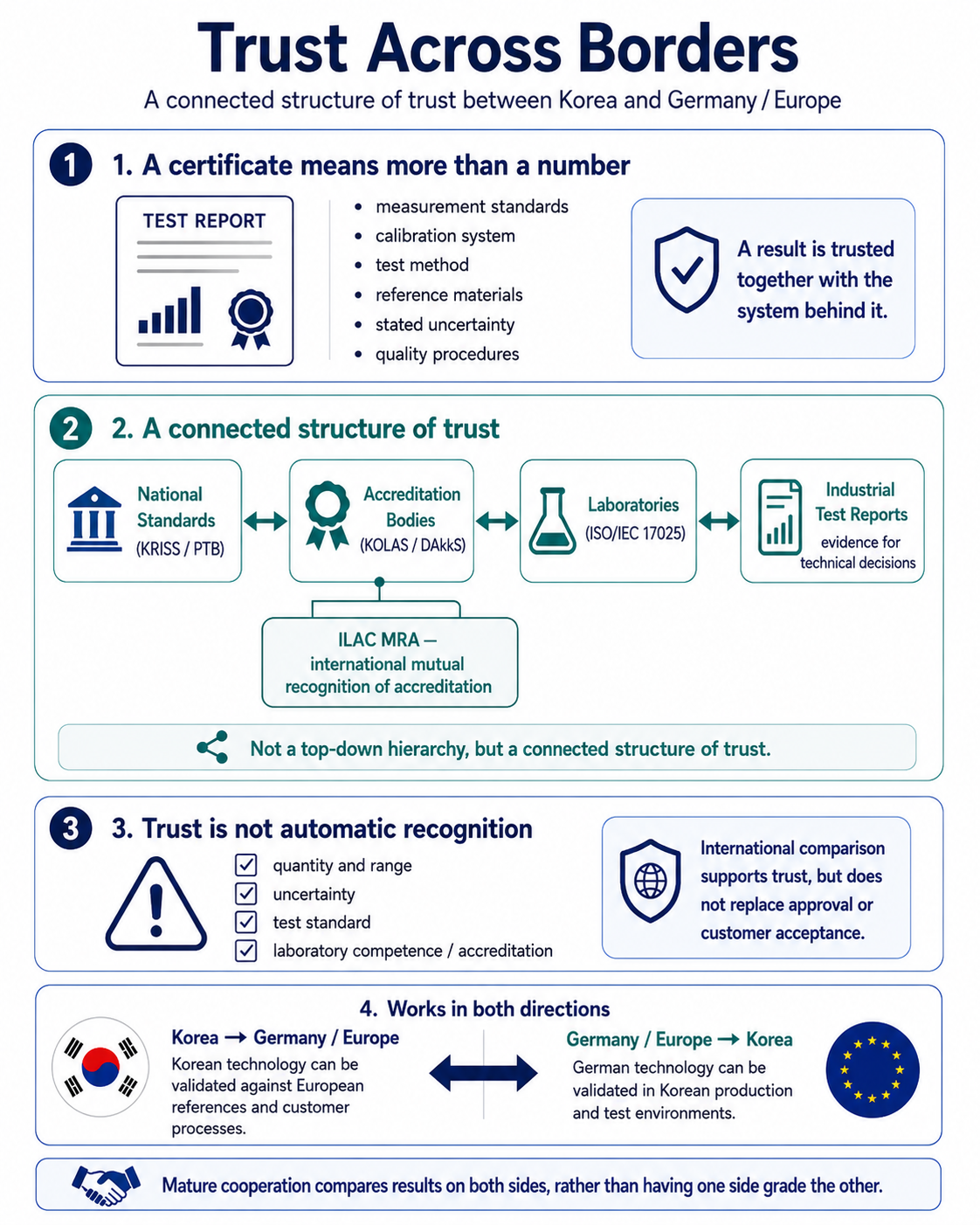
A certificate is trusted together with the system behind it — standards, methods, uncertainty and quality. That system is also tested internationally. Under the CIPM MRA, national metrology institutes such as KRISS and PTB participate in international comparisons and reviews that establish the basis for equivalence within published ranges and uncertainties.
Equivalence is not automatic recognition. It does not replace product approval or customer acceptance. And in industrial testing, a distinct but connected accreditation system also matters: laboratories may operate under ISO/IEC 17025 accreditation through bodies such as KOLAS and DAkkS, linked through international accreditation arrangements. These are not simply layers in a top-down hierarchy; together they form a connected structure of trust. When those connections are in place, a result produced in one country can support technical decisions in another.
The structure also works in both directions. German technology can be validated in Korean production and test environments by the same principle. Mature cooperation compares evidence on both sides rather than allowing one side to grade the other.
What Infrastructure Cannot Decide
The researchers and engineers of public research infrastructure can help design the right test methods and interpret the results. But facilities alone do not decide the next step.
- Which industrial problem should be validated first
- Who bears the cost of the pilot and further testing
- Which regulations and customer requirements must be passed
- Who takes responsibility for production, certification and supply contracts once validation ends
Measurement, analysis and pilot facilities can reduce technical uncertainty, but they do not automatically produce regulatory approval, economic viability or a customer's purchasing decision. Evidence generated in public facilities makes the next decision possible — it does not make the decision.
That is why infrastructure must be followed by a transition structure: an agreement, made in advance, on which evidence triggers the next step, and on who provides the funding, data, equipment and authority when it does.
Evidence makes the next decision possible. Responsibility gives that decision an owner. That is the subject of the next article.
Conclusion · The Third Place of Trust
The place where different laboratories and companies come to trust the same result is not either side's meeting room. It is a third place, where both sides can re-confirm results against common references and methods — and it does not have to be a building. The connected infrastructure itself — references, recognised methods, comparable instruments and records — plays the role.
Return to the sample the Seoul lab sent. The way two laboratories reach the same number was never a matter of goodwill; it runs through references and methods both sides can trace.
The evidence is ready. Now it needs cost, responsibility and an owner for the next decision — the subject of the next article.
EDITORIAL NOTE
About This Reporting
Interview basis, editorial treatment and sources
Read
This article draws on official materials from BIPM, KRISS, KBSI and KISTI, and from PTB, BAM and Fraunhofer. The “three rooms” are an editorial frame by K-Welle, not an official institutional classification.
The opening scene of the Seoul and German laboratories is a fictional example for illustration, not a case involving any specific institution or company. “The Crossing” progress marker is a K-Welle editorial frame that reuses the chain of transition (From Research to Industrial Proof) as a shared coordinate across the four articles published together.
Facility access and external-use conditions vary by institute, instrument and time; check official guidance before applying. Partner institutions supported reporting access and had no role in the content.
Corrections: editor@k-welle.com
Sources · Linked on publication
- BIPM — Historical perspective: kilogram
- BIPM — SI base unit: kilogram
- BIPM — CIPM MRA and KCDB
- KRISS — National measurement standards
- PTB — Germany's National Metrology Institute
- KBSI — Introduction and analytical infrastructure
- BAM — Mission statement
- Fraunhofer FFB — Research infrastructure
- Fraunhofer FFB — FFB Fab construction status, July 2026
- FMD — About / FAQ: “cross-location and cross-technology collaboration between 13 Fraunhofer Institutes and 2 Leibniz Institutes”
- KOLAS — Korea Laboratory Accreditation Scheme
- DAkkS — Germany's National Accreditation Body / international recognition
- KISTI — National Supercomputing Center and DataON history