Same Degree, Different Systems

A Guide to SNU, KAIST, and POSTECH for International Researchers — K-Uni Mapping
The question is not which university is best.
It is which system you are entering.
An international researcher considering Korea will encounter three names first:
Seoul National University (SNU), KAIST, and POSTECH.
Inside Korea, they are grouped together.
Outside, they operate differently.
The same PhD places you in different post-graduation systems.
This article does not rank universities.
It shows which path each system opens.
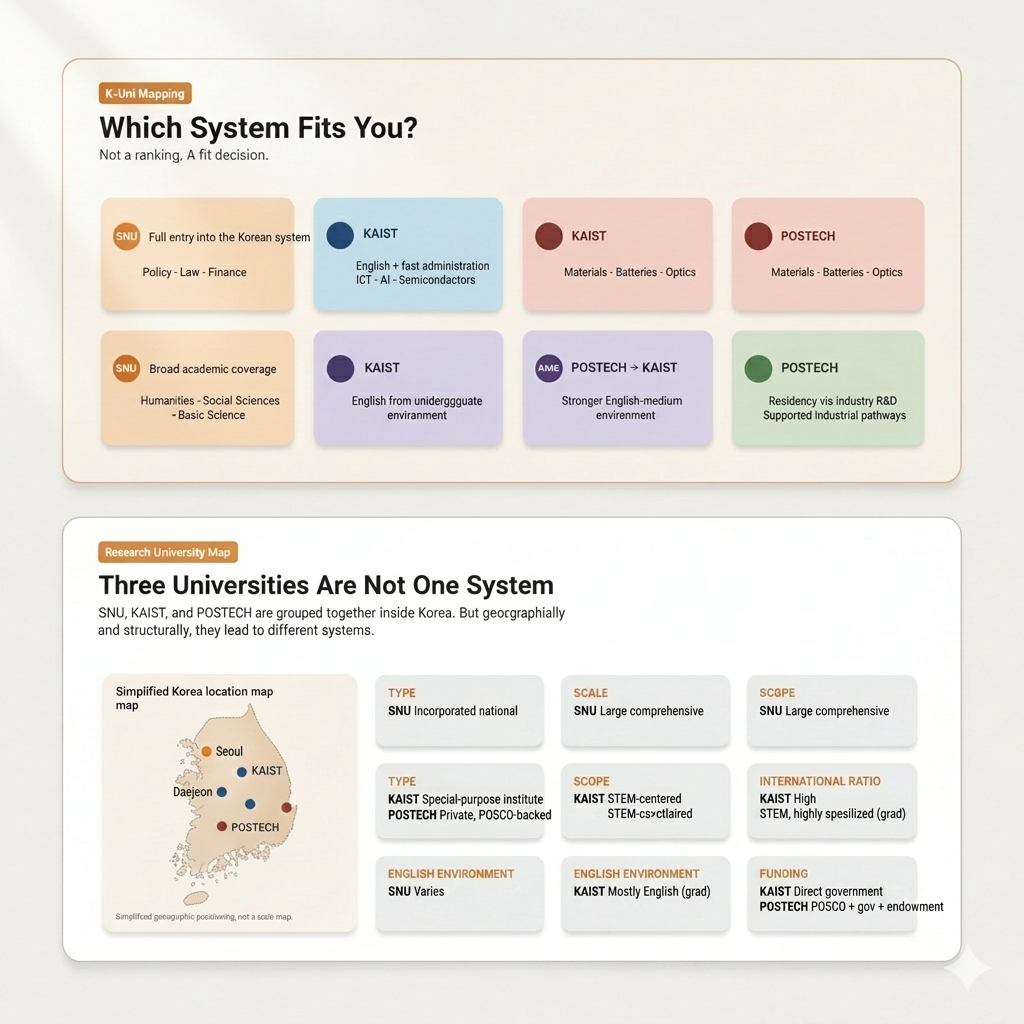
SNU sits at the center of the Korean system.
KAIST acts as a global STEM gateway.
POSTECH operates inside industrial R&D.
They are not substitutes. They lead to different system
Not a ranking. A fit decision.
Five Questions That Narrow the Choice
1. Can you finish in English?
KAIST and POSTECH run most graduate programs in English.
SNU depends on department.
This determines whether you invest 1–2 extra years in Korean.
2. How international is the system?
POSTECH > KAIST > SNU.
This is not about diversity.
It defines how systems are built—administration, housing, communication.
It decides whether your first semester is friction or research.
3. Where does your field connect to industry?
- KAIST: AI · semiconductors · robotics · ICT
- POSTECH: materials · batteries · optics · biotech
- SNU: policy · law · finance · biomedical · basic science
This shapes your first job after graduation.
4. Does the visa pathway actually work?
All support D-2 visas.
The difference begins after graduation.
KAIST and POSTECH connect directly to on-site or nearby R&D centers.
SNU connections are broader—but dispersed.
This determines whether you stay or leave.
5. Does the system extend beyond the degree?
A PhD is not the endpoint.
The postdoc track decides whether you remain inside the system.
Check five-year hiring patterns before applying.
Your degree opens the door. The system decides if it stays open.



SNU / KAIST / POSTECH
Strengths Map
SNU — Seoul National University
- Full disciplinary coverage
- Strongest interface with Korean institutions (policy, law, finance, biomedical, basic science)
- Weakness: uneven international infrastructure
Best fit: entry into the Korean system as a whole
KAIST — Korea Advanced Institute of Science and Technology
- Government-backed, fast decision-making
- Leading in AI, semiconductors, robotics, biotech
- Close to ETRI and major corporate R&D
Best fit: fast industry-linked STEM pathway in English
POSTECH — Pohang University of Science and Technology
- Small, research-intensive
- Strong in materials, batteries, optics, biotech
- Highest international and English usage
Best fit: deep, focused research with industrial alignment
Three Mistakes to Avoid
1. “SNU is #1, so choose SNU”
True inside Korea’s signal market.
Not necessarily true for your path.
2. Choosing by global rankings
Rankings favor comprehensive universities.
They do not reflect field strength or lab outcomes.
A 200-rank gap rarely defines your next five years. Your lab does.
3. Ignoring lab fit
The university does not decide your trajectory.
The lab does.
Evaluate three things:
- Advisor’s international PhD track record
- Industry collaboration channels
- Working language inside the lab
Find one alumnus. Send one email.
That one reply can define your next five years.
For international researchers, these are not one group.
They are three different systems.
- SNU — interface with the Korean system
- KAIST — structured, English-based STEM gateway
- POSTECH — deep research within industrial networks
Systems are not ranked. They are matched.
One Action This Week
Pick two universities.
Find one international PhD alumnus in each.
Send one question:
“What were your five years in this lab like?”
Next
The first group covered.
Next: the second system layer.
UNIST · GIST · DGIST · KENTECH
Smaller. More focused. More accessible.
The question: which system works best for you?