Funding Fit

Which money fits my technology now?
“The first question in raising money is not ‘What money is out there?’ but ‘What is missing now?’”
— EPISODE KEYSTONE
PART I · LENS 7 · FIT
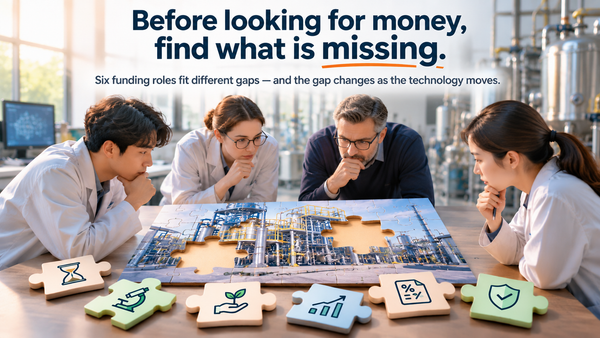
Before Looking for Money, What Is Missing?
A research team sits at a table. Its research funding has run out, and it needs pilot equipment. A customer is interested, but there is no contract. The team could set up a company, but there are no sales yet. One person tells it to look for government R&D funding; another, to meet investors; a third talks about policy loans and guarantees. None of them is wrong. The question is what this team needs first, now.
This part of the series has not simply listed kinds of money. It has looked at what each kind of money looks at. Patient money looks at the time until the next proof. Public labs offer research capability and equipment that a company does not have to own. A subsidy looks at the investment costs and economic gaps that the public has a reason to share. A fund looks at who chooses and what is to be recovered. A tax credit looks at when the benefit can actually be used. A guarantee looks at whether there is a source of repayment while credit is blocked. So this episode does not explain one more kind of money. It turns those six into diagnostic questions.
The Same Technology, Different Money
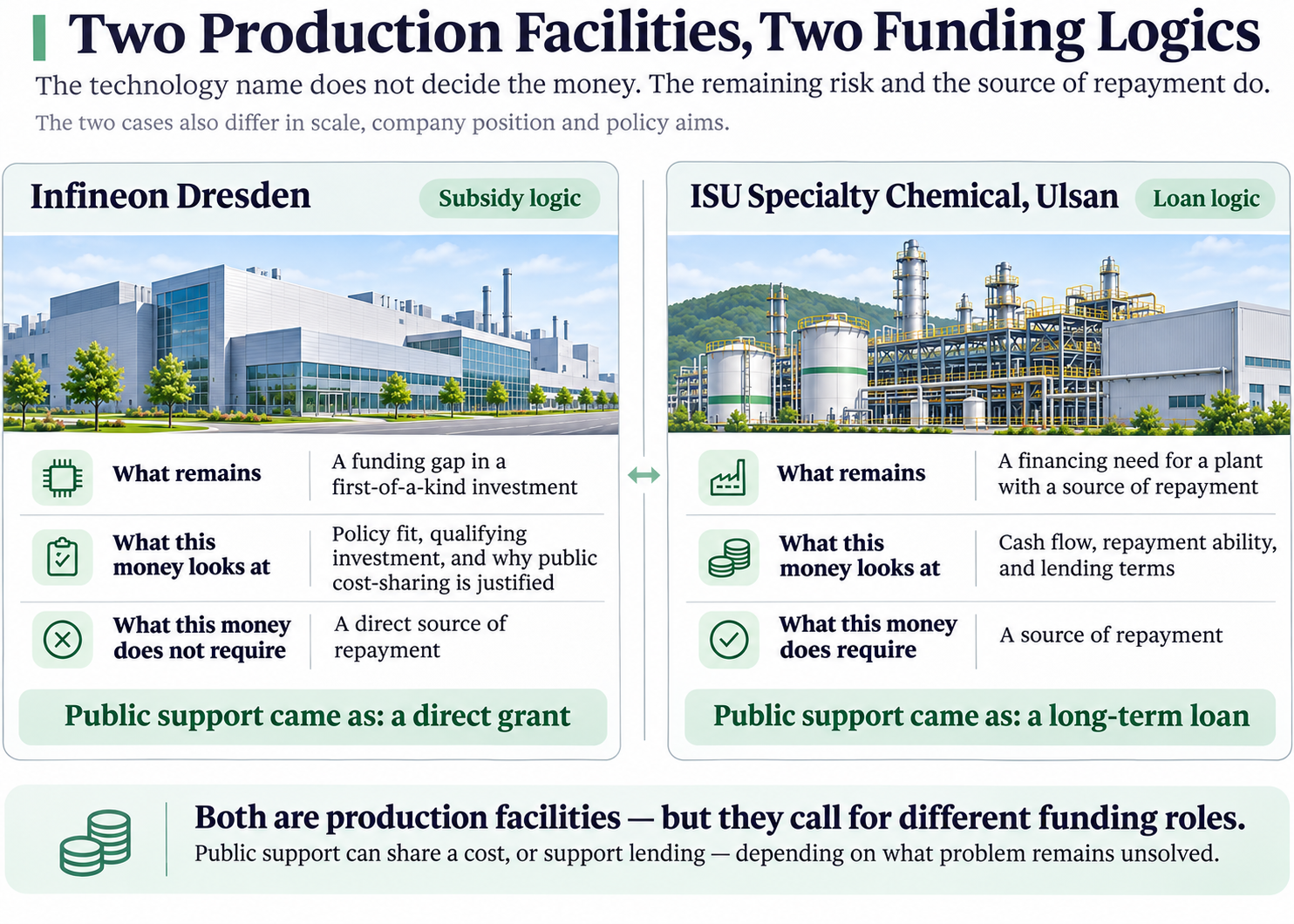
The name of a technology or an industry does not decide the money. Even for the same battery-material technology, the role of the resources needed changes with the problem that has to be solved now: laboratory validation, pilot scale-up, customer validation or the first production line. These problems do not always appear one after another in a neat line, either. Infineon's fab in Dresden and ISU Specialty Chemical's plant in Ulsan both involved production facilities, but they were financed under different logics: one through subsidy support, the other through debt. Their scale, company position and policy aims differed too, but what set the logic of the money was not the technology. It was the risk that remained, and the source of repayment, at that point.
So pairings such as “subsidies for battery start-ups” or “policy loans for manufacturers” put the question in the wrong place. The money that fits is decided not by the name of the technology but by the problem that has not yet been solved and the state of the company. Even for the same technology, if the remaining risk, the resources needed, the cash flow and the credit differ, so does the money that fits. The rest of this episode is six questions for reading that state. The questions follow the order of this part of the series, but the answers do not arrive in that order.
What Must Be Proved Next? — TIME
The first question is not about money. What does this technology need to prove next? That the principle works? That the same result can be repeated? That it runs at pilot scale? That customers will pay? That the cost of mass production adds up? A decade of technology can be divided into stretches between one proof and the next, and each kind of money waits for different evidence, over a different period, with different conditions for getting its money back. Money and resources carry the time and cost to the next proof. So before looking for money, a team needs to answer one question.
What must be proved next — and how long will it take?
If the next proof is still at laboratory level, research time and validation infrastructure are likely to matter more than a source of repayment. If the answer is customer validation, research funding alone may not be enough; the customer's test environment, the cost of validation and capital to last through that period may all be needed. If the cost of mass production has to be confirmed, the question of a source of repayment draws closer, along with equipment, working capital and customer volumes. Researchers are not the only ones who decide what the next proof is. What customers and testing bodies look at before moving to the next stage sets the answer.
Cash, or Capability and Equipment? — INFRASTRUCTURE
The second question is whether what is needed to reach that proof is cash or resources: researchers, analytical equipment, pilot facilities, certification and testing capability. Which of these must be bought outright, and which can be accessed from outside? Public research institutes give companies access to research capability and testing infrastructure that they would find hard to own, through contracts, joint research or shared use. If those resources can be used, the amount of cash needed changes.
The amount of cash needed is not the same as the amount of resources a company must own. Some teams that seem short of money are in fact short of a way to reach equipment and people. In that case, separately from looking for investors, they can check whether research institutes, joint research or shared infrastructure could reduce the capital they need in the first place. But using public infrastructure also comes with costs and contract terms, and what opens that access is a contract between the research institute and the company.
Why Should the Public Share This Cost? — GRANT
The third question is whether any of the remaining costs is something the public has a reason to share. A subsidy does not remove a company's risk. By sharing part of the cost, the public changes the size of the investment risk the company has to carry. So the logic of a subsidy asks three things. Without support, what would change in the company's choice? How large is the gap that has to be closed between that choice and the policy objective? And after meeting the conditions attached to the money, what risk still remains with the company?
If the same investment would proceed in substantially the same way without support, the case for public cost-sharing is weaker. Conversely, even when the public has a clear reason to share the cost, the money attaches only to the gap, conditions come with it, and the remaining risk belongs to the company. The answer to this question is set by government and specialist agencies through their assessment. What a company can do first is answer for itself what it would choose without support.
Who Picks This Company, and What Return Do They Need? — FUND
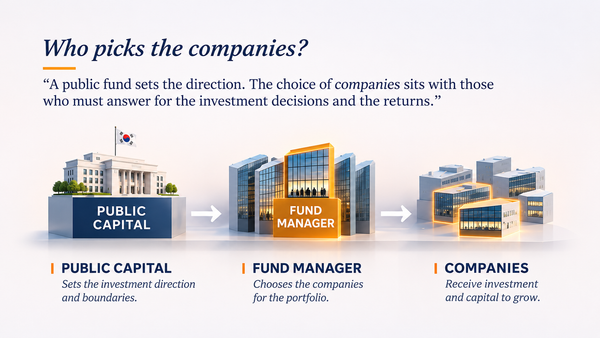
A subsidy asks why the public should share this cost; a fund asks why this company will grow. The same team cannot give the same answer to both. A public fund sets the direction, but leaves the choice of which companies to invest in to fund managers who must answer for that judgement and for the returns. So the fourth question splits in two. Who actually makes the investment decision? And what return do they need — and by when?
Will the market grow within the fund's time? Will follow-on capital come? Is an exit route visible? If it is hard to explain a path to growth and exit within the fund's lifetime, the fit with that fund is low. Matching the government's investment direction and passing a fund manager's investment committee are different things. The answer to this question is set by the fund manager.
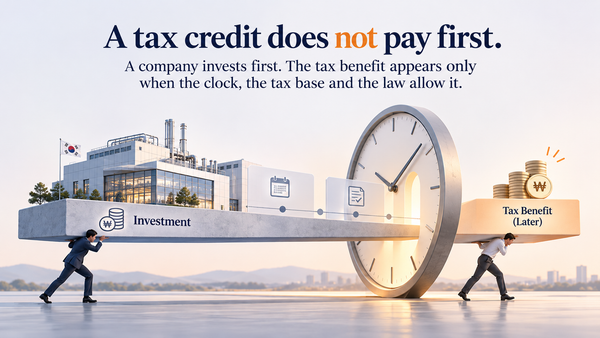
When Can the Tax Benefit Actually Be Used? — TAX
The fifth question is a question of time. A tax credit does not pay for the investment; it changes the after-tax price of the investment and the time at which the benefit appears. The time when the right to a credit arises and the time when that right is actually used are separate, and to use the benefit at a given point, a company needs taxable income and tax to pay.
KRW 100 million needed today and KRW 100 million less tax three years from now do not play the same role. A team should first write down how many years remain until it makes a profit, and where the cash it needs in the meantime will come from. So the question is not what the credit rate is, but when the credit can actually be used. The company can draw this timetable first; tax advisers, accountants and investors then read that time again by their own standards.
Is There a Source of Repayment, or Is Only Credit Blocked? — GUARANTEE
The sixth question creates a decisive fork for debt financing. Before a loan, three questions need to be separated: business risk (will the business work?), repayment risk (what will repay the debt?) and who bears the loss if it is not repaid. A company credit guarantee attaches directly to the third — the loss a lender would bear if the debt goes unpaid. A state guarantee applies the same principle one level up, to a funding relationship, changing the risk that investors bear when a fund or policy finance institution raises money in the market. Neither creates a source of repayment. Both change who bears the loss — and with it, the terms on which the market will lend.
So before looking for a guarantee, a team needs to establish which layer and which funding relationship is blocked. If what is blocked is the viability of the business, it is not a question for a guarantee. If there is no source of repayment yet, loans and guarantees are not yet this team's question; the money it needs lies somewhere in the first five questions. Only when there is a source of repayment but credit, collateral or a track record is lacking does the space open to consider guarantees and loans. Evidence of a source of repayment comes from a company's contracts, sales and cash flow; whether it is at a level that supports a loan is judged by banks and guarantee institutions. What counts as a source of repayment is covered later in the series.
Even for the same project, a different person decides the answer to each question. The next proof is decided by researchers, customers and testing bodies; infrastructure by research institutes and companies; subsidies by government and specialist agencies; equity investment by fund managers; the timing of tax by tax advisers and accountants; and credit by banks and guarantee institutions. Looking for funding means reading what each of these people looks at.
Funding Fit Map — Six Questions on One Page
Before putting the six questions on one page, lay the clocks of money over one another. A subsidy does not assume repayment of principal as an ordinary loan does. A loan carries an agreed repayment schedule from the moment the money arrives. A fund assumes a rise in company value and an exit within a fixed lifetime. The effect of a tax credit comes after profits are made and tax is calculated. Public infrastructure is not cash itself but a resource accessed through a contract or a programme. Laid over one another on a single time axis, these separate the money that matches today's need for cash from the money that becomes yours later.
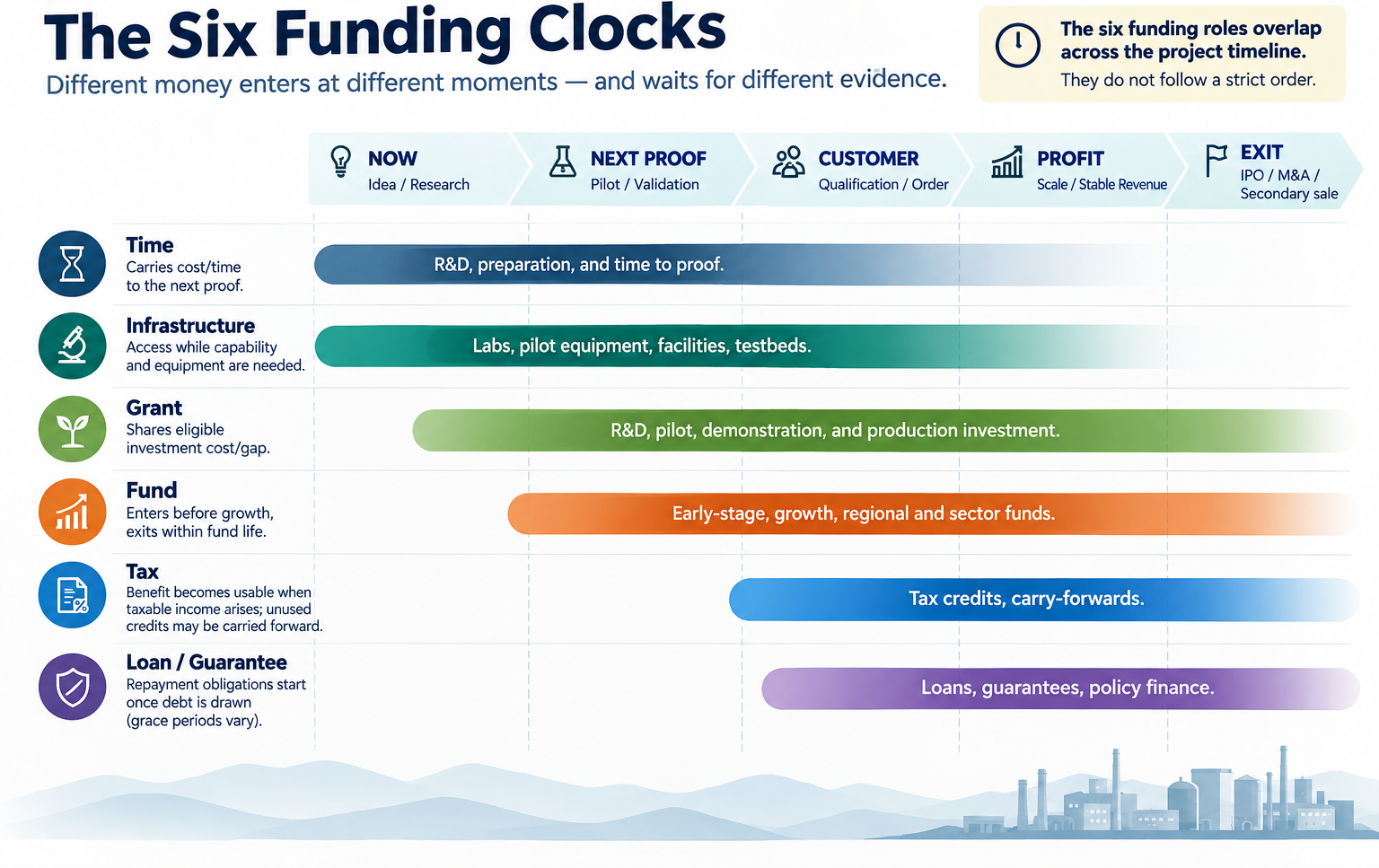
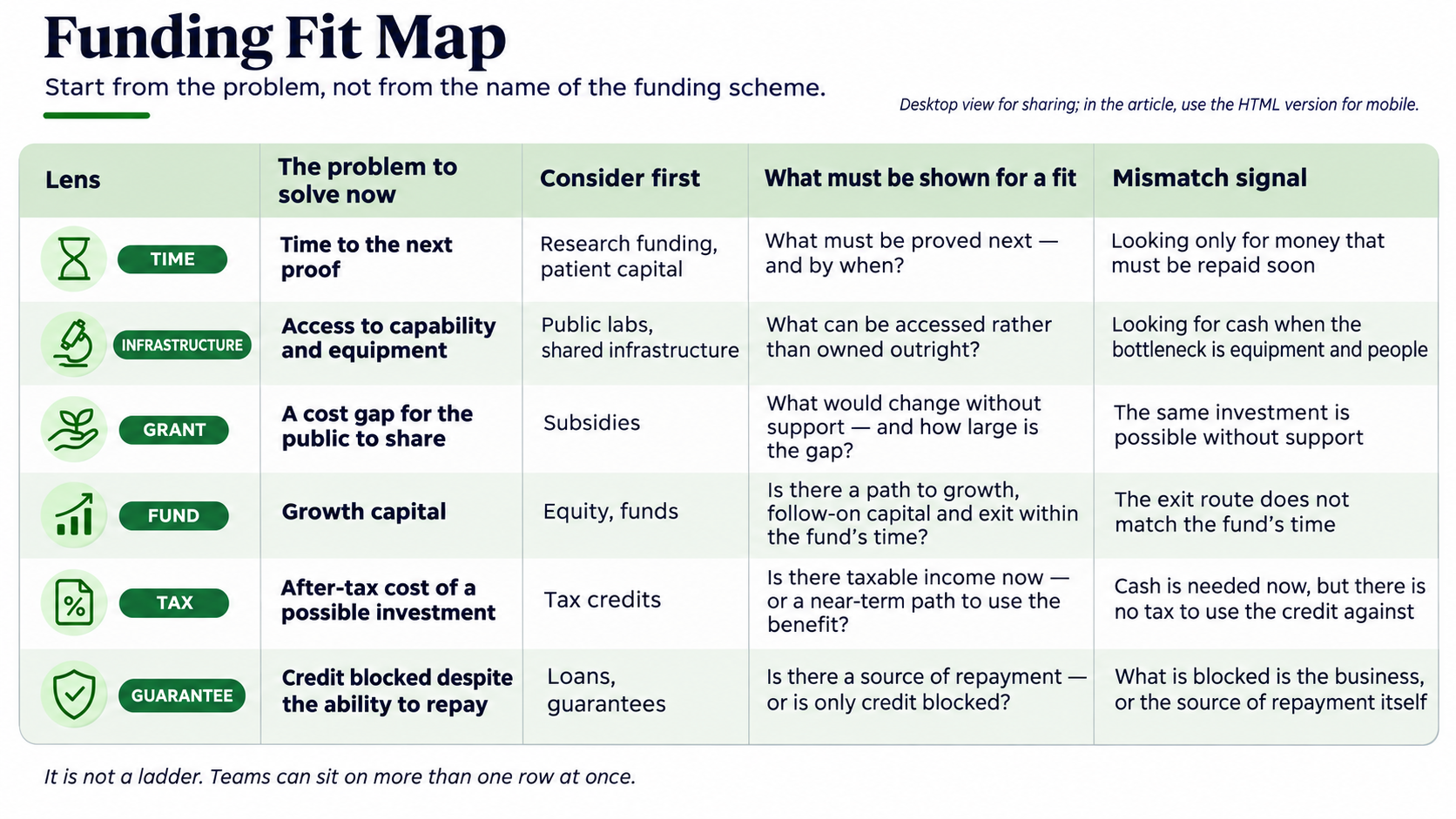
Put the six questions over the six funding roles, and they become a single diagnostic table. The table is not a ladder to be climbed from top to bottom. A team can sit on two rows at once, and the same team can move to a different row a year later. Start from the left-hand column, “the problem to solve now”, and read to the right.
Four Mismatches
The table is useful less for picking the right answer than for spotting the wrong match. Here are four that come up often. When a team needs pilot equipment but looks only for investors, the problem is infrastructure rather than capital. When a team with no source of repayment looks for policy loans and guarantees, the lending question has not opened yet. When a loss-making early-stage company looks only at the size of tax credits, the timing of the money is off. When a project could go ahead without public support but seeks a subsidy, the public's reason to share the cost is weak. In all four cases, what looked like a shortage of money may in fact be money in the wrong role.
Four Mismatches
The table is useful less for picking the right answer than for spotting the wrong match. Here are four that come up often.
Four common signs that the money and the problem do not match.
Needs pilot equipment, but looks only for investors
Read the bottleneck: the immediate problem may be access to infrastructure, not simply more capital.
No source of repayment, but looks for loans and guarantees
Read the bottleneck: the lending question has not opened yet.
Loss-making, but looks only at the size of tax credits
Read the bottleneck: the timing of the benefit does not match the need for cash now.
Could go ahead without support, but seeks a subsidy
Read the bottleneck: the case for public cost-sharing is weaker.
The Research Team's Case
Apply this to the research team in the opening. The principle of the technology has been validated. Data on repeatability is lacking. There is no pilot equipment. A customer is interested, but there is no purchase contract. There are no sales; the team could set up a company; there is no collateral.
Run through the six questions, the team reads like this:
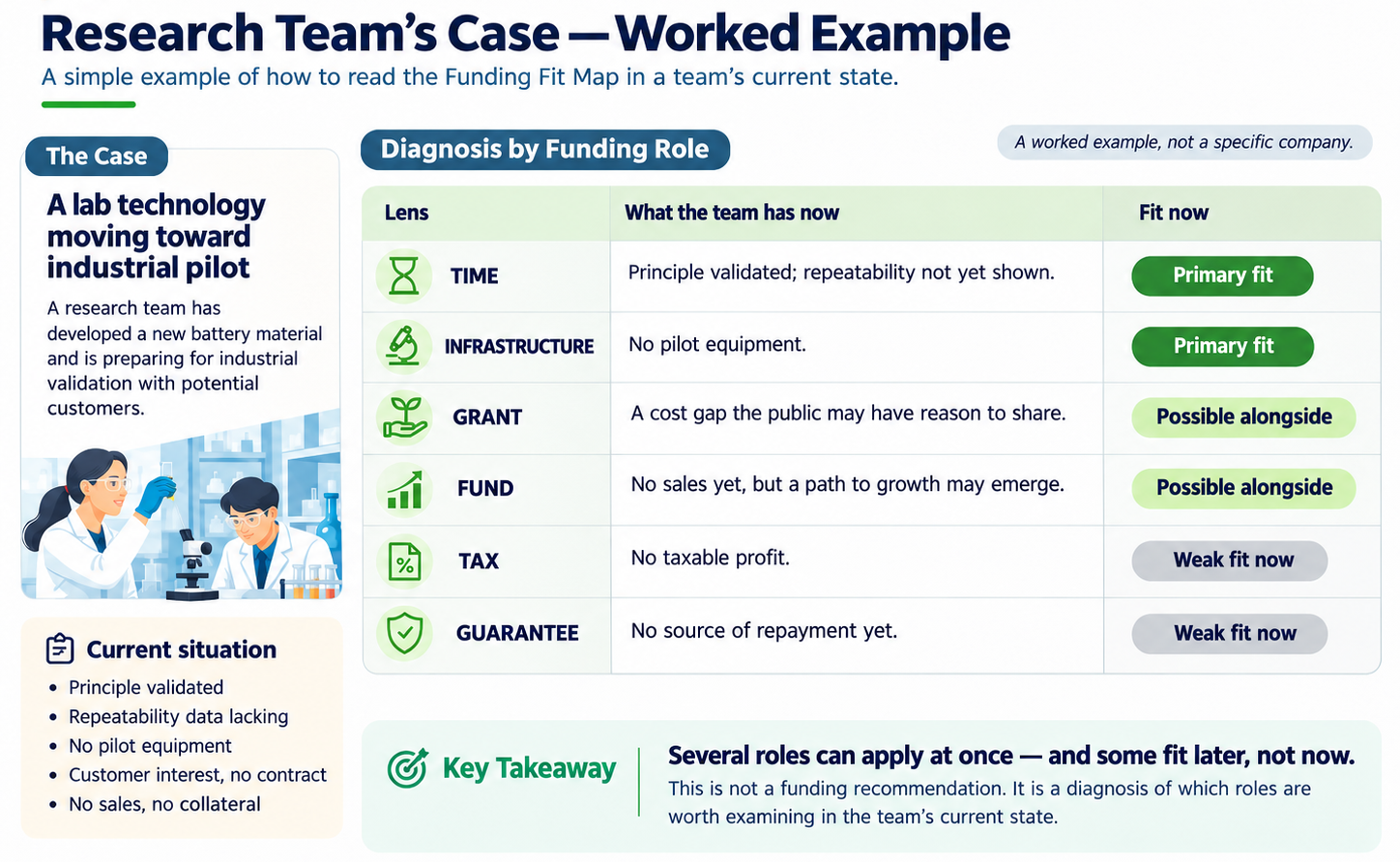
Money in several roles can overlap at the same time, and no single one is fixed to come first. This is not an answer to what the team should receive, but a list of what to consider together in this state.
K-Flow · Reader Tool
Diagnose your funding fit
+
Answer the six questions from your project’s current state. The point is not to choose one funding scheme, but to identify which problem needs solving now.
What must be proved next?
Who decides: researchers, customers, testing bodies
Do you need cash, or access to capability and equipment?
Who decides: research institutes, companies
Without support, what would change?
Who decides: government, specialist agencies
Who makes the investment decision — and what return do they need?
Who decides: fund managers
When can the tax benefit actually be used?
Who decides: companies, tax advisers and accountants
Is there a source of repayment, or is only credit blocked?
Who decides: companies, banks, guarantee institutions
The problem I need to solve now is:
Then check: does the money you are looking for solve this problem? If not, look again at its role.
For the reader to sketch: write each of the six answers on one line, and mark which of these problems the money you are looking for actually solves. If it does not connect to any of them, it is time to look again at the role of that money.
Which Role Is the Missing Money Meant to Play?
This episode does not say which money is the right answer. The six funding roles each look at something different, and even for the same team, the money that fits changes as the state of the project and the company changes. Before searching under a different name of money, the first task is to read that state accurately. Good fundraising is not about finding the largest sum, but about finding the money and resources that can take on the role that is missing now.
When the research team gets up from the table, what it should take with it is not a list of money but a one-line diagnosis: is what is missing now money itself — or has the team been looking at money that does not match its present state?
So far, the question has been which money fits. But in the world of lending, one more question remains: who will repay, when, and with what? The next episode asks that question from the bank's side.
FLOW MAP — Source · Allocator · Vehicle · Entry · Selection · Scale-up
CHECK — Which of the six answers does the money you are looking for actually attach to?
NEXT → Ep.8 Source of Repayment — Who Repays, When, and With What?
About This Reporting
This episode involves no new reporting. It is the editors' synthesis, on one page, of the public material used earlier in this part of the series and our reading of it. The diagnostic table, the six questions, the four mismatches and the research team's case are all generalisations.
The table's “mismatch signal” column describes an order of review, not the eligibility requirements of any particular scheme; actual eligibility and terms are set by each scheme's call for applications and its assessing body. The research team's case is a hypothetical example to show a “list to consider together” and does not refer to any particular company.
Corrections: editor@k-welle.com