The Technology Clock

Who can wait ten years?
“A decade of technology is not one long wait. It is a structure for sharing the time and risk until the next proof.”
— EPISODE KEYSTONE
PART I · LENS 1 · TIME
Three flows run through this episode: the flow of materials (the route by which a battery becomes a battery again), the flow of technology (from research to permit) and the flow of money (who shares that time). Questions arise where the three meet.
Opening
On 14 July 2026, in Hanau near Frankfurt, Fraunhofer IWKS issued a short press release. A company that had started at the institute had received a permit to process lithium-ion batteries and battery waste industrially. The company is called Viridis Recycling.
Readers of K-Institute will remember IWKS. It is the institute where Dr Songhak Yoon, explaining black mass and battery recycling, described how hard — and how important — the pilot stage is if laboratory technology is to reach industry. Viridis is on that same road.
According to IWKS, the company grew out of recycling technology developed at the institute over several years. The technology was transferred to a separate company, the Hydropulse process was validated, and a pilot-scale recycling plant was built. The company then received a permit under the German Federal Immission Control Act (BImSchG) for its site in Hanau. The permit does not certify the technology's performance; it is the legal basis for processing battery waste in an industrial facility. The next step is set too: a first pilot line in the Stuttgart region, due to start operating in the first quarter of 2027, with capacity to be increased in stages. This road is not over yet.
But one question comes first. Why keep developing a technology that takes this long? It is the same question a research team runs into first when its research funding ends: who carries the time until the next proof? Time here is not simply waiting. It is a cost that keeps arising while researchers and equipment are kept going, tests are repeated, and customers and permits are awaited, all to produce the next proof. When a technology's time grows longer, someone has to keep carrying that cost.
A Spent Battery Is No Longer the End of the Line
The meaning of battery recycling is changing in Europe. The old question was how to dispose of used batteries safely. The question now is different: how much of the lithium, nickel, cobalt and copper inside a battery can be recovered and put back into the next battery?
The EU Batteries Regulation (Regulation (EU) 2023/1542) turned this shift into numbers. Recycling-efficiency and material-recovery targets for lithium-based waste batteries rise in stages until 2031, and from 2031, industrial and electric-vehicle batteries above a certain size must contain a minimum share of recycled material in their active materials: 16% for cobalt, 6% for lithium and 6% for nickel. Among its aims, the regulation lists reducing dependence on raw materials from third countries.
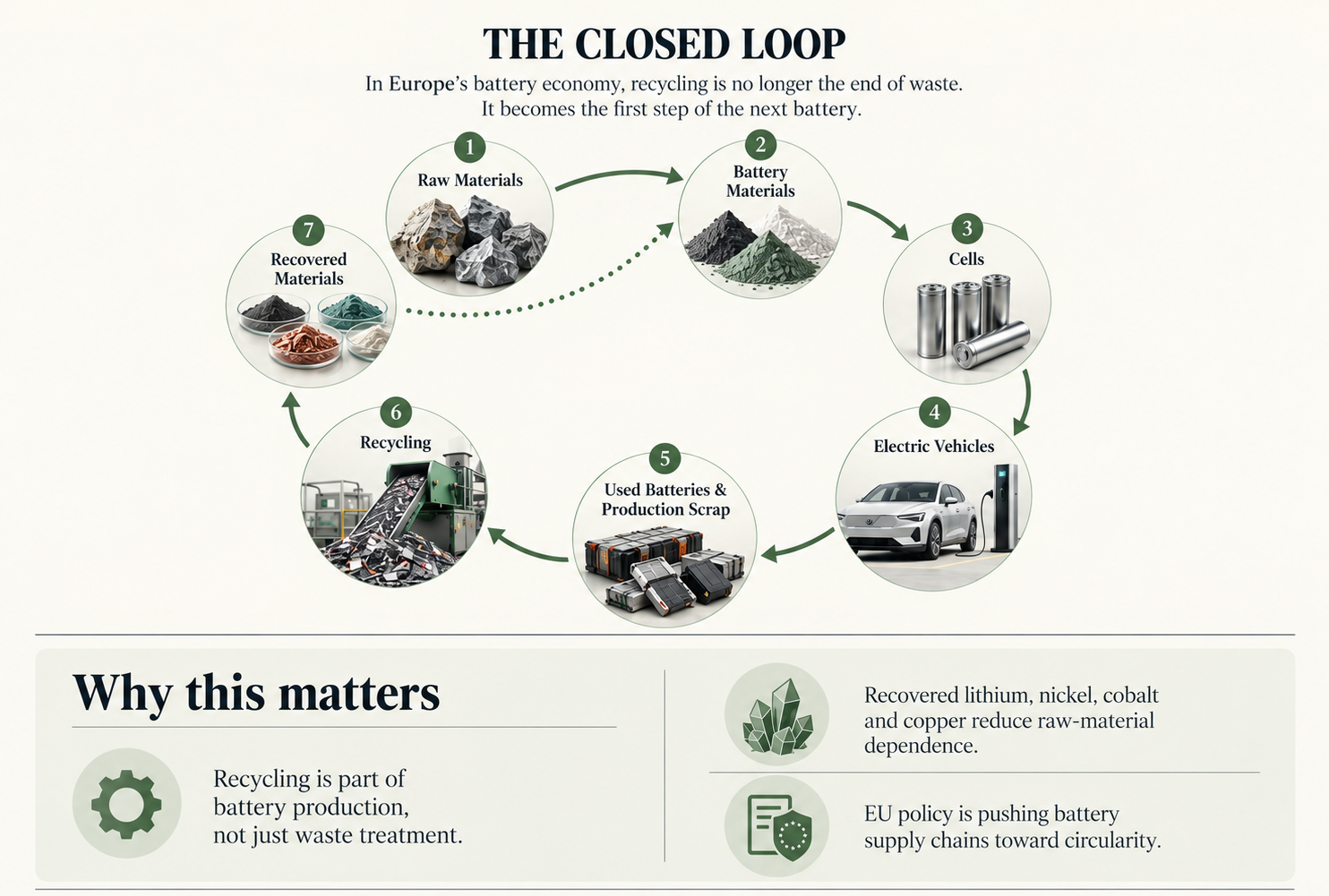
Recycling has become one step in a closed loop that runs from waste treatment back into battery production: from raw materials to battery materials and cells, from electric vehicles to spent batteries and production scrap, and through recycling back to recovered materials that become battery materials again. That loop is what Europe is building.
Where Korean Batteries End Their Life in Europe
Korea is not far from this loop. LG Energy Solution has a battery plant in Wrocław, Poland, and Samsung SDI one in Göd, Hungary, supplying batteries to European carmakers. Whether a battery is made in Korea or in Poland or Hungary, the moment it enters the EU market it falls under Europe's regulation and collection system. When a battery reaches the end of its life, it enters Europe's waste stream, and more and more raw material has to be recovered within Europe and fed back into industry.
So Korean companies are already building a recycling chain inside Europe. In August 2022, POSCO completed PLSC in Brzeg Dolny, Poland. According to POSCO, the plant collects and dismantles battery production scrap and spent batteries generated in Europe to produce 7,000 tonnes of black mass a year, which is sent to POSCO HY Clean Metal to extract lithium, nickel, cobalt and manganese. The technology came from SungEel HiTech.
One thing has changed. Recycling facilities need to be close to the markets where batteries are produced, used and discarded. That is why Korean recycling technology went to Europe.
Where Does Viridis Sit in the Chain?
The usual battery-recycling process runs from discharging and dismantling, through shredding and black mass, to hydrometallurgy and the recovery of lithium, nickel and cobalt. POSCO's Polish plant produces up to the black mass stage and sends the metal recovery that follows to its joint venture in Korea.
Viridis's Hydropulse process targets a step earlier. According to IWKS, it breaks battery cells apart using shock waves generated in water and damages the materials less than mechanical shredding does. The long-term aim is to improve the recovery of key raw materials such as lithium, nickel, cobalt and graphite.
At the industrialisation stage, recovery rates have to be looked at alongside other questions: how much lighter the downstream process becomes, how much energy, chemicals and waste water are saved, and how many euros it costs to process a tonne. Public sources do not answer these questions. The answers lie with the company running the equipment, the institute validating it and the customers who will take the recovered materials. Only once they confirm those answers can investment, licensing or a joint venture move to the next step. And getting those answers takes time. Who carries the costs that arise during that time decides where the technology moves next.
The same problem appears when a technology crosses institutional and national boundaries. At a forum held jointly by Korea's National Research Council of Science and Technology (NST) and Fraunhofer in July 2026, the Korea Institute of Industrial Technology (KITECH) and IWKS opened the door to cooperation with a memorandum of understanding (MOU). But which processes will be validated by whom, and who will carry that cost, remain to be seen.
The Proof Changes at Every Stage
In the laboratory, a technology can work. Industry asks different questions. Does a process that worked at 10 kilograms give the same result at 10 tonnes? Do purity and recovery rates hold over months of continuous operation? Are the results stable when the type of battery fed in changes? Then come the customer's questions. Can the recovered material go into a real production process? Is its quality the same every time?
Set out as IWKS has published it, the road runs like this: from research, through spin-off and technology transfer, registration as a certified waste-management company and process validation, to a pilot plant and a permit, and then scale-up. The press release says only that the research took “several years” and does not give the year the company was founded, so this article does not give a year either. The order is clear. The permit was not the end: IWKS itself called it a “prerequisite for scale-up”. It explained that Stuttgart was chosen to make cooperation along the battery value chain easier and to speed up industrialisation.
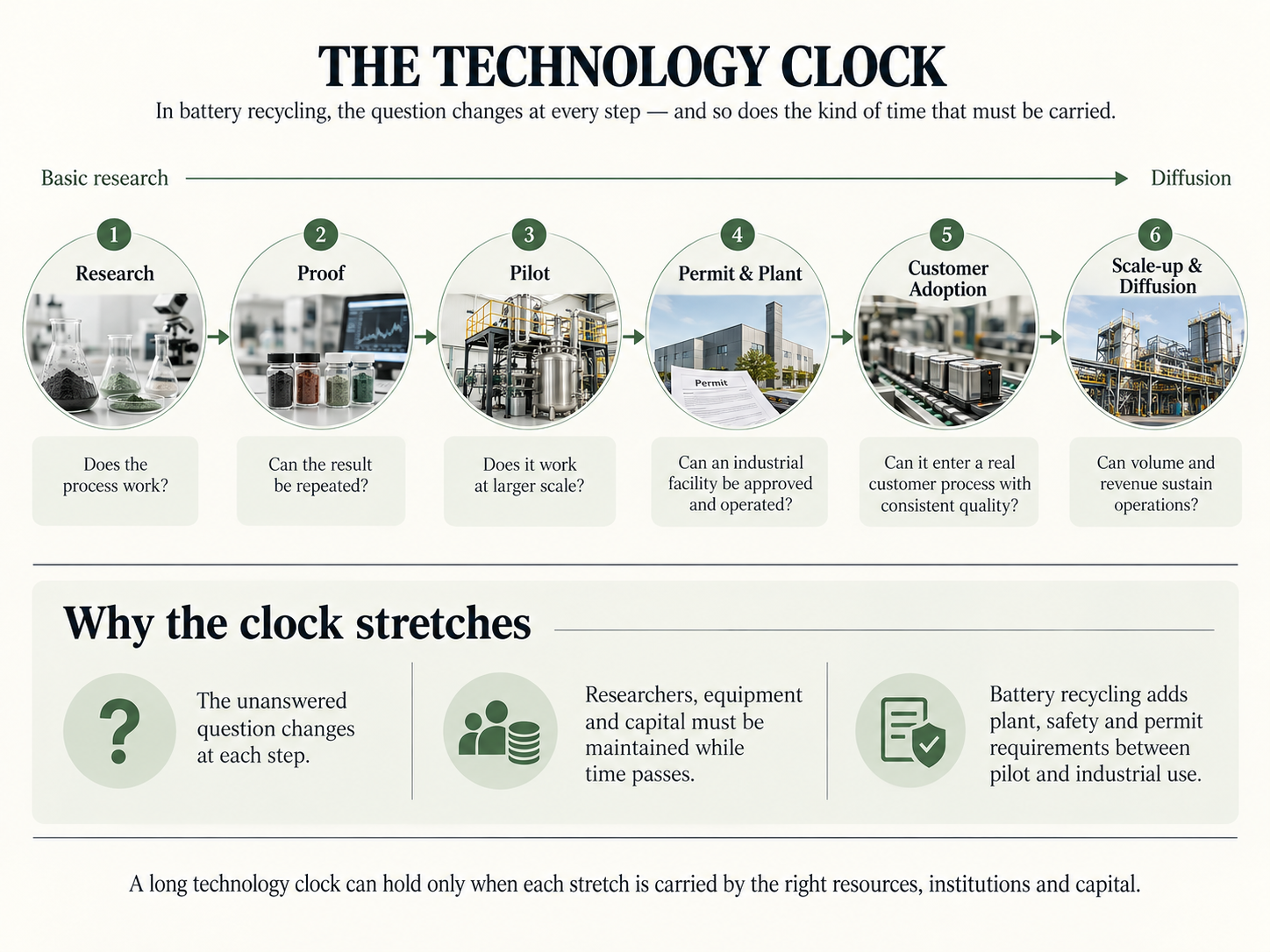
Following Viridis's route, what has to be confirmed changes at each step. In research, the question was whether the process works. Scaled up to a pilot, what matters is whether the same result can be repeated; at the permit stage, the conditions for operating as an industrial facility have to be met. After that comes whether the recovered material can go into customers' processes and, at the commercial-plant stage, whether there are enough volumes and sales to keep operating. In our reading, while the time grows longer, the same risk does not simply continue; the kind of uncertainty that remains changes at each move to the next stage.
The point is that this change does not happen only inside the technology. Each stage asks for different evidence. In research, the question is whether results can be reproduced; at the pilot, whether they hold at larger scale; in customer validation, who will actually use it; at the commercial plant, whether there are the volumes and cash flow to keep operating. Because the evidence asked for changes at each stage, so does the money that has a reason to wait for that evidence.
K-Institute called this road Research → Proof → Pilot → Adoption. In battery recycling, facilities and permits are added in between. Spent batteries are a material that requires fire and hazardous-materials management, control of waste water and emissions, and safe storage and transport all at once. That is why the technology's time grows longer. This is the second flow, the flow of technology.
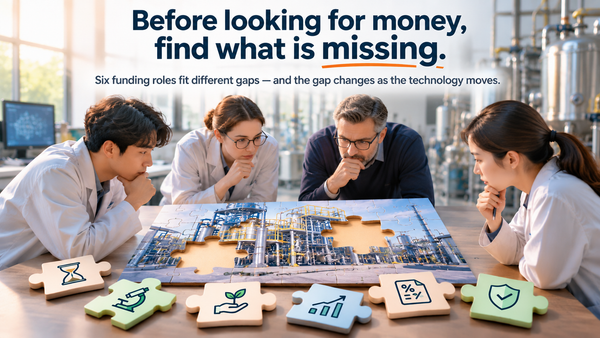
So matching the technology clock and the money clock does not simply mean finding money that will wait a long time. It means connecting the time and cost needed to reach the next proof to capital or infrastructure that can carry that risk. How, then, does money keep time?
Money Does Not Wait for the Same Proof
Money has clocks too. But the money clock here does not mean only how many years a pool of money exists. When money goes in, what evidence it can wait for, and when it has to be recovered or repaid together make up money's time. The life of a fund, the period within which investors must get their money back, the life of a policy fund and the period over which a pension fund carries payment obligations are different clocks. The table below shows that different capital runs on different time. But these periods are not periods of waiting for any one company. What matters is which proof the money has a reason to wait for. Korean and German cases are set side by side not to compare institutions, but to show that the same “long time” can carry different responsibilities and purposes.
Capital / institution | Published period | What this time measures | What it means directly for a technology company |
|---|---|---|---|
Venture fund (sub-fund of the Korea Fund of Funds) | Lifetime set at formation (statutory minimum 5 years) | The period for investing and exiting | Not a promise to wait ten years for one company |
Korea Fund of Funds | 30 years (2005–2035), extendable in 10-year steps | Recycling of policy capital | Not a holding period for companies |
National Pension Fund | Decades | Pension payment obligations | Not a holding period that waits for technology |
German Future Fund (Zukunftsfonds) | Until 2030 | Period of policy capital supply | Not an investment period for individual companies |
ERP Special Fund | In existence since 1953 | Recycling of capital | Different from investment periods for individual companies |
The clock in this table that closes soonest is the venture fund's lifetime. Korea's Enforcement Decree of the Venture Investment Promotion Act sets the lifetime of a venture investment fund at five years or more, and each fund must invest and exit within the lifetime it set at formation. The ten years in the title come from here: the time within which a fund must close the loop from investment to exit. Korea Venture Investment Corporation (KVIC) explains that the Fund of Funds is not money that holds a start-up for a long time, but a structure that commits capital to sub-funds and “recycles recovered funds” back into the venture market.
A pension fund has the longest obligation period in this table. Korea's National Pension Fund looks decades ahead, to when today's contributors will draw their pensions. But the purpose the National Pension Act sets for this money is not to wait for technology; it is to manage reserves for paying pensions. Germany has a different kind of long money. The ERP Special Fund, built on Marshall Plan aid, has been recovering money and supplying it again to companies and investment markets since 1953. The Federal Court of Audit explains that the fund's capital must be preserved. It is not an old budget but capital that keeps coming back. Even the same “long money” has different purposes and responsibilities.
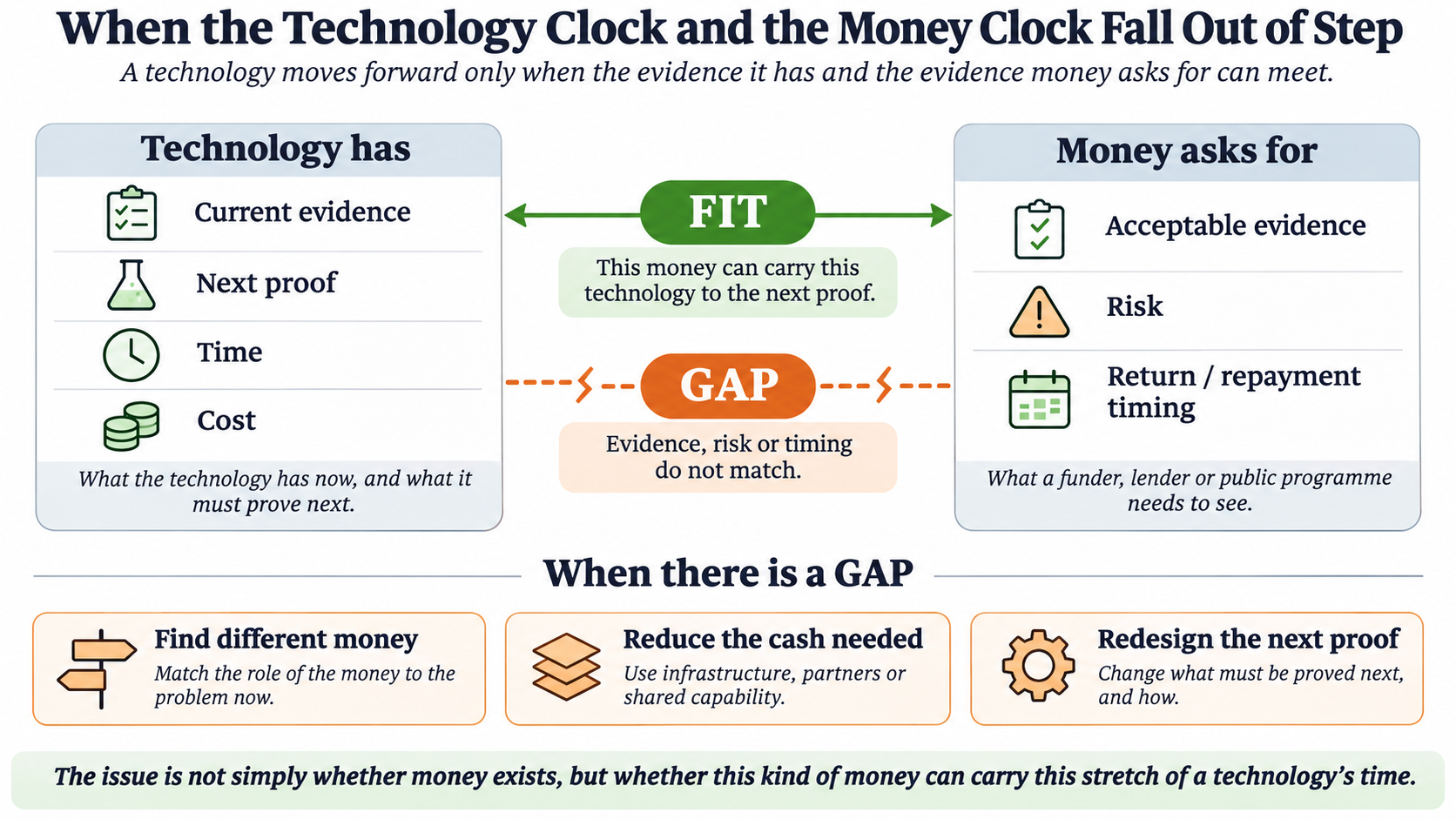
This is where the technology clock and the money clock fall out of step. The technology may still be producing its next proof while the capital is already asking for exit prospects or a source of repayment. Conversely, if a company that already has customer contracts and cash flow keeps looking only for early research funding, the form of its money lags behind its technology. The problem is neither that money is too short nor that technology is too slow. A funding gap arises when the evidence a technology has now and the evidence money asks for do not match. So when a technology's stage changes, the role of the money it needs changes too. Even for the same technology, the role of the money needed differs depending on whether the remaining problem is research risk, access to facilities, growth risk, or bringing forward cash flow that already exists.
The Money Behind Viridis Is Not Visible
Who invested how much in Viridis, and how long they waited, cannot be confirmed from public sources. Nor can the earlier contributions of Fraunhofer research funding and outside industrial funding to the development of Hydropulse be separated. The IWKS press release names no investors.
The technology clock is public; the capital clock is not. So these sources alone cannot say which money actually carried which stage at Viridis. What can be confirmed is that the technology moved forward while being asked for a different proof several times. What this article can ask, then, is not “who actually put up the money?” but “what kind of party was needed to carry the time and risk of each stage?”
Time Is Not Bought with Cash Alone
Matching the money clock is not only a matter of finding more cash. One thing is visible. IWKS said that after the spin-off, Viridis continues to use the institute's research infrastructure and the pilot plant in Hanau. Had the company had to build a pilot plant on its own from scratch, it would have needed more capital. Research infrastructure extends a technology's time by reducing the capital a company has to raise itself. One way of finding money is to reduce the amount of cash needed.
This is also why several parties can share a technology's time: they do not all need to take part for the same reason. A research institute looks at technology transfer; a regional government at local industry; an industrial company at recycling capacity and securing raw materials; an investor at future cash flow. Which of these went into Viridis cannot be confirmed. But one thing is visible. What sustains a technology through its time is not one long pool of money, but a connection of money and infrastructure that each have a reason to carry the stretch to the next proof. This is the third flow, the flow of money.
Closing
Viridis's next steps are still open. Securing feedstock, customer approval and money for a commercial plant all remain. The direction of the market it is heading for is clear: the EU requires more raw material to be recovered from spent batteries and, from 2031, requires that material to go back into new batteries. What the company's route so far confirms is something else. Different resources — research funding, the institute's facilities, company capital, customers and follow-on capital — can each carry a technology's time through their own stretch.
“Ten years” looks less like one investor's patience than a technology's time shared among several parties.
The technology clock counts the time to the next proof. The money clock counts whether there is a reason to wait for that proof. When the two ask for different moments, the technology meets a gap in the money or resources it needs to move to the next stage. Filling that gap means finding different money, reducing the amount of cash needed, or redesigning the next proof itself.
The same questions come back to a research team. What must it prove next? Is what it needs to reach that proof cash, equipment or research time? And who has a reason to carry that stretch? If Korean technology has to go through the same time in Europe, who carries the next stretch becomes important. In our analysis, that role could be further research funding, or European research institutes, customers and financial players.
A long technology timeline can be sustained when money and infrastructure with a reason to carry each stretch connect.
A decade of technology is not one long wait. It is a structure for sharing the time and risk until the next proof.
The next episode turns to the stretch that public laboratories carry. In a country where the private sector bears most of the cost of R&D, who funds public laboratories, and what do companies put in?
FLOW POSITION — Source · Allocator
CHECK — How much time and cost will it take to reach the next proof, and what money has a reason to carry that stretch?
NEXT → Ep.2 The Money Behind Public Labs — Who Funds Public Labs, and What Do Companies Put In?
About This Reporting
The description of Viridis Recycling stays within the scope of Fraunhofer IWKS's press release of 14 July 2026. The company's founding year and sources of funding are not in that release, and K-Welle has not confirmed them separately. POSCO's Polish plant follows POSCO's 2022 announcement; the locations of Korean battery makers' European plants follow each company's public material; and the EU targets follow Article 8 and Annex XII of Regulation (EU) 2023/1542. The memorandum of understanding between KITECH and IWKS is described only within the scope of the forum's official announcement; whether it has been implemented has not been confirmed.
Setting the technology clock and the money clock side by side is an editorial arrangement and does not mean that any particular fund invested in Viridis. The fourth column of the table in “Money Does Not Wait for the Same Proof”, “What it means directly for a technology company”, is the editors' interpretation, not any institution's disclosure. The sentences on reasons for taking part in “Time Is Not Bought with Cash Alone” are general and do not describe Viridis's actual funding. The purposes and periods of each institution follow their disclosures and the relevant laws. The lifetime requirement for venture investment funds follows the Enforcement Decree of the Venture Investment Promotion Act; the lifetime and extension rules for the Korea Fund of Funds follow the explanatory memorandum and main provisions of the amendment passed by the National Assembly in December 2025.
The three flows are K-Welle's editorial framework. The research team in the opening and closing is a hypothetical example and does not refer to any particular institution or company. The paragraph on the evidence each stage asks for in “The Proof Changes at Every Stage”, the paragraph on funding gaps in “Money Does Not Wait for the Same Proof”, the paragraph on the two clocks in the closing, and the sentences on Korean technology are not what public sources state directly but the editors' interpretation drawn from Viridis's route.
Corrections: editor@k-welle.com
Sources
In addition to the material linked in the text, we consulted:
- K-Welle, K-Institute, Episode 4 (infrastructure a company cannot build alone), Episode 5 (the pilot as the cost of belief), Episode 6 (Songhak Yoon, IWKS)
- Fraunhofer IWKS — Ausgründung Viridis Recycling erhält BImSchG-Genehmigung (14 July 2026) (in German)
- Regulation (EU) 2023/1542, Article 8(2) — minimum recycled content (cobalt 16%, lithium 6%, nickel 6%), applying from 18 August 2031
- Enforcement Decree of the Venture Investment Promotion Act, Article 34(5) — registration requirements for venture investment funds, lifetime of five years or more (in Korean)
- National Assembly — partial amendment to the Venture Investment Promotion Act (alternative bill), explanatory memorandum and main provisions (December 2025; draft Article 70: Fund of Funds lifetime of 30 years, extendable in 10-year steps with the approval of the members' meeting) (in Korean)
- National Pension Service Investment Management — investment principles (in Korean)
- Federal Agency for Civic Education (bpb) — ERP-Sondervermögen (in German)
- Federal Ministry for Economic Affairs and Energy (BMWE) — Investitionsoffensive für den Mittelstand (30 July 2025) (in German)