From Research to Industrial Proof
How research evidence becomes pilot-ready when funding, ownership and responsibility align — and why even a signed contract does not end the burden.
How evidence, funding and responsibility move a technology towards a pilot
Suppose the laboratories in Seoul and Germany finally reached the same number. The material has proved its performance. The celebration is short — because a question no one settled in advance soon arrives. Who pays to repeat this result on larger equipment? And who is responsible if that test fails?
The evidence is ready. But evidence does not move by itself.
A pilot is the price of belief.
A pilot is the cost the market demands before it believes in a technology. Who bears that cost, when, and how — this article is about that structure.
Once evidence is agreed, what technology meets next is the language of responsibility.
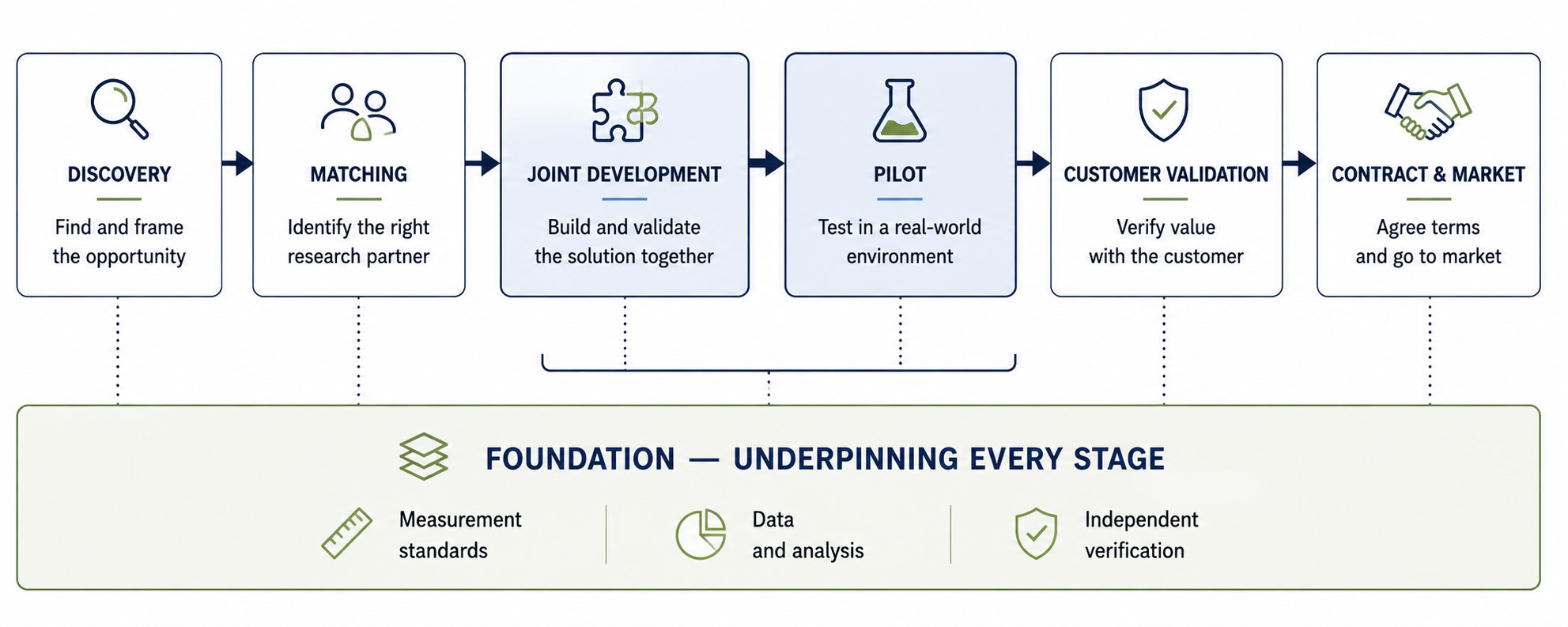
The Chain of Transition
The Crossing is not a fixed pipeline. It is a map of changing requirements. Discovery and matching depend mainly on information and networks; joint development adds researchers and research funding; pilot and customer validation bring in equipment, process data, capital, regulation and industrial ownership.
The further a technology moves, the language of performance does not disappear — it acquires another vocabulary: cost, yield, safety, regulation and supply responsibility. And in this article, a pilot is a stage, not a specific facility: the passage in which laboratory performance is tested for repeatability under real or near-industrial conditions, and for scale, throughput, cost and process integration.
The Official Crossing
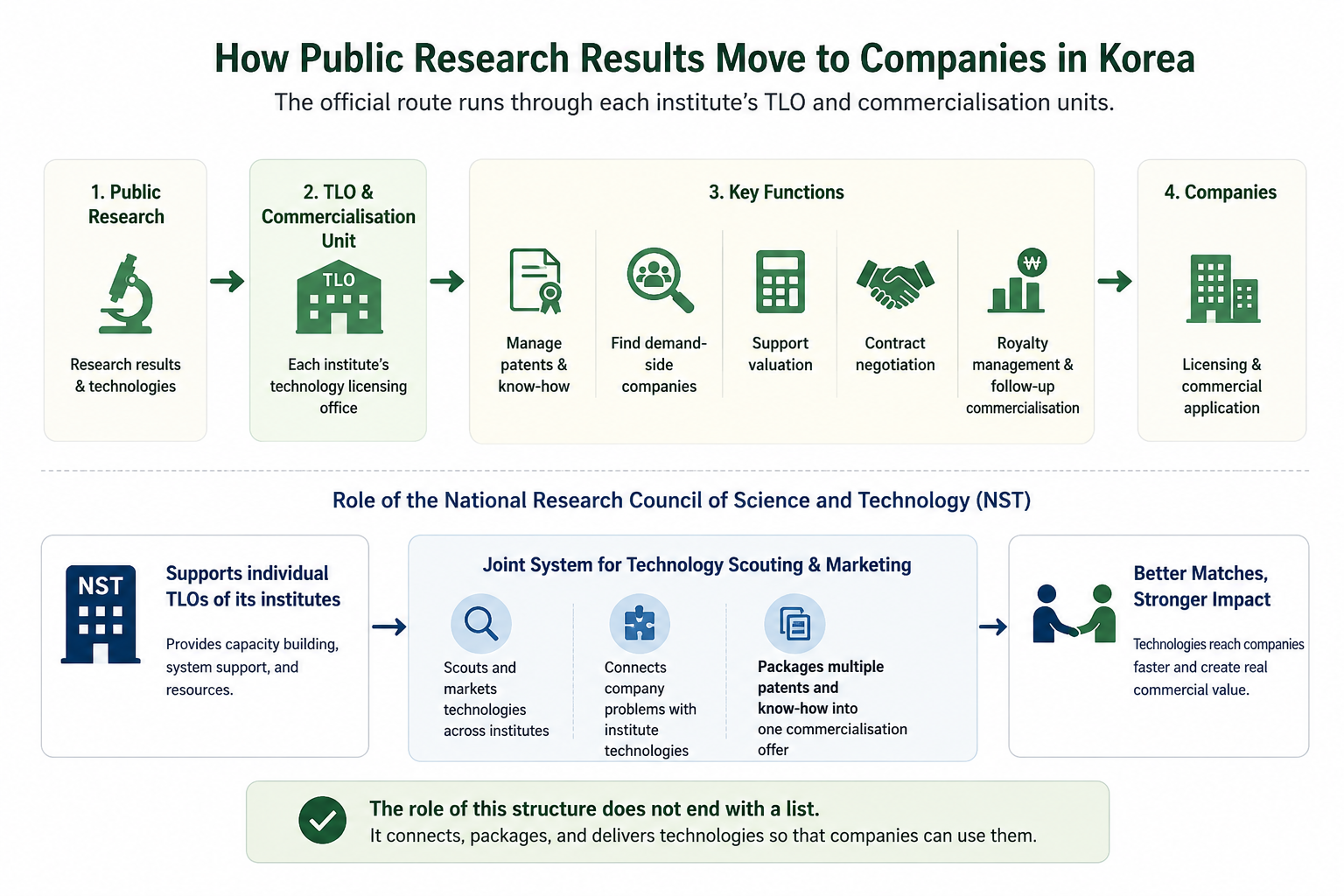
In Korea, the official route by which public research results move to companies runs through each institute's technology licensing office (TLO) and commercialisation units. They manage patents and know-how, find demand-side companies, and support valuation, contract negotiation, royalty management and follow-up commercialisation.
The National Research Council of Science and Technology (NST) supports the individual TLOs of its institutes and has operated a joint system that scouts and markets technologies across institutes. The role of this structure does not end with putting good technologies on a list: it connects the problems companies bring with the technologies institutes hold, and where needed packages several patents and bodies of know-how into a single commercialisation offer.
There are aggregate figures as well. Data provided by the NST joint-TLO secretariat for 2023–2025 suggest that overseas transfers were a very small share by number of contracts but a large share of royalty income. This does not mean overseas transfers are generally worth more; it means that in this period a small number of overseas contracts accounted for a substantial part of the income — contract counts alone are a poor measure of international commercialisation.
When the Chain Reaches a Contract
There is a case in which public technology travelled all the way to a contract with a global company.
On 28 June 2024, the Korea Institute of Machinery and Materials (KIMM) signed a technology-transfer agreement with KBR, the US process-technology and engineering company, for its CPOx® technology — catalytic partial oxidation.
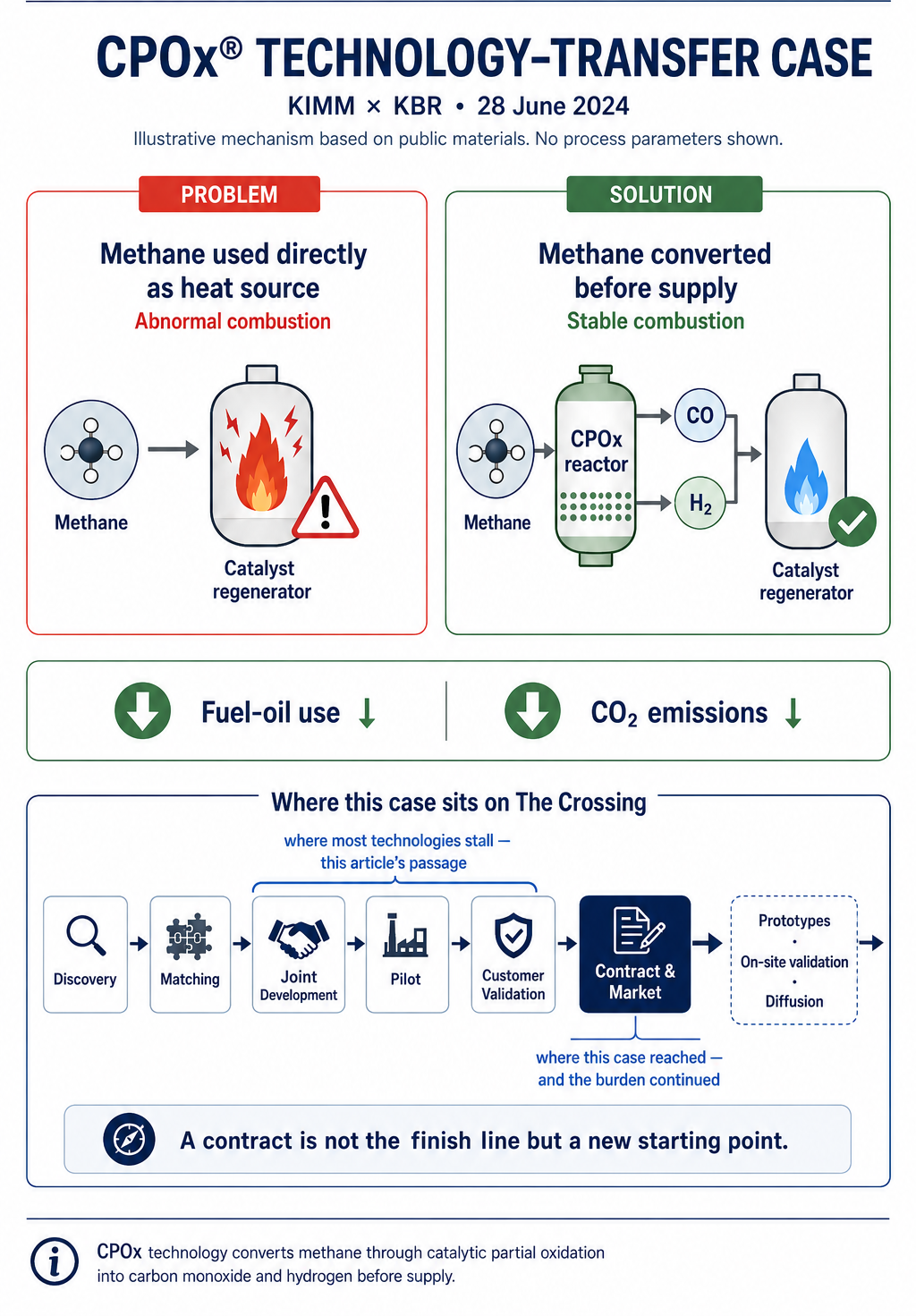
The point of this case is that it was not a simple purchase. KBR owned a process and an industrial problem; KIMM's technology connected to that problem as a working component; an organisation existed to turn research results into a contractable form; and the party who would develop the technology after the contract was defined. What the case shows is not the size of the technology but the structure.
It should not be described as a completed commercial success. What public records confirm is a technology-transfer contract; application in customer processes, further development and diffusion are tasks that come after. A contract is not the end of the chain but the new starting point of follow-up development and application.
Daehoon Lee, the principal researcher who led the development at KIMM, likened technology transfer in a press interview to a “poisoned chalice.” Even after a contract is signed, researchers may still carry much of the prototype work and on-site validation support, while dedicated support for this stretch remains limited.
Where the Chain Loses an Owner
Why, then, do so many technologies stop in the middle of the chain? Not simply because pilot programmes or facilities are missing. The deeper problem is that the research project, the pilot and customer validation are not connected into one continuous structure of responsibility.
Three clocks expose the gap: the research project clock, the pilot clock, and the regulation-and-market clock.
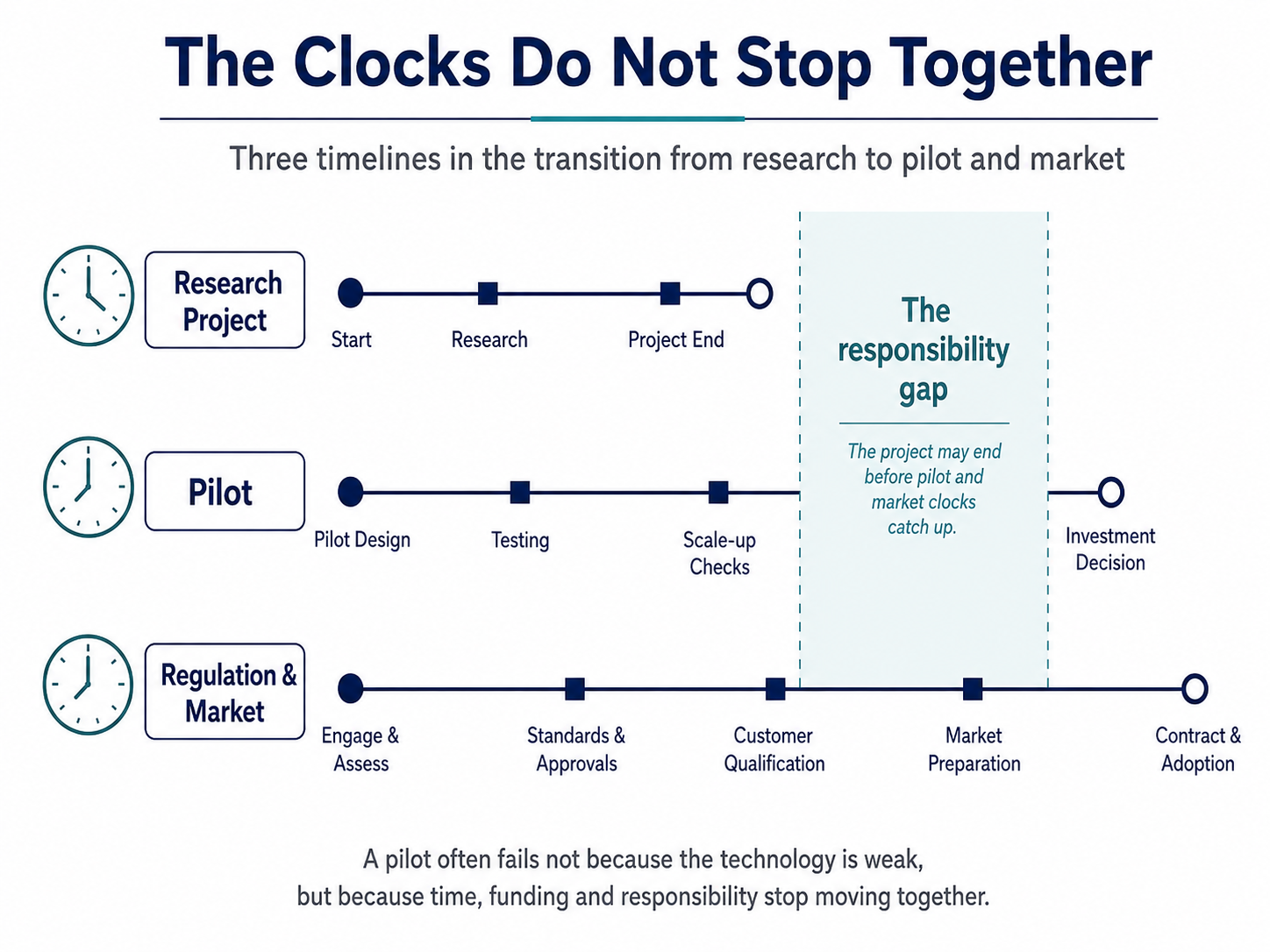
The research project's clock follows a contracted end date. The pilot's clock follows repeatability and process stabilisation. The clock of regulation and the market follows certifiers, customers and investors. The clocks do not stop together. A research grant may end while the technology still needs a pilot. A pilot may finish before customer qualification begins. A technically successful result may still need environmental or economic evidence.
In this stretch, the owner of the next stage's cost and responsibility becomes unclear. The institute has finished its project; the company has not yet made its investment decision; the customer will not put an unvalidated technology into its own process. The pilot gap is not only an absence of facilities — it is a gap in responsibility.
Europe faces the same gap. Fraunhofer institutes may use preliminary feasibility work before deeper collaboration, and Horizon Europe projects can include pilot, demonstration and validation activities depending on the call and action type. These mechanisms reduce uncertainty; they do not automatically carry a technology into the next commercial stage.
The Support Map
Korean–German technology cooperation has several support windows. But platforms, funding and facilities do not do the same job.
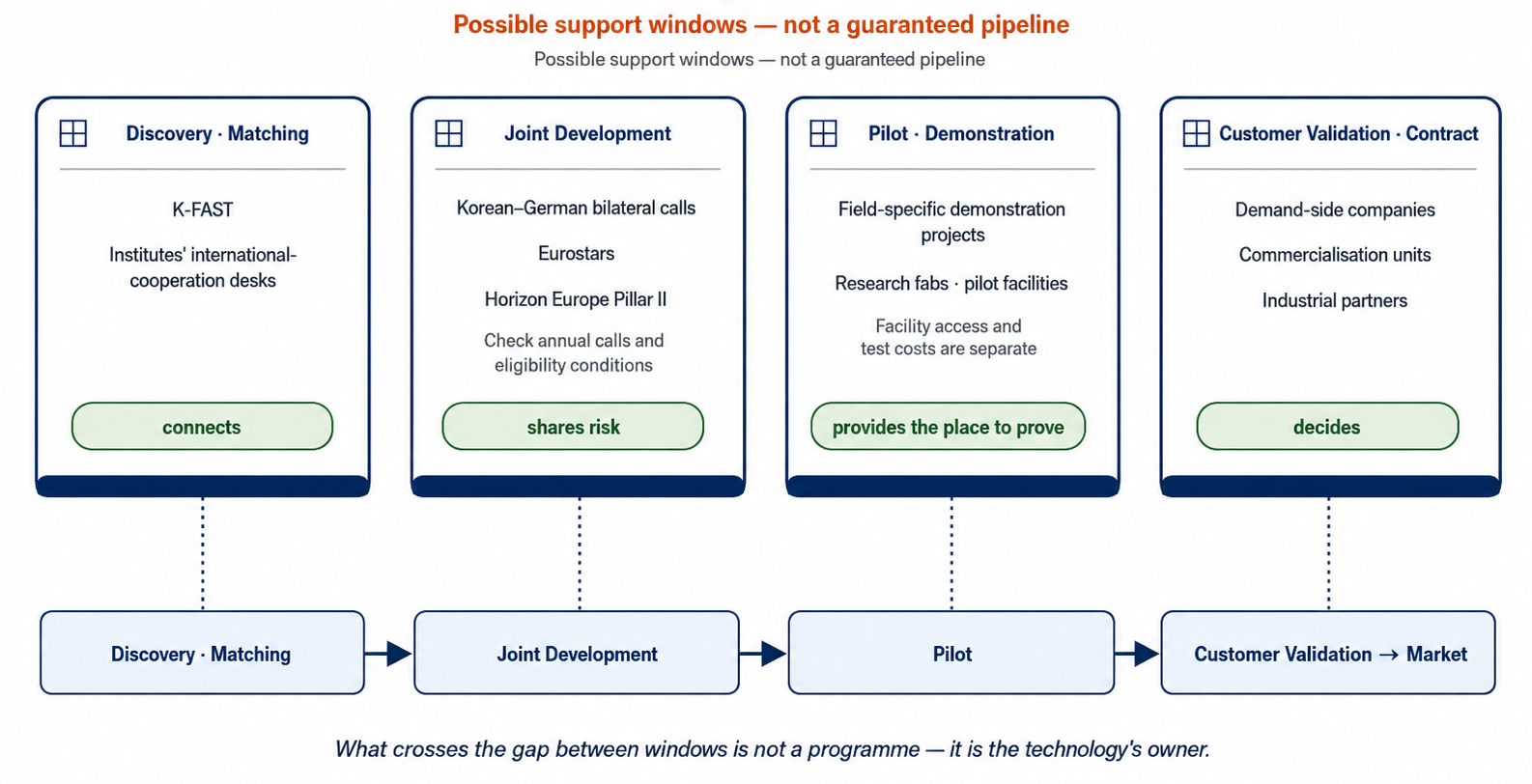
These windows do different jobs. K-FAST is a collaboration platform, not a funding programme. Bilateral calls and Eurostars can share R&D risk under specific eligibility and consortium rules — the 2024 Korean–German 2+2 call, for instance, required a consortium of at least four organisations and was limited to semiconductors and assistance robotics; it is not a standing programme. Horizon Europe Pillar II gives Korean organisations, as an associated country, access to relevant calls under substantially the same conditions as EU entities — but not every call funds a pilot. Research fabs and pilot facilities provide capability, not automatically the budget to use it.
A platform connects. Funding shares risk. Infrastructure provides a place to prove. The customer decides whether the proof is enough. None of them, on its own, guarantees the move to the next stage.
What Structure Cannot Finish
What this article has drawn is the general structure — the chain of transition, the technology-transfer system, the three clocks, the support windows. But structure is a necessary condition, not a sufficient one. As The Bridge Builder showed, finding the right institute does not complete a collaboration; the application, the roles, the required evidence and the next responsibility have to be designed together.
Structure can reduce the cost of proof. It cannot assign the owner of that cost.
Technology becomes pilot-ready when evidence has an owner, a budget and someone authorised to make the next decision.
The next article, published alongside this one, goes inside the material and the process. In the direct recycling of battery black mass, how are purity and impurities managed? Do laboratory results repeat after scale-up? What data proves environmental and economic performance? How the general structure of transition is tested again in front of a real technology — through the experience of Dr. Songhak Yoon.
EDITORIAL NOTE
About This Reporting
Reporting basis, editorial frames and sources
Read
This article draws on official materials from NST and its joint-TLO secretariat, the Korea Institute of Machinery and Materials, Fraunhofer, the European Commission, Eureka and the operators of the programmes mentioned.
Technology-transfer statistics are based on data provided by the joint-TLO secretariat and do not represent stage-by-stage conversion rates. The KIMM–KBR case is described within the technology content and contract scope confirmed by public records; the remark by principal researcher Daehoon Lee is quoted from a published press interview (ZDNet Korea, August 2024).
The “chain of transition” and the “three clocks” are editorial frames by K-Welle, not official classifications. “The Crossing” progress marker is a K-Welle editorial frame that reuses this article's chain of transition as the shared coordinate of the four articles published together.
Programme fields, eligibility and periods change with each call; check the operators' official guidance before applying. Partner institutions supported reporting access and had no role in the content.
Corrections: editor@k-welle.com
Sources · Linked on publication
- KIMM — KBR CPOx technology-transfer agreement, press release (28 June 2024, Houston)
- ZDNet Korea — interview with principal researcher Daehoon Lee (August 2024)
- European Commission — Republic of Korea to join Horizon Europe under Transitional Arrangement (January 2025)
- Korea-EU Research Centre — signature of the Korea–EU Horizon Europe association agreement (July 2025)
- KIAT — 2024 Korean–German (2+2) joint technology development call
- Eureka — the Eurostars programme
- NST joint-TLO secretariat data (internal, non-public)