4 Korean STEM Universities, 4 Different Paths
UNIST, GIST, DGIST, and KENTECH for International STEM Researchers
Four universities. Unfamiliar names. One heavy question.
An international STEM candidate considering Korea usually starts with three names: SNU, KAIST, and POSTECH.
But the list does not end there.
There is a second group: UNIST, GIST, DGIST, and KENTECH.
They are smaller.
They are STEM-specialized.
They are strongly English-medium.
And they are tied directly to Korea’s industrial strategy.
For international Gen Z researchers, the question is not simply whether these universities are “good.”
The harder question is this:
Can a degree from these universities travel — across borders, employers, and visa systems?
Korean media rarely answer this question. When they do, they often use Korea’s internal signal hierarchy: SKY first, then the rest.
That is not how international researchers should read the system.
This article looks at UNIST, GIST, DGIST, and KENTECH through five practical issues:
- research style
- growth fields
- English operation
- industry connection
- international hiring
- visa and residency relevance
The goal is not to rank them.
The goal is to ask whether the degree gives you mobility.
The Four Schools at a Glance
| University | Core Position | Strong Fields | Best-Fit Researcher |
|---|---|---|---|
| UNIST | Industrial STEM university in Ulsan | Secondary cells, energy, semiconductor materials | Researchers targeting batteries, energy, mobility, or manufacturing-linked R&D |
| GIST | AI, optics, and science hub in Gwangju | AI, optics, next-gen semiconductors, biotech | Researchers seeking AI/optics pathways in an English-first research environment |
| DGIST | Convergence research institute in Daegu | Advanced robotics, brain science, next-gen semiconductors | Researchers aiming for postdoc, institute-based, or convergence research pathways |
| KENTECH | Energy-specialized university in Naju | Next-gen batteries, hydrogen, climate technology | Researchers focused on energy transition and climate-tech R&D |
These schools are not backup options.
They are Korea’s smaller, more focused STEM systems.
For some international researchers, they may be a better fit than larger, more famous universities.
Issue 1. Will You Study — or Work in a Lab?
These four institutions were designed to move students into research earlier.
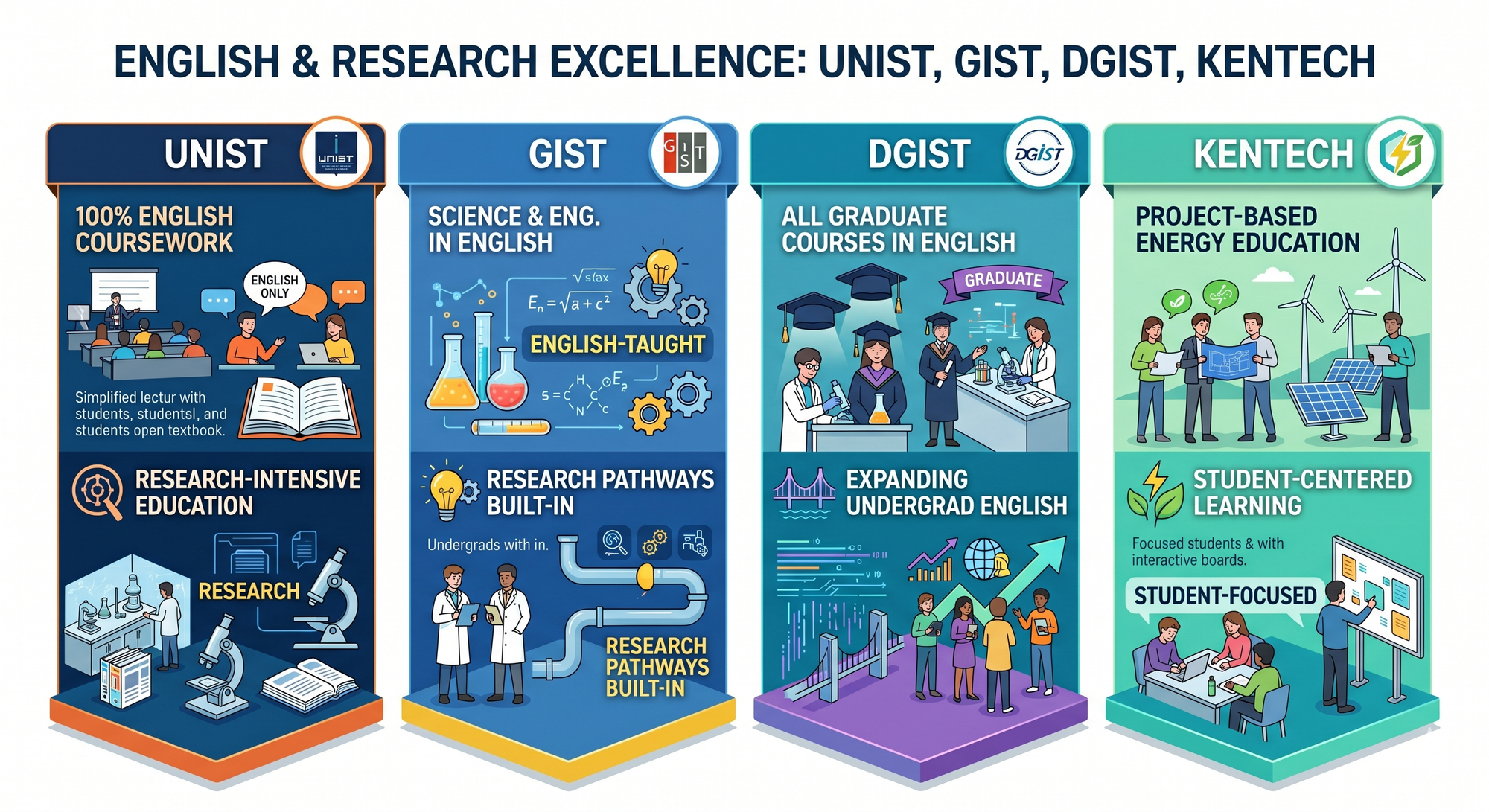
At graduate level, the distinction becomes even clearer.
These are not mainly places where you “take classes.”
They are places where you join a lab.
For international researchers, that matters.
A practice-based STEM degree travels better than a lecture-based credential because it produces visible outputs: papers, code, prototypes, patents, conference presentations, and industry projects.
Mobility begins with evidence.
In STEM, evidence comes from the lab.
Issue 2. Is Your Field Where Korea Is Growing?
Korea is already strong in memory semiconductors, displays, shipbuilding, automotive, and petrochemicals.
These sectors are globally competitive. But for international researchers, mature sectors may offer slower entry, narrower hiring, or stronger Korean-language integration requirements.
The more relevant question is where Korea is investing now.
Korea’s current strategic technology agenda includes areas such as AI, semiconductors, secondary batteries, advanced biotechnology, hydrogen, advanced robotics, and quantum technologies, with the government’s 2024–2028 master plan committing large-scale R&D investment to 12 critical and emerging technologies.
This is where the four universities become more interesting.
Their strengths map directly onto Korea’s growth agenda.
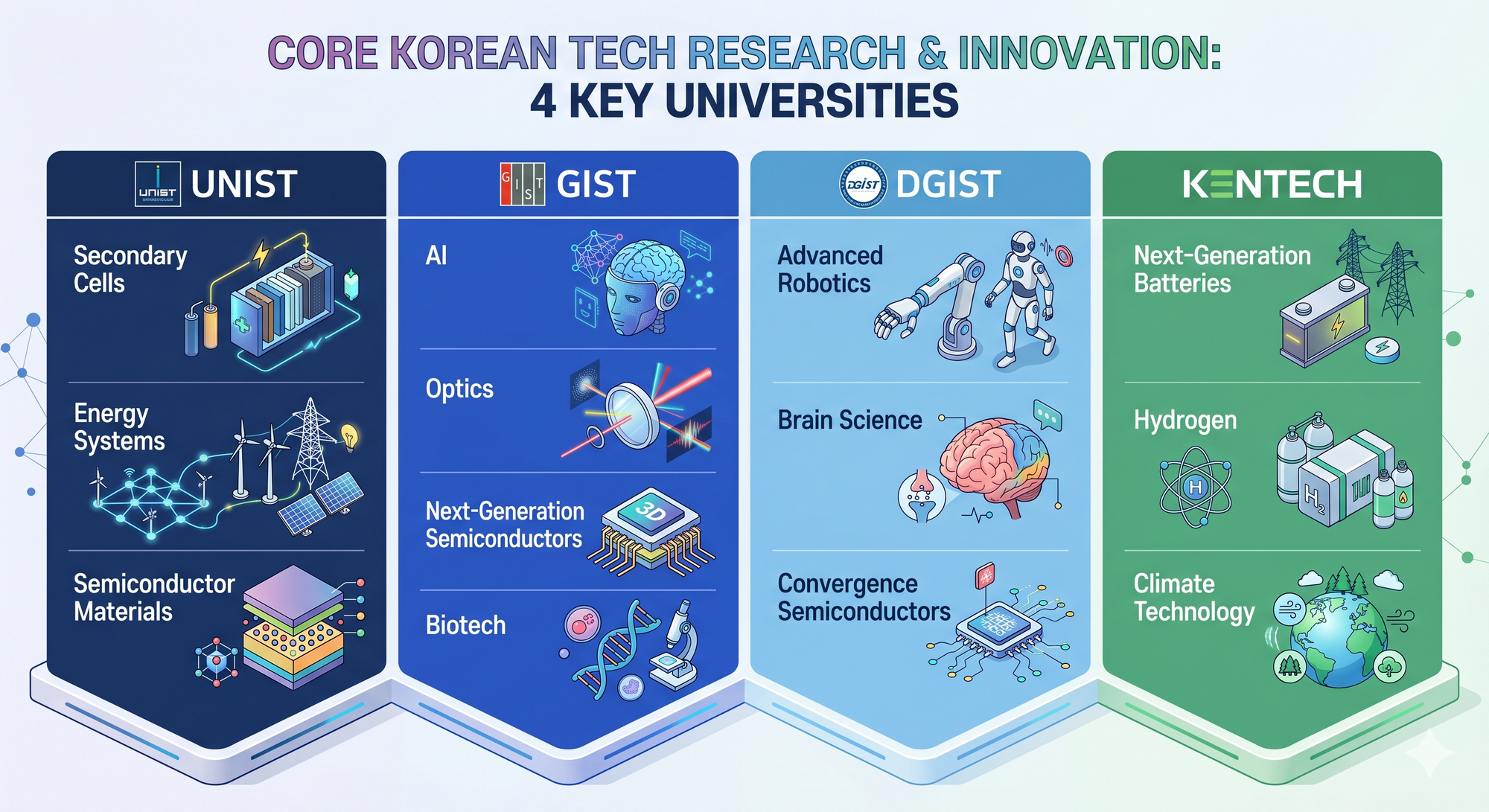
For an international researcher, the question is not:
“Is Korea famous for this field?”
The better question is:
“Is Korea hiring, funding, and building in this field now?”
Established strength gives reputation.
Growth fields give openings.
Issue 3. Can You Actually Work in English?
English is one of the strongest selling points of UNIST, GIST, DGIST, and KENTECH.
At the university level, these are among Korea’s most English-medium STEM environments: UNIST promotes 100% English instruction, GIST and DGIST operate strongly in English, and KENTECH was designed as a globally oriented energy university.
But English courses do not guarantee an English-working lab.
Within the same university, one lab may run meetings, paper drafts, and code reviews in English. Another may operate mostly in Korean.
The university may teach in English.
The lab decides whether you can actually work in English.
Issue 4. Is the Industry Connection Real?
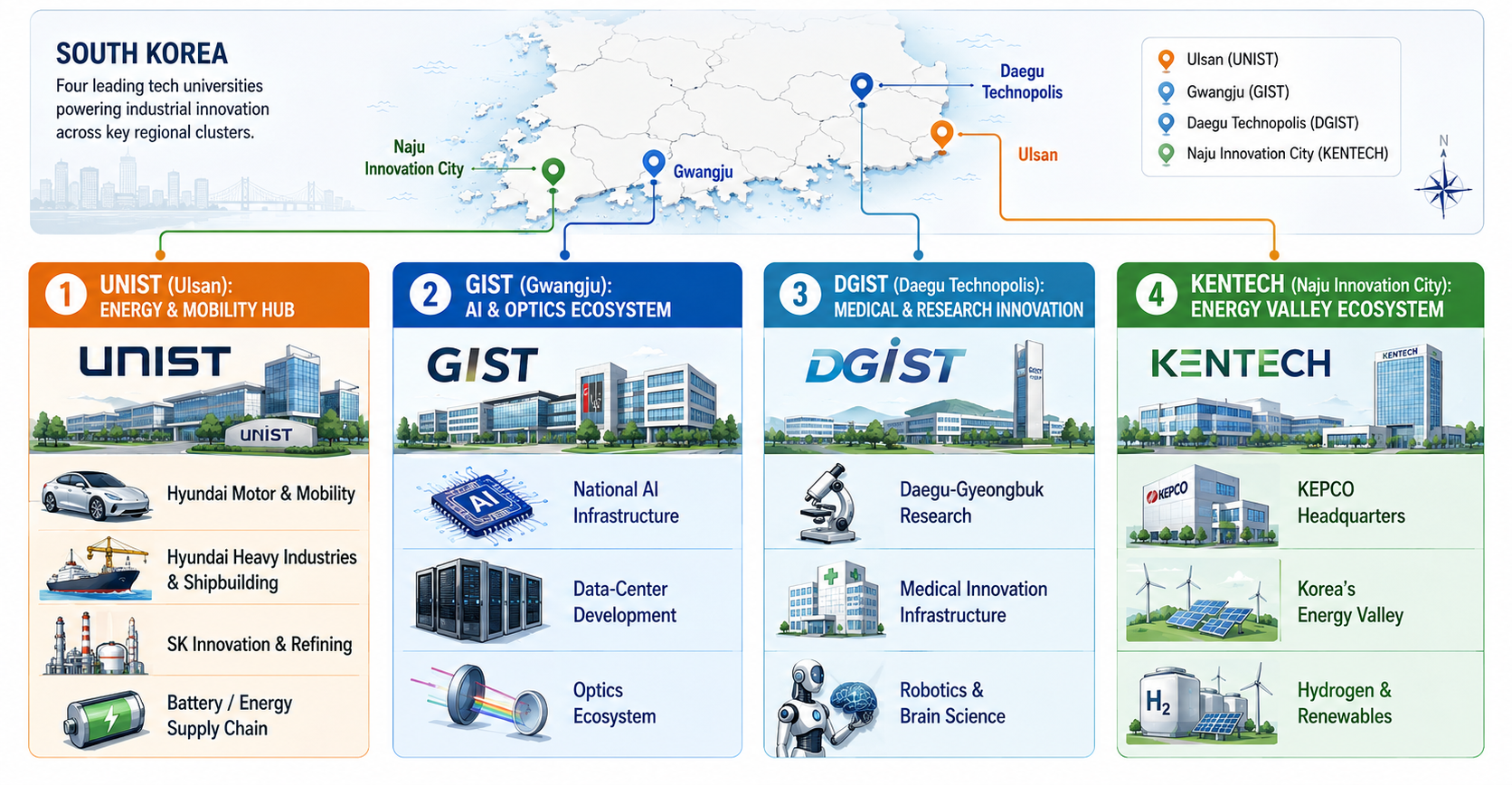
English pages often show the marketing version, while Korean Industry-University Cooperation pages usually reveal actual partner companies, project scale, and recent cases. The strongest signal is whether international students have entered internships, R&D projects, or corporate labs before.
Marketing says partnership; internships prove access.
Issue 5. Does Your Field Hire International Researchers?
For students hoping to stay in Korea, the key question is not only whether a field is strong, but whether it hires internationally.
Globally connected fields — AI, secondary cells, system semiconductors, optics, hydrogen, renewables, and biotech — tend to offer more portable degrees and clearer hiring routes. Korea-domestic fields, especially those tied to local regulation, clients, suppliers, or Korean-language operations, are harder to enter.
This also changes how the four schools should be read: UNIST fits batteries and semiconductor materials, KENTECH fits energy and hydrogen, GIST fits AI and optics, while DGIST may lead more naturally to research institutes or postdoc tracks than direct corporate hiring.
The field decides whether the degree travels.
The pathway decides whether you stay.
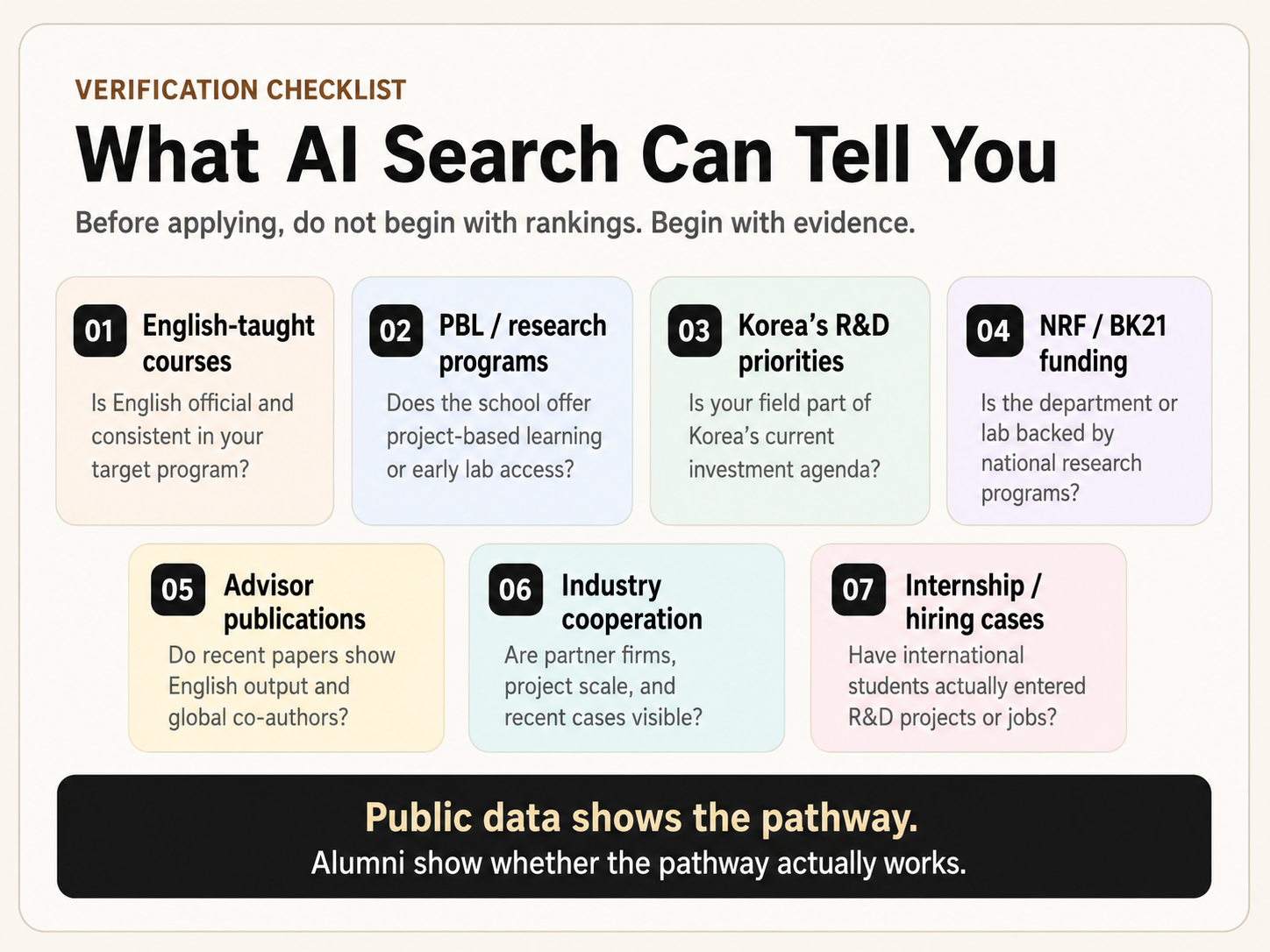
But AI search cannot fully answer the most important question:
How does the lab actually work?
Find the last five papers from your target lab.
Look at:
- language of publication
- co-author countries
- international collaborators
- alumni destinations
- funding acknowledgements
- BK21 or NRF project participation
This is the fastest self-check on global mobility.
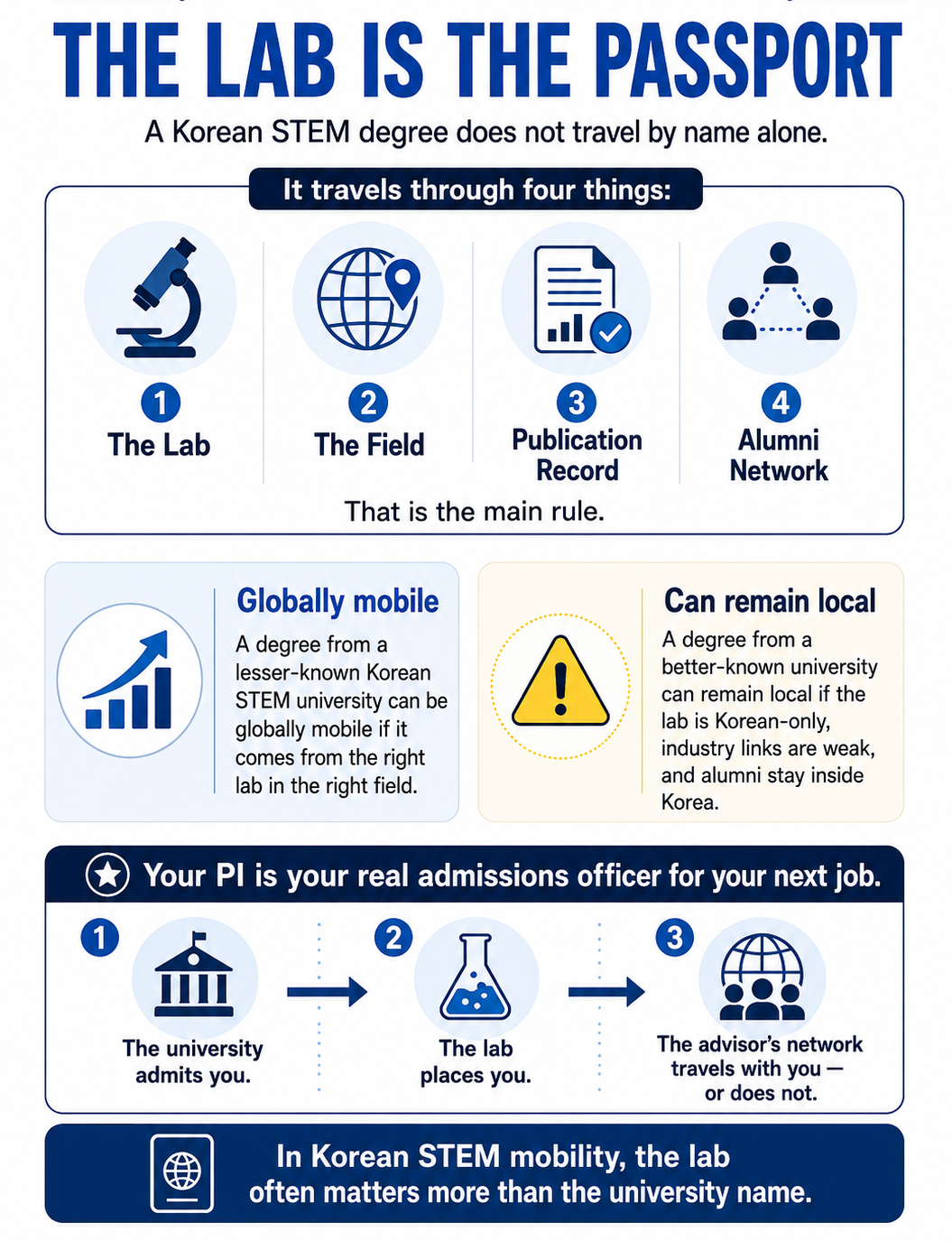
A Korean STEM degree can travel.
But not automatically.
It travels when the field is global, the lab publishes in English, the advisor collaborates internationally, and alumni move across borders.
It travels further when Korea itself is investing in the field.
And it becomes more powerful when it also opens a realistic residency path.
For international Gen Z researchers, the university name is only the start.
The field gives direction.
The lab gives evidence.
The alumni network gives proof.
The visa pathway gives optionality.
The real passport is the lab.