Inside Korea's AI Growth
Talent Shortages, System Strengths, and Gen Z
Beyond the Chip, A More Complex Korea Emerges
To many in Europe, Korea is first and foremost the land of speed—AI breakthroughs, semiconductor dominance, and hyper-digital lifestyles.
But the real story lies behind the hardware.
Korea’s strength is not only technological; it is structural and human.
Today, the country does not view the rise of its AI semiconductor industry or ESG sectors as isolated technological success.
Under a broad consensus that talent is the nation’s core strategic resource, Korea is transforming itself into a human-centered, system-driven laboratory for economic and social experimentation.
Yet behind this remarkable coherence lies tension:
the pressure to move quickly, the concentration of power, the widening value gaps, and questions about sustainability.
This is the Korea Europe does not often see.
This is The Unseen Korea.
1. System — Korea’s Talent-Centric Engine
Korea’s education system is often caricatured abroad as relentless exam competition.
In truth, it functions as part of a national project to build the workforce for future industries.
In 2025, the government allocated ₩2.4 trillion (~€1.65 billion) specifically to AI and advanced industry talent.
This positions education not as a social service but as industrial strategy.
This creates a high-speed pipeline:
Learning → Experimentation → Startup Formation → Global Networks
Examples
- K-Digital Training
A 6–12 month practical program producing AI and cloud engineers ready for immediate deployment.
Korea’s advantage is not its curriculum—it is the velocity of upskilling. - AI Graduate Schools
Purpose-built institutions where students work directly with industry on R&D.
Education and industry are synchronized in near real time.
But the system has its pressures.
The demand for continuous reskilling creates psychological strain, particularly among younger cohorts.
The challenge for Korea will be supporting accelerated talent development without accelerating burnout.
2. Structure — A Synergistic but Highly Concentrated Industrial Architecture
Korea’s industrial speed stems from a highly coordinated architecture where government, universities, and corporations operate almost as a single unit.
Industry–academia–research hubs in AI, semiconductors, and green sectors form circular feedback loops:
Education feeds industry. Industry feeds R&D. R&D informs policy. And policy accelerates education again.
Examples
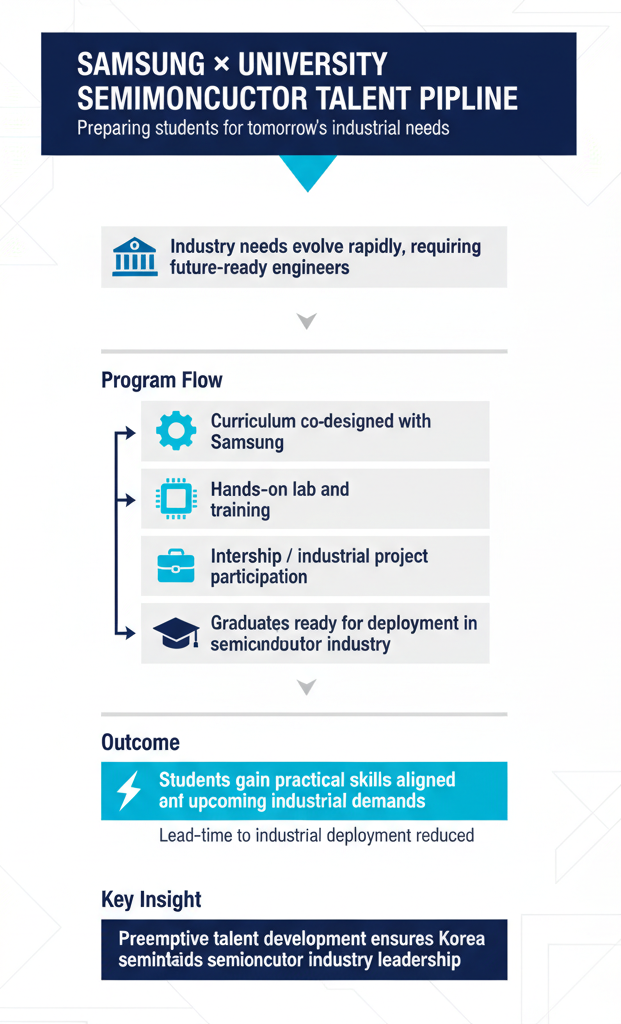
- Samsung x University Semiconductor Departments
These programs pipeline students into tomorrow’s industrial needs—sometimes before those needs fully materialize.
- ASML Remanufacturing Center in Hwaseong
The Dutch semiconductor equipment leader’s expansion reflects the depth of Korea’s supply-chain reliability and skilled labor base.
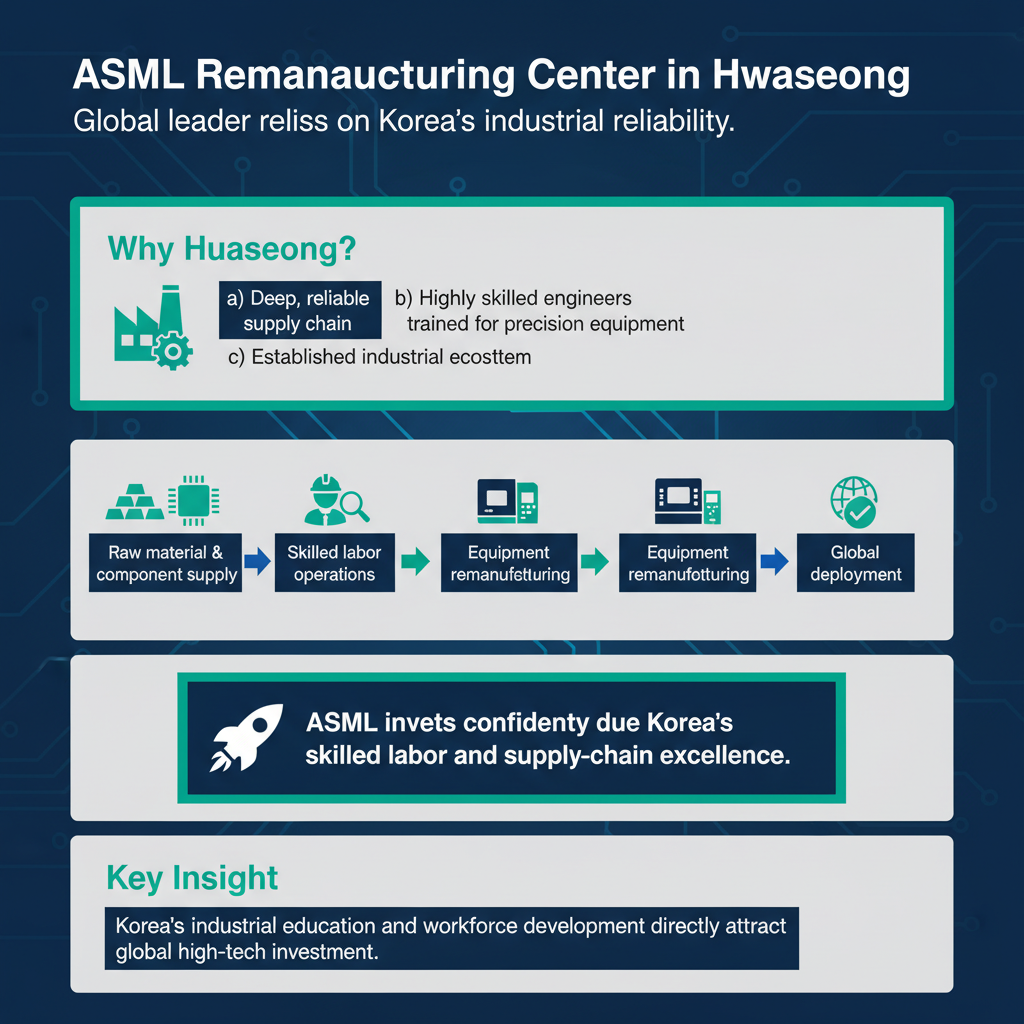
The OECD Digital Government Index (2023) ranks Korea among the global leaders in digital public administration—an essential foundation for rapid innovation.
But coordination has trade-offs.
The centralization that fuels Korea’s speed can also concentrate decision-making in a few large actors,
raising concerns about market distortion, limited space for independent startups, and uneven resource distribution.
AI adoption is also outpacing regulatory frameworks.
Questions around data governance, transparency, and AI ethics remain unresolved.
Maintaining agility while embedding ethical guardrails will determine Korea’s credibility as a global AI leader.
3. Mindset — The EQ-Driven Generation Behind Korea’s Cultural and Market Shifts
Structural capacity alone does not explain Korea’s transformation.
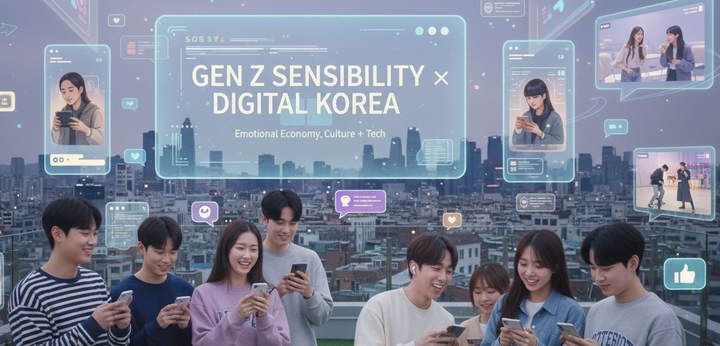
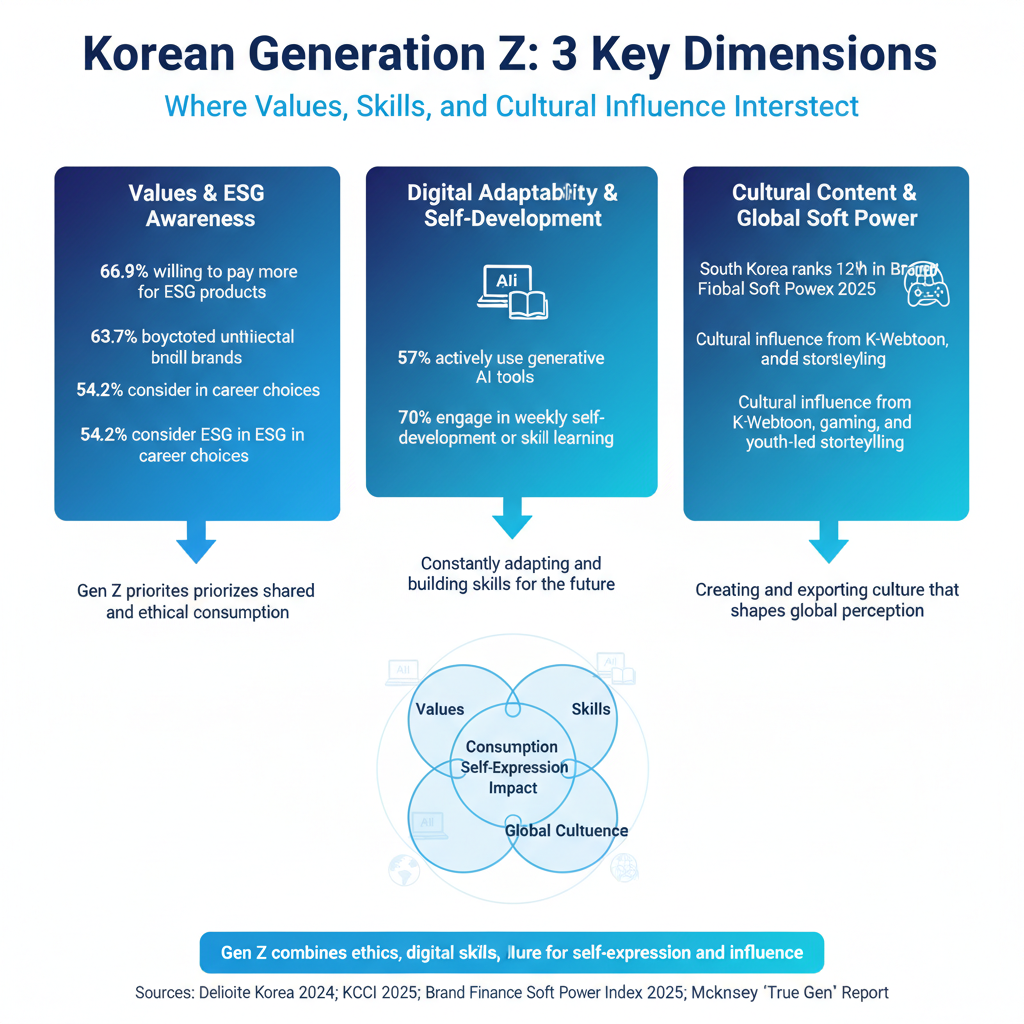
At its core is Generation Z, a cohort that treats technology not as a passive consumption tool but as a vehicle for identity, experimentation, and ethical choice.
Korean Gen Z increasingly shapes markets by blending technology, culture, design, and emotional value.
Characteristics
- Co-Advancement Mindset
Less zero-sum competition, more collective intelligence and shared progress. - Soft Power Creators
K-webtoon, gaming, social ventures, and youth-led storytelling are globalizing Korean soft power. - Emotion-Based Market Dynamics
Deloitte Korea (2024):
73% of Gen Z say “brands are a language of emotional self-expression.”
But this comes with social tension.
Hyper-digital lives intensify expectations for constant self-optimization.
Inter-generational value gaps widen as older cohorts prioritize stability while Gen Z prioritizes meaning, ethics, and emotional alignment.
Managing these pressures—digital fatigue, overwork, fragmented identities—will be crucial for Korea’s long-term social sustainability.
4. Talent Beyond Borders — Korea as a Global Platform of Experience
Korea is no longer a closed labor market.
More than 200,000 foreign students and researchers now engage with Korean universities, AI labs, and startups.
Government programs such as K-Startup Visa, AI Research Fellowships, and sector-specific exchanges integrate global talent not as an accessory but as a necessity.
Korea increasingly positions itself not as a destination of learning, but as a platform of experience where ideas and skills are validated in real time.
For European readers:
Korea offers something rare in advanced economies today:
a place where policy, industry, and youth culture converge with enough speed to create real opportunities.
You can observe structural transformation not as theory but as practice.
You can test your skills in an environment that rewards experimentation.
You can build networks that extend beyond national boundaries.
Korea’s Dual Reality
Korea’s AI transformation is powerful and ambitious.
Its strengths—systemic coordination, talent-driven policies, Gen Z innovation, and global openness—are genuine.
But so are its challenges:
centralization, regulatory lag, social fatigue, inter-generational friction, and ethical dilemmas.
Korea’s future will depend on balancing these forces—
leveraging its speed and coherence while confronting its pressures and contradictions.
The Unseen Korea is not just a success story.
It is a case study in how a nation experiments with the future—
and the tensions that make such experimentation possible.
References — Inside Korea's AI Growth Sources
Click to expand / collapse
-
Ministry of Science and ICT (Korea).
K-Digital Training Program Overview. 2023.
Available at: https://www.k-digital.or.kr - Korea Institute for Curriculum and Evaluation (KICE). Digital Skills and Industry Readiness Report. 2022.
- OECD. Skills for a Digital World: Korea Case Study. 2022.
- Choi, J., & Lee, S. “Upskilling Strategies in the Korean ICT Industry.” Journal of Technology and Education, Vol. 15, 2023.
- Ministry of Employment and Labor (Korea). AI & Cloud Workforce Upskilling Initiatives. 2023.
- The Korea Herald. “K-Digital Training Accelerates AI Talent Deployment.” 2023.
-
Startup & Corporate Case Reports (aggregated, anonymized):
- Manufacturing AI Vision Deployment: internal HR report, 2023
- Financial AI Ops Reskilling: financial institution press release, 2023
- Startup MLOps MVP case: Korean Startup Association, 2023
Dawn Chang, PhD · Editor-in-Chief, K-Welle · editor@k-welle.com