Vol.3 Beyond Seoul | Regional Anchors & Field Routes
Designing Your Stay Through Regional Hubs
[Series Intro]
The K-Welle Regional Report reads Korea not as a tourist destination, but as a system of choices. Each volume helps readers design their own pathway through the lenses of cost, networking, experience, and major–career fit.
Why Design a Life Outside the “Republic of Seoul”?
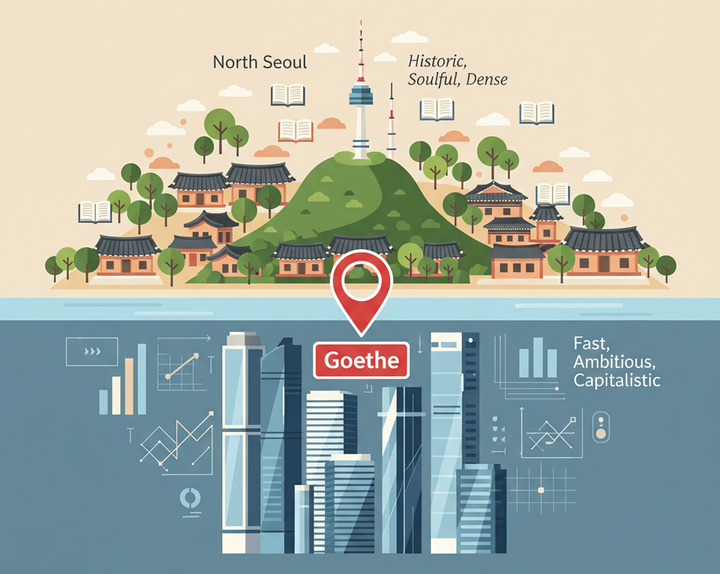
The saying “Everything in Korea is in Seoul” is only half true. Seoul offers the highest opportunity density—but it also demands high housing costs, intensified competition, and a relentless pace.
The key question is simple: Do you need that density right now?
Why These Cities: The Goethe Anchor Logic
Vol.3 focuses on regional university cities where three conditions align: (1) an international-student community that speeds up settlement, (2) daily “field routes” into nearby industry and research clusters, and (3) a visible Goethe coordinate inside the university-city ecosystem—not as a promise of programs, but as a cultural marker that makes a new city feel more navigable.
Three Lenses for Choosing a City
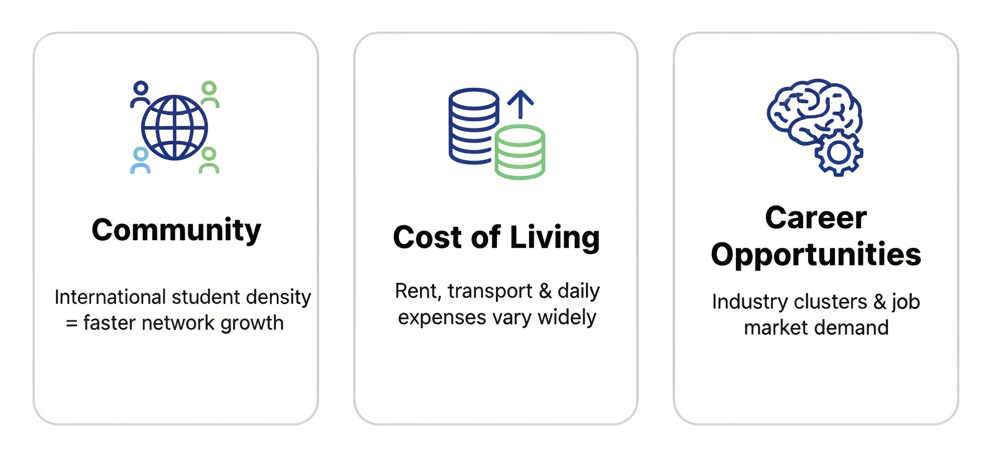
To design a stay for growth—not just movement—we read cities through three lenses:
(1) International Student Density (Community)
More than diversity, it determines settlement speed: information travels faster, peer support is easier, and help is more accessible.
(2) Industry & Research Clusters (Field Route)
Where can your major be encountered as a routine—not a one-off visit? The goal is a workable field route within a 30–60 minute living radius, where your commute becomes part of your learning environment.
(3) The Anchor (Goethe Coordinate)
A psychological reference point that reduces volatility in a new city. Even the presence of an anchor coordinate can stabilize decision-making and daily navigation.
City Guide: Which Rhythm Fits You?
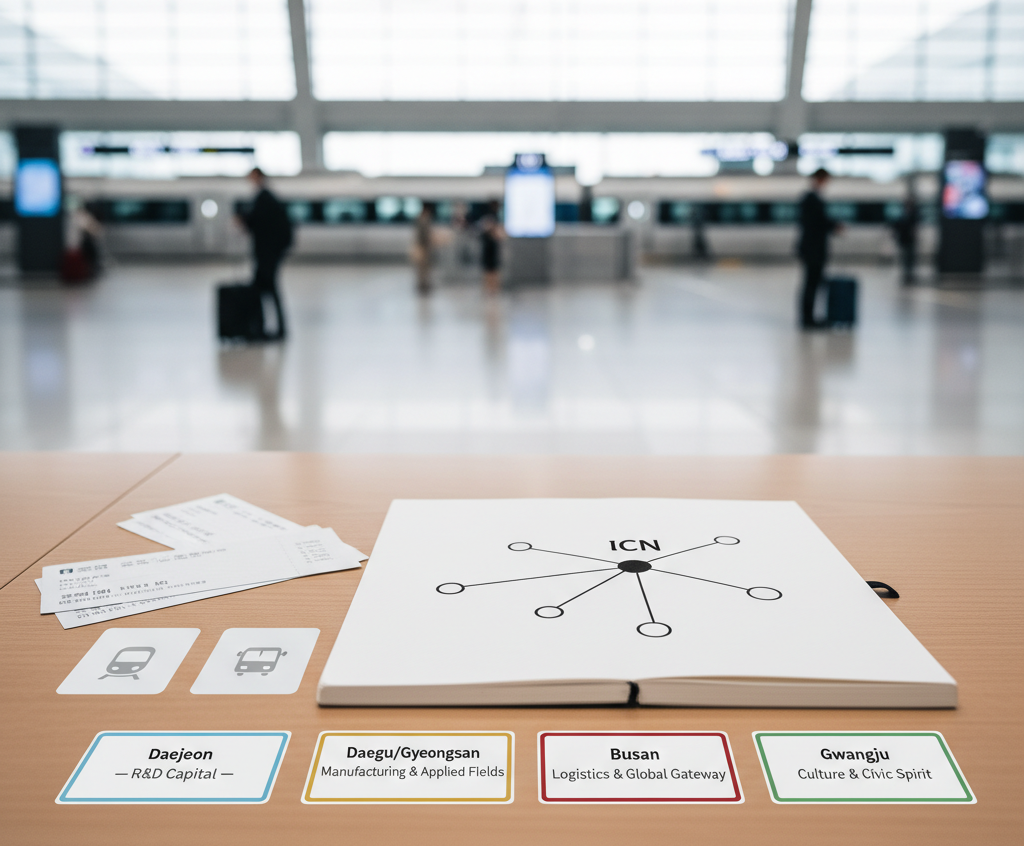
The four options below are not substitutes for Seoul. They are distinct rhythms you can choose based on purpose. (For full university names, acronyms, and Korean-language course availability, please refer to the separate Directory page.)
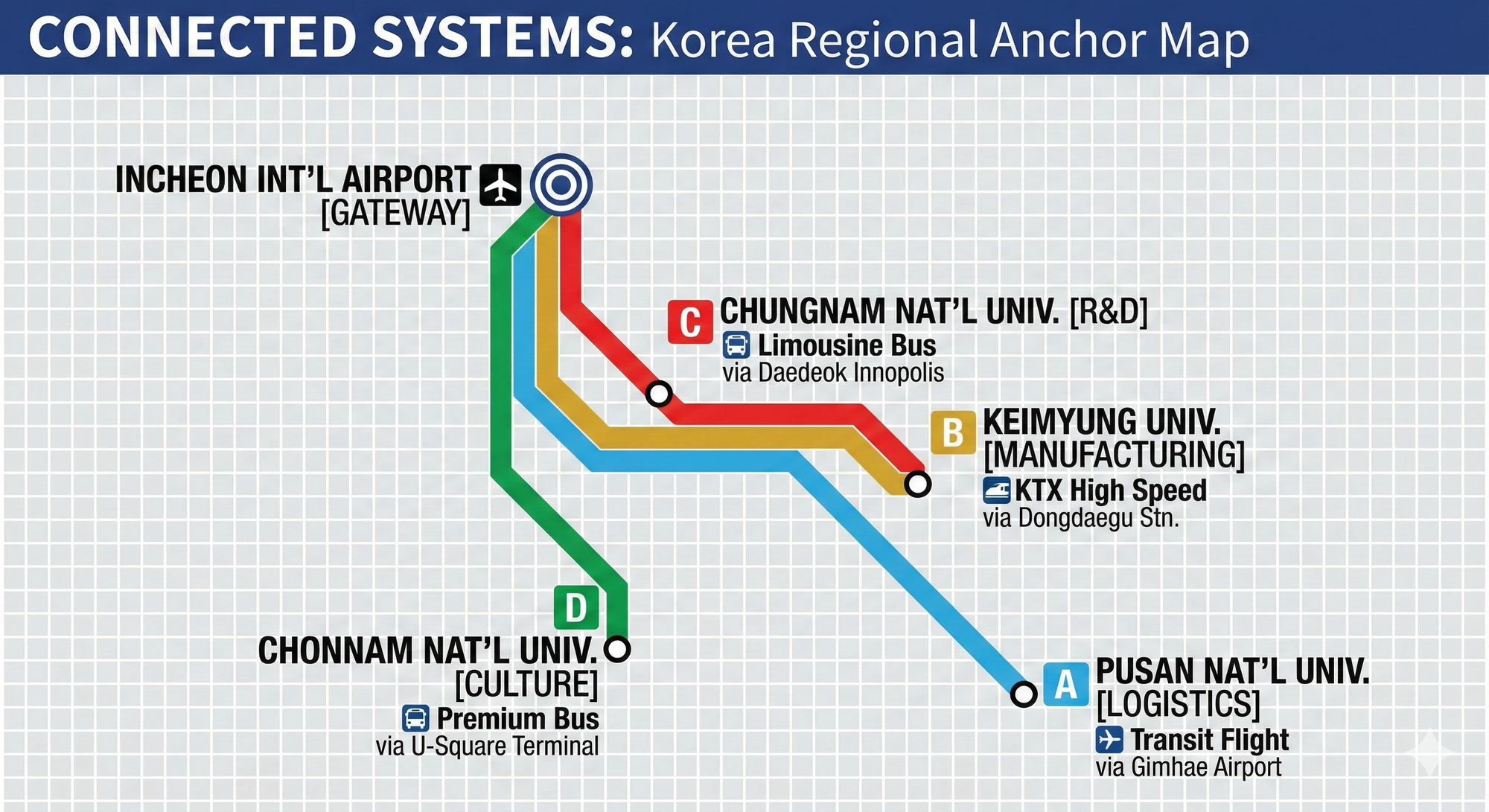
A. Daejeon — The Research City Standard: R&D Capital
One-line definition: A city where quiet immersion and project rhythm come naturally.
Recommended for: Engineering / Natural Sciences / Research-oriented readers; those who prefer focus over noise.
Community signal: A stable international student belt centered around key campuses (see Directory for WSU / HNU / CNU).
Cluster route: The city’s core is not a landmark district but the Daedeok R&D Belt.
Anchor meaning: Best for readers who value information access and connectivity over spectacle.
Micro-Action: Choose one seminar/demo-day in the Daedeok area this month and write down five keywords that define the topic.
B. Daegu / Gyeongsan — The Inland Hub of Manufacturing + Medical + Campus Belt
One-line definition: A compact region where manufacturing foundations and applied industries coexist.
Recommended for: Business & Economics; Medical & Healthcare; readers interested in organizational culture and supply chains.
Community signal: A thick international student pool formed by the large campus belt (see Directory for KNU / KMU / YU).
Cluster route: Manufacturing/parts/machinery routes coexist with medical/healthcare pathways within realistic distance.
Anchor meaning: A strong “stability signal” for first-time visitors—proof that connection does not disappear outside Seoul.
Micro-Action: Check one EXCO forum/exhibition schedule and note one bottleneck you think Korean industry is struggling with (talent, regulation, cost, speed, etc.).
C. Busan — The Port City Open to the World: Logistics & Global Gateway
One-line definition: Not “next to Seoul,” but a complete international city in its own right.
Recommended for: Logistics / Trade / Marine / Energy; readers who want a dynamic rhythm and ocean-based city life.
Community signal: Foreigners are naturally integrated into the city; university options and urban scale support long stays.
Cluster route: The core experience is not startup “discourse,” but real exposure to ports, logistics flows, and supply chains.
Anchor meaning: In a large city, an anchor coordinate prevents you from being swallowed by the pace—connection stays legible.
Micro-Action: Observe port/logistics flow once and summarize in three lines where “speed” is created (system, manpower, infrastructure).
D. Gwangju — The City Experimenting with Culture & AI: Civic Spirit & New Industry
One-line definition: A value-driven hub with a clear urban narrative.
Recommended for: Arts / Humanities / Social Sciences; readers interested in AI convergence, content, and cultural policy.
Community signal: Quieter in scale, but the community texture is distinct—civic identity, arts, and public culture are highly legible.
Cluster route: Cultural infrastructure (e.g., ACC—Asia Culture Center) coexists with state-led AI experimentation.
Anchor meaning: A symbolic coordinate that connects through values, not only language—useful for widening perspective.
Micro-Action: Choose an ACC-related program and write five sentences on how technology is being combined with culture.
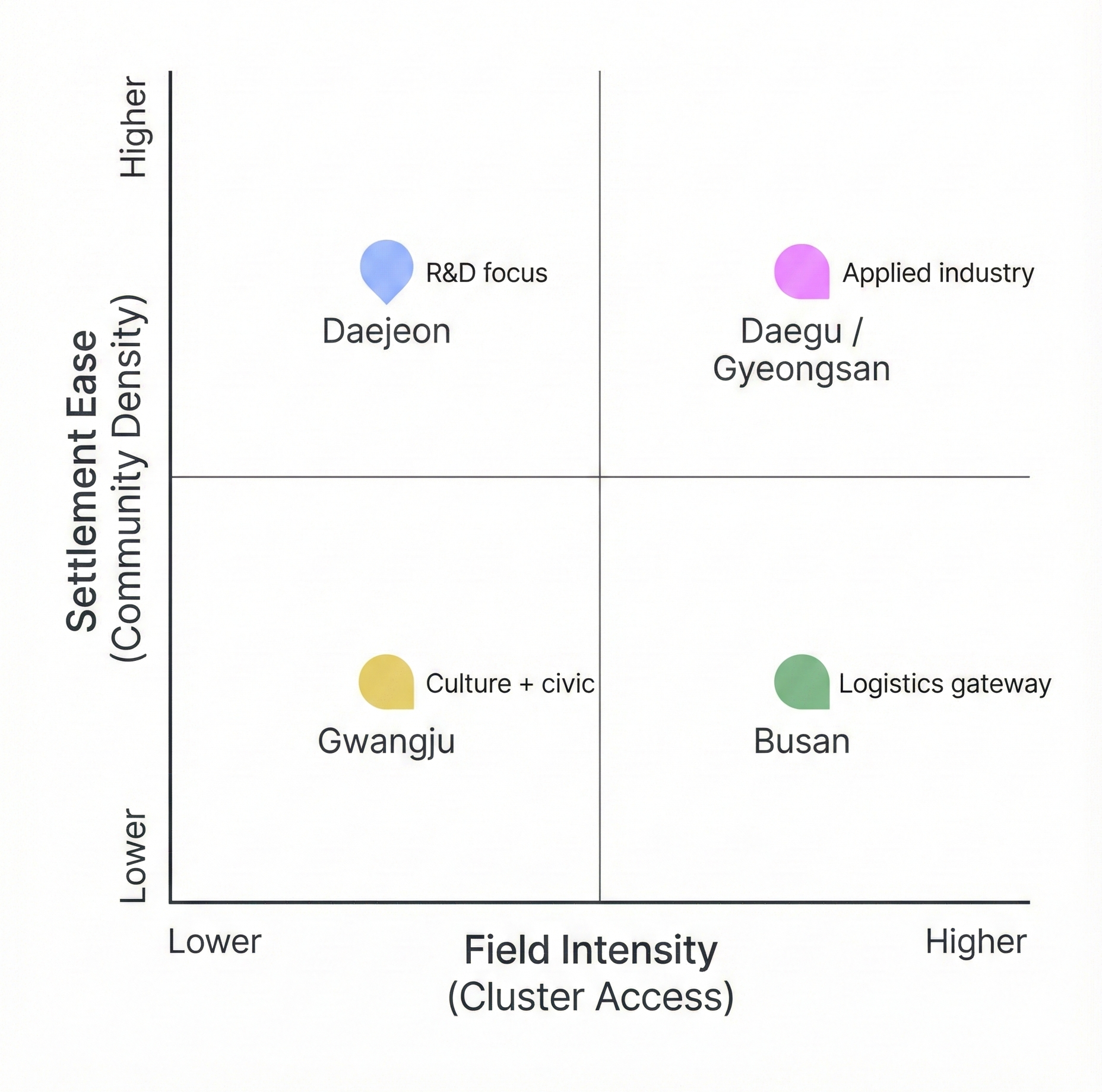
Three Questions to Find Your City
The best place is never simply a good city. It is a city that fits you.
- Does my journey begin with people (community) or with field experience (clusters)?
- Do I need Seoul’s fast density, or the regions’ deep sustainability?
- Where must I spend the most time each day: campus, lab, or industrial site?
Goethe is not a destination—it is a coordinate.
Once you mark that coordinate, your stay becomes design, not just travel.
This article does not recommend a single path. It offers a way to think about Korea as a system of choices.
Appendix: University Decoder
Acronyms used in this article (for quick reference).
- WSU: Woosong University (Daejeon)
- HNU: Hannam University (Daejeon)
- CNU: Chungnam National University (Daejeon)
- KNU: Kyungpook National University (Daegu)
- KMU: Keimyung University (Daegu)
- PKNU: Pukyong National University (Busan)
- JNU: Chonnam National University (Gwangju)
Note: Availability and structure of Korean-language programs vary by institution and term. Please verify on each university’s official website.
Dawn Chang, PhD · Editor-in-Chief, K-Welle · editor@k-welle.com