Vol.2 Where is the Career?: The Ambition & Engine
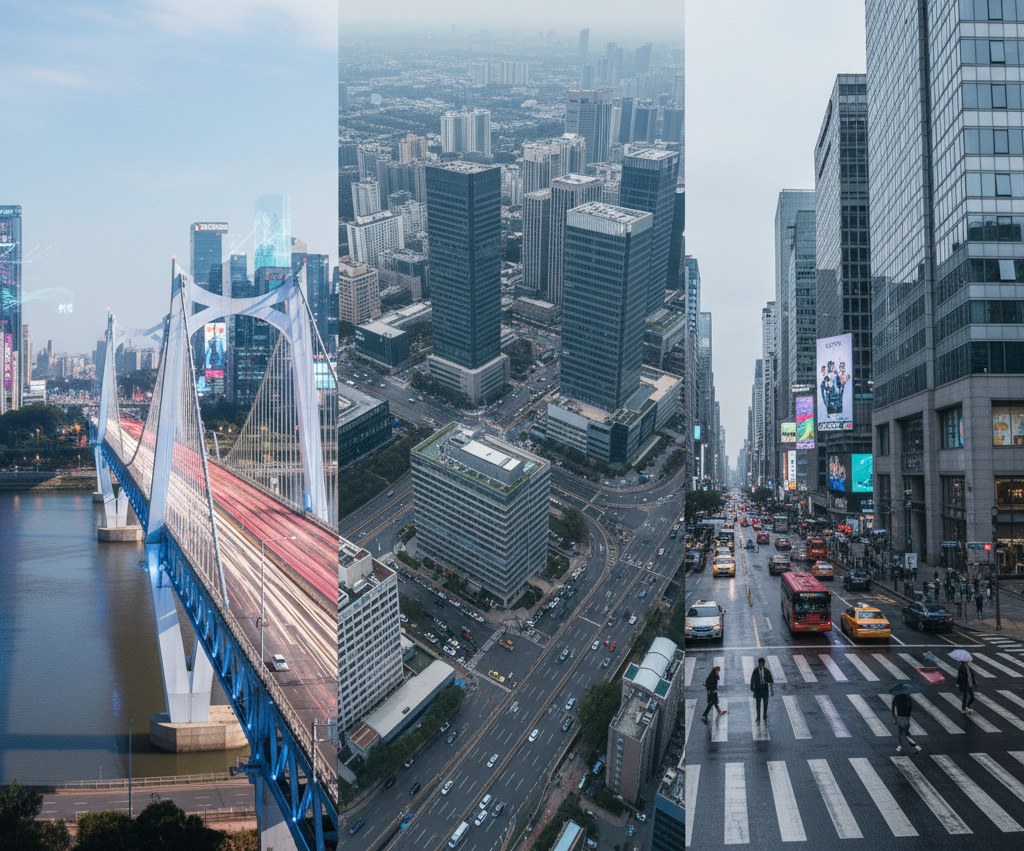
Cross the River for Ambition: Decoding Korea’s Economic Engine
[Series Intro]
The K-Welle Regional Reports read Korea not as a tourist destination, but as a ‘System of Choices.’
From the contrasting rhythms of Seoul divided by the Han River (Vol.1), to the engine of career and innovation expanding into the metropolitan area (Vol.2), the German networks and lifestyle efficiency found in regional cities (Vol.3), and the specialized laboratories designed for future industries (Vol.4).
Each report helps you design your own path based on Cost, Network, Experience, and Fit.
1. South of the River is Not Scenery, It’s the “Route of Industry”
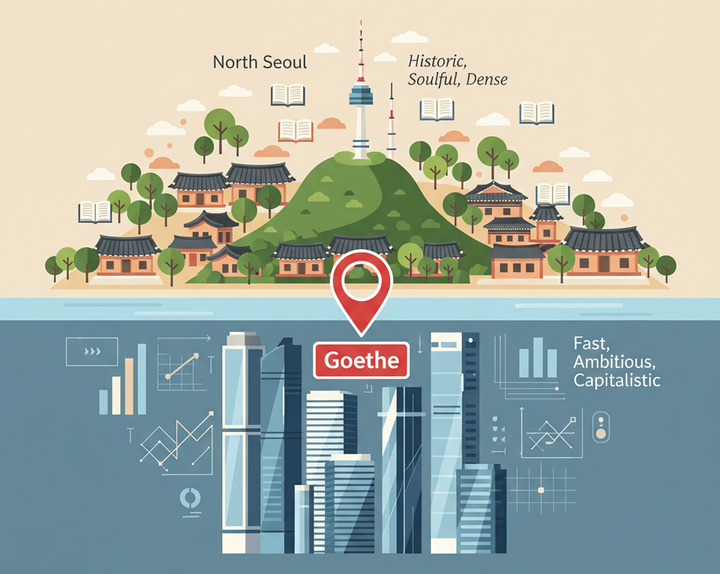
If Vol.1 read Seoul’s rhythm through emotion, culture, and life, Vol.2 reads Seoul and its metropolitan area through career, industry, and innovation.
As the subway crosses the bridge to the South of the River, the grammar of the view outside the window changes distinctly. The dense, traditional alleyways disappear, replaced by a massive grid concentrated with corporations, capital, data, and services.
This is a space dominated by efficiency rather than romance, results rather than process, and timelines of achievement rather than narrative.
The crucial question here is not “Where is it good to live?” but rather:
“Which experience connects to which industry structure?”
Why Korea Moves Fast
-
History
Limited resources → people and time became the strategy.
-
Reality
'Ppalli-ppalli' is a survival logic, not impatience.
-
Insight
Don’t judge—decode. Speed powered competitiveness..
Different from German stability. Same goal: resilience.
[Context Briefing] The Logic Behind Korea’s Speed
- History (Fact): Korea was a nation with almost no natural resources. The only resources the state could rely on were people and time. Korea achieved industrialization—which took the West a century—in just about 30 years (Compressed Growth).
- Reality (Phenomenon): Consequently, Korean cities are fast, the lifespan of buildings is short, and industry trends rotate rapidly. The so-called ‘Ppalli-ppalli (Hurry-hurry)’ culture is not a personality trait, but a strategic choice for national survival.
- IPE Insight: Before criticizing or idolizing this speed, it is necessary to understand it as the engine that drove Korea’s innovation and competitiveness. It is a different trajectory from German stability, but a different route toward the same goal—national competitiveness.
2. The Engine: Innovation Hubs & Clusters (The Metropolitan Route)
If Namsan is your psychological basecamp, Gangnam, Pangyo, Suwon, and Songdo are your ‘Fields’ for career exploration.
When passing through these areas, take out your earphones and listen to the noise of the city. That noise is not advertising; it is the signal of capital and talent in motion. Unlike German cities which are often functionally differentiated, the southern metropolitan area is a space where different industries coexist compressively.
Crossing Hannam Bridge, Into Samseong-dong
A. Gangnam & Teheran-ro: The Showcase of Compressed Desire
This is not a campus. It is a space of ‘Proof’ where meetings, recruitment, and pitching happen 24 hours a day. There are no universities here, yet the startups and global companies that university students most desire are all gathered here.
It is a space where the startup sensitivity of Berlin and the corporate centrality of Munich operate simultaneously on a single street.
- Thinking Point: Listen carefully to the conversations flowing in cafes and shared offices. Toward which industry is the energy of this street currently flowing?
B. Seoul National University (Gwanak): The Logic of the Elite Track
Its isolated location at the foot of Gwanak Mountain, away from the city center, is no accident. This is the space where Korean society’s research-centered elite track operates. Much like German research universities, networks and symbolic capital operate here over the long term.
- Thinking Point: Look at the library lights that stay on late into the night. Is the driving force here pure curiosity, or is it pressure accumulating within competition?
C. Pangyo: Korea’s Silicon Valley—But Korean Style
Home to Naver, Kakao, and gaming/platform giants, Pangyo hides a culture of speed-based competition behind hoodies and casual attire. It resembles Silicon Valley, but the attitude toward failure and the speed of decision-making within organizations are distinctly different.
- Thinking Point: Observe how developers here absorb failure and how quickly they recover their speed.
D. Suwon: The Heart of Manufacturing Innovation
Suwon is a place where the phrase “The city breathes with the company” fits perfectly. The manufacturing ecosystem centered on semiconductors and mobile technology forms the very rhythm of the city.
While the German Mittelstand and dual vocational training have strengths in gradual stability, Suwon demonstrates what happens when manufacturing is expanded to the level of a national strategy.
- Thinking Point: If Pangyo is the city of ‘Code,’ Suwon is the city of ‘Process.’
E. Songdo (Incheon): The Laboratory of the Future City
Built on reclaimed land from the sea, this city combines the Incheon Global Campus (IGC), a bio-cluster, and smart city infrastructure. It is a testbed showing how Korea designs a global education and research hub.
- Thinking Point: In this perfectly planned city, what does your desired future lifestyle look like?
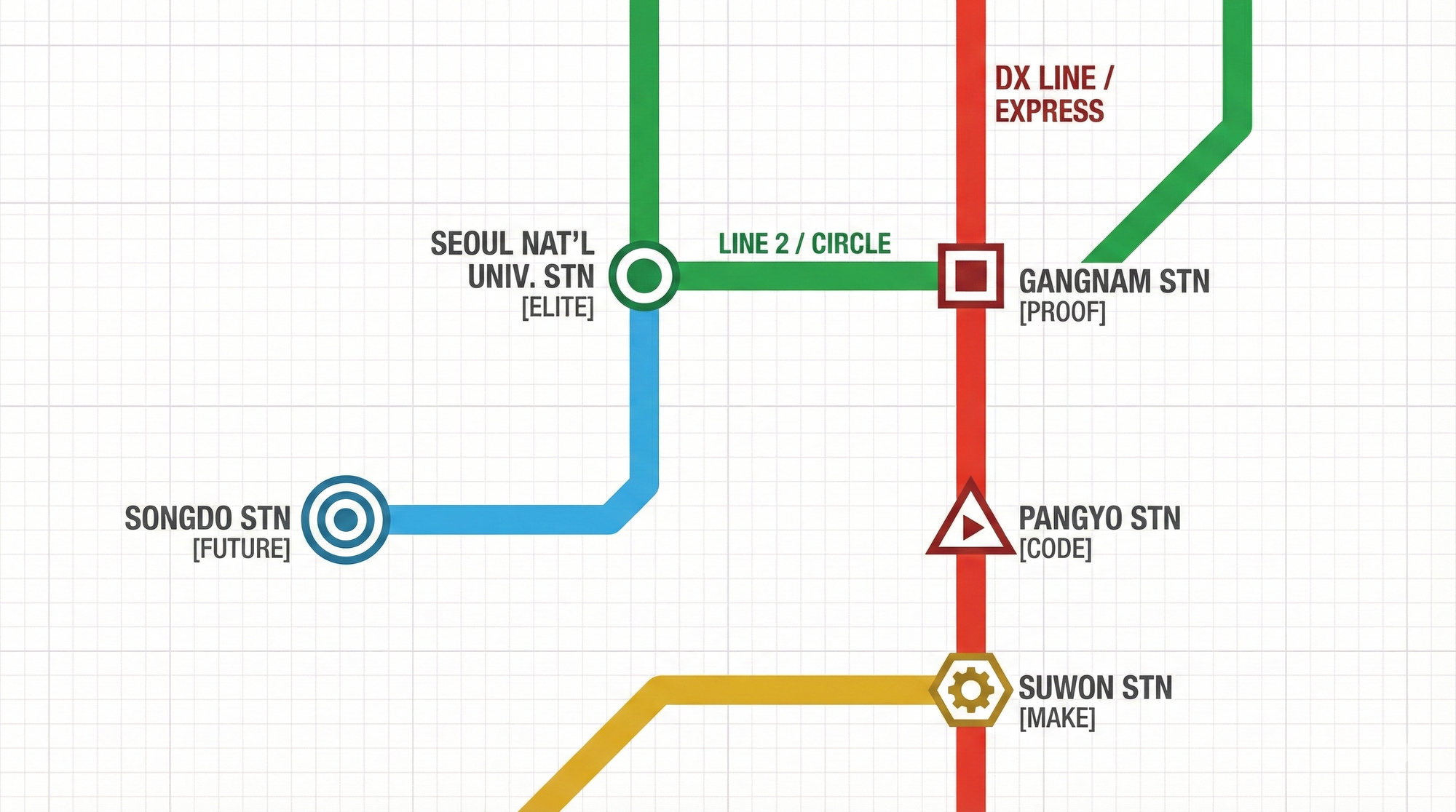
🚇 Seoul Industry Metro Map
Based on the official Seoul Metro network. Colors correspond to actual lines.
- DX Line (Red): Speed & Innovation (Gangnam ↔ Pangyo)
- Line 2 (Green): Elite Network (SNU ↔ Gangnam)
- Suin-Bundang (Yellow): Manufacturing Belt (Suwon ↔ Giheung)
- Incheon Line 1 (Sky Blue): Future City (Songdo)
3. Reality Check: The Two Faces of Opportunity & Cost
Entering this engine comes with a clear trade-off.
- High Density: Concentration of startups, investors, and global firms.
- Speed: Rapid transition from idea to product.
- Connection: Access to the frontline network of industry.
- High Cost: Highest rent and living expenses in Korea.
- Burnout: Reduced personal recovery time.
- Competition: Constant pressure for performance.
4. [Reflection] Questions for Your Journey
Do not just consume this city with your eyes. There are no right answers. Instead, you need questions.
- The Keyword: What word stopped your gaze on this street? How does it connect to your major or interests?
- The Shadow: What price does Korea’s speed demand from the individual? Are you prepared to handle that cost?
- The Connection: If you were to start your career in Korea, in which city would you want to stand?(For a German student, these questions can materialize into choices for exchange programs, internships, research participation, or corporate R&D.)
[Editor’s Note] Enjoy the Uncomfortable Speed, But Do Not Be Consumed
The speed of the metropolitan area exponentially increases the density of learning and opportunity, but it simultaneously demands the cost of ‘Burnout.’
Remember the Anchor Strategy from Vol.1.
Keep your residence in Gangbuk or near universities that offer emotional stability, and utilize Gangnam and Pangyo as destinations for ‘Strategic Expeditions.’
This is not an acceptance of Korean-style workaholism, but a choice in how you manage speed.
“This article does not recommend a single path.
It offers a way to think about Korea as a system of choices.”
Dawn Chang, PhD · Editor-in-Chief, K-Welle · editor@k-welle.com