Why Korea Leads AI Now
Watch Korea now: AI policy, industry, and Gen Z converging to create a unique live testbed for structural transformation.
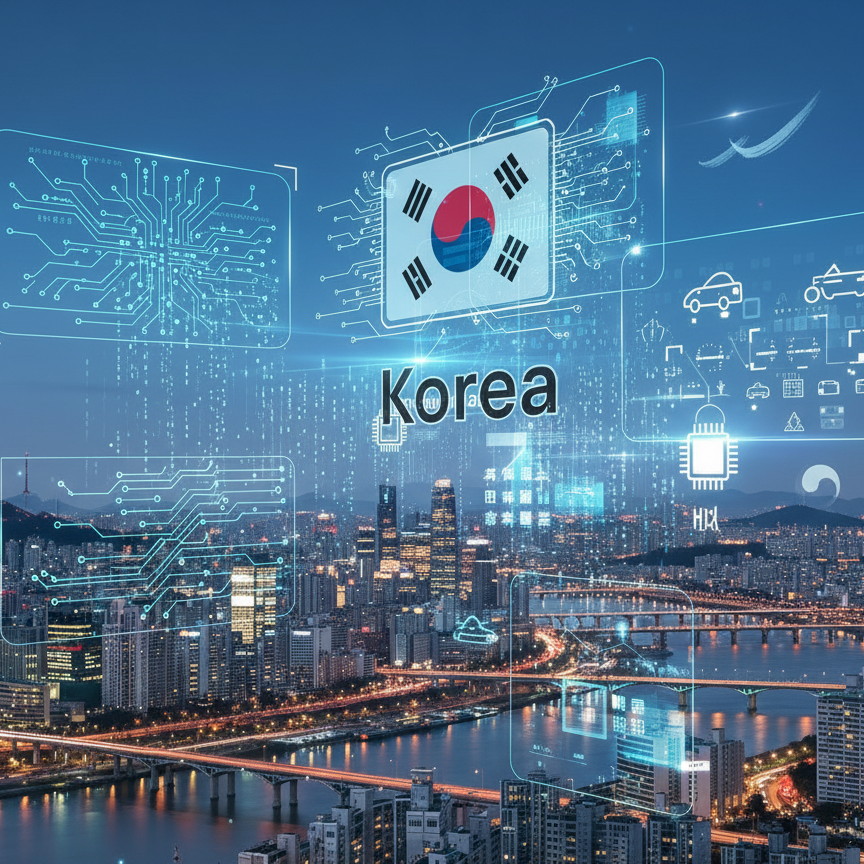
South Korea's AI Policy and Industrial Strategy Explained(2025): Turn Toward an “Innovation Testbed” Where Industry and Policy Interlock
Korea is rapidly evolving into a nation-scale innovation lab, as industry, government policy, and demographic shifts align on a single track.
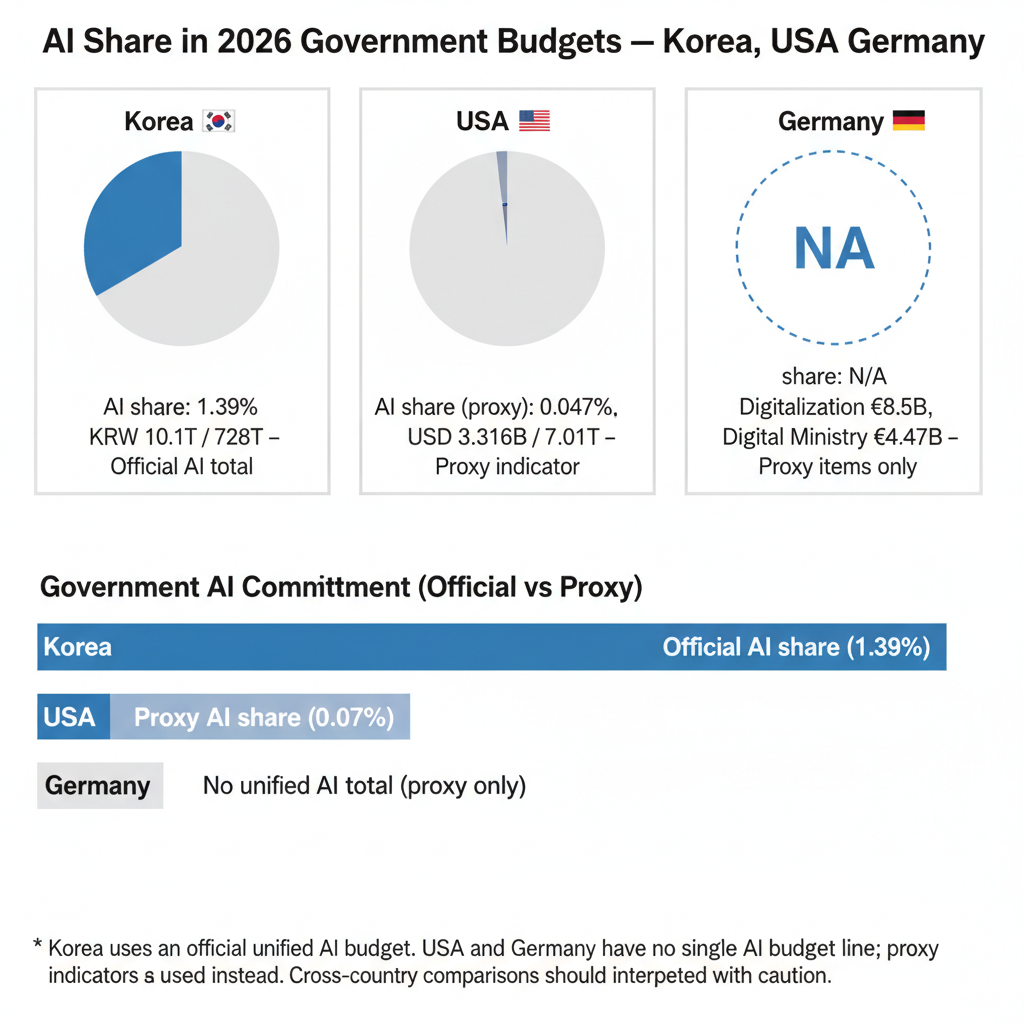
For the 2026 budget, the government allocated ₩10.1 trillion to AI—moving beyond simple tech promotion toward a strategic investment that retools national systems.
Internationally, the OECD recognizes Korea as one of the fastest countries to build data-driven public administration and AI infrastructure. As strong policy execution meets a fast industrial trial-and-error culture, Korea is building a new economic model where technology, culture, and policy operate together.
As this foundation strengthens, Korea is shifting from symbolic demonstrations of technological capability to systematic, budget-backed transformation.
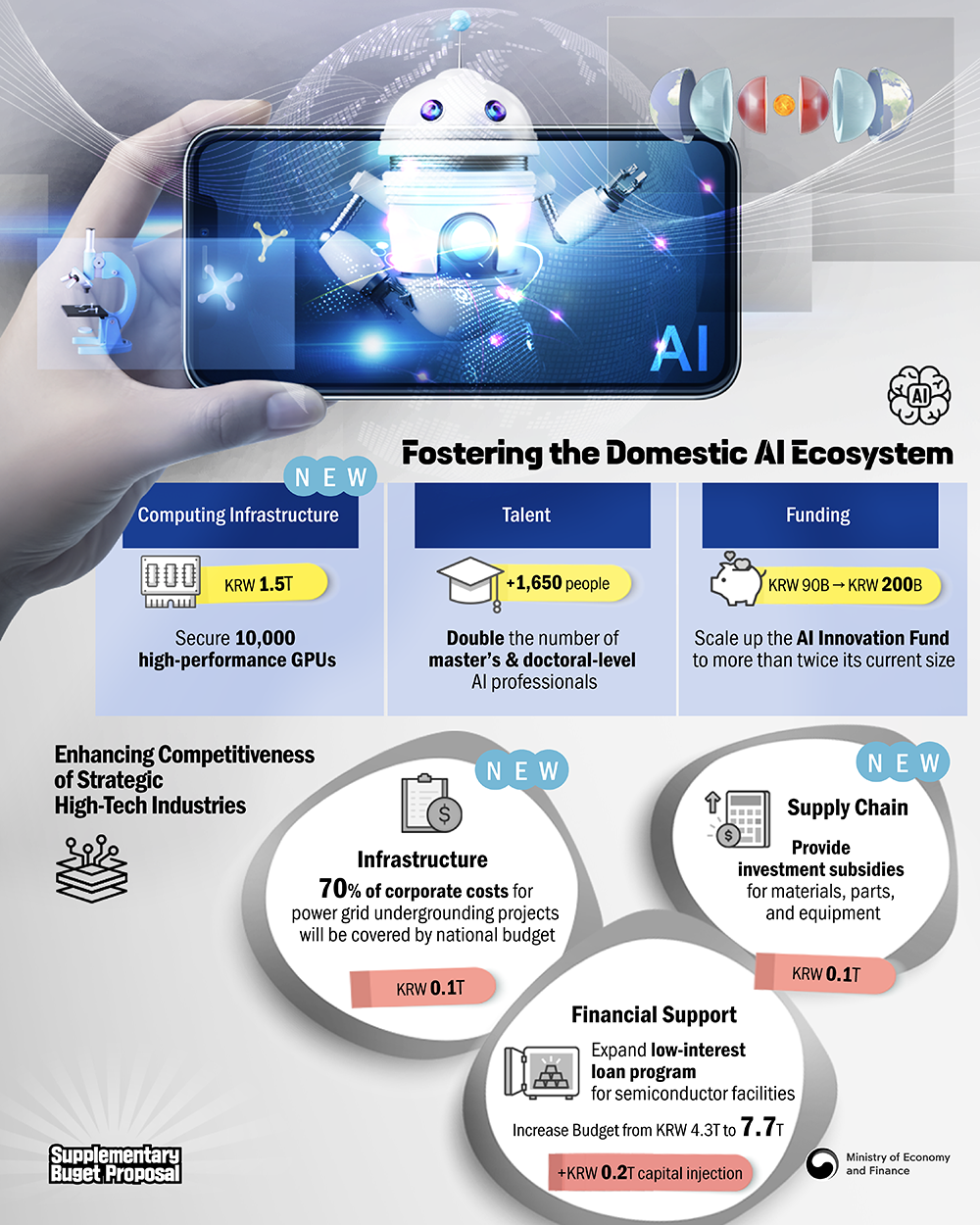
In April 2025, the Ministry of Economy and Finance announced a comprehensive AI industrial strategy focused on three pillars:
(1) national-scale computing infrastructure, (2) advanced talent development, and (3) an expanded AI innovation fund for startups and strategic industries.
This includes securing 10,000 high-performance GPUs, doubling the number of AI master’s and PhD-level specialists, and increasing the AI Innovation Fund from ₩90 billion to ₩200 billion.
Rather than isolated pilot projects, these initiatives form a coherent structure designed to embed AI into the country’s economic core.
The aim is clear: to reposition Korea not simply as a fast adopter of technology, but as a place where policy, industry, and emerging generations can prototype the future at scale.
Why Now? Structural Experimentation in a Low-Growth Era
he global economy faces low growth, aging populations, and weakening consumption. Korea also confronts ultra-low birth rates and soft domestic demand. Rather than treating these as mere crises, Korea is using them as a mandate to design a new growth structure.
The government is pushing a coordinated policy package to re-code the economy and society:
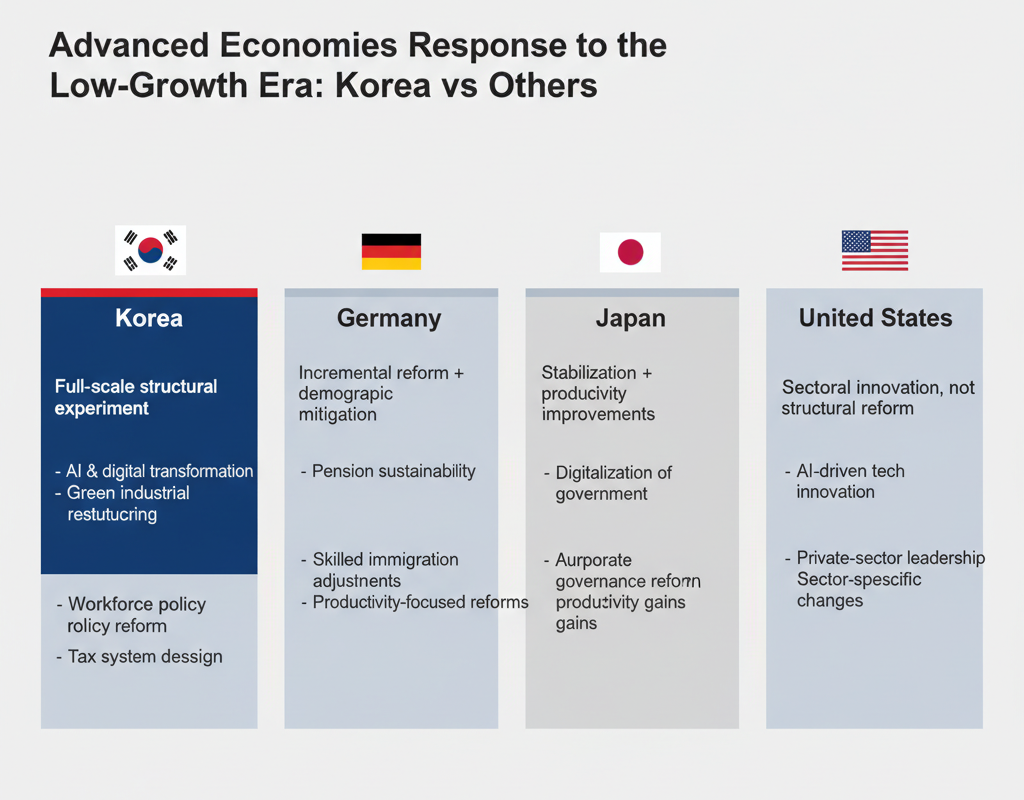
• AI and digital transformation
• ESG and green industrial restructuring
• Reforms to foreign workforce policy
• Tax system adjustments
Unlike many advanced economies that rely on incremental reforms, Korea views demographic and economic pressure as an opportunity to run a full-scale structural experiment. The goal is not only to stimulate growth but to redesign the architecture of how growth is created.
Each part of this package functions as a lever within a single, interdependent system. AI infrastructure expands the technological frontier; ESG restructuring redirects capital toward sustainable industries; foreign workforce reforms stabilize labor supply in key sectors; and tax adjustments modernize the state’s fiscal engine. Together, these measures show that Korea is not simply adapting to a low-growth era—it is attempting to prototype a new operating model for an advanced economy, where innovation emerges from the alignment of state capacity, industrial agility, and societal adaptation.
Yet Korea’s transformation is not driven by policy architecture alone. A new internal resource—its Gen Z—is reshaping demand from within. This generation acts not as passive consumers but as market-makers who blend technology, culture, design, and emotion to create new forms of value. Their rapid feedback loops and experimental consumption patterns provide the live testing conditions that allow Korea’s policy and industry experiments to materialize at speed.
Korea is where policy, industry, and a newly empowered generation converge at speed—making it one of the most compelling places today for Europe’s students and young innovators to learn, build, and experiment.
References Official sources
Click to expand / collapse (updated periodically)
Official sources used for the infographics “AI Share in 2026 Government Budgets” and “Advanced Economies’ Response to the Low-Growth Era”.
1) AI Share in 2026 Government Budgets
Korea
- MOEF — 2026 Government Budget Proposal (AI/Digital items). moef.go.kr
United States
Germany
- BMF — Bundeshaushalt 2026 (digital/innovation items). bundesfinanzministerium.de
2) Advanced Economies’ Response to the Low-Growth Era
Korea
- MOEF — Medium-Term Fiscal Strategy. moef.go.kr
- KDI — Structural reform / productivity reports. kdi.re.kr
Germany
- BMF — Fiscal framework. bundesfinanzministerium.de
- BMAS — Skilled immigration & labour measures. bmas.de
Japan
- Cabinet Office — Economic & Fiscal Report. cao.go.jp
- METI — Productivity / governance reforms. meti.go.jp
United States
- CBO — Long-Term Budget Outlook. cbo.gov
- Commerce — AI/digitalization reports. commerce.gov
Cross-national
Dawn Chang, PhD · Editor-in-Chief, K-Welle · editor@k-welle.com