K-Living Cost Structure
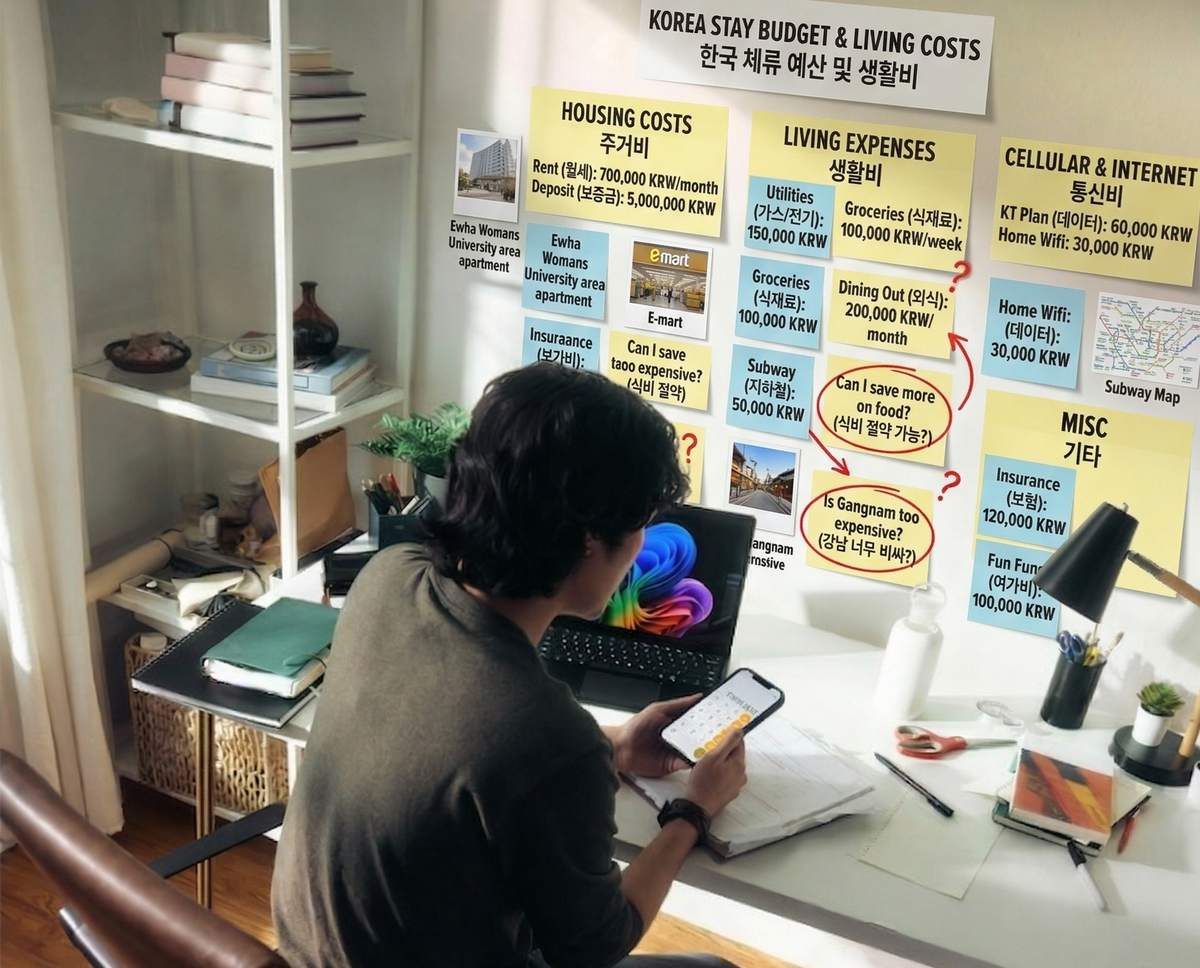
Understanding the Cost System of Staying in Korea
Housing in Korea does not strictly operate as a monthly system.
However, when estimating the cost of staying, calculating expenses on a monthly basis makes it easier to compare living costs across different lengths of stay.
For individuals planning to stay in Korea, living expenses can generally be divided into Fixed Cost and Variable Cost two categories.
Among these costs, housing represents the largest component of fixed expenses.
Variable costs differ depending on length of stay, lifestyle, and activity purpose, and the categories of spending may shift over time.
Housing Options
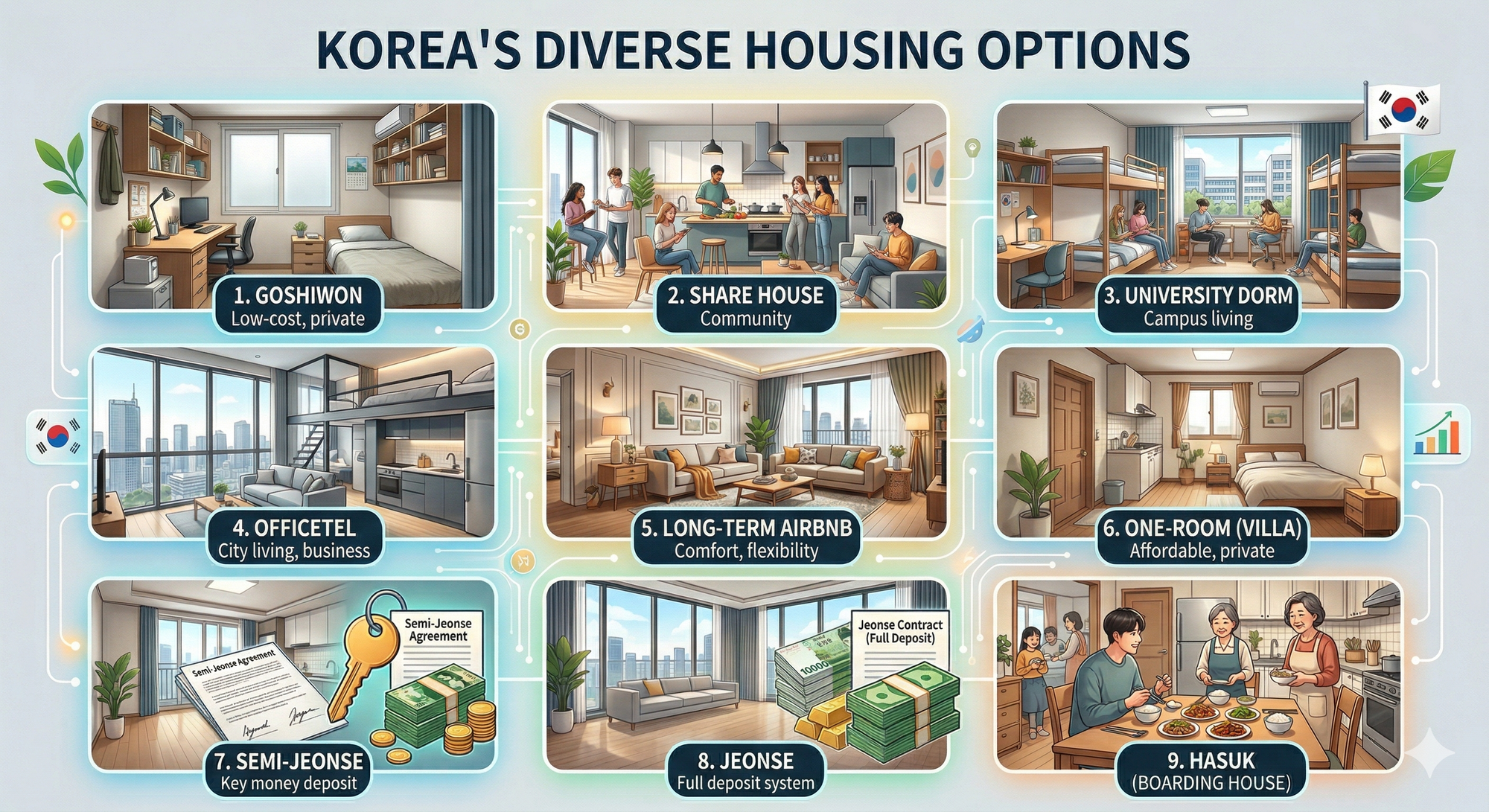
Common Housing Types for Foreign Residents
Housing costs in Korea depend not only on rent but also on how the housing contract is structured.
Two different housing cost structures commonly exist.
| Payment Structure | Housing Types | Monthly Expenses (Maintenance, Utilities, Web) |
|---|---|---|
| Rent-Inclusive |
Goshiwon, Share House, Dormitory, Hasuk |
Included in Rent
|
| Deposit-Based |
One-room, Officetel, Semi-Jeonse, Jeonse |
Paid Separately
|
| Type | Key Features | Deposit (USD) | Monthly Rent (USD) |
|---|---|---|---|
| Goshiwon | Micro-studio, low deposit, immediate move-in | $0 – $150 | $230 – $460 (All-inclusive) |
| Share House | Shared spaces, community-oriented | $380 – $1,540 | $380 – $770 (Mostly inclusive) |
| Univ. Dorm | Most affordable, secure environment | Minimal | $150 – $380 (Inclusive) |
| Officetel | Private kitchen/bath, modern lifestyle | $3,800 – $15,400 | $540 – $1,150 (+Utilities) |
| Long-term Airbnb | Fully furnished, flexible stay | None | $770 – $1,920 (Inclusive) |
| One-room (Villa) | Most common, private living | $2,300 – $7,700 | $310 – $620 (+Utilities) |
| Semi-Jeonse | High deposit, reduced monthly rent | $15,000 – $75,000 | $80 – $310 |
| Jeonse | Deposit-based system, no monthly rent | $38,000 – $150k+ | $0 |
| Hasuk (Boarding) | Includes home-cooked meals | $0 – $770 | $380 – $690 (Meals incl.) |
Health Insurance
Insurance requirements depend on the length of stay.
| Stay Duration | Insurance Type | Key Requirements |
|---|---|---|
| Short-term (< 90 Days) |
Travel Insurance / International Student Insurance |
Arranged privately before or during travel. |
| Long-term (> 90 Days) |
National Health Insurance (NHI) | Mandatory. Requires Alien Registration Card (ARC) for enrollment. |
Typical contributions:
| Category | Monthly Cost |
|---|---|
| Students / no income | $45 – $60 |
| Employees | about 7% of monthly income |
Communication Costs
Communication expenses consist of two components.
- Mobile phone service
- Internet connection
| Category | Housing Types / Details | Monthly Cost (USD) |
|---|---|---|
| Included Internet |
Goshiwon, Share House, Dormitory, Hasuk (Boarding), Airbnb |
$0 (Included in Rent) |
| Separate Subscription |
One-room (Villa), Officetel, Apartments |
$15 – $30 |
| Mobile Plans |
Prepaid SIM or Monthly Contract (Data-heavy plans vary by provider) |
$30 – $60 |
Variable Cost
Monthly Variable Budget (Seoul)
Variable costs depend on lifestyle and activity level.
| Category | 3 Months | 6 Months | 1 Year | Notes |
|---|---|---|---|---|
| Food | $310 – $460 | $270 – $420 | $230 – $380 | Short stays involve more dining out |
| Transportation | $60 – $90 | $50 – $80 | $45 – $70 | Tourist mobility increases early costs |
| Leisure & Culture | $115 – $190 | $90 – $150 | $75 – $140 | Cultural exploration highest in early months |
| Shopping | $40 – $115 | $40 – $90 | $40 – $75 | Clothing and lifestyle goods |
| Communication | $0 – $23 | $0 – $20 | $0 – $15 | Additional data usage |
| Healthcare | $8 – $23 | $8 – $23 | $8 – $23 | Pharmacy and minor care |
| Education | $75 – $150 | $60 – $115 | $40 – $90 | Language courses or workshops |
| Miscellaneous | $15 – $40 | $15 – $30 | $8 – $23 | Gifts or small purchases |
Why Short-Term Stays Often Feel More Expensive
People staying for three months typically spend more on experiences rather than daily life operations.
Dining out, cafés, travel, and cultural activities tend to represent a larger share of spending.
As a result, monthly variable costs are usually highest during the early stage of a stay.
After about six months, daily routines begin to stabilize.
Transportation becomes more predictable, and spending patterns become more consistent.
For residents staying around one year, consumption often shifts toward planned living patterns such as grocery shopping and routine expenses.
This makes monthly variable costs easier to manage.
Longer stays do not necessarily reduce total spending, but they generally improve monthly cost efficiency.
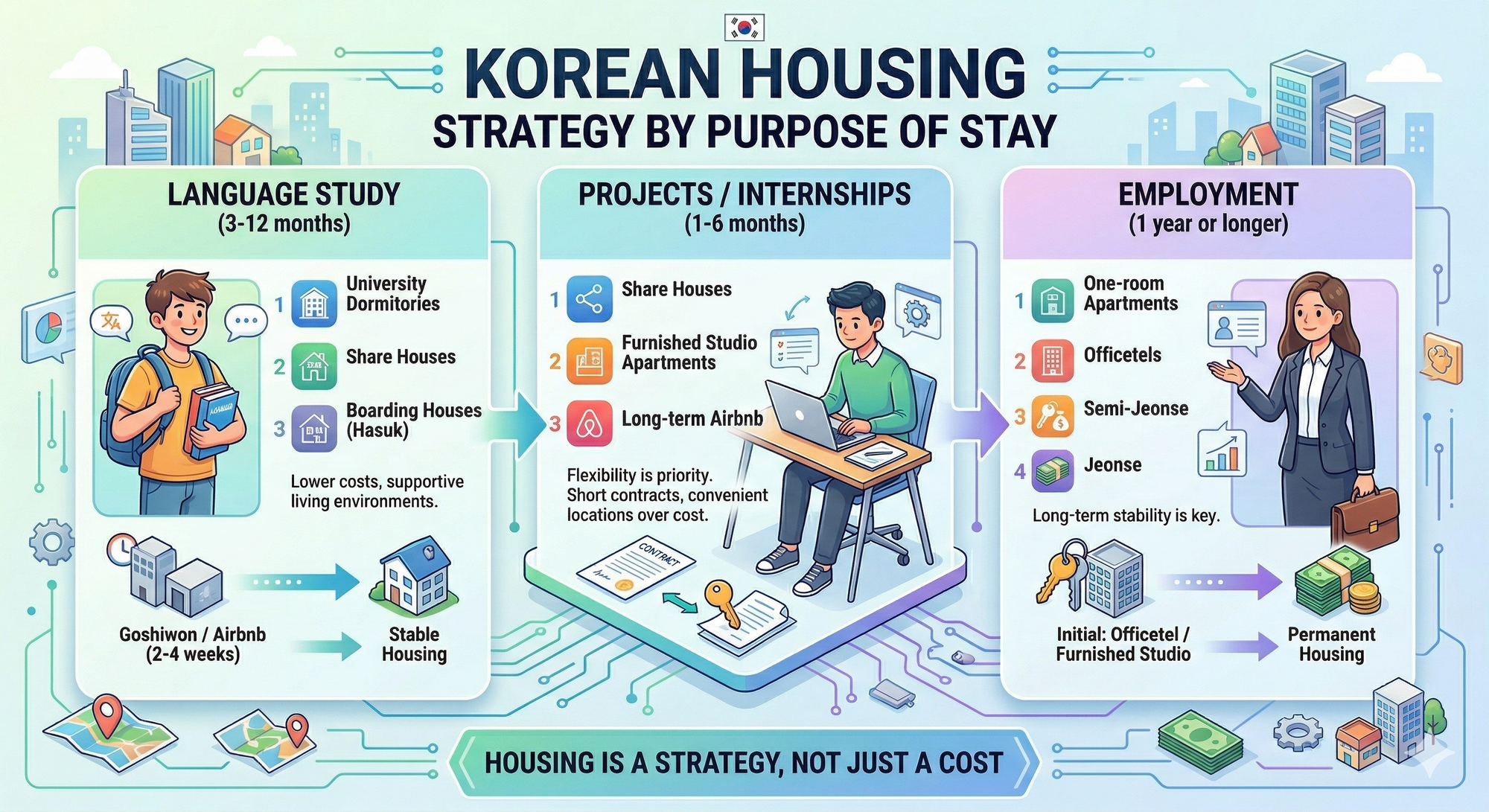
What purpose of stay, what length of stay, and what cost structure can be sustained?
Short stays benefit from flexible housing with low deposits.
Longer stays benefit from more stable housing structures, even if deposits are higher.
Before the 90-day mark, housing represents the core cost of staying.
After 90 days, health insurance and communication services become integrated into the fixed cost structure of everyday life.
Variable costs may decrease as the length of stay increases, but this reduction does not occur automatically.
It depends on whether temporary spending patterns transition into a stable living routine.
Korean Housing Terms
These are housing terms that may feel unfamiliar to German and European readers.
고시원
오피스텔
하숙
전세
반전세
보증금
References
The cost indicators in this article are based on public housing, insurance, communication, and living-cost data commonly used in Korea.
- Korea Real Estate Board – Monthly rent trends, deposit structure, and housing market indicators
- Statistics Korea (KOSIS) – Household expenditure and consumer spending data
- Seoul Metropolitan Government – Seoul living-cost and urban lifestyle survey data
- National Health Insurance Service – Health insurance requirements and premium guidance for foreign residents
- Ministry of Science and ICT – Mobile plan and internet service pricing information
- Numbeo – Comparative Seoul living-cost database for international readers
Dawn Chang, PhD · Editor-in-Chief, K-Welle · editor@k-welle.com