Vol.1 Seoul’s Dual System: Density vs. Velocity
Seoul’s Two Faces: Finding Your Anchor Between History and Ambition
This series is not a Korea tips column. It is a guide to designing a long-stay Korea strategy.
Our core readers are German and European students planning to stay in Korea for three months or longer—as exchange students, visiting researchers, interns, or field explorers.
K-Welle focuses on how to understand Korea through systems (institutions, cities, industry routes) and cost–benefit logic (housing, mobility, time, opportunity cost), rather than listing trending places or short-term attractions. Instead of “what to do,” we focus on where to base yourself, what to optimize for, and which daily routes connect culture to career.
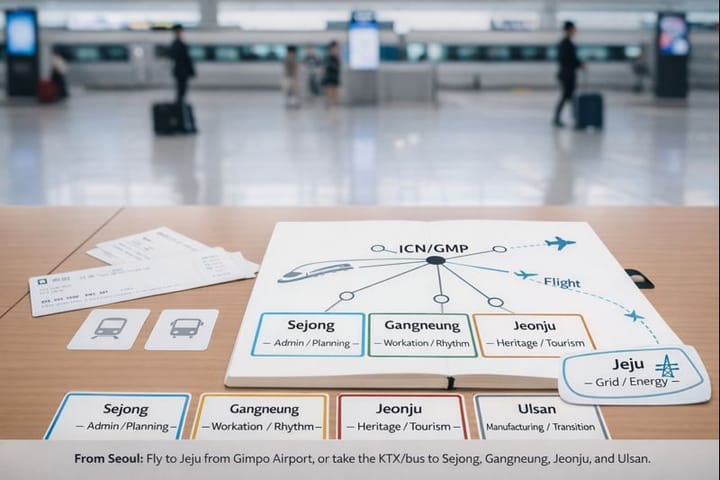
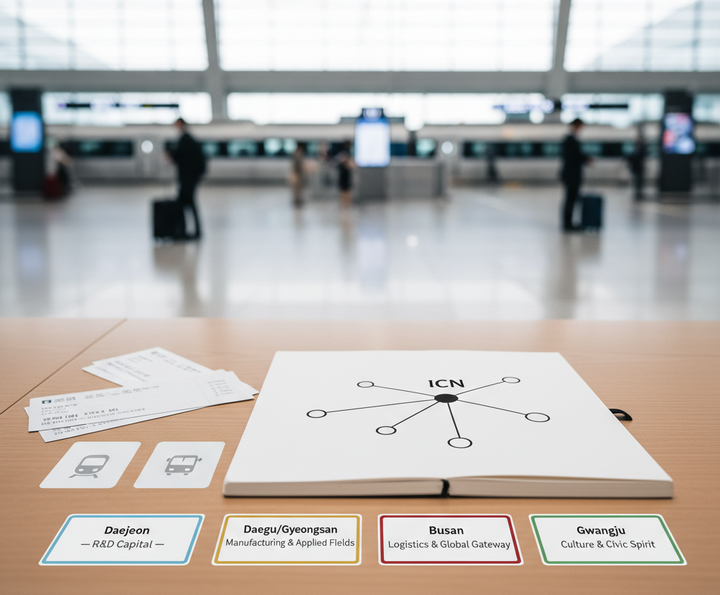
Vol.1 decodes Seoul’s rhythm across the Han River. Vol.2 maps the capital region’s career and innovation engine. Vol.3 highlights regional hubs where German networks and cost-efficiency become clearer. Vol.4 explores specialized purpose-built cities aligned with majors and future industries.
We do not offer a single correct city. We offer a way to design your route based on your goal.
1) Cross the River—or Stay?
The first structural reality long-stay visitors feel in Seoul is the Han River. In the two minutes a subway crosses the bridge, the city outside the window changes—sometimes more dramatically than any travel brochure admits.
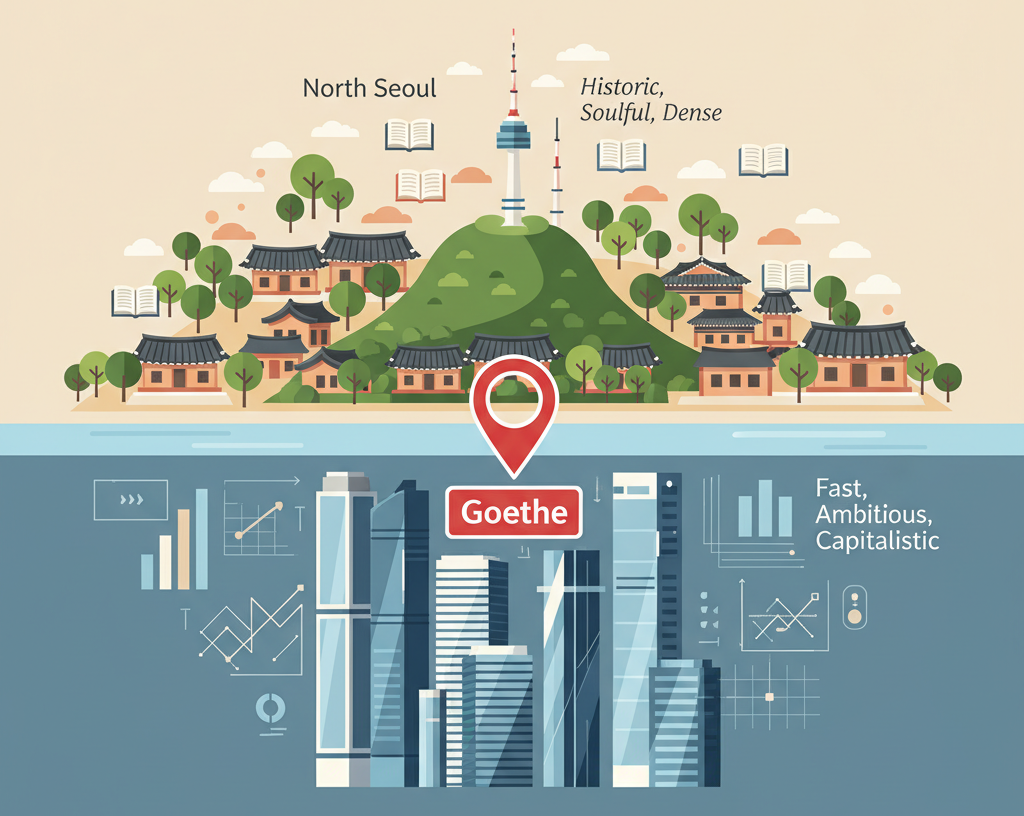
North of the river (Gangbuk) concentrates cultural and academic density—palaces, museums, hillside neighborhoods, and local community rhythms that naturally slow your pace. South of the river (Gangnam) concentrates capital and industry routes—wide grids, glass towers, and a 24/7 tempo that assumes speed.
Before you choose a school, choose your base. Ask:
What do I need most right now?
Is it emotional stability (Emotional Density)—or an environment that pushes you into career acceleration (Growth Speed)?
This is not taste. It is strategy.
2) The Anchor: Goethe-Institut Korea at Namsan
At the seam where these two Seouls collide sits Goethe-Institut Korea, near Namsan (Huam-dong). Geographically it is close to the city’s middle; psychologically it can function as a long-stay anchor.
Namsan (Huam-dong)
Together with nearby cultural institutions, the area forms a quieter diplomacy & culture belt compared to high-intensity commercial zones. From the Namsan slope, you can place History (older roofs and alleys) and Ambition (the southern skyline) into the same frame—useful when you are redesigning balance, not chasing novelty.
3) The Network: Read Seoul by Living Areas—not Rankings
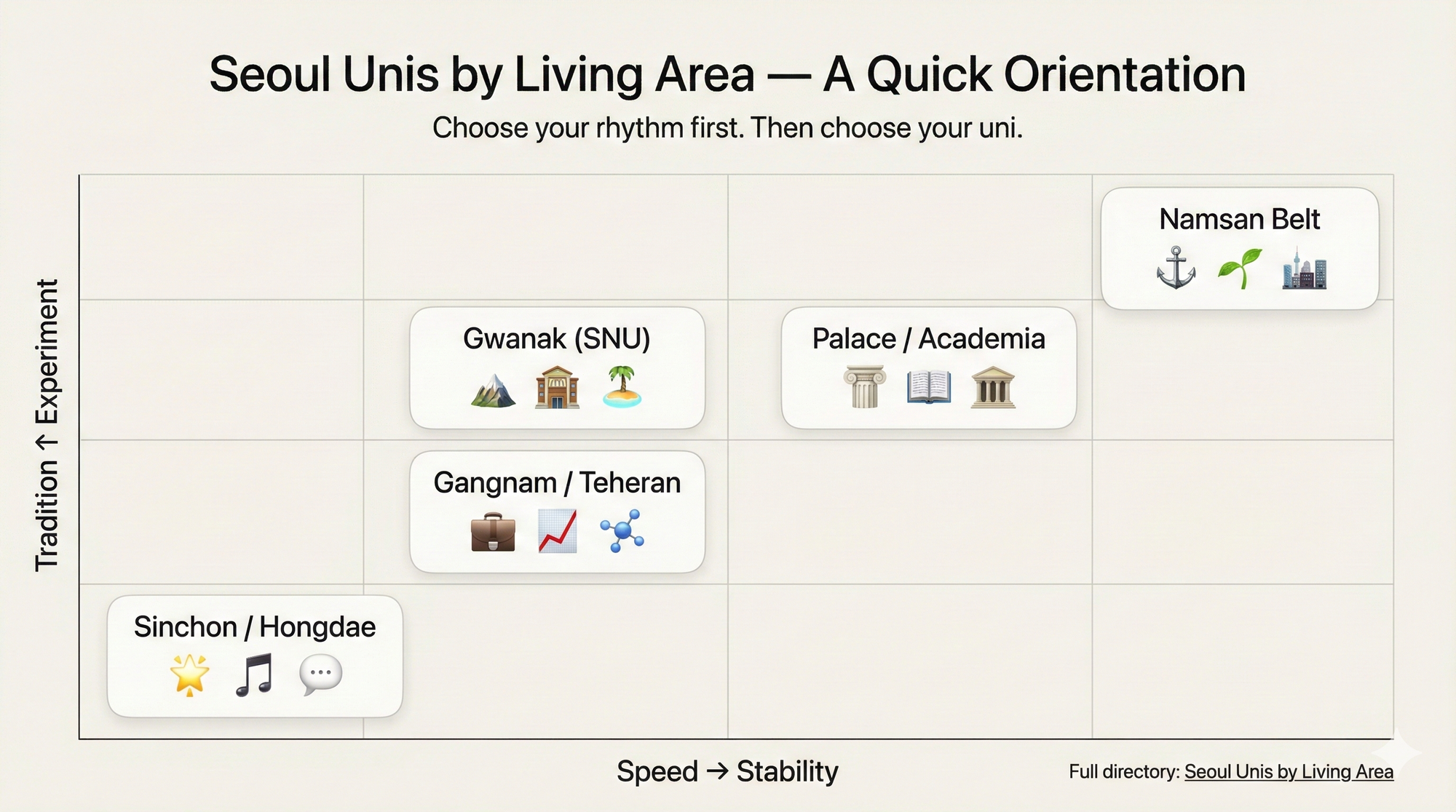
Seoul’s university landscape becomes clearer when you view it as city functions, not league tables. The most useful question is not “Which university is best?” but: Which living area supports my goal—and my daily rhythm?
Reference Directory: For a detailed, always-updated guide to Seoul universities by living area (including notes related to language programs and long-stay routines), please see the K-Welle directory page: Seoul Unis by Living Area
For this Vol.1 post, here is the simplified structure that matters most for first-time long stays:
A. North of the River: Culture & Academic Density (Gangbuk)
- Namsan / Jung-gu living area: stable routines near the city core; easier to balance culture and daily logistics.
- Jongno and adjacent heritage-academia areas: dense time layers (heritage + humanities + museums).
- Sinchon / Hongdae living area: exchange-student density and international interaction; high exposure to contemporary youth culture.
B. South of the River: Career & Industry Routes (Gangnam and beyond)
- Gwanak living area: designed for immersion and academic density rather than city-culture convenience.
- Gangnam-daero / Teheran-ro: the industry route—startups, big firms, conferences, and capital flows. Less campus, more field.
Three fast decision questions
- Is your #1 priority stability (life rhythm / emotional base) or opportunity (career / industry routes)?
- Are you immersion-type (research / focus) or community-type (network / exchange)?
- Which daily mobility cost (time/energy) are you willing to pay—repeatedly?
4) Reality Check: The Cost of Romance
Gangbuk’s romance comes with real trade-offs: hills, older housing stock, and practical inconveniences (insulation, parking, building conditions) compared to newer officetel-style living. For long stays, this friction can either drain you—or teach you Seoul’s layered time—depending on whether you treat it as a design variable.
Editor’s Note: Design for Balance
Gangnam’s intensity is attractive—but if you enter unprepared, it can accelerate burnout. My recommendation is structural:
Root your life in the north (emotional base, culture, recoverable rhythm) and extend into the south (industry routes, trend exposure, career experiments) when you need it.
The Han River is not a line of separation; it is a bridge of optionality—if you actively use it.
This article does not recommend a single path. It offers a way to think about Korea as a system of choices.
Dawn Chang, PhD · Editor-in-Chief, K-Welle · editor@k-welle.com