Pali-Pali OS
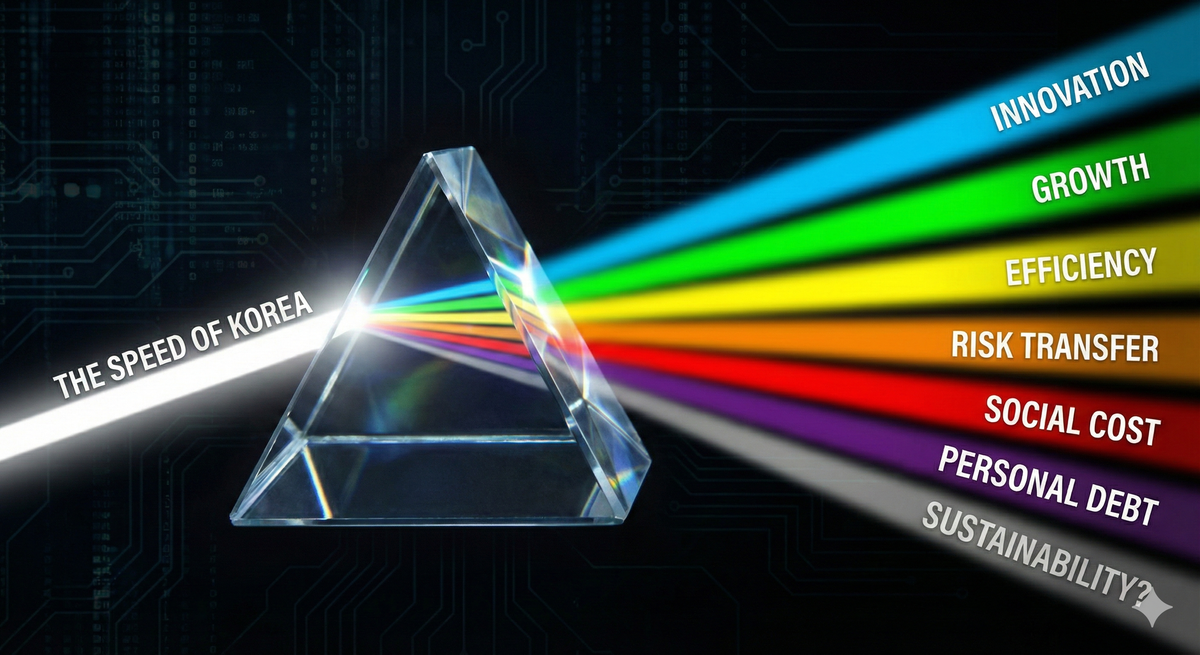
Not “Hectic,” but Korea Designed for Wait Removal
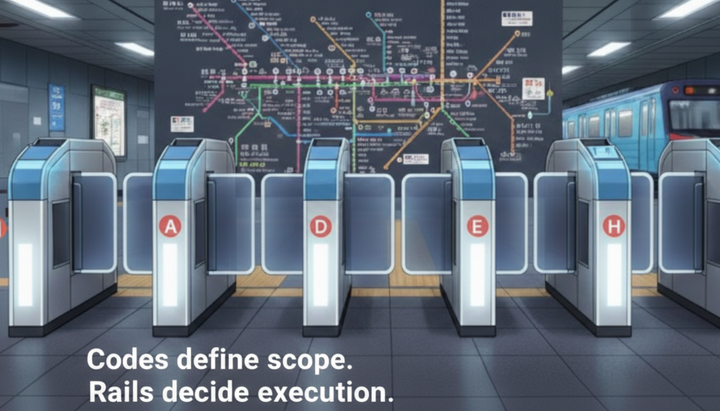
Korea’s speed is rarely the product of people rushing. It is more accurately the product of waiting being engineered out of the process.
This chapter asks one question:
Why does Korea—often a place where execution happens automatically—look like a place that “decides quickly”?
Korea’s global standing in digital government helps explain why this feels tangible. In the UN’s 2024 E-Government Development Index, Denmark ranks 1st, Estonia 2nd, Singapore 3rd, and the Republic of Korea 4th (EGDI 0.9679).
In the OECD’s 2023 Digital Government Index (DGI), Korea ranks 1st overall.
“Korea Operating System” as design, not vibe
It is the shared set of layers that governs how everyday interactions—civil requests and petition feedback, payments, contracts, delivery, and alerts—actually flow.
K-Digital Trust Stack
Operational Architecture
Verification wall & machine-verifiable ID claims.
Automated conditions and process-trigger logic.
Proof-sharing across diverse services & institutions.
“Korea is fast” is what the user experiences.
“Wait removal” is what the system is doing.
Speed is not haste—it is wait removal
Many comparisons start like this:
- Korea: fast vs Europe: careful
That framing is emotionally satisfying and analytically weak. The core distinction is not personality. It is process architecture—whether a system relies on discretionary approval or rule-based automation.
Korea’s speed often comes from a structural move: not approving faster, but reducing how often approval is required—primarily by removing repetitive proof and the time-cost of re-verifying the same facts across institutions and transactions.
"approval waiting” disappears in ordinary places
If you observe daily life closely, you will notice a recurring pattern: action begins without a visible “permission moment.”
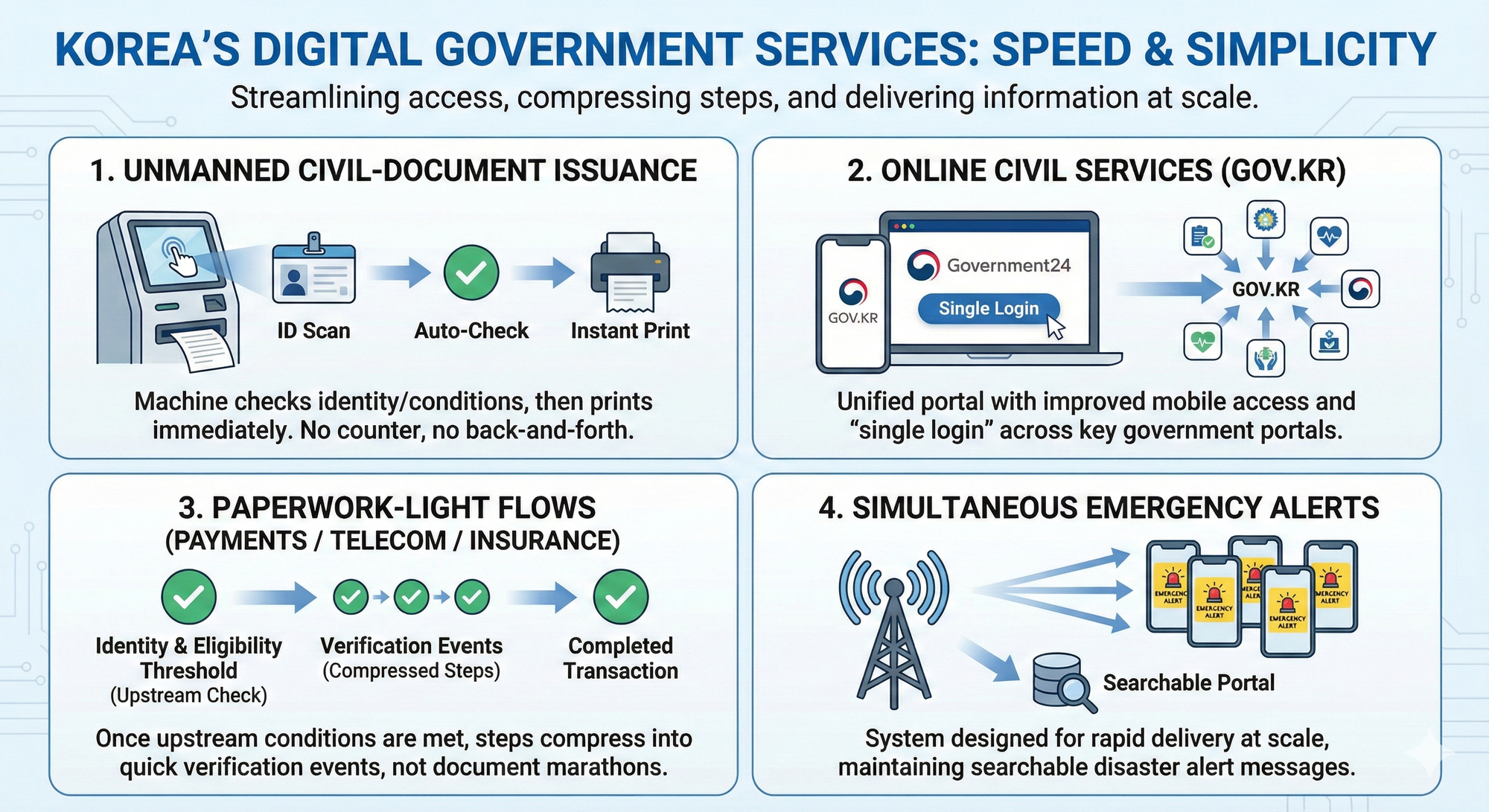
Across these scenes, the common pattern is clear.
The system does not ask, “Is this person okay?”
Instead, it asks: “Have the conditions already been met?”
Institutions: ex-ante alignment beats ex-post approval
Korea’s public–private operating rhythm is often misread as “fast decision-making.” In many domains, the institutional move is different: make the decision unnecessary at the transaction edge—by shifting time-costs upstream and eliminating repeated proof at the point of use.
That requires three design commitments:
Conditions must be explicit
If thresholds and eligibility are ambiguous, automation collapses into endless review.
Conditions must be digitally provable
This is where identity infrastructure becomes the first dependency—identity as a computational prerequisite, not a cultural trait. (See Case Identify Verification.)
Proof must be reusable across systems
The real killer of time is not a single form; it is repeated re-validation of the same facts across institutions. Interoperability is the wait-removal engine.
Speed is not effort. It is alignment.
And that alignment is not a “Korean trait”—it is a property of the OS: rules made explicit, proofs made digital, and systems made interoperable.
Korea as an industrial testbed: fast learning beats perfect design
Not “design perfectly, then launch,” but “launch under conditions, then iterate.”
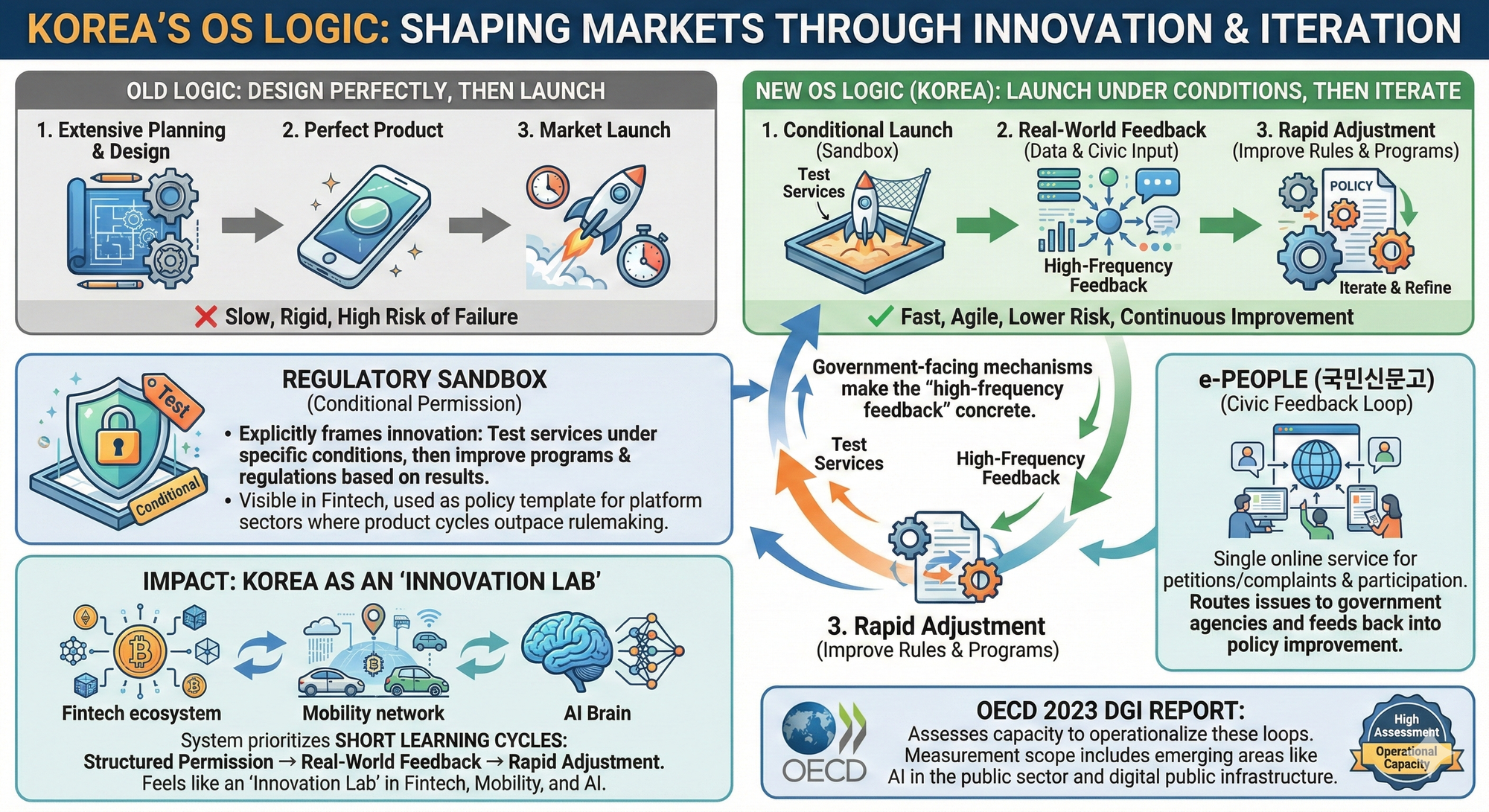
This is why Korea can feel like an “innovation lab” in areas such as fintech, mobility, and increasingly AI: the system prioritizes short learning cycles—structured permission, real-world feedback, rapid adjustment. The OECD’s 2023 DGI report also notes that the measurement scope includes emerging areas such as AI in the public sector and digital public infrastructure, underscoring how governments are being assessed on their capacity to operationalize these loops.
Trade-offs: “outside the standard” suddenly becomes slow
Wait removal has a cost. In rule-based systems, the margin is where pain concentrates.
Exception handling cost: it slows down abruptly outside the standard
Infrastructure fragility becomes a national variable
Wait removal is powerful. But the more you remove waiting through automation, the more the resilience of the central stack—core infrastructure, interoperability, and identity layers—becomes a key variable in national operations.
What the reader needs: a fit and bottleneck diagnosis
The conclusion of this chapter is not an evaluation of Korea’s OS.
What the reader needs is a fit and bottleneck diagnosis.
Fit
Am I comfortable with a system that is slower but allows more exceptions/negotiation?
Or do I fit better in a system that is fast but condition-clear, where exceptions are inconvenient?
Bottleneck
In Korea, the slow part is often not “daily life,” but entry qualifications (permissions).
Everyday transactions may speed up—yet the bottleneck appears until you become a user who meets the conditions.
Dawn Chang, PhD · Editor-in-Chief, K-Welle · editor@k-welle.com

![How Cost & Accessibility Shape City Choice for Gen Z [Vol 2.]](/content/images/size/w720/2026/02/nano-banana-2026-02-03T10-53-01-1.png)