

The Money Behind Public Labs
Who funds public labs — and what do companies pay?
“Public labs do not remove a company's costs. They change what kind of cost it is, when it falls, and who bears it.”
— EPISODE KEYSTONE
PART I · LENS 2 · INFRASTRUCTURE
Public Labs in a Country Where Companies Do the Research
Public labs do not disappear in countries where companies spend most of the R&D money. In Korea and in Germany alike, companies are the largest performers of research and development. But if companies do most of the R&D, why are public labs needed at all?
It is not efficient for every company to buy expensive analytical equipment, build its own pilot plant and employ researchers from many fields for years. Some technologies need long research before a market exists; some facilities are better shared than owned separately by a handful of companies. So public research institutes keep up long-term research, along with research capabilities and testing and validation infrastructure that a single company would struggle to maintain. But a public lab does not make researchers' time or equipment free. Someone has to pay the salaries, buy and maintain the equipment, and run the pilot facilities.
Understanding a public lab therefore means separating two questions. Who keeps the lab running? And when a company uses the lab, who pays? The two are not independent. The formula of money that keeps a lab running shapes how the lab behaves; that behaviour shapes the doors to cooperation that open for companies; and those doors change what companies actually spend on R&D. This episode follows that sequence in Korea and in Germany.
If Companies Do Most of the Research, Why Public Labs?
Korea's total R&D expenditure in 2024 was KRW 131.05 trillion. Of that, 78.8% came from private and foreign sources and 21.2% from government and public sources. By performer, companies spent KRW 106.70 trillion, or 81.4% of the total; public research institutes accounted for 10.1% and universities for 8.4%. In Germany, too, companies hold the largest share. Total R&D expenditure in 2024 was €137.1 billion: companies spent €92.5 billion, universities €24.1 billion and research institutions outside universities €20.4 billion. As shares, that is 67.5% for companies, 17.6% for universities and 14.9% for non-university research institutions.
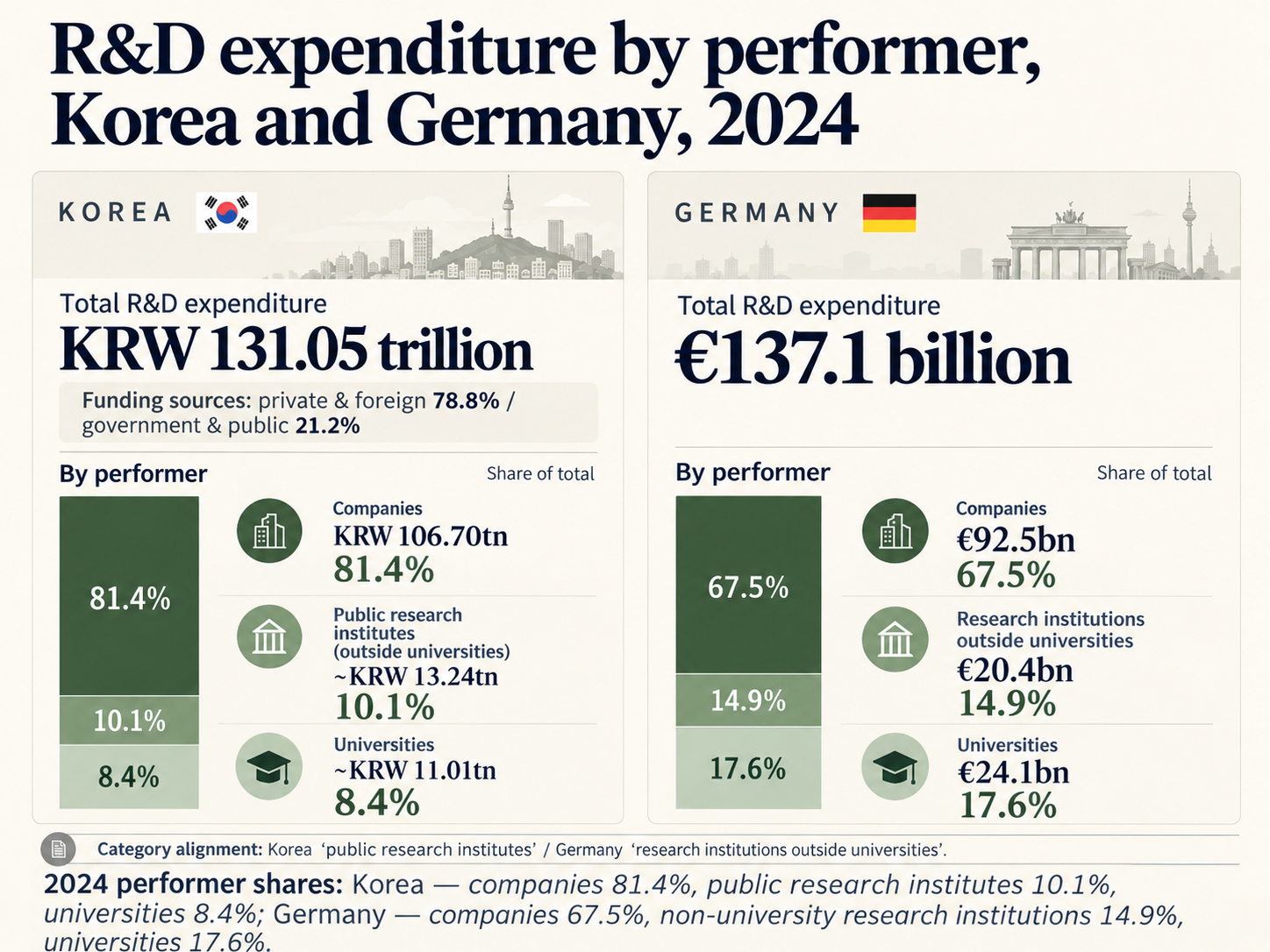
On these numbers alone, public research institutes are a minority of total R&D. But that small share carries functions that differ from a company's in-house lab. A corporate lab researches for its own products and markets. Public research institutes hold equipment and specialists that no single company could easily maintain, and run testing, analysis, validation and pilot infrastructure that many companies and organisations can use. They also take on research before a market has fully formed, and technologies whose risks no single company could carry alone. A public lab's role is not only to research ahead of companies. Keeping shared research capabilities that companies need not each own is just as important. The next question follows naturally: where does the money to maintain those capabilities come from?
Where Does a Lab's Money Come From?
In 2025 the Fraunhofer-Gesellschaft had a total business volume of €3.6 billion, of which contract research — its core business — accounted for €3.2 billion. The money comes from three sources: base funding from the federal and state governments; research contracts and licence income from companies; and competitive public project funding from the federal and state governments and the EU. Under the Fraunhofer model, base funding is capped at one-third, shared 90:10 between the federal government and the states. The rest the institutes must win competitively from outside. In 2025, externally earned income made up 71.1% of the operating budget. Within that, industry revenue accounted for 31.0% and federal and state public projects for 30.1%; the remainder includes EU and other external project funding. Fraunhofer's industry revenue in 2025 was €966 million: €768 million from contracts with companies and €198 million from industrial licences. Public project income was €1.254 billion. Within one organisation, base funding to prepare future technologies, research bought directly by companies and research commissioned competitively by governments and the EU all arrive at once.
Korea's government-funded research institutes do not run on base funding alone either. The 23 institutes under the National Research Council of Science & Technology (NST) had a combined 2025 budget of KRW 5.29 trillion: 37.3% government contributions and 62.7% self-generated income. But there is an important difference. Fraunhofer reports industry income and public project income separately and manages them as key indicators. NST's public figures do not break the 62.7% of self-generated income down into government-commissioned projects, private-sector contracts and technology fees. Government-commissioned projects count as “self-generated” in name only; the money is the government's. So Fraunhofer's 31.0% industry revenue and NST's 62.7% self-generated income should not be set side by side to judge which is closer to the market. What can be compared is how each system is designed to raise money beyond base funding.
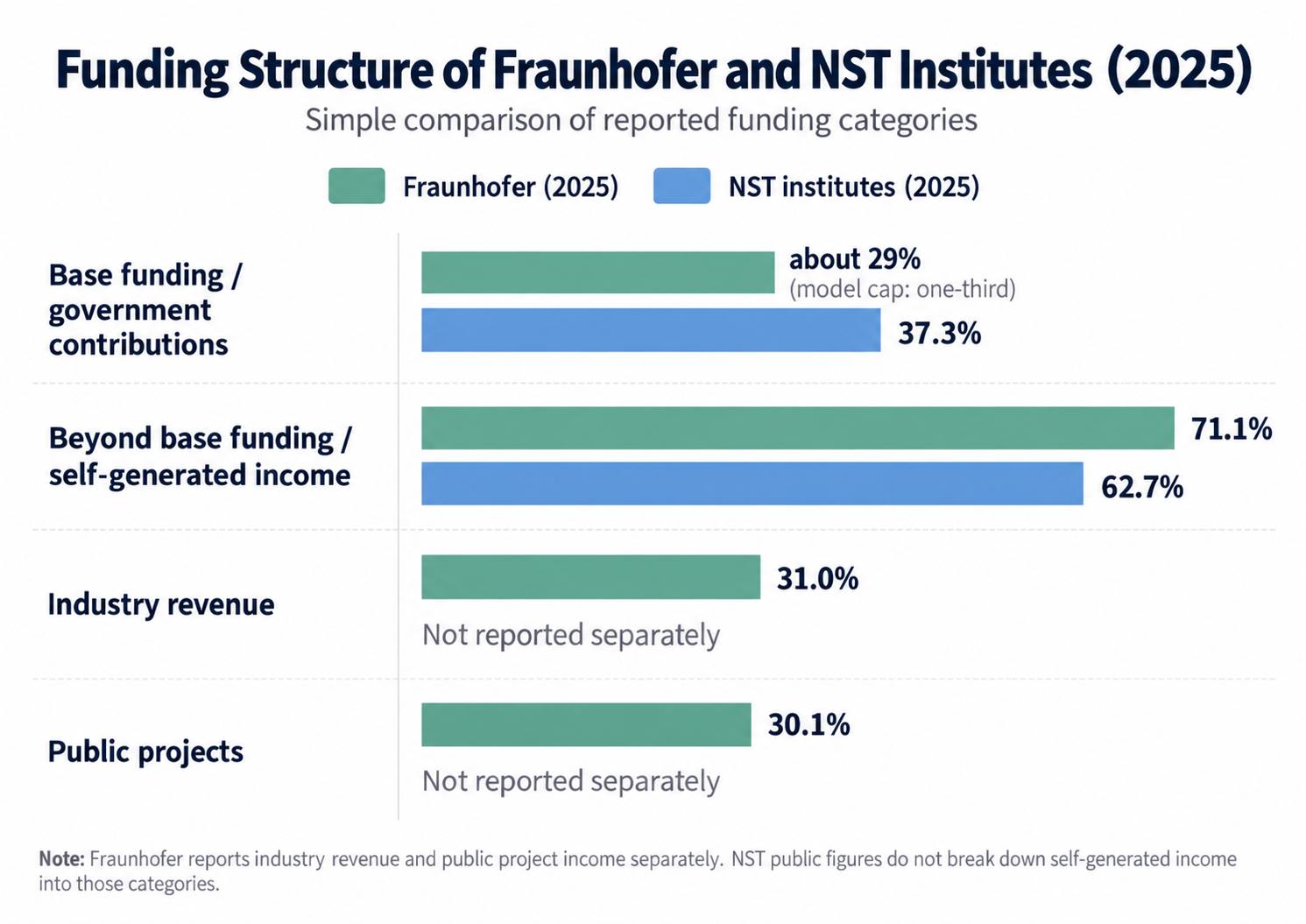
Note: Fraunhofer's external project funding and NST's self-generated income are not the same accounting item. The table shows the funding structure each system publishes, not how close each is to the market. NST figures follow the 2025 budget plan, excluding carry-overs.
What Does the Money Tell a Lab to Do?
Research funding keeps a lab running, but it is also a rule of behaviour. Fraunhofer does not run its institutes on base funding alone; they must keep winning industry contracts and public projects. Fraunhofer itself describes the share of external project income as a core operating indicator, and says a high share of external funding encourages entrepreneurial thinking in its institutes and responsiveness to market and social needs. Compressed editorially, the formula tells a research institute to find real demand outside. That demand may come from companies, or from governments and the EU. What matters is that the institute does not simply wait for base funding: it must turn outside problems into projects and win contracts or grants.
A different formula long operated in Korea's government-funded research institutes. The Project-Based System (PBS), introduced in 1996, tied a large part of researchers' and research units' salaries and research budgets to winning outside projects. Securing projects from government R&D programmes affected not only research itself but also how organisations were run and how researchers were paid. Compressed the same way, that formula was closer to “win projects”. Fraunhofer also carries out many public projects, and Korean institutes also do joint research and contract research with companies. A simple split — Germany follows companies, Korea follows government — does not hold. The difference lies in which way of raising money has pushed an institution's behaviour more strongly.
And Korea's formula is now changing. The Ministry of Science and ICT (MSIT) and NST are reorganising the institutes around missions, on the premise that PBS will be abolished. The detailed Post-PBS implementation plan approved by the NST board in September 2026 requires each institute to set core missions at institutional level, and to restructure its research into basic research, strategic research and, as an exception, government-commissioned projects. Incentives such as research allowances are also to move from being linked to contract volume to differentiated rewards based on excellent results. The question put to the institutes is shifting from “how many projects did you win?” to “what did you achieve in your core mission?” How this transition will change behaviour in the labs is still unfolding. But one thing is clear. Where research money comes from, and on what conditions, does not only make research possible. It also draws the line around what a public lab counts as a result and which role it takes on.
This difference in funding formulas does not stay inside the lab. It shows up in the doors that open for companies. At Fraunhofer, contract research — where a company brings a specific problem and buys research directly — appears clearly as a separate income item in the funding structure. In Korea's institutes under PBS, winning government and public R&D projects was tightly linked to research funding, and in the business support of the Korea Institute of Industrial Technology (KITECH), companies often come in as participants in government programmes or joint technology development schemes. Germany of course has government joint projects too, and Korea has research, testing and technology transfer that companies pay for directly. The difference is not whether demand-led routes exist. At Fraunhofer, research bought directly by companies is visible as an item in the funding structure; at KITECH, companies' routes in are more visible as programmes — government projects, business-support schemes, shared equipment use and technology transfer. We can now read the lab's formula from the company's side. Even at the same institute, what a company pays depends on which door it walks through.
Same Lab, Different Payers
The existence of public labs does not mean companies can do R&D for free. Even with the same research institute, what the company pays, what the government pays and what the institute contributes all depend on the contract or programme chosen. From the company's side, there are five different doors. On the Korean side, we take KITECH — whose main mission is applied industrial technology — as the point of comparison.
A. The company commissions research (contract research)
The most direct route is for a company to take a specific problem to a research institute and pay for the research itself. This is Fraunhofer's signature business model. The company and the institute agree on scope and schedule, performance targets and deliverables, cost and intellectual property, and then the company commissions the work. The €768 million from contracts with companies seen in Section 02 is money that came through this door. It is the volume of R&D that companies bought as actual customers.
What the company gets is not a report. For as long as it needs, it gains access to researchers in a specific field, specialist equipment, prototyping and process development, and pilot and demonstration capacity. Building all of that in-house would mean hiring researchers, buying equipment and maintaining facilities. In contract research, part of those fixed costs and capital investment becomes the research cost of a specific project. The public institute is not paying the company's costs. It lets the company buy only the time it needs instead of owning the capability. Korea has had this door too. Through its former Company-Commissioned Production Technology Commercialisation Programme (K-Welle's translation; no official English name has been confirmed), KITECH identified company needs, assigned a principal investigator, agreed target specifications and royalties, and then optimised its own core technology to the company's specifications before transferring it for a fee. Read this case as evidence that Korea also has a demand-led route close to contract research. In Korea, however, the door tends to open under the name of an institutional programme rather than as an income item, and more often alongside the next door.
B. Government and company share the research cost (publicly funded joint R&D)
The second door is for a company and a research institute to join a government or EU R&D programme together. The company does not pay the institute the full research cost. Within one project, government funding, the institute's research budget and the company's own contribution are combined. In Germany, Fraunhofer institutes and companies join federal or EU programmes as consortia. Here too, the company may carry its own share or contribute in kind and in staff under the programme rules, and the exact shares depend on the programme and the type of company. In Korea's national R&D, several organisations also join one project, but companies and government-funded institutes are not subject to the same cost shares. Each call sets, for each participant, the government-funded and self-funded portions of R&D costs, and the cash contribution required by company size. Within the same project, KITECH, as a non-profit research institute, may have a high share of government funding, while the company pays its own share according to its size and the programme rules. Nor is that share all cash. Depending on the programme, the salaries of the company's researchers, its existing equipment and materials can count as in-kind contributions.
So in joint R&D, the question for a company is not how large the government grant is. It is how much cash the company must put in, what counts as in kind, and how the research budget is split between the institute and the company. KITECH's demand-responsive joint technology support programme also added companies' cash contributions to government funding to put the institute's staff and equipment to work on company needs. The role of public R&D is not to remove a company's research costs, but closer to sharing still-uncertain development costs among government, institute and company.
C. Buying equipment and testing capacity instead of research (infrastructure use)
Companies do not always need a new research project. Sometimes they need to analyse, test and measure a product they have already developed, or validate it on larger equipment. Then, instead of hiring a whole institute, the company uses specific equipment and services. Many Fraunhofer institutes offer testing, analysis, validation and demonstration services to companies, priced by equipment, test scope, staff and contract. Building one expensive machine in-house would mean paying, on an ongoing basis, for purchase, space, specialist operators, maintenance and calibration, and upgrades. Using a research institute's facilities turns the cost of owning equipment into the cost of using it for the time needed.
At KITECH in Korea this structure is plain to see. KITECH's regional centres open their equipment for shared use by companies, which pay usage fees. Government or local-authority support can be added. In 2025 and 2026, the Jinju Ppuri Technology Support Center's equipment-fee support programme covered part of the cost for small and medium-sized materials and parts companies in the region using the centre's equipment. So a single machine has two cost routes: ordinary use, where the company pays the full fee, and supported use, where public money covers part of it. Public research equipment is not free. Companies can use equipment the public sector has already built without owning it, and policy programmes can lower the fee further. Buying equipment worth hundreds of millions or billions of won up front and paying for a few test runs differ completely in the size and timing of the cash needed.
D. Developing together, each contributing something different (joint development)
The fourth door is where the company is neither a simple customer nor merely a participant in a government project. The company brings real products and production processes, materials, field data and engineers; the institute brings researchers, existing patents and know-how, analytical equipment and pilot facilities. Public research money may be added, or both sides may pay their own costs. So the words “joint research” alone say nothing about the cost structure. Actual contracts set out separately who pays which salaries, who pays for materials and prototypes, whether equipment fees are charged separately, who owns newly created intellectual property, whether each side may use the other's existing intellectual property, and whether royalties arise at later commercialisation. Newly created IP, the IP each side brings in, publication rights, exclusive or non-exclusive licences and prototype material costs are each separate items to negotiate. Joint development does not mean joint costs. Even with the same institute and the same technology, these terms change what a company actually pays in cash.
E. When research ends, the money relationship does not (technology transfer)
Finally, R&D costs and technology fees are different money. KITECH defines technology transfer as a contract in which it grants a licence to technology it holds and the company pays royalties in return. The procedure runs from application and negotiation to contract and payment, then technology hand-over and reporting on commercialisation; depending on the contract and commercial results, running royalties may arise. So even if a company bore costs in joint R&D, it does not automatically gain the right to use all the intellectual property the institute holds.
Who paid for the R&D and who holds the right to use the resulting technology commercially are different questions.
The same is true at Fraunhofer. The €198 million in industrial licence income seen in Section 02 is money from this door. Once research ends and products begin to reach the market, a new cost can appear: not research funding, but the price of the right to use intellectual property.
Same public lab, different flows of money
The route a company uses changes what it pays, when it pays, and what it does not need to own.
Editorial classification by K-Welle. Actual cost-sharing, IP and support terms vary by programme, institution and contract.
What matters across these five doors is not a verdict that Germany or Korea is better. Both systems have several cost routes between public labs and companies. At Fraunhofer, the door through which companies buy research directly shows up as one pillar of the funding structure. At KITECH, combinations of public programmes and company contributions appear in many forms: national R&D, business-support schemes, shared equipment use, in-kind support and technology fees. What differs is which kinds of transaction are more visible in the system, and which costs it is designed to share between the public sector and companies.
What Changes for the Company?
We can now see what the earlier figures mean for a company. As a hypothetical example, imagine a company that needs a pilot plant worth €5 million. It has more than one road.
If the company builds the plant itself, it must find a site, buy the equipment, hire researchers and set up a testing system. The €5 million goes out now, all at once, from the company's own money. If it uses a public institute's existing pilot facilities, it pays only project costs. Capital investment becomes a usage fee, and research staff who would have been a fixed cost become external research spending on a specific project. If it uses government joint R&D, part of the research cost is shared, and shared-equipment programmes can cover part of the fees. Development costs it would have borne in full become costs shared with government, and the size and timing of the cash it needs change again. And once the research ends, commercialising the developed technology may require a technology-transfer contract and royalties. At that point, the price of the right to use intellectual property can arise separately from the research costs already paid.
So it is not accurate to describe the economic effect of public research institutes on companies simply as cutting costs. Equipment the company would have had to own becomes a usage fee; development costs it would have borne in full become costs shared with government; and costs that would have been fixed as in-house research staff become external research spending on a specific project. Conversely, a company that uses a public institute still has money to pay: contract research fees and its own contributions, equipment fees and testing and analysis charges, prototype materials, royalties, and follow-on investment in commercialisation. A public lab is not a place that erases a company's costs. It is a place where the kind of cost changes, its timing changes and the parties who bear it are divided.
Closing — From Research Funding to Investment
In Korea and in Germany, companies perform the most R&D. Yet both countries maintain public research institutes — to keep, in common, research capabilities and equipment that no single company could hold for the long term; to research technologies whose markets do not yet exist; and to test, validate and develop together with companies. An organisation chart alone does not explain what those labs do. Who funds the research, and what that money tells the lab to do, shape how institutes behave; that behaviour shapes the doors that open for companies. For a company, this difference is not an internal administrative matter. Even for the same technology, the size and timing of the cash it needs depend on which door it uses. So when looking at public research money, the question does not end with how much the government gives a research institute. Because of that money, which research capabilities stay in public hands — and on what cost structure can companies use them?
And the moment a technology leaves the lab, the question changes again. Even after a technology has been validated on public research infrastructure, building a real factory takes far more money. That is investment, not research funding. Why does a government pay part of the cost when the company bears the risk of the plant and equipment? The next episode follows Infineon's Smart Power Fab in Dresden to look at the boundary between the investment a company carries and the subsidy a government pays.
FLOW POSITION: Source · Entry
CHECK: Is cash what you lack — or research capabilities and facilities you need not build yourself?
NEXT: Ep.3 The Place of Subsidy — Who Takes the First Investment Risk?
About This Reporting
This article does not evaluate any particular research institute or explain the terms of any particular contract. It follows, through public Korean and German sources, one causal line: a public research institute's funding formula shapes its behaviour, that behaviour shapes the routes to cooperation it offers companies, and those routes change companies' actual R&D cost structure.
R&D statistics come, for Korea, from the 2024 Survey of Research and Development published by MSIT and the Korea Institute of S&T Evaluation and Planning (KISTEP) in December 2025, and, for Germany, from the Federal Statistical Office's (Destatis) press release on 2024 R&D expenditure (March 2026). Germany's shares by performer are calculated from the amounts; Destatis did not publish them. Fraunhofer's funding figures follow its Annual Report 2025. The 71.1% share of externally earned income is relative to the operating budget, while the 31.0% industry revenue and 30.1% federal and state public projects are shares within project funding — the bases differ. Budgets for NST's institutes follow NST's published 2025 business plan and budget, excluding carry-overs. Because self-generated income includes government-commissioned projects, it cannot be compared with Fraunhofer's industry revenue.
PBS and Post-PBS are described on the basis of the detailed implementation plan MSIT and NST published after the extraordinary board meeting of 8 September 2026. Each institute's core missions and medium- to long-term roadmaps are due later this year, so the results of the transition cannot yet be assessed. KITECH's routes for companies follow KITECH's published technology-transfer procedure, its regional centre's calls for equipment-fee support (2025 and 2026), and its information on the Company-Commissioned Production Technology Commercialisation Programme. Support rates and caps for equipment fees differ from call to call and are therefore not given in the text. Fraunhofer and KITECH differ in size and legal status: the former is an association of some 70-plus institutes, the latter a single government-funded institute. This article does not compare the two by size; it compares only the forms of the routes through which companies reach public research capabilities.
The five doors in the text (contract research, publicly funded joint R&D, infrastructure use, joint development and technology transfer) are an editorial classification by K-Welle to explain companies' cost structures, not any institution's product categories. Cost-sharing and intellectual-property terms in real contracts differ case by case. The €5 million pilot plant in Section 05 is a hypothetical example. This article does not constitute legal, tax, investment or contractual guidance.
Corrections: editor@k-welle.com
Sources
- MSIT and KISTEP, results of the 2024 Survey of Research and Development, December 2025 (in Korean)
- Statistisches Bundesamt (Destatis), Pressemitteilung Nr. 107: 3,8 % mehr Ausgaben für Forschung und Entwicklung im Jahr 2024, March 2026 — destatis.de
- Fraunhofer-Gesellschaft, Annual Report 2025 and press release on its publication, June 2026 — fraunhofer.de
- National Research Council of Science & Technology (NST), budget support for its institutes in 2025 — nst.re.kr (in Korean)
- MSIT and NST, press release on the detailed Post-PBS implementation plan (board decision of 8 September 2026) (in Korean)
- Korea Institute of Industrial Technology (KITECH), technology-transfer information (licensing and royalties) — kitech.re.kr (in Korean)
- KITECH Jinju Ppuri Technology Support Center, calls for equipment-fee support for technology development, 2025 and 2026 — kitech.re.kr (in Korean)
- KITECH, information on the Company-Commissioned Production Technology Commercialisation Programme and the demand-responsive joint technology support programme — partner.kitech.re.kr (in Korean)