Living Inside Korea’s System

Entering Korea is relatively easy.
Staying and building a life there is a different matter.
The practical question behind long-term stays is simple:
Can you actually operate your life inside K- system?
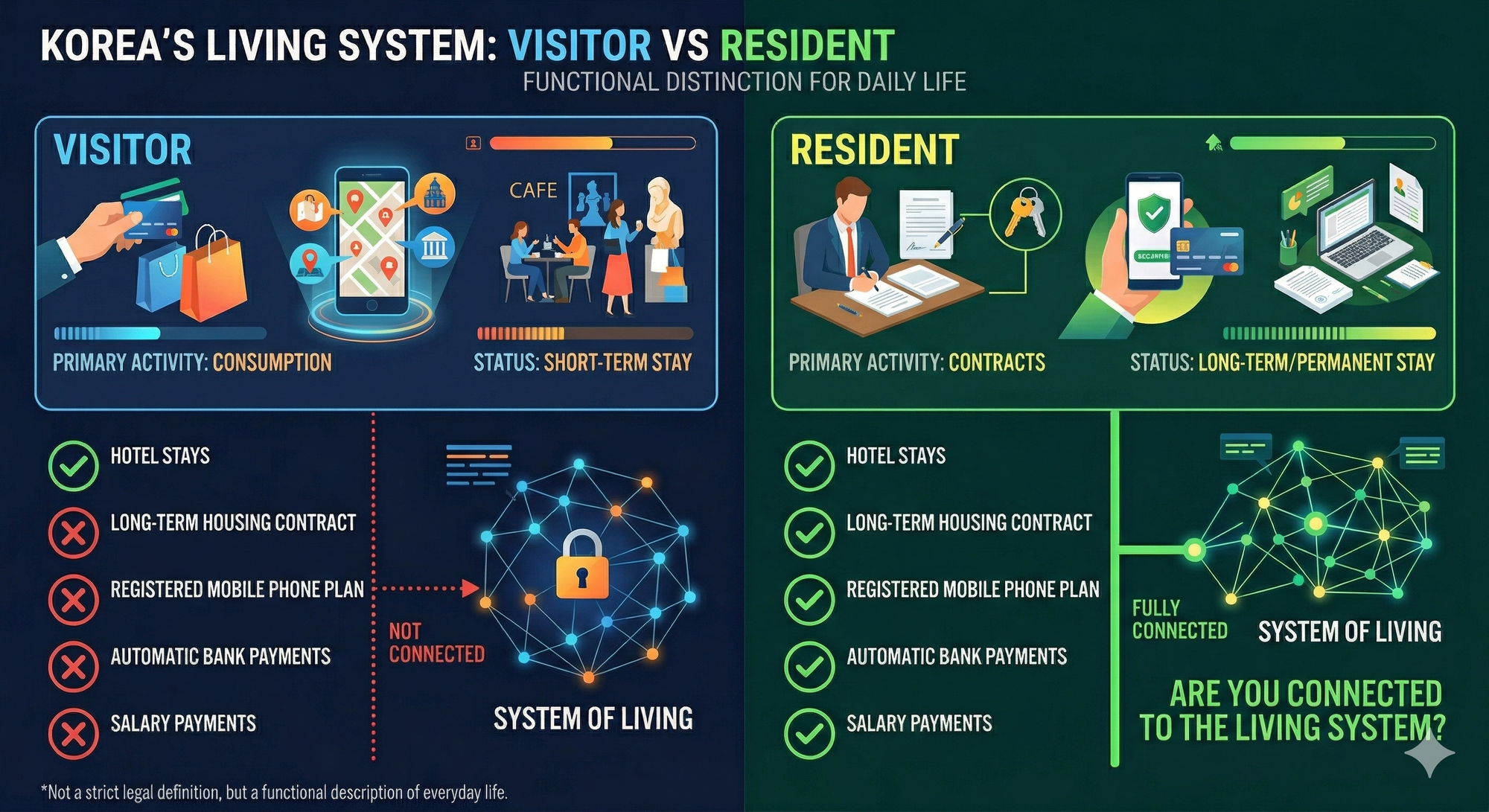
The real question therefore becomes: Are you connected to the living system?
Residency Status and Income Possibility
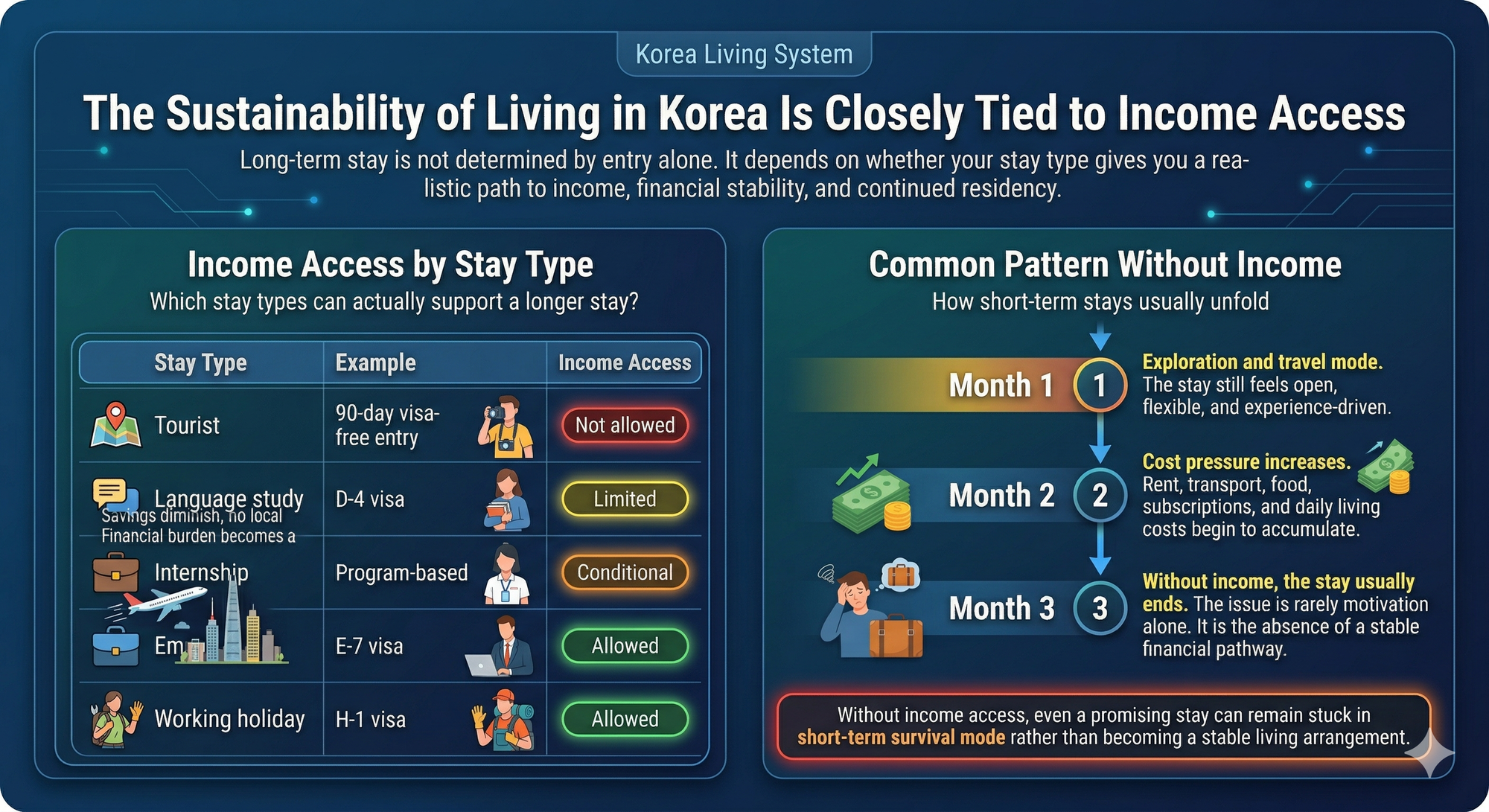
This is not an official statistic but a commonly observed pattern among short-term residents.
How Everyday Life in Korea Actually Works
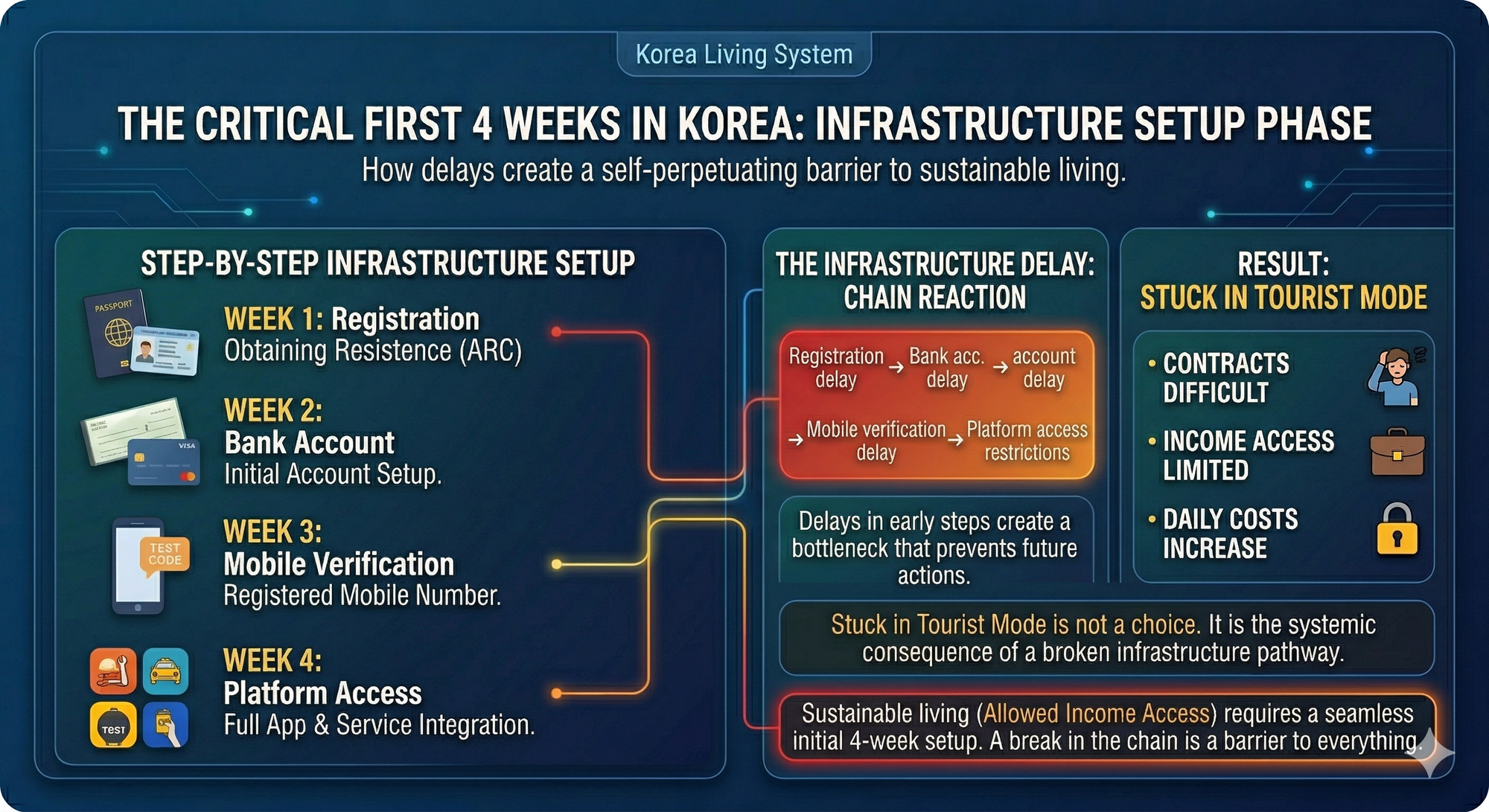
Stable residency usually develops through the following sequence.
Arrival → Registration → Identity → Contract → Settlement
Each step activates specific functions of daily life.
1. Registration
Alien Registration
Foreign residents staying longer than 90 days must register with immigration.
After registration, residents receive an Alien Registration Number, which functions as a core identity reference in many systems.
Once registered, it becomes possible to:
- Open a bank account
- Sign a mobile phone contract
- Establish official residency status
Typical processing time: 2–4 weeks
2. Identity
Digital Verification
In Korea, mobile phone verification functions as a digital identity system.
It is commonly used for:
- financial authentication
- online payments
- government services
- platform logins
Without verified mobile authentication:
- service access becomes restricted
- many apps cannot be used
3. Contract
Participation in the Economic System
Most infrastructure in Korea operates through contracts.
Typical contracts include:
- housing
- telecommunications
- employment
Once contracts become possible, everyday infrastructure begins to connect.
4. Settlement
Payment and Financial Structure
Life becomes stable once regular financial flows are established.
Typical components include:
- rent payments
- utility bills
- salary payments
- money transfers
A stable settlement structure allows daily costs to be managed predictably.
Initial Infrastructure Costs
Starting a longer stay in Korea usually involves the following initial expenses.
| Item | Estimated Cost |
|---|---|
| Alien registration | about ₩30,000 (~€20) |
| Mobile phone plan | ₩30,000–80,000 per month |
| Bank account | usually free |
| Housing deposit | ₩5M–20M (€3K–€13K) |
| Monthly rent | ₩500K–1.2M (€330–€800) |
Without a housing contract, long-term accommodation often relies on hotels or short-stay rentals.
These can increase monthly costs by 30–80% compared to standard leases.
Common Failure Patterns
Most failed stays are not caused by visa issues.
They usually begin with system connection failures.
Administrative Friction Spiral
Delayed registration leads to:
- reliance on foreign cards
- higher transaction fees
- difficulty signing contracts
Platform Lock-Out
Failure to obtain verified mobile authentication leads to:
- limited access to delivery apps
- payment services
- administrative platforms
Income Illusion
Some visitors arrive assuming:
"I’ll find opportunities once I get there."
Without a legal work pathway or income source:
- expenses continue
- income remains zero
In many cases, the stay ends within 3–6 months.
Entering the city is easy.
Connecting to the system is not.
Long-term residency ultimately depends on one question:
Can you contract, verify your identity, and manage payments inside the system?