
Korea Is Not an Experience - It's a Signal Investment
A Korea Experience GPS for Gen Z
For many European Gen Z students, staying in Korea is still framed as a cultural experience — a chance to consume K-content and lifestyle on site.
But Korea’s university and industrial system operates less on the richness of experience and more on how quickly evaluatable outputs (signals) are produced — and how efficiently those signals convert into hiring decisions, recommendations, or collaborative projects.
A stay of 6 to 24 months is therefore not tourism. It is a market-entry experiment.
The real question is not Seoul versus regional cities. It is structural: through which platform are you entering?
1. Density in Korea Is Industrial, Not Merely Geographic
Korea is often described as “Seoul-centric.” Yet in practice, density varies by industry. It can be broken down into four structural axes:
- Corporate and investment density
- Research density
- University–industry linkage structures
- Speed of signal conversion
The key issue is not regional hierarchy, but this:
Where can your field convert output into evaluation most efficiently?
2. What Matters Is Not Location, but Decision-Maker Proximity
In many Korean industries, decision-making authority tends to be relatively concentrated at upper levels. Output does not gain value by existing — it gains value when evaluated.
Signal Reach Speed
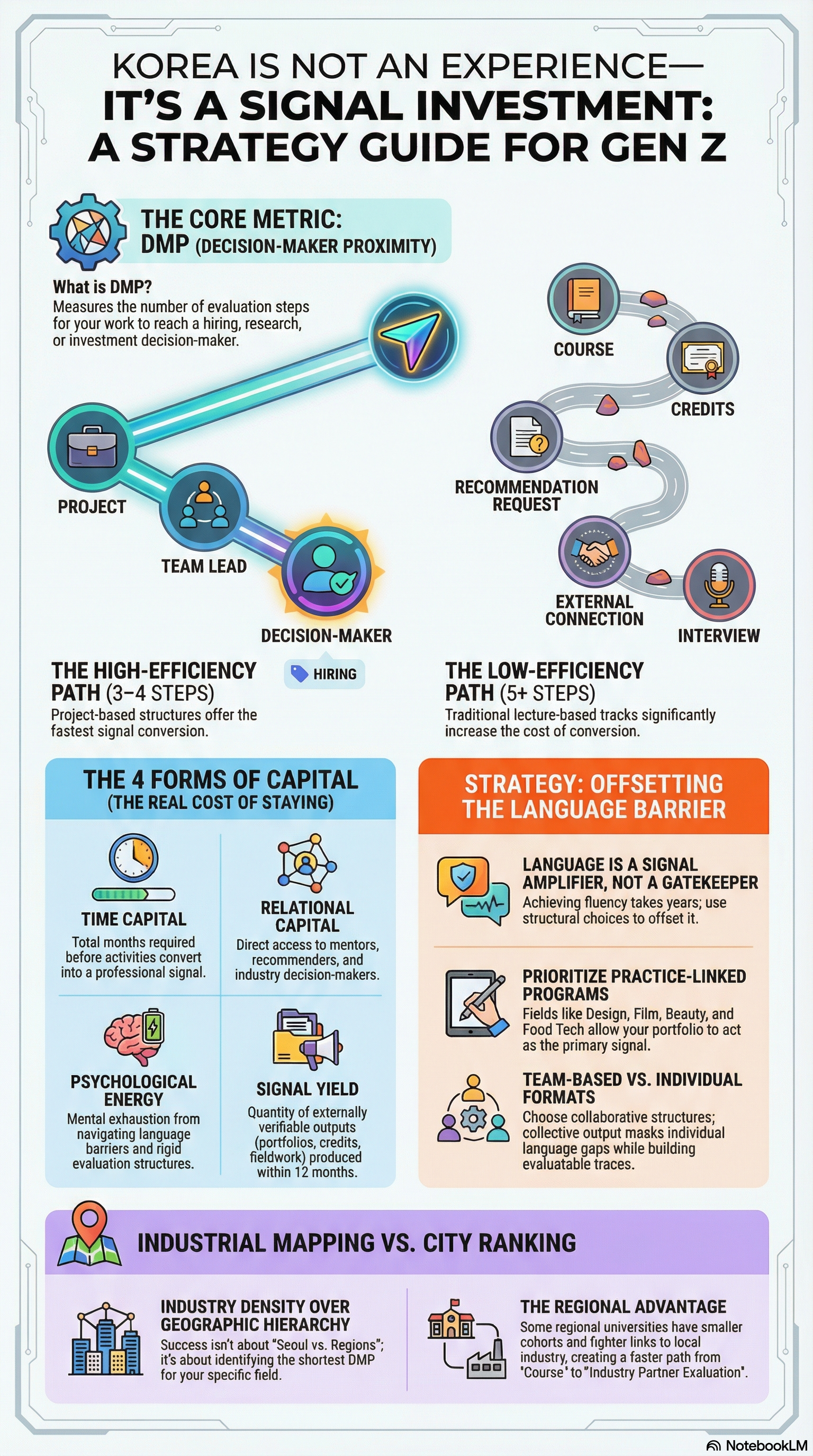
DMP: Number of steps to reach a Decision-Maker
If your stay lasts 6–24 months, the difference in steps becomes a difference in conversion cost.
3. Korean Universities Are Not a Single Model
Viewing Korean universities as purely research-oriented academic institutions leads to strategic misjudgment. In reality, research-centered tracks coexist with practice-intensive, industry-linked programs.
Traditional academic tracks often require high language proficiency and rely heavily on professor-centered networks for industry access. For foreign students, producing externally visible signals within a short timeframe can take longer.
By contrast, some practice-oriented majors generate outputs more quickly. Examples include:
- Hotel, tourism, and culinary management (training restaurants, hotel operations participation)
- Beauty, fitness, and sports training (center-based practice, competitions)
- Film, media production, and applied music (project-based evaluation)
- Design, industrial design, and visual content (portfolio-centered assessment)
- Smart agriculture, food tech, and region-linked industry programs (field-based practice)
In many of these fields, the output itself functions as the signal, rather than academic publications or advanced credentials.
This means that even before reaching full language fluency, students can accumulate externally presentable artifacts — team projects, production credits, fieldwork participation.
In other words, even without complete preparation in degree, certification, or language, it may be possible to accumulate evaluatable traces.
Some regional universities also have relatively small cohorts and strong ties to local industries. In certain cases, this creates a shorter pathway:
Course → Professor → Industry Partner → Field Evaluation
This does not mean regional institutions are inherently superior. It means that in some structural configurations, DMP can be reduced more quickly than in traditional research-heavy tracks. For students who are not yet fully prepared, this structural difference can determine whether entry is possible at all.
4. Language Is Not to Be “Overcome” — It Must Be Offset
Achieving near-native fluency within one to two years is unrealistic for most students. The strategic approach is not elimination of the barrier, but structural offset.
- Choose output structures less dependent on advanced linguistic performance
- Prioritize team-based projects over individual presentation formats
- Enter practice-linked programs
- Select structures with shorter DMP
When results are produced early, language shifts from being a gatekeeper to being an amplifier.
5. The Real Cost of Staying Is Four Forms of Capital
The primary costs of staying in Korea are not purely financial. They accumulate across four forms of capital:
- Time Capital — additional months required before conversion
- Relational Capital — access to mentors, recommenders, decision-makers
- Psychological Energy — exhaustion caused by language and evaluation structures
- Signal Yield — the quantity of externally verifiable outputs within 12 months
What matters is not the total cost, but how the cost is structured.
6. Industrial Mapping Is Not a City Ranking
The difference between Seoul and regional cities is not hierarchy, but industrial configuration.
The only relevant question is:
In which industrial structure can my field reach evaluation with the shortest DMP?
Conclusion
The core of a Korea strategy is not Seoul versus the regions.
It is:
- How many steps separate me from a decision-maker?
- Does the structure offset language dependency?
- Can I produce externally evaluatable output within 12 months?
Density differences exist. But density is not a fixed condition — it is a variable shaped by pathway design.
Staying in Korea is not a cultural experience.
It is an investment decision about where your field can convert into evaluation most efficiently.