Korea Experience GPS

How Gen Z Can Turn a Short Stay into a Real Career Asset
A stay in Korea is often seen as a cultural 'gap year.' But for the strategic Gen Z, it is a high-density 'career lab'.
Duration and entry mode shape the quality of the experience
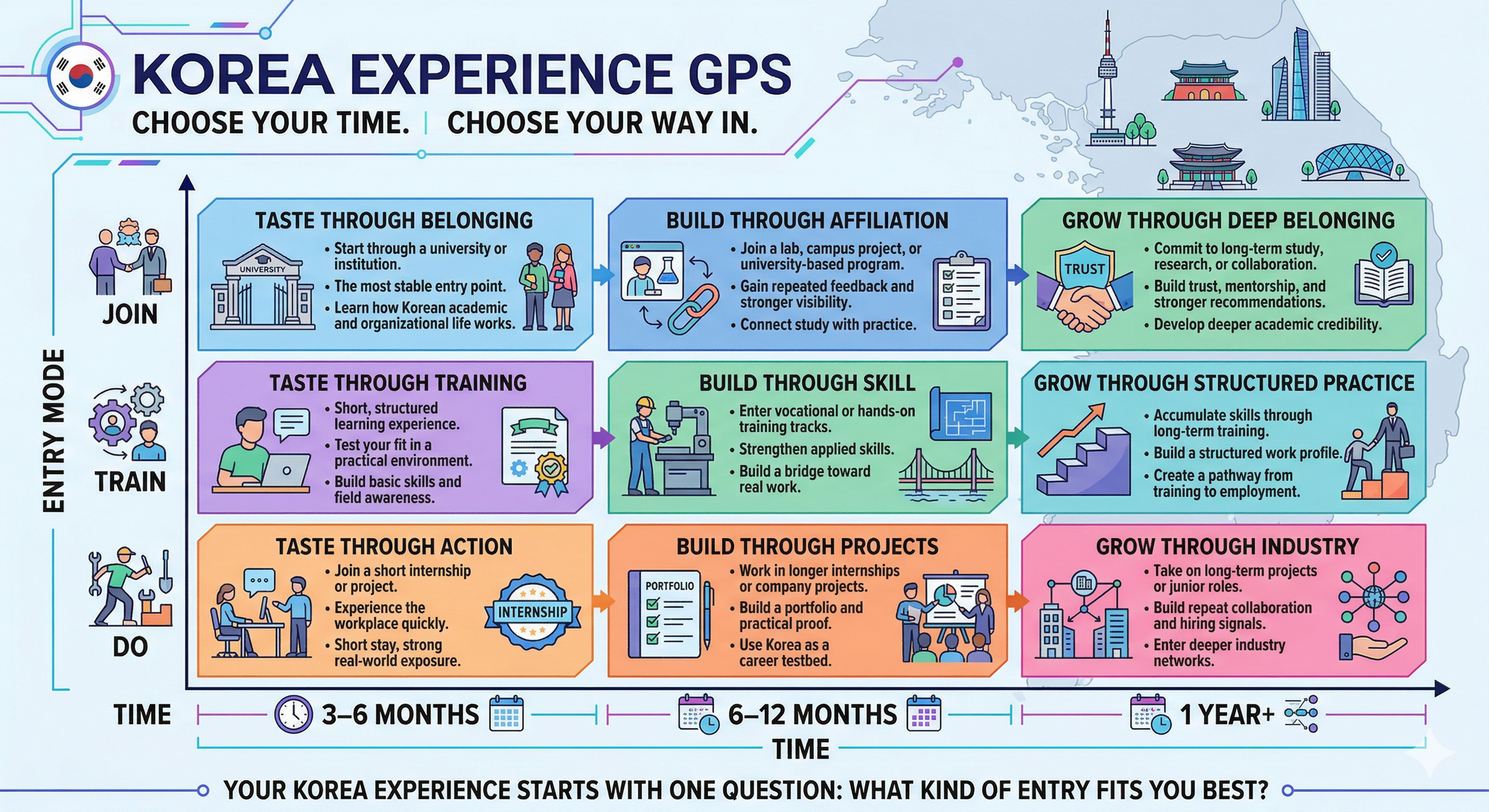
The first infographic maps a Korea stay along two variables: time and entry mode.
The time axis is divided into three phases.
A stay of 3–6 months can function as a testing period: enough to understand the pace of life, explore an institution, or try a short project.
A period of 6–12 months creates more room to build something tangible through research, training, or project-based work.
A stay of 1 year or more tends to provide stronger conditions for continuity, trust-building, and deeper networks.
The second axis is how entry takes place.
Join refers to entering through affiliation, such as a university, lab, or institutional host.
Train refers to skill-based or hands-on entry through structured learning and practice.
Do refers to direct participation through internships, projects, startups, or work-based experience.
The key point is straightforward: the value of a stay in Korea is shaped not only by how long it lasts, but also by the structure through which it begins.
In Korea, what matters is not only experience itself, but how it is interpreted
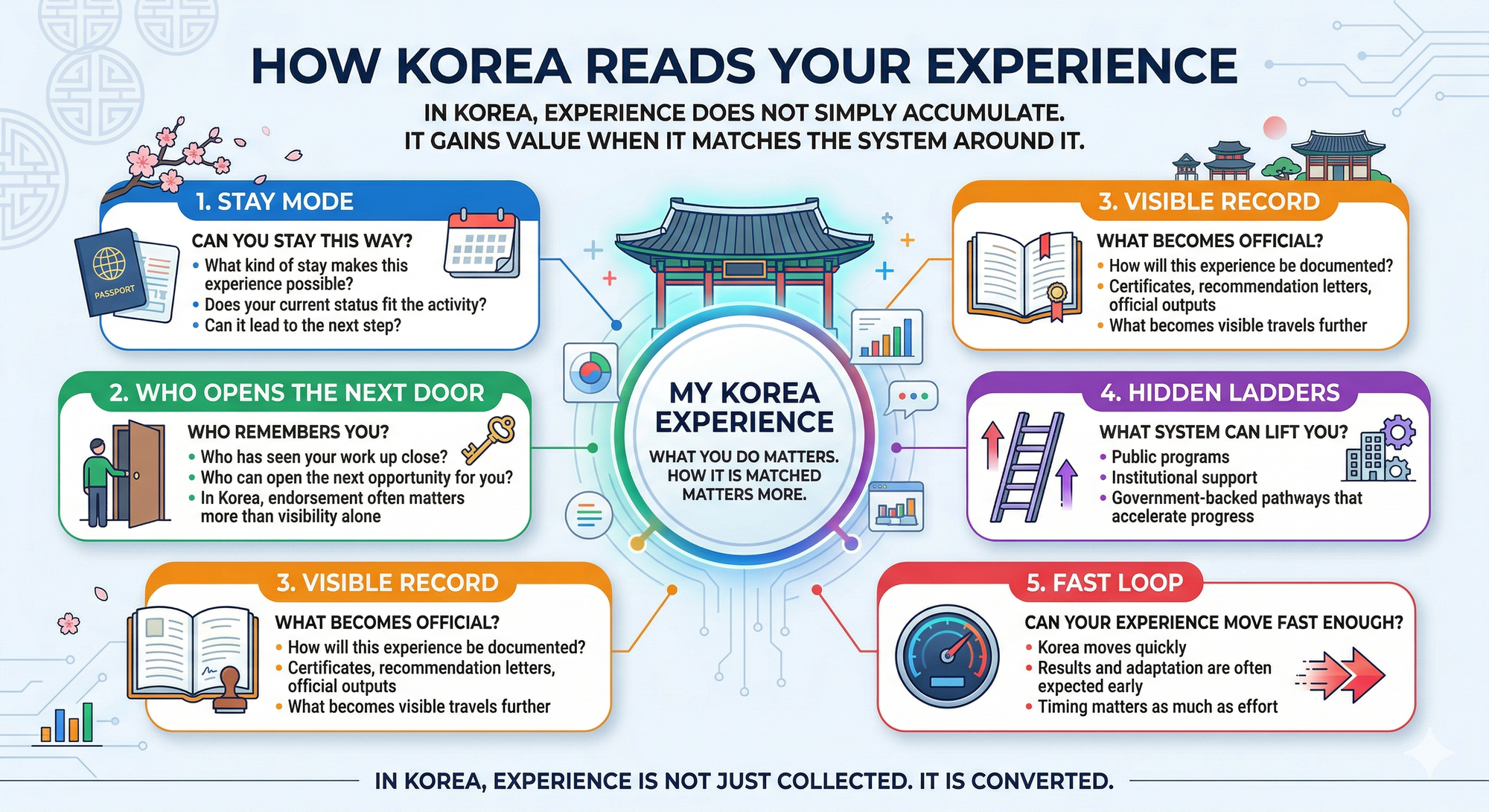
The second infographic focuses on how experience is read inside the Korean system.
What matters is not only what someone has done, but how that experience is recognized, documented, and connected to further opportunities.
It highlights five elements.
Stay Mode (Visa compatibility) asks whether a given experience fits one’s current conditions of stay.
Who Opens the Next Door points to the people who observe, remember, and potentially connect that experience to a next step.
Visible Record refers to the forms of documentation that remain official and legible.
Hidden Ladders captures the role of public programs and institutional pathways.
Fast Loop(Speed of feedback and adaptation) reflects the speed at which experience is often evaluated and converted in Korea.
Taken together, these factors suggest that a stay in Korea can be understood not only as a period of participation, but also as a process shaped by people, records, systems, and timing.
Skills often gain more traction when they are translated into formal signals
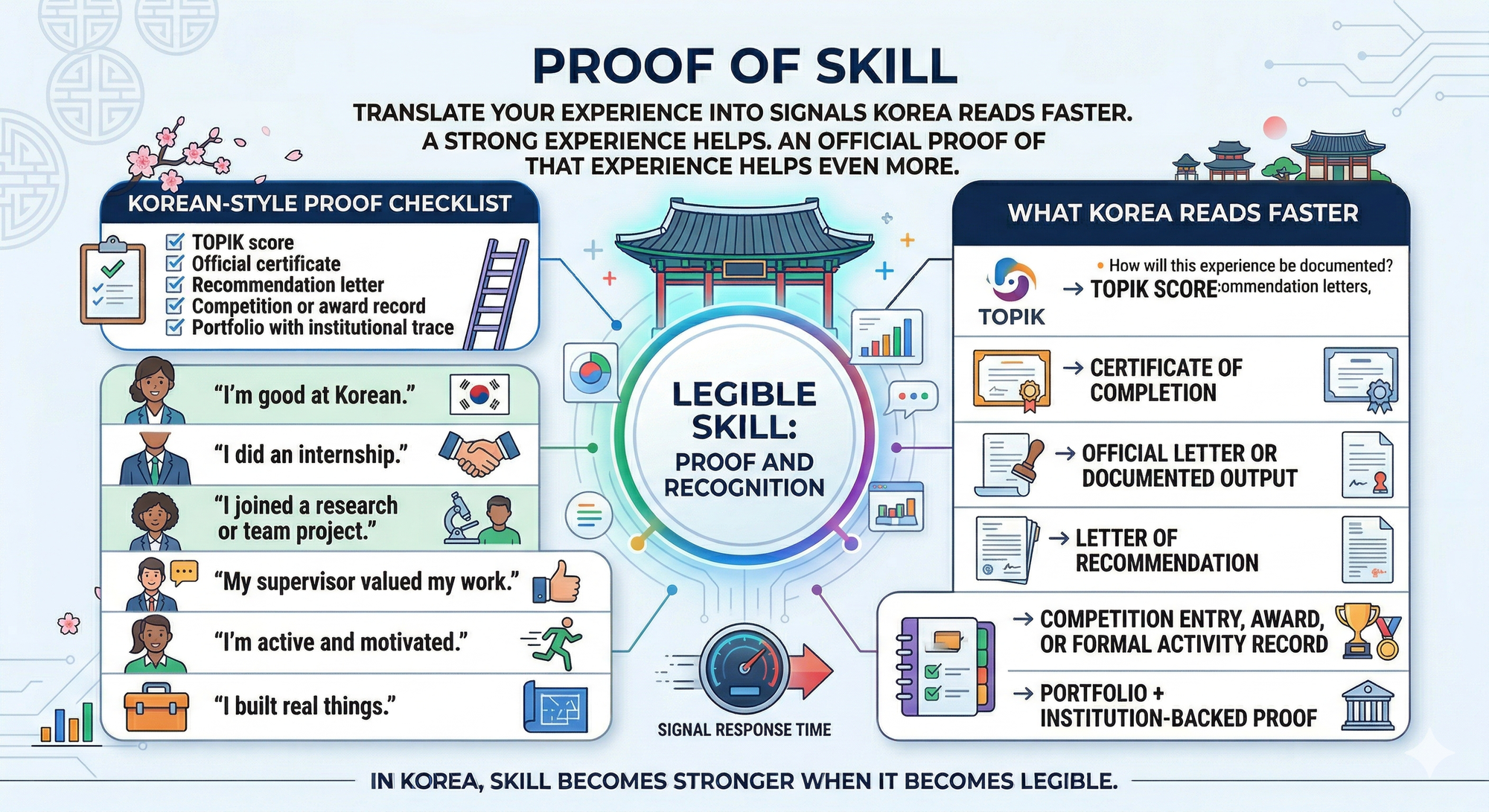
The third infographic compares informal self-description with the kinds of documented signals that tend to travel more effectively in Korea.
In many European settings, portfolios, GitHub profiles, interviews, and initiative can function as strong indicators on their own. In Korea, those same signals may become more effective when paired with formal proof.
For example,
“I’m good at Korean” becomes more legible as a TOPIK score.
“I completed an internship” carries more weight when supported by a Certificate of Completion.
A positive impression from a supervisor can become more transferable through a Letter of Recommendation.
Research, team projects, and public activities can also gain value when they leave behind institution-backed outputs, awards, or formal records.
The broader implication is that experience in Korea often becomes more useful when it can be translated into visible and verifiable proof.
Government and institutional programs can accelerate long-term value
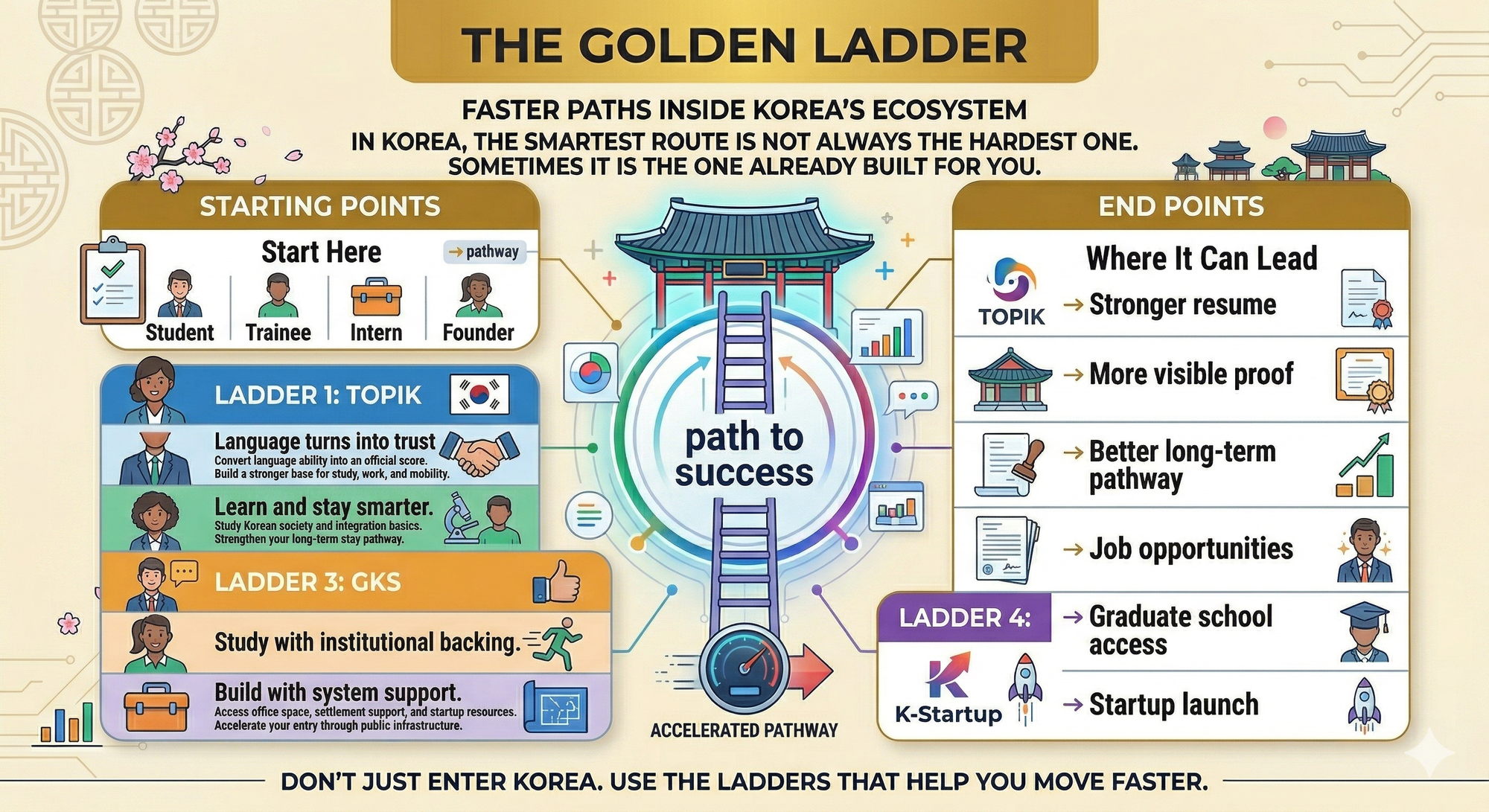
The fourth infographic highlights Korea’s Institutional Shortcuts and institution-backed programs. These are not equally relevant to every visitor, but in some cases they can function as meaningful accelerators.
Examples include TOPIK and KIIP, which support language acquisition and longer-term integration; GKS, which links scholarship support to academic mobility; and startup-related public programs, which can provide infrastructure, visibility, and institutional backing.
The significance of these programs lies not only in support, but in structure. They can help transform a short stay into something more durable by connecting it to a wider pathway: academic progression, stronger legitimacy, deeper institutional ties, or entrepreneurial traction.
For students, trainees, interns, and founders, these ladders may provide a more efficient route than building every step independently.
This framework does not define a single correct way to approach Korea. It offers one perspective for readers interested in how a relatively short stay might connect to broader academic, professional, or mobility outcomes.
The question is no longer 'How long will you stay?' but 'How will you convert your stay?'
Dawn Chang, PhD · Editor-in-Chief, K-Welle · editor@k-welle.com